Territories Talk-Talk
pp. 35-41 · Read in the full issue

By Tolala
Eighteen years ago this month on January 23, 1942, d be exact the Japanese Forces occupied Rabaul.
[E thousand-odd Australian troops, nicknamed “Little Hell” (they were the 2/22nd Battalion) i poker slang, and the NGVR , after a gallant defensive action the beaches, retired to the lings and the South Coast, de -3 an Order of the Day: “There 1 be no Withdrawal,” which inally came from the Brass Hats Australia. (No doubt but that it a sturdy order.) Before long “withdrawal” had developed an “Every man for Himself” ne events of these first months .942 have now become history; the pages do not make pleasant ling, though there are many s of gallantry and fortitude, of ■sacrifice and determination rded on the part of our fight men. y the end of February, 1944, not iuse or building was standing in township of Rabaul. Its name changed to Rubble. But the unes of war had also changed, in September, 1945, Australian ps were again encamped within town-site. nd today: Rabaul is bigger and hter than ever. The wheel has led full circle.
The Booze
Question
Discussions last month with Min ister Hasluck on the liquor question brought to light a mixed dish of opinions. In Rabaul, a Tolai native spokesmen is reported to have favoured a total ban on alcoholic liquor. Later, in Port Moresby, a group of native councillors plugged for drinking permits for “native leaders”.
The divergence of opinion, as ex pressed by the natives on this im portant issue, suggests to my mind that the variety of views is in fluenced by the natives’ religious training, and the possibility of his expressed opinion being not so much his own as that of his religious
adviser. Such tactics have not been unknown in the Territory.
Some mission bodies hold broad and realistic views on the subject* others are just the opposite.
A sidelight of the liquor issue appears in a Times Courier report (16/12/59) of a Rabaul TAG meeting with the Minister when Rev.
Wesley Lutton (Chairman of the Methodists) described the drink situation as “one of the most de moralising problems in our midst”.
Another councillor, Mr. C. Mc- Millan, “suggested that the illegal selling of liquor to natives was a challenge to the church. People who sold the liquor,” he said, “were members of church congregations and the church had a ‘moral obligation’ to correct its members”.
To which statement the Rev.
Lutton is reported to have made the somewhat Pharisaical reply: “I would like to say that the suppliers are not in my church.”
Does one infer that the reverend gentleman knows the identity of those illegal traffickers?
The Booze Question is a ticklish problem. Ban it and you breed black marketeers; control it with permits you encourage class-consciousness and favouritism and build up a ton of work for police and judiciary.
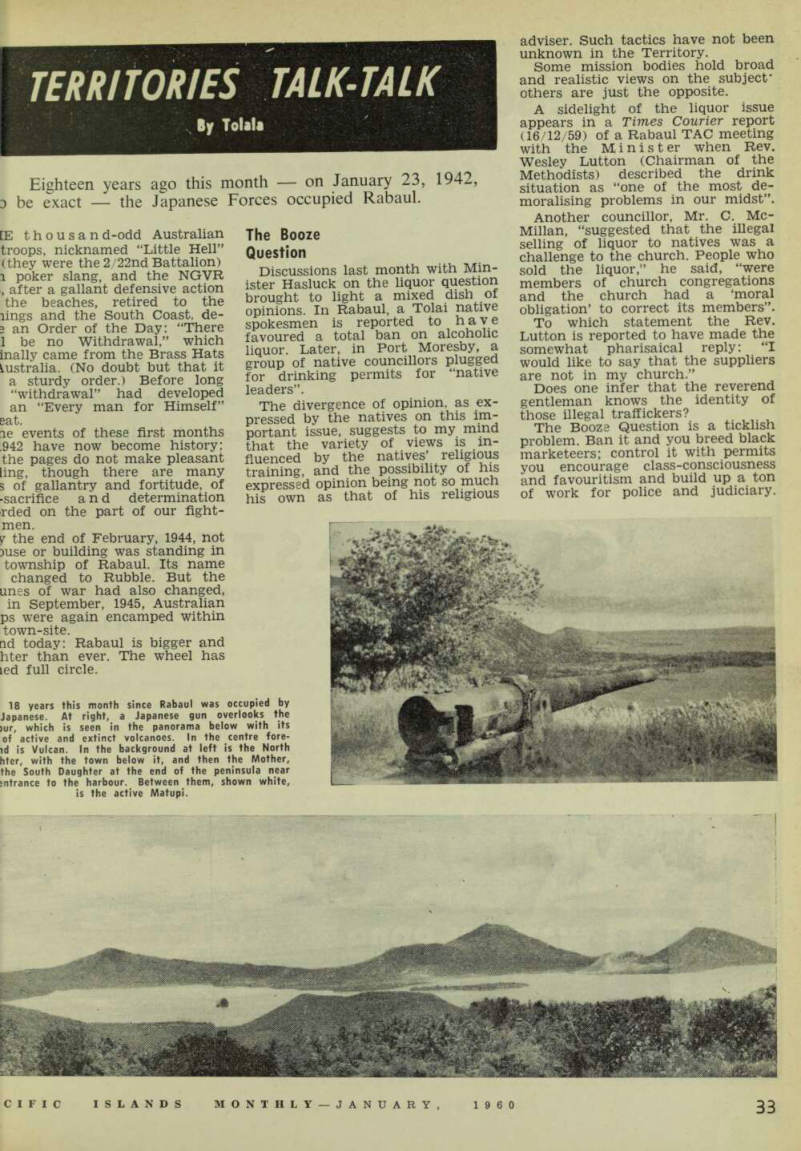
18 years this month since Rabaul was occupied by Japanese. At right, a Japanese gun overlooks the our, which is seen in the panorama below with its of active and extinct volcanoes. In the centre fore [?]d is Vulcan. In the background at left is the North [?]hter, with the town below it, and then the Mother, the South Daughter at the end of the peninsula near entrance to the harbour. Between them, shown white, is the active Matupi.
ro maintain the present status i appears the wisest action, with * addition of a little more of the ailed fist” policy in dealing with enders especially the sellers of ior to natives. Their offence is rallel to that of the early re liters in the Solomons who used sell firearms to the Malaitamen.
:ouraging
grancy L repercussion of the Government icy of encouraging freedom of ion and unrestricted meanderings native people is to be seen in complaint lodged by Central Dis it Officer, D. R. M. Marsh, about )0 native squatters living in ialor in Port Moresby under ►eking conditions, caused princip 7 by unemployed foreigners. In er words, itinerant natives with ir families who arrive seeking : excitement of the bright lights Moresby and stoop to crime when ► larder is empty.
They have been urbanised for long,” said Mr, Marsh, “and iy from the villages that at this ge it would cause hardship to d them back.” lie preservation of village life i communal living was not so g ago an all-high target of ministration policy. Careful tab 3 kept on recruiters to see they not depopulate villages, and if re were any indication of such finishing man-power the area 5 declared closed to recruiting, n Rabaul, the same problem has sen and the vagrants here hi de many native wanderers from resby and other Papuan ports, )ued with the desire to pick le of the alleged plums from this >re prosperous locality.
Such uncontrolled migration can only add to the Administration’s headaches and, if a Sydney paper’s report is correct, providing homes in Moresby for these itinerants at a cost of £1,200 each will be a con siderable drain on the Territory’s funds. And for what? As an ex ample of Democratic freedom?
Isn’t it about time the Admin istration got a bit tough with these wanderers? This so-called freedom which has been allowed since the amalgamation has had nothing to recommend it from any point of view. It is a privilege for which the average indigene is not yet fitted to enjoy in any beneficial manner.
That Amalgamation
Whether it is recognised in official circles or not, I would not know.
But . . . the age-old question of the merger of Papua and New Guinea is not by any means a pleasantly-accepted fait accompli; more especially amongst old TNG’ites of all colours.
Possibly it has never occurred to the Powers-That-Be that the Tolais, in particular, resent being relegated to an inferior status to Moresby.
The expansive Government policy of development in PM has, by no means, gone unnoticed by the more observant Tolais, and they want to know “Whaffor?”
Old European residents of NG, who know only too well of the vari ous Commissions of Inquiry in the past appointed to investigate the
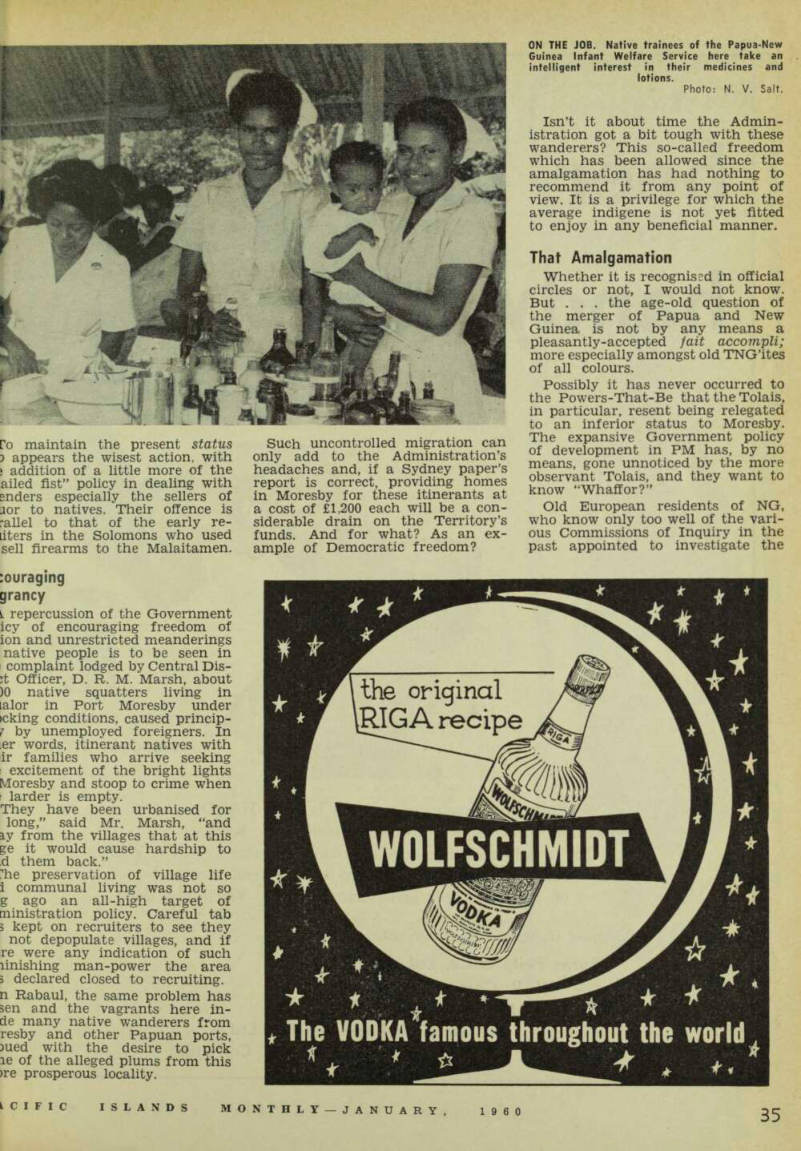
ON THE JOB. Native trainees of the Papua-New Guinea Infant Welfare Service here take an intelligent interest in their medicines and lotions.
Photo: N. V. Salt.
disability of the merger and of lelr negative findings, also realise lat the Trustee Territory has be ime a secondary consideration in lerything save native welfare. And at is naturally played up for the nefit of UNO.
Even oil exploration has been nfined solely within the Papuan rders. Was that purely for tech cal reasons? Or does the political mient come into the picture? The test is on possible oil prospecting the British Solomons!
Despite political assurances that Ve are there to stay” the Trustee jrritory could be anybody’s baby the years to come.
lying Its
ay A report of Minister Hasluck’s eech at Minj, on December 12, ntains the following: Mr. Hasluck said that as long as e Australian Government provided w-thirds of the Territory's finance, i e Commonwealth Parliament mid not relinquish the right to we the final voice.
Without wishing to embarrass the mister, but judging by past per rmances, the Commonwealth Gov nment would not relinquish its jht even if the Territory were If-supporting.
Over 20 years ago the Trust irritory had an initial surplus of yenue over expenditure of £61,906. lat was in 1936-37; in 1937-38 the rplus was £59,691 and in 1938-39 dropped to £17,947.
E have no recollection of Canberra ing any the less vocal on account the Territory’s financial inde ndence in those days. And I leave at that, except to add that copra Rabaul during those days was ound the £7 a ton mark, and the iigene was comparatively happy ,and contented with conditions nerally.
it Bishop Wade
Amongst the season’s greetings e other day came a message from shop T. J. Wade who, since the rly ’Thirties has been Number le of the Marist Mission in ugainville and Northern Solomons, and a most popular man in every ;tion of the community. He went the USA some months ago for jatment and now, owing to ill alth, he is unable to return to the lands and he resigned in No mber.
This is sad news for him, and jo for the many friends he made ring his 30-odd years amongst all lours in Buka and Bougainville, xe mission field can ill-afford to >e men of his calibre for he was tolerant, broad-minded man. May i find worthwhile work in a more ngenial climate.
Magic Monoliths
A Press message from Moresby tells of the discovery of “carved stone pillars and boulders which local natives believe have magical powers” on Aibom Island, in the Chambri Lakes area, by Trader- Writer Peter England; a man who knows his Sepik. [See PIM, this issue].
From England’s description they appear to form a miniature Stone henge and should be well worth in vestigating by an expert on such matters.
There are two stone pillars down Buka way that I know of and credited with having magic powers in my day, though probably keen mission influence in those parts has by now divested them of any supernatural qualities. One was situ ated in the Lontis district of North Buka, the other on the southern portion of Fred Archer’s plantation on Jame Island.
I have seen somewhere that these monoliths were attributed to the Children of the Sun—a pre-historic folk who were alleged to settle where gold and pearls abounded.
There are similar pillars to be found in the British Solomons.
Friend G. A. V. Stanley might have something to say on the sub ject. Come in, G.A.V.
A Pukpuk Tale
The story of Siarua, with very excellent sketch by Brett Hilder of this fine Roroanan (PIM, Dec., p. 85) in which mention is made of Siarua’s service with W. H. Lucas recalls to mind the story told by J. W. Campbell, who accompanied Lucas in 1912 when the latter was selecting land for Choiseul Planta tions Ltd., in Bougainville.
The pair were having a dip in a river near Roroana after tramping through the neighbouring bush look ing for suitable coconut land, when a kiddie suddenly started shouting and gesticulating from the bank.
He was warning Lucas of a slumber ing pukpuk, hidden from Lucas’ eye.
After scrambling to safety up the bank, Lucas turned to J.W. and remarked: “By God! That lad saved my life! I’d better give him some tobacco, I suppose. . . . How many sticks d’you think I should give him?”
J.W. paused a moment, cleared his throat in his inimitable manner and replied: “Well, you’re the best judge of what your life is worth.
I’d suggest three sticks, anyway.”
The lad got four sticks. And it could have been Siarua.
Some years later, J.W., who was then senior inspector of the Ex proboard, of which Lucas was chairman, was telling the story in Ah Chee’s pub in Rabaul. Amongst
; listeners was a very much grieved, recently expropriated ;rman and I heard him remark a fellow-countryman in his own nguage: “What a pity the onkey’ was there to shout a ,rning!” Lucas was by no means pular amongst the German inters.
mparative
xation Dne Aussie businessman, at least, lo recently took a holiday tour rough P-NG hadn’t much npathy for Territorial pub jpers when they complained about cation. rhe tourist, himself a hotelier in IW, when I questioned him on 3 reaction to taxation by folk Up nder, replied: “What have they t to complain about? Nothing!” cited one publican in the Moresby ;a whose licence fee was £6O a ir. “And mine’s £1,500,” said the irist, “and I don’t suppose I do y more business in a year than does. And his staff is mostly tive labour. How’d he like to pay W award rates?” : only mention this in passing, tere’s probably another side to j coin. I dunno. I don’t own a b anywhere. ose B 4
ippers
!’m a bit with Bulolo’s skipper, 1 Wilding, in his effusion regard ; the Lae anchorage and the old ie masters. (PIM, Dec., p. 26).
Certainly, I have sailed in all ise M-seven-lettered ships he ntions—and a few others as well, pre-war years we always anchored the bight to which Bill refers— at least I presume so —as Mil d Haven was very much a war lation.
Dpposite the bight-anchorage jre stood a crane on the high eshore; occasionally there used be landslides along the foreshore and big chunks of it fell into the i. ; think old Henry Eekhoff’s store s the nearest building to the iding spot in those days and there s always plenty of cargo going lore for the Bulolo goldfields to later transported by Guinea : way s’ Junkers.
Bill’s plea for the “Before” ippers is apt. Only those who led with those old-time mariners 1 appreciate what risks they used take in entering anchorages 'ten uncharted) or in laying off mds like Aua and Maty (up in 2 Western Isles) discharging and dng on cargoes. rhe seamanship of these B 4 ppers cannot be rated too highly.
Bill Wilding can rest assured that
the old-timers have elephantine memories. They don t forget.
Local Government The move in some Territorial quarters for the establishment of Local Government and which was put up to the Minitser again dur ing his recent tour had a sympa thetic hearing.
What benefits, exactly, these ad vocates expect to derive from private citizens shouldering public respon sibilities in P-NG I fail to realise.
To start off with; It means another tax levy; it means going, hat in hand, for subsidies from the Government for this, that and another thing. And it by no means
guarantees the Voice of the People being heard or, perhaps, one should say their wishes implemented if for some obscure reason the Govern ment does not concur.
Local Government, in NSW at any rate, has developed into a farce insofar as democratic principle of “By the People, for the People” be ing observed. And there is no reason to suppose that the procedure of LG either in NT or in P-NG (if obtained) will materially differ in this respect.
There is not sufficient co-ordin ated team-work amongst the non official populace to facilitate the working of Local Government organisations. It would breed more headaches than anything.