Get Richer
p. 24 · Read in the full issue
Sydneysider Goes Walkabout
In Peru The Rich Get Richer
LIMA, PERU: Cold Humbolt Current equals tons of fish, equals millions of seabirds, equals guano on the offshore islands.
And guano is the pervading smell in certain winds of Callao, about five miles away and chief port around here. Guano is also one of the chief exports, so if its perfume is not that of Chanel No. 5, it’s just too bad. The income it brings in smells OK.
CALLAO, of course, is where Kon Tiki, Willis’ Little Sisters, and more recently, Tahiti Nui 11, kicked off on their long drifts to Polynesia. But the Peruvians are blase about raft drifts: If monu ments mark the spot, I have failed to find them. "Right from there,” they say off-handedly, waving to the steamer wharf when you ask them where from. * * * this place is like Goroka, New Guinea Highlands, in that everything happens together: pansies, roses, gerberas. May-bush, gladiola, oleanders, hibiscus, bougain villea. Plus geraniums. The geranium is the national flower, and there are more varieties, more highly coloured—rioting over wrought iron railings, climbing up walls, clumped in gardens, spilling out of window boxes—than any place else on earth.
All this, plus the prevailing archi tecture (modem Spanish, plus wr ought-iron) in such smart residential districts as Miraflores, re sults in one of the most pleasant cities most of us in this partv have ever seen. . other side of the ledger, are the hideous tenements where a dozen crowd into a room, the hovels of scrub mats and mud bricks on the outskirts of the town—with spasms of social conscience stick ing up here and there in modern brick government schools and housing estates.
Sociaily and politically there is a policy of equality, with the equality the o^?idiL alS ° i to without cales of most Western countries. Consequently, the rich
tend to get richer, even if the poor cannot get much poorer.
Nonetheless, the Peruvian of Lima, by and large, appears happy, well fed, with a culture and economy that is modified North American. He speaks Spanish and his currency is in sols—27i large brassy coins to the US dollar. But dollars are accepted as readily as local currency. Many of the largest US firms and trading houses are established here, well-known US brand names crowd the hordings, and flaring-fin, US automobiles crowd the streets and highways.
Export income comes from cotton, guano, oil, gold and silver. Best buy: Silverware (about half the price of Australian). Favourite local tipple: Piscay Sour (local grape brandy, lemon juice, white of egg, whipped together and served near freezing.) Famous attractions: Pre-Inca and Inca ruins in the desert a few miles out of the city and the Inca museum in Lima. (The Incas buried their dead curled up in Buka baskets; and fought their wars with clubs so near the pineapple-clubs of ancient Fiji that it makes no difference. Heyerdahl has plenty of superficial evidence in this place to support most of his theories). * * * The big surprise of Lima—ll deg.
S. latitude and near sea-level—is its climate. This is mid-summer, when P eople in places like Suva, or Rabaul or Port Moresby, in similar latitudes, or even in Sydney at 34 deg, s., are literally stewing in their own perspiration. Here, in daytime, it is just comfortable in lightweight wool; or cotton or terylene, with a wool cardigan. At
night something more is nee< There is an underlying sharpi in the air—again like Goroka, ] Credit for this state of aff: goes to the cold Humbolt Cun and probably the proximity of Andes, on whose lowest slopes Li is built. The Andes (which h been obscured from our sight mist and haze, which evidently usual), are responsible for this 1 pf desert, as complete as the Salu in which the city lies.
Port Moresby is said to be in rain-shadow of the Owen Star ranges, but usually between 40 j 50 inches of rain per year esci around the edges. The Andes cc pletely block off natural rain fr this coastal beir. Precipitation about 4 inches per year—in the fo of mist, not from real rain.
Lima, with water from mountains or from coastal artes: bores, blooms and flourishes. Out city limits the grey desert begi patchworked here and there fields of corn or cotton, irrigai from bores sunk in the sand witl a few hundred yards of the oce shore. * * *
Conversation Piece (Frorr
woman from Jersey, US, on her i circumnavigation of the world) : told the taxi man I didn’t ws to see any ruins or any museu or any of that stuff. I told him take us to the best tea place. > had a wonderful tea —six of us, 1 only 3 dollars. And with stra' berries!”
Some males of the touring spec: don’t do much better. Some of t hardened characters from our st made a B-line for San Mart Square and saw Peru thereaft from the lounge of the Boliv Hotel, through a haze of Pise: Sour!
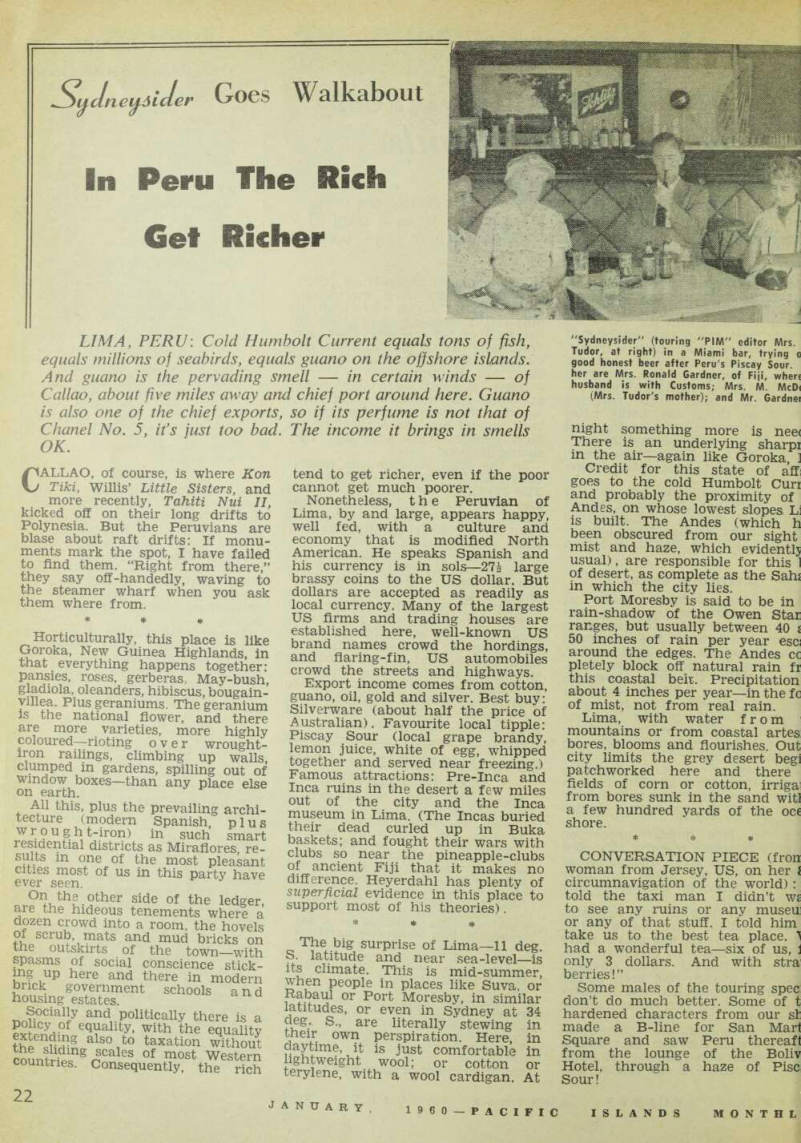
"Sydneysider" (touring "PIM" editor Mrs. [?] Tudor, at right) in a Miami bar, trying o[?] good honest beer after Peru's Piscay Sour. her are Mrs. Ronald Gardner, of Fiji, where husband is with Customs; Mrs. M. McD[?] (Mrs. Tudor's mother); and Mr. Gardne[?]