..the mystery of the ghost that
p. 86 · Read in the full issue
walked at Christmas
Hugh Hastings Romilly, who died in 1892 at the age of only 36, from malaria, was one of fhe least known, yet more able, administrators of the British Pacific. There is no doubt he would nave been destined to become one of the really great Pacific figures had he lived.
Romilly was at various times a Deputy Commissioner for the Pacific, first Acting Governor of -*3903, British Consul in the New Hebrides and a special commissioner during negotiations For annexation of Rotuma. It was while he was in Rotuma that he took part in an adventure with ghosts that is as perplexing today as it was when he recorded it almost 80 years ago.
H. H. Romilly first saw Rotuma in 1879, two years before it was annexed by Britain, and at a time when few people had even heard of it. Missions had been there for many years, but it was also the funk-hole of escaped convicts and runaway seamen, who fought among themselves and with the natives.
BUT in October, 1879, because of inter-tribal quarrels and religi ous wars, which made life unsafe nd property insecure, three of the aost powerful of Rotuma’s chiefs ailed for Fiji where they asked he Governor, Sir Arthur Gordon, o annex Rotuma in the name of he Queen.
Sir Arthur promisid to forward heir petition to England, and told hem that until the answer arrived le would send a relative of his own, Ay. Arthur Gordon, not to govern hem but to advise them.
The chiefs departed, very pleased, accompanied by Mr. Gordon, and an Australian half-caste, named Thomas Simpson, as an interpreter.
A month later, Romilly went to Rotuma to help Gordon.
There followed an odd series of events.
On Christmas Eve, 1879, Romilly and Gordon visited the house of one of the chiefs, Alipati, and spent the night. On Christmas Day, Alipati came in much excited about some thing. He said that one of his men had been attacked during the night
and that he was so badly woundeJ that it was impossible he could n cover. The man, while asleep in It Imuse, had been cut over the hes: with a knife to such an extent tin his head has been nearly cut in ha) although, oddly, he was not the dead.
Unusual Bandage
Romilly and Gordon went an saw the wounded man. His head wr bandaged with a coarse cloth an round it, to keep it in place, we: strips of banana leaves.
When asked by the white me. who had been the attacker, Alips assumed an air of mystery.
“Was it a white man?” Gordt asked.
“It was not”.
“A Rotuma man, then?” saf Gordon.
“No”.
“Then who was it?” asked Gordei and Romilly together, as white mtj and Rotuma men composed tl: whole of the population.
With much hesitation, and i evident fear of giving mortal oifent by bringing such an accusatk against a member of the di tinguished visit o r s’ househo]< Alipati at last said: “Tom, 1 killed him.”
The white men refused to belieE it, but in the next few days it b; came apparent that the whole Rotuma believed it was Tom, ti: Australian half-caste, who h;j committed the murder (Kimueli hij since died).
Tom, they said, had been se< near the house that night, he luj been seen with the murderer’s kni:i footprints like Tom’s were found the house, and he had been out i Christmas Eve.
In the course of an investigate the white men’s faith in Ton originally so strong, grew less, tl at last it became evident that Ten had to be arrested and that, necessary, committed for trial Fiji.
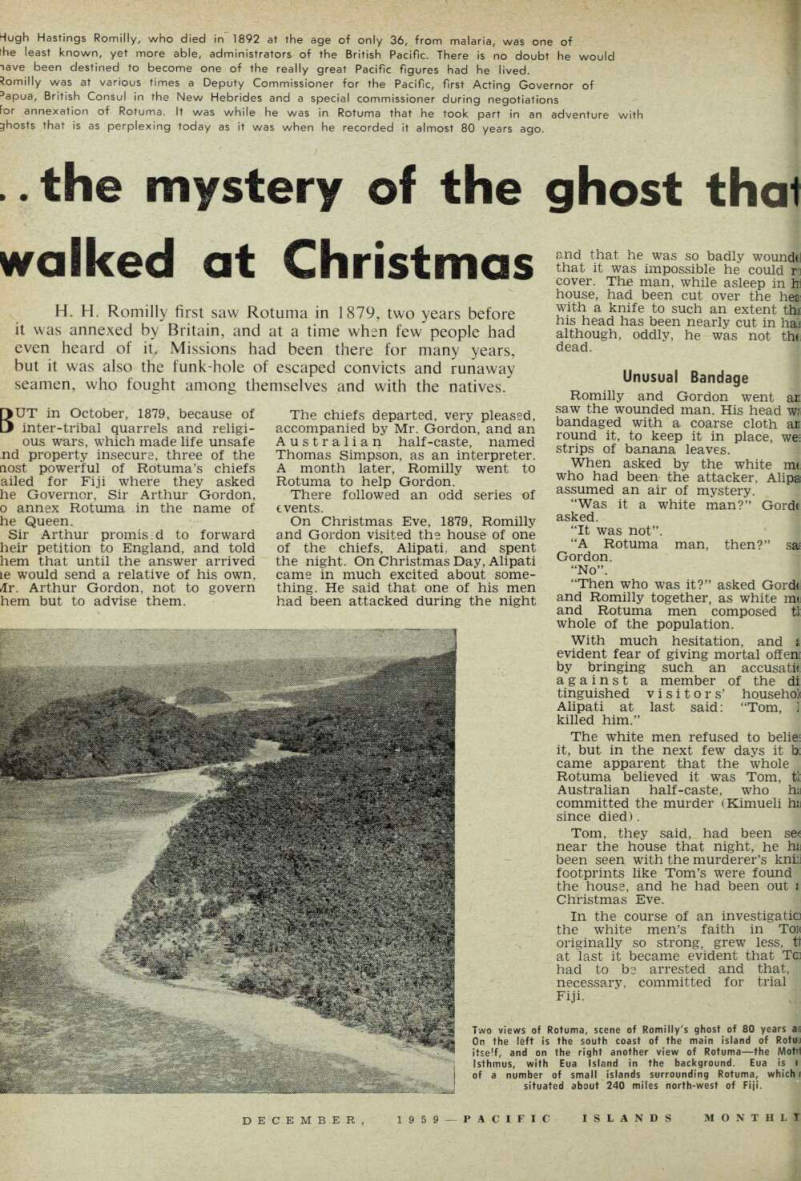
Two views of Rotuma, scene of Romilly's ghost of 80 years On the left is the south coast of the main island of Rotu[?] itself, and on the right another view of Rotuma —the Mot[?] Isthmus, with Eua Island in the background. Eua is [?] of a number of small islands surrounding Rotuma, which [?] situated about 240 miles north-west of Fiji.