Papua's Memorial To Unity
p. 85 · Read in the full issue
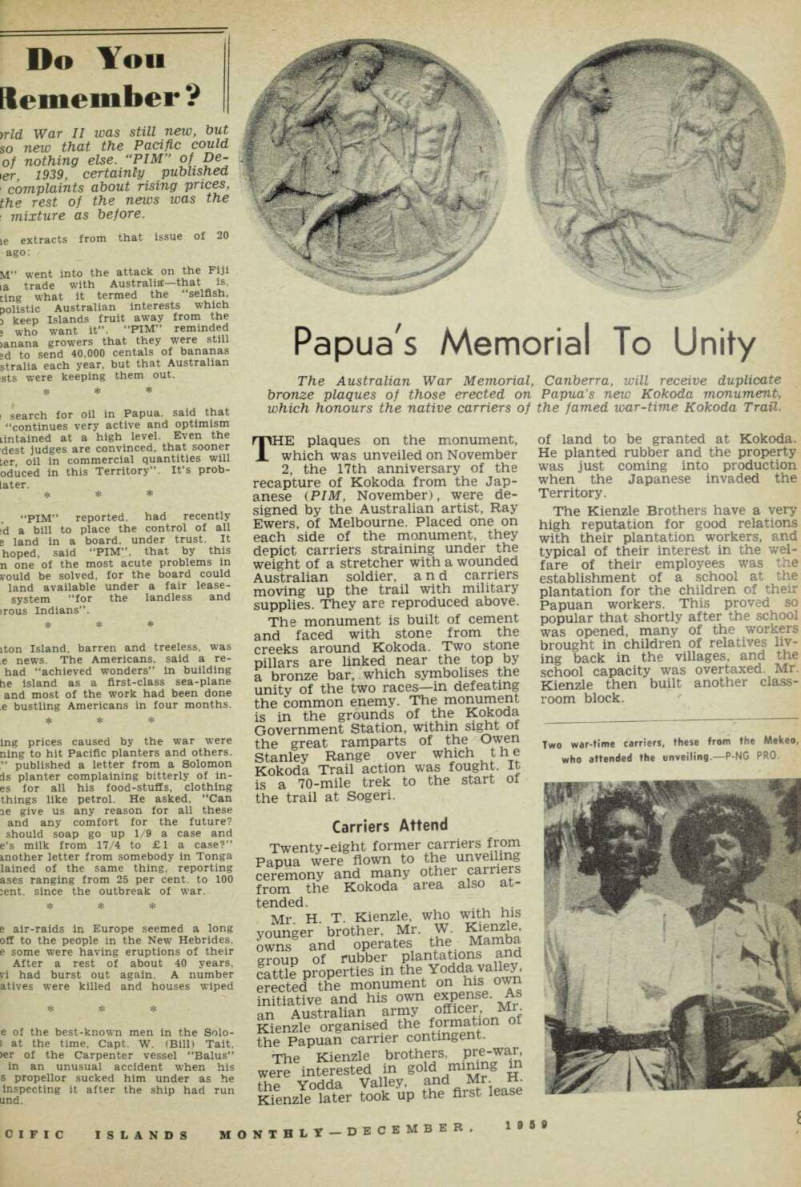
The Australian War Memorial, Canberra, will receive duplicate bronze plaques of those erected on Papua’s new Kokoda monument, which honours the native carriers of the famed war-time Kokoda Trail.
THE plaques on the monument, which was unveiled on November 2, the 17th anniversary of the recapture of Kokoda from the Jap anese (PIM, November), were de signed by the Australian artist, Ray Ewers, of Melbourne. Placed one on each side of the monument, they depict carriers straining under the weight of a stretcher with a wounded Australian soldier, and carriers moving up the trail with military supplies. They are reproduced above.
The monument is built of cement and faced with stone from the creeks around Kokoda. Two stone pillars are linked near the top by a bronze bar, which symbolises the unity of the two races—in defeating the common enemy. The monument is in the grounds of the Kokoda Government Station, within sight of the great ramparts of the Owen Stanley Range over which the Kokoda Trail action was fought. It is a 70-mile trek to the start of the trail at Sogeri.
Carriers Attend
Twenty-eight former carriers from Papua were flown to the unveiling ceremony and many other carriers from the Kokoda area also at tended.
Mr H. T. Kienzle, who with his younger brother, Mr. W. Kienzle, owns and operates the Mamba group of rubber plantations and cattle properties m the Yodda valley, erected the monument on his own initiative and his own expense. As an Australian army officer Kienzle organised the fOTmation o the Papuan carrier contingent.
The Kienzle brothers, pre-war, were interested in gold mining m the Yodda Valley. and Mr H.
Kienzle later took up the first lease
of land to be granted at Kokoda.
He planted rubber and the property was just coming into production when the Japanese invaded the Territory.
The Kienzle Brothers have a very high reputation for good relations with their plantation workers, and typical of their interest in the wel fare of their employees was the establishment of a school at the plantation for the children of their Papuan workers. This proved so popular that shortly after the school was opened, many of the workers brought in children of relatives liv ing back in the villages, and the school capacity was overtaxed. Mr.
Kienzle then built another class room block.
Two war-time carriers, these from the Mekeo, who attended the unveiling.—P-NG PRO.