[?]ow To Achieve General Literacy Among
pp. 71-79 · Read in the full issue
[?]most Two Million Natives
is the first of three articles in which Papua-New Guinea's Director of Education G. T. Roscoe, explains the nature of the Territory's number one administrative' problem how it is being tackled. The articles are taken from an address given by Mr. Roscoe in Moresby in October to the P-NG Regional Group of the Royal Institute of Public Administration one of the best surveys ever made of the education policy as a whole, problem of giving basic education to If million natives, and providing them one medium of communication in place of their present 500 jages, dominates all administrative planning in the Australian Territory.
When considering Australia’s policy in relation to de jlopment of Papua and New Guinea, it is well to remind Lirselves of the circumstances under which our people first iok possession, and their reasons for doing so.
E hundred years ago European lowers had no interest whatever n this island. As a result of the :co-Prussian War of 1870-71 a ;d German Empire was estab d under Kaiser Wilhelm I. His Wilhelm 11, cherished an tion to establish a colonial and nercial Empire. the 1880’s, the Germans estab d themselves in north-east New iea. The British annexed what low Papua, and the Dutch pied the island west of 140 deg. mgitude. len World War I broke out in at Britain’s request, the Aus in Naval and Military Ex ionary Force was sent to occupy lan New Guinea, e military occupation lasted till A most interesting account he military administration is l in Charles Rowley’s book, The ralians in New Guinea 1914- He points out that they came onquer and remained to ad iter, a task for which they were ier qualified nor prepared, quite an extent, the Australian inistration was at the mercy of lan planters and missionaries, uld not afford to disturb them, their knowledge of the country the people gave them a decided ntage in dealing with the Ad stration.
Difficulties
ne of the difficulties we still with German missionaries date to that period, including the >y the Lutheran Mission of the language as a lingua franca *eas where it bears no relation ie vernacular.
Government officers consider it gives the Mission an advantage against the Government in dealing with the native people and that this
advantage is in fact used at times against the Government.
Former German New Guinea was entrusted to Australia by the League of Nations under mandate. World opinion had been influenced in favour of the rights of small nations by the case of “Brave Little Belgium”, and the conditions of the mandate show clearly an intention that the administering power should protect and care for the indigenous inhabitants of the Mandated Terri tory.
The responsibilities did not, how-
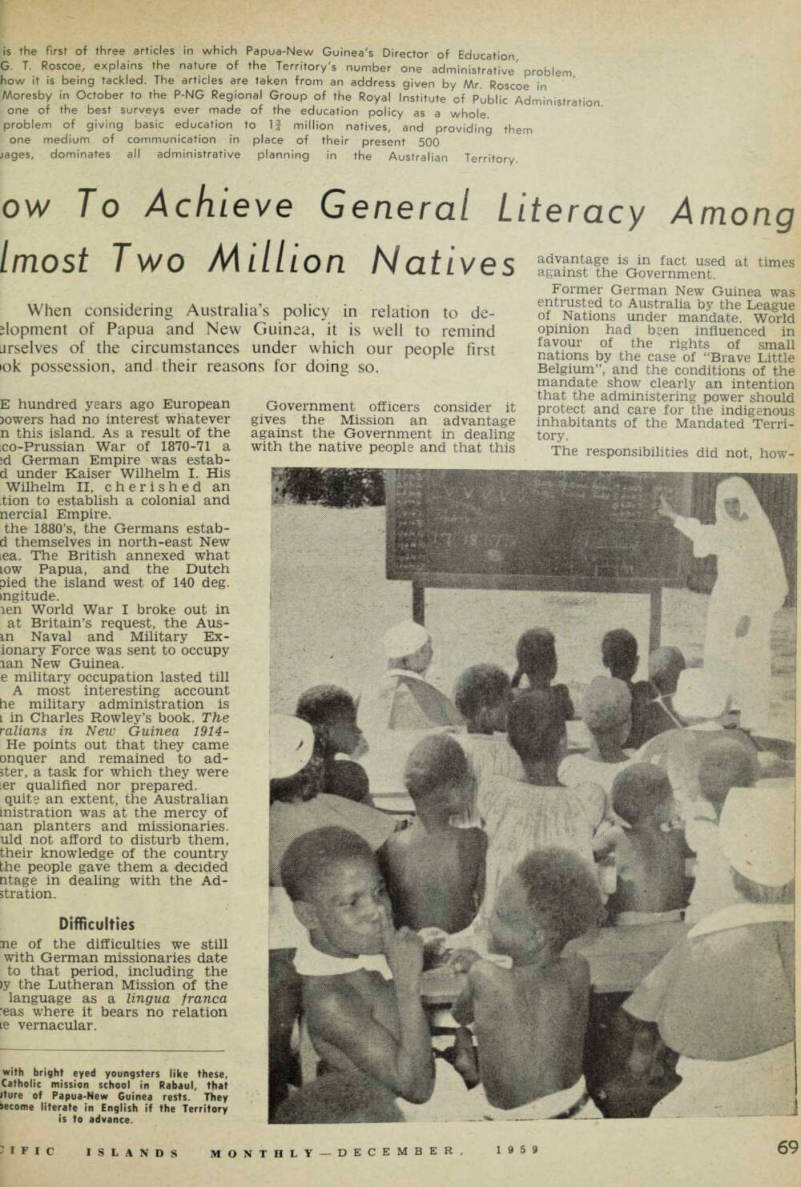
with bright eyed youngsters like these, Catholic mission school in Rabaul, that [?]ture of Papua-New Guinea rests. They become literate in English if the Territory is to advance.
go so far as to involve the spment of the indigenous ation to a status of equality Europeans. i Australian Administration in Mandated Territory collected from native people, and spent loney on schools. But the Gov snt schools were all in the bourhood of Rabaul and there 0 Government aid to, or super of, Mission schools. Mission tion was ancillary to the pro ion of the Christian Faith.
NG No Longer a "Bastion" the outbreak of the Pacific Japan found it necessary to y New Guinea in order to ain supply lines for the in -1 invasion of Australia.
American and Australian lign in New Guinea against apanese saved Australia from on; and, at the close of the ;here was practical unanimity Slew Guinea must be held as tion for the defence of Aus against attack from the north, t is one good reason why we ;re now. he second place, a year or two 1945, there was amongst the than people a sentimental in in thO natives of Papua and Guinea. This found expression s nice things that were said t “Fuzzy-Wuzzy Angels on wen Stanley Track”. ;n Australia accepted the eship of north-east New a from the United Nations, ssu m e d a far greater re bility than she had done the former mandate.
Id powers now have a consci tbout Colonialism and justify continued occupation of in dent territories by a policy of tnent for the indigenous in ,nts. Australia is pledged to ite the social, economic and al development of the people 3 Territory to the point where an earn their own living, pay way and manage their own *
'Jo Complete Agreement
re is not complete agreement ; ultimate objective, stioners in the Trusteeship il ask what target date is set idependence. The Australian entative invariably replies that not possible as yet to fix a te date for the conferring of Dvernment. It is worth noting in English, as in Dutch and h, there are two distinct for “independence” and “self iment”; but in the languages ne of our critics there is no distinction; because they t conceive of self-government understand it in the British lonwealth.
Fourteen years have now elapsed
£»,TSii* vss, s
”7' It would no longer be necessary for an aggressor from the north to use New Guinea as a stepping A^S-roi£ n atom i c sub ?} ar i ne + off the C v? St c ? ald destroy all our metropolitan cities with guided missiles; long-range bombers from Asia could bomb Sydney and return home without re-fuelling; intercontinental ballistic missiles could do the same from launching sites almost anywhere in South-East Asia -
The Australian „„„ «
s-, r,k ~‘s.ra are:
terest has diminished. ~w u c , , , v
Why Shouldn t You Pay Taxes?"
The same thing is true of con cern for the native people. No doubt the general Australian at titude is benevolent—but not to the extent it was in 1947 We, in New Guinea, are not so important in Australian eyes as we would like to think we are In the September. 1959, issue of Pacific Islands Monthly, Mr. Menzies and Mr. Hasluck are accused of using
influence to keep the New ea Income Tax issue out of the ins of metropolitan news ’s in Australia. at is nonsense. The metropolitan papers did not give much space le subject of Income Tax in Guinea because their readers not greatly interested, it week I had a conversation an Australian businessman in ul. He said, in effect; “Why dn’t you people pay Income and pay just as much as we i Australia? Why should the alian taxpayer be burdened in to develop New Guinea? Why dn’t you people who live here impelled to pay for it?” went on to say that we were far too much for the native e, particularly in the field of ition —which, of course, pro -1 a suitable reaction from me. v far this Australian may be . as a sample I do not know, vhen we ask for greatly in ed financial resources for the Dpment of this country, we to remember that no demo : government can go too far 1 of public opinion, is not at all certain how the ,yers of Australia would re a greatly increased annual from the Commonwealth to Administration. s question of the availability ance is one of vital importance, particularly where the develop of education is concerned, stated in my second-reading h on the Budget that to intro- Universal Primary Education n 15 years woiuld cost at >t £50,000,000, and thereafter )0,000 a year to maintain. ;urally, we do not need so much ie early stages, but the more ssful we are. the more the nistration will be burdened n a continuing and increasing cial responsibility.
Administration policy on educa tion has been defined by the Min ister for Territories in his memo randum of February 24, 1955. Mr.
Hasluck said that the education of the native people should be “such as to enable them in time to—
Aims of the Policy-Makers
(a) Take part in the manage ment of their own political affairs: (b) —Engage in various sorts of economic activity and to manage their economic affairs; (c) —Change from the social habits and customs of a primitive society to those of a civilised society; (d) —Develop the primitive social organisation into a social organisa tion better suited to their changing political and economic circum stances ; (e) —Acquire knowledge and understanding of themselves and the world about them, beyond what they had as primitive villagers.
“We are deciding that the aim of the education shall be to give fuller scope to the individuality of each of them and to fit all of them for shaping the political, economic and social changes in which they are bound to take part,” said Mr.
Hasluck. He then stated three definite objectives: (a) The political, economic, and educational advancement of the people of Papua and New Guinea. (b) A blending of cultures and, in the absence of any indigenous body of religious faith, founded on native teaching or ritual. (c) The voluntary acceptance of Christianity.
Clash or Blend of Cultures?
Some comment is called for on the concept of the blending of cultures.
Mr. Hasluck explained what he meant in these terms: “To retain what is best in native life and to blend it with the in fluences of Western civilisation so that while gaining the advantages of Western civilisation they will not lose their proper pride in the fact that they have an identity as Papuans and so that, when in the generations to come they may be required to manage their own affairs to a greater degree, they may feel a common bond among themselves as a people”.
The term “blending of cultures” was the title of a monograph pub lished by T. E. Williams, Govern ment Anthropologist in Papua be fore the Pacific War. On Williams’s tombstone in Bomana Cemetery there is the inscription, “He Loved These People”: and there is some evidence that his affection was re ciprocated.
Williams did not want to see the Papuan turned into an inferior imitation of a European. He recog nised that there are many features
Director of Education, Mr. G. T. Roscoe.
apuan culture that have real h. I might mention specifically systems of kinship and mutual ation, which provide the Papuan ?er with social security analog to what we achieve with life ■ance, old-age pensions, super lation and feo forth.
"Best of Natives" lliams urged that the best ires of native life should be ;rved and blended with the i desirable features of our own. like less practical anthro fists who proposed to preserve itive communities as museum jits, Williams realised that there eatures of native life that must liminated in the interests of anity. He refers specifically to iry, head-hunting and certain il practices. recognised, too, that there are ents in our culture which the 'e would be well advised not to ire. The custom of drinking 101 is one of these, but on this : the native does not share ams’s views. r friend and predecessor as :tor of Education, Mr. W. C. es, was an enthusiastic anthro jist and a great admirer of ams. It was at his instance that ams’s monograph was reprinted listribution to all our education >rs. a newcomer to the field of re education, I learnt to share Groves’s views. I felt that a ; should be kept in native ation for the use of the aculars, and that the people’s vays of life should not be com ily broken down. some extent I shared Mr. res’s vision of the Papua and Guinea of the future, consist
peasants and living in modest comfort; but with out the complications and frustrations and material paraphernalia of modern civilisation.
Experience has shown that this pleasant dream is unlikely to come true. Our own culture is rapidly changing in unpredictable ways. hnvi]fo- ef^ Ct cul i ur l e . contac t is nativf? npnnip h ?Q ° f the «nH V ffin 6^S!^.o lS ri to as . ses , s and still more difficult to control, We are dealing with human matenal; and, as every teacher knows, while human material is in some respects remarkably plastic, in other directions it is extremely re- Iractory Psychological reactions are far more complicated than chemical re-
predict mUCh m ° r6 difficult t 0
Native's Demand for Enalish
T + 15 Q UJ te out of the question to P re .P are a blueprint for an ideal cl^ 1 - and pohtical organi S nH °thpn°l tl l e indigenous people, hnes dlr6Ct development Our position is not at all analogous to that of a builder > cutting material to pre-calculated dimensions and then fitting it together in accord ance with a static plan. Our situa tion is intensely dynamic, it might rather be compared to that of an inexperienced canoeist shooting the rapids. He cannot pos sibly stop or turn back, nor can he check the velocity of his craft, (Over)
stream he must go; and he > the course is set with rocks r hirlpools. He must concentrate eping the canoe from capsiz id from being wrecked on the Later, when he reaches calmer he may have a chance to look and see where he Is. change the metaphor, the Ad oration is a schoolmaster who t foresee the later career of ipils. He shares with them his mowledge and wisdom in the that when they leave school will be competent to face up atever situations they meet. successful schoolmaster is srho progressively renders his ince unnecessary. concept of the blending of es is not being accepted by ative people.
August, I visited the Chimbu istrict to perform the official ig of the Gena School. Sivi, ader of the people in the estab mt of the school and the pal contributor to the build made a long and eloquent i. told me they had established arding-school because they d the children to become in English, and they would much more quickly as boarders as day pupils. He said he d English, not Pidgin, or Kote, limbu. thermore, he said that Primary tion was only a beginning. *en who finished their Primary .tion at Gena should go on le Intermediate School at :a, win a scholarship to Aus and thence go on to the rsity. sked him why the insistence ?her education, and particularly >h. He replied, “We want our
children to be exactly like you.”
I asked them whether he would not prefer a synthesis of the best elements in native culture with selected elements from our own.
Envy White Prosperity
His reply was more emphatic than polite. He made it quite clear that if he could he would make a clean sweep, and have the Chimbus of the next generation, in all respects but their skins, indistinguishable from Australians.
There is good reason to believe that Sivi’s attitude is shared by
nature? f £ iS people - 11 is the most natural thing in the world that primitive people should envy our material prosperity and our appaiently limitless resources.
They are quite right when they Assume that the first essential for sharing in our prosperity is to establish communication by learning English. & Missionaries often attempt to shrug off the native demand for by murmuring, “Cargo pult. They say that the native thinks there is some kind of verbal magic about the language that will brmg the cargo if you pronounce the right spell.
I do not think this is entirely true, I have often explained to native leaders that the path to that knowledge, which is power, is long and arduous—that I, myself, have had to study all my life, and am studying still. I am sure that some at least appreciate this.
The point I am making at the moment is that, having come in con tact with Europeans, they find the old way of life unsatisfactory and are prepared to go to considerable trouble to change it.
The second article in this series (in January) deals with Mr.
Roscoe’s proposition that “the hey to the whole problem is teacher training”.
New high scbools, like this one recently com pleted in Port Moresby, will take pupils of all races who have reached the necessary standard of education Thus children will not have to be s ent to Australia for secondary education a system which has come in for criticism in the past by native leaders, as well as others who say that the native people should be edu cated in their own environment.