Spontaneous Combustion
pp. 67-69 · Read in the full issue

Eric de Bisschop’s Final Report Spontaneous Combustion Began it All
Eric de Bisschop was a very unusual man; his 67 years of e overflowed with adventure right to the end; and when he ed, it was a headlined, spectacular finish.
3 theory about the origin of he Polynesians was as un irthodox as the man himself, bis death from injuries received i Tahiti Nui 111 capsized in the of Rakahanga, Cook Islands, ugust 30, 1958, was caused in tly by his wish to add another of “proof” to the evidence he built up over 25 or more years.
Tahiti Nui, just recently avail in the English edition (the ch edition appeared just before author’s death) he propounds thing of his theory—but Lises to write a full length on the subject “when I get to Tahiti”, after the planned from Papeete to South :ica and back, ridiculed Heyerdahl’s theory Polynesia was populated from b America—to de Bisschop’s of thinking the drift of Kon was a waste of time and didn’t 3 anything except the obvious, a raft can float, can sail with vind and can drift along with current. the same time, he did not )t the theory that the Pacific populated from Asia, with a ling-off place somewhere in yasia. is a bit difficult to decide from present book just what he did ve, except that he dismisses the of the Middle East as the le of mankind. His line of ming seems to be that the aesians were the result of a of independent spontaneous mstion, right there in the be —their’s, he says, “was a ime civilisation which could have arisen or developed any •e except in the Pacific itself”
Five Centuries Back
his own satisfaction he had 3d the “course of the Polynesian tm” back five centuries before Christian era, and still had d no “source”. this time he says, the Poly ms moving westward had ad their influence through nesia, and then as a Javano nesian mixture, had gone on to i a new maritime culture that ad as far as Madagascar, India, the shores of the Red Sea. the same time, the Polynesians i moving eastward, along the fic coast of South America, in
isolated trading voyages not nearly so numerous as their westward thrust.
In 1935, de Bisschop and a com panion made a remarkable voyage in a Polynesian double-canoe from Honolulu to France across the Pacific and the Indian Oceans and around the Cape of Good Hope. He probably reasoned that if he could do this, this ancient Pacific mari time civilisation of his could have produced sailors capable of doing likewise.
Waited 20 Years He waited over 20 years before tackling the voyage to show that the ancient Polynesians could have also gone eastwards. This was a harder nut to crack, but although neither the drift voyage to South America nor the return to Poly nesia was completely successful, it showed that it was not impossible, but if at the same time, exceedingly difficult. The Polynesian visitors to South America, even 500 years before Christ, must have been few and far between.
Apart from a little preliminary theorising, the present book is devoted to the story of the building of the raft Tahiti Nui, from bamboo, and the drift voyage that began at Papeete in November, 1956, and ended six months and
4,000 miles later when a Chilean Navy ship attempted to tow them as the raft showed signs of break ing up in hurricane weather when still about 400 miles short of the South American coast.
De Bisschop and his party of four were taken to Callao and there immediately set about constructing a balsa raft for the return drift which began, and ended at end of August at Rakahanga, with de Bisschop’s death, on April 13, 1958. [Storms blew the raft north of the intended course and eventually Tahiti Nui II became waterlogged and started to sink. The whole party installed itself on top of the
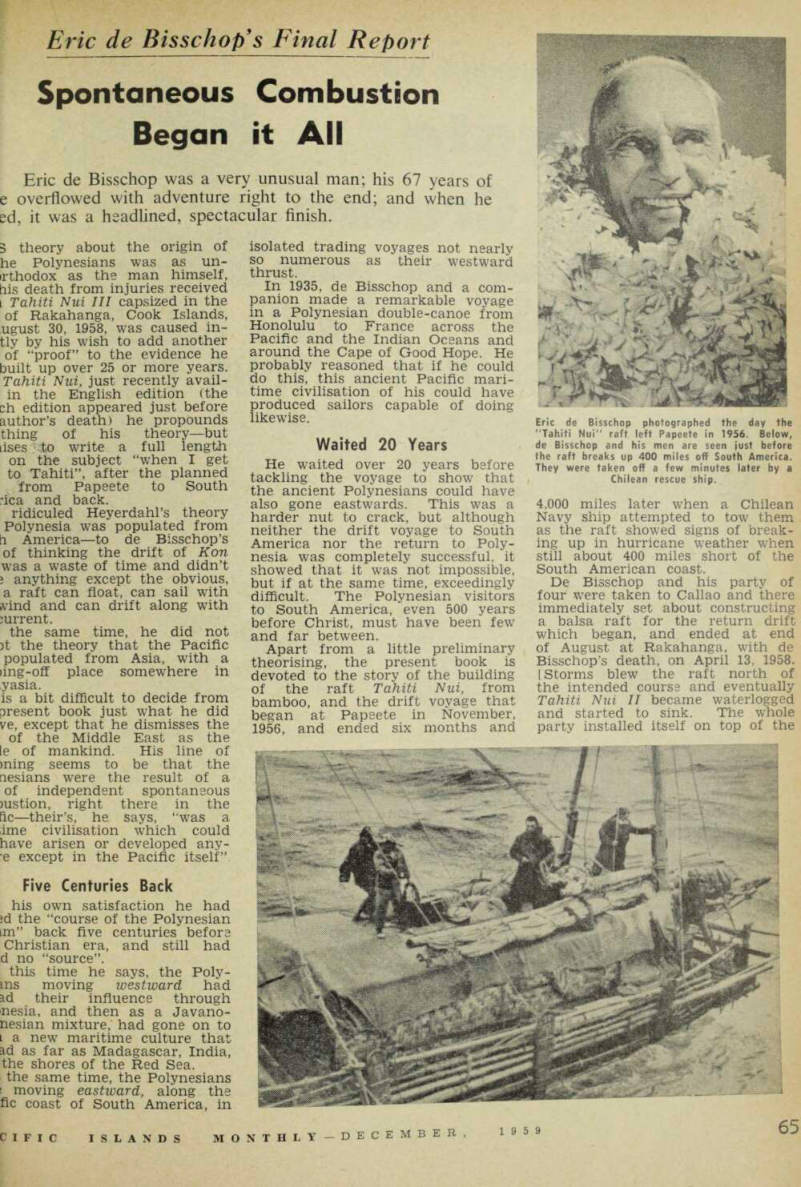
Eric de Bisschop photographed the day the "Tahiti Nui" raft left Papeete in 1956. Below, de Bisschop and his men are seen just before the raft breaks up 400 miles off South America.
They were taken off a few minutes later by a Chilean rescue ship.
while the raft broke up beneath i it was then that they built nailer raft out of empty water ns and other bits of the original and transferred themselves and t remained of their supplies. y tried to land at Manihiki, bruk, and Penrhyn but were ied away by unfavourable winds currents. Finally they set a se for Rakahanga, only to have r leader killed when the raft ck the fringing reef.]
"Unorthodox"
•ic de Bisschop may have had -thodox and detailed theories hing back two thousand years Polynesian history, but his y of the first (eastward) instal t of the double drift is a very lan one. It is an account, not much of a great moment in 3ry —as de Bisschop doubtless jved it to be—but of the much e mundane business of five of assorted temperaments ig cooped up together under uently difficult circumstances in mall space, and at the mercy he wind, the currents and the ther. e Bisschop and his adventurers ted normally and, at times, ■oughly got on one another’s res. (Nonetheless some of them ;ed in Callao for the second ton Tahiti Nui II.) The whole y is well larded with a typical ich Polynesian outlook on life : saw nothing unusual in de chop’s wife, from whom he had i separated for nine years, and vahine getting together to ig comfort to him during his days in Papeete, e Bisschop came of a good ach family; but he got himself side by supporting Vichy during Second World War. Before t he had been Navy officer, nan, police chief, adviser to a nese army; he travelled widely
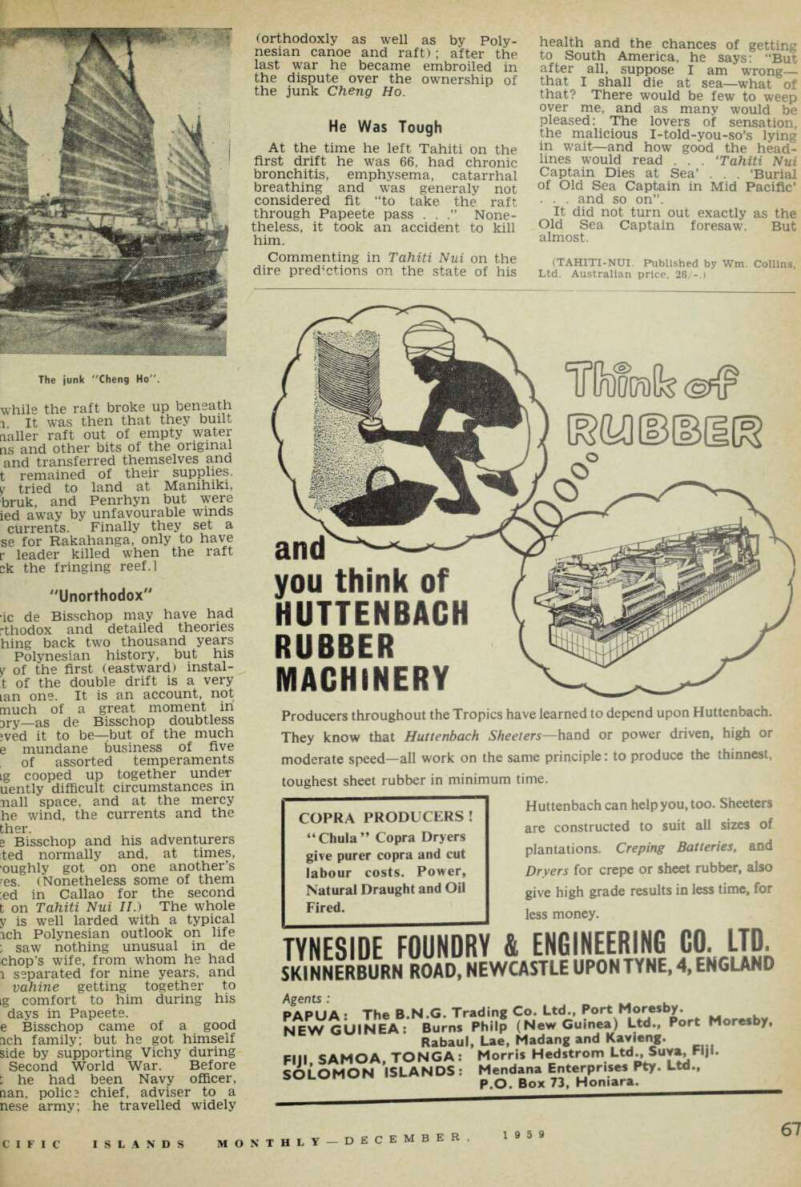
(orthodoxly as well as by Poly nesian canoe and raft); after the last war he became embroiled in the dispute over the ownership of the junk Cheng Ho.
He Was Tough At the time he left Tahiti on the first drift he was 66, had chronic bronchitis, emphysema, catarrhal breathing and was generaly not considered fit “to take the raft through Papeete pass . . .” None theless, it took an accident to kill him.
Commenting in Tahiti Nui on the dire predictions on the state of his
health and the chances of getting to South America, he says: “But after all, suppose I am wrong— that I shall die at sea—what of that? There would be few to weep over me, and as many would be pleased: The lovers of sensation, the malicious I-told-you-so’s lying in wait—and how good the head lines would read . . . ‘Tahiti Nui Captain Dies at Sea’ . . . ‘Burial of Old Sea Captain in Mid Pacific’ . . . and so on”.
It did not turn out exactly as the Old Sea Captain foresaw. But almost. (TAHITI-NUI. Published by Wm. Collins, Ltd. Australian price, 28/-.)
The junk “Cheng Ho".