German Eagle Returns To N. Guinea
p. 33 · Read in the full issue
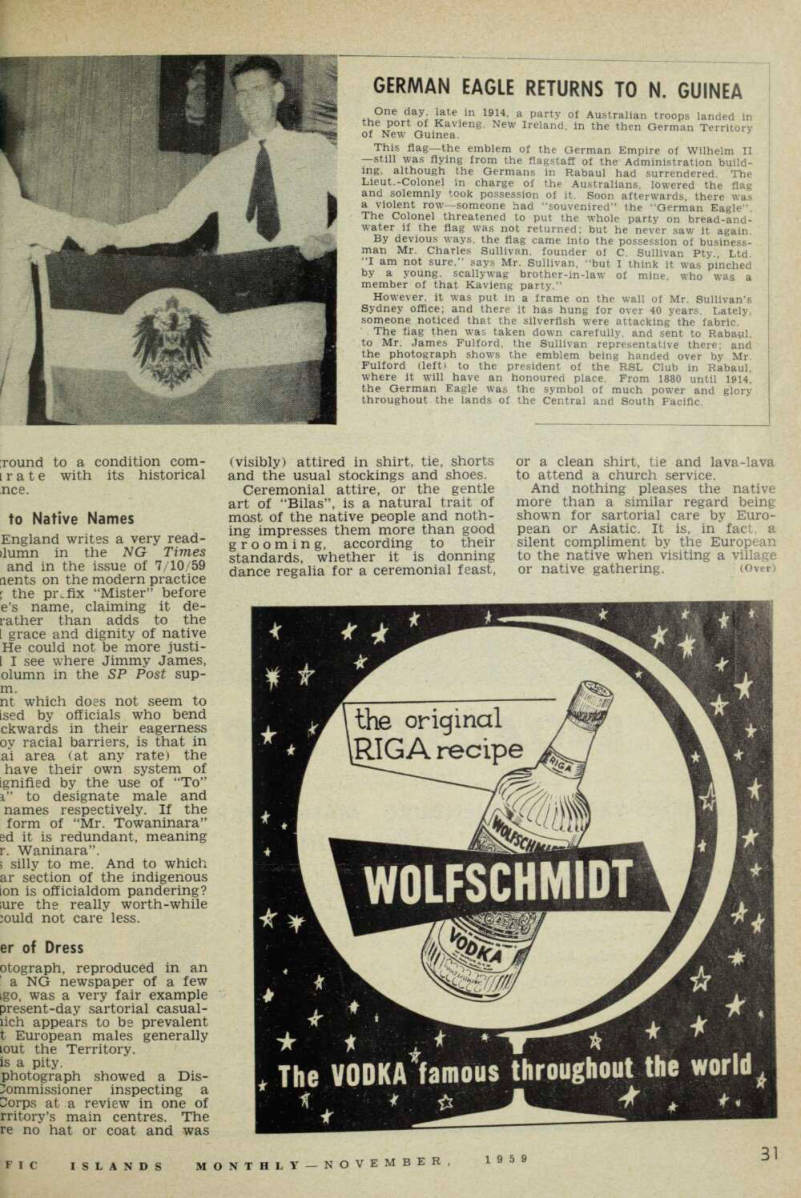
One day, late in 1914, a party of Australian troops landed in the port of Kavieng. New Ireland, in the then German Territory of New Guinea. * This flag—the emblem of the German Empire of Wilhelm II —still was flying from the flagstaff of the Administration build ing, although the Germans in Rabaul had surrendered. The Lieut.-Colonel in charge of the Australians, lowered the flag and solemnly took possession of it. Soon afterwards, there was a violent row—someone had “souvenired” the “German Eagle”.
The Colonel threatened to put the whole party on bread-and water if the flag was not returned: but he never saw it again.
By devious ways, the flag came into the possession of business man Mr. Charles Sullivan, founder of C. Sullivan Pty., Ltd.
“I am not sure,” says Mr. Sullivan, “but I think it was pinched by a young, scallywag brother-in-law of mine, who was a member of that Kavieng party.”
However, it was put in a frame on the wall of Mr. Sullivan’s Sydney office; and there it has hung for over 40 years. Lately, someone noticed that the silverflsh were attacking the fabric.
The flag then was taken down carefully, and sent to Rabasil. to Mr. James Fulford, the Sullivan representative there; and the photograph shows the emblem being handed over by Mr.
Fulford (left i to the president of the RSL Club in Rabaul, where it will have an honoured place. From 1880 until 1914, the German Eagle was the symbol of much power and glory throughout the lands of the Central and South Pacific.