Territories Talk-Talk
pp. 31-35 · Read in the full issue
By Tolala
Fhe recent ruling by Papua-New Guinea Land Titles nissioner, C. P. McCubbery, over a claim by natives for in the Toma area, near Rabaul, recalls probably the most ame and diabolical murder ever perpetrated by the early people and there were not a few grisly massacres around the turn of the century.
itives’ claim and the Corn oner’s refusal to recognise ere reported in the Port newspaper, in which the ioner is reported to have quite rightly, too, that “the nan confiscation was still : generation natives have i convenient memories and i to recall the butchering Voolf on Varzin plantation forebears, which led to the on of certain lands by the government as further jnt to them, following a expedition by native police, igedy occurred in 1902, and ,rs later I had an account m one of the police boys pedition. The savage treat his woman by her attackers e adequately described and mltze (a niece of Queen who happened to be vlsit- Woolf at the time, had a is escape as she hid in an while the killing took place, civilisation comes to the s they must realise that ; of the fathers shall be pon the children . . .” ” Woolf, the husband of the ate victim, survived to be .ted in 1921 and passed on st a few years later. sses On film fans’ idol, Errol Flynn, irered his last curtain call a though he is resting, he the subject of storms in uarters. This is as he would ; columns written about the Press only sketchy was made of his days in nea which, perhaps, is just :or Flynn was never a very memory to many of the Guinea folk who carried their books for years and »te him off as a bad debt.
Flynnian characteristic of off his financial obligations recorded by R. W. Robson e The Trade Winds Blow o Magazine Section, this > well as by Frank Clune
_,,_ , , „ m his Debunking of Errol Flynn, which apeared some years ago in the Sydney Bulletin .
It will be interesting to see whether Flynn’s prospective book, My Wicked, Wicked Life, will give a true account of his New Guinea escapades.
Philatelists, Ahoy!
. ' , * , . . .. , There’s no doubt but that PIM readers have a variety of interests.
One whose hobby is philately, writes me asking about an air mail cover posted in Port Moresby on December 18, 1934, “per plane G-ABJU. Pilot Lord Semnhill (*??) This is hard to w r ite s the enmflrer aecipner, writes tne enquirer “Could it be Noel Simphlll, etc. It is addressed to Victoria.”
“Another envelope”, writes the same philatelist, “is marked ‘per favour Major Brearley. Hay-Wau,’ and is post marked ‘Hay, NSW, April 3, 1936’ over an Australian stamp; and then, over a New Guinea Bird-of-Paradise air mail stamp, is post-marked, ‘Post Office
Wau 16 April 1936’. The addressee was Mr. W. T. Hooper, Box 19, Post Office, Hay, NSW’. Main enquiry is’
What exactly was the flight made by Major Brearley and was he con nected in any way with aviation in NG?
Any information from readers?
Come in, please
Bouquet For Private
Enterprise
It seems to be the invariable practice in the Australian Press that when a correspondent writes to the Editor on matters New Guinea, he harps on segregation, inter-racial rivalry, colonialism and the “arrogant” attitude of the non natives towards the native people.
It was therefore a pleasing change to read in The Observer (17/10/59) a letter from one, William McLaren, of Adelaide, who decried the “fantastic attitude to the settlers in NG” prevailing in Australia. “Are they to be sacrificed as the most expendible in any conflict?” he asks. And then takes a logical view of the situation, ending with: If there is a feeling of insecurity in New Guinea, it is Administration-inspired; if there is dissatisfaction in New Guinea, it is dissatisfaction not with the settlers but by them. If the settlers have no part to play in the Australian Government’s future plans for the Territory, they should be told now, not messed around with, not kept as persona non grata who pay the taxes, do the work, run the risks, and get criticised for expecting some rewards. It is about time the Government told the settlers where they stand.
For far too long has private enter prise in P-NG been made the whipping-post of political time servers, including the chair-borne bureaucrats who pull the strings in Canberra. (Over)
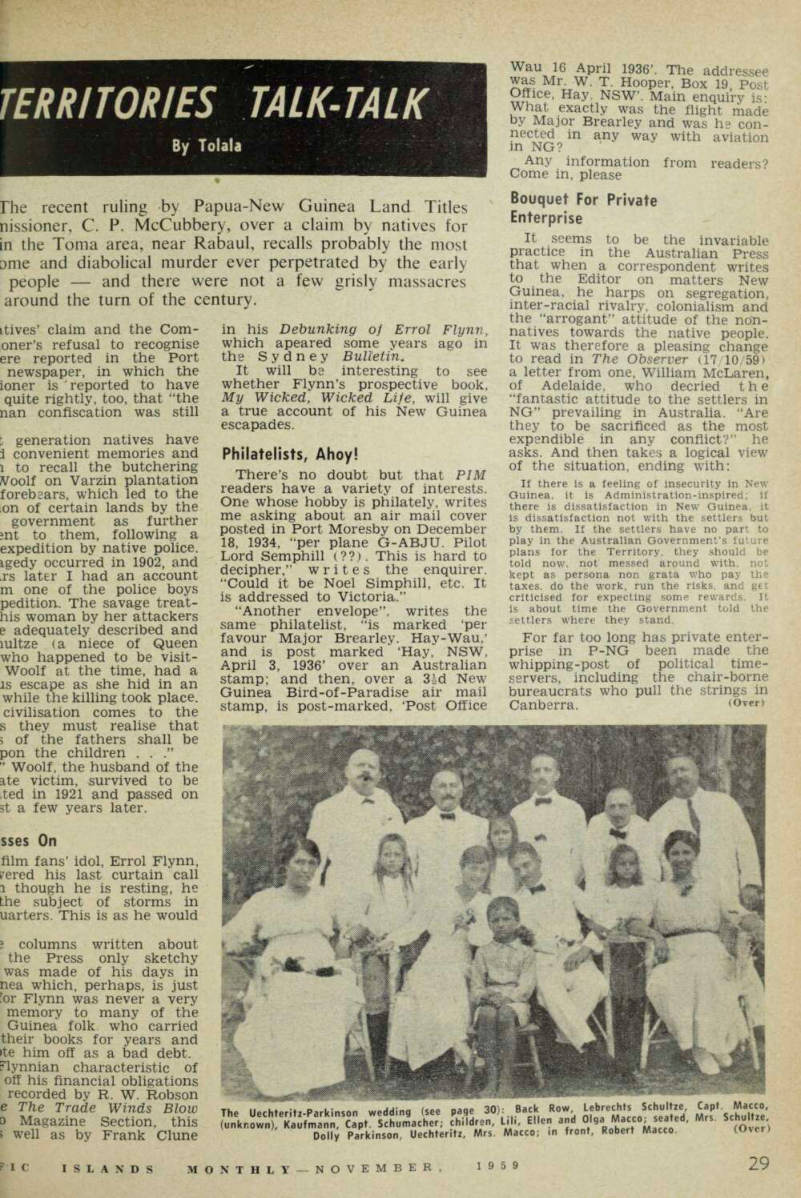
The Uechteriti-Parkinson wedding (see page 30): Back, Row Lebrechta Scholtze, Capt. Macco (unknown), Kaufmann, Capt. Schumacher; children, Lili, Ellen and Olga Macco, seated, Mrs. Schultze, Dolly Parkinson, Uechteritz, Mrs. Macco; in front, Robert Macco. (Over)
From my own experience iii I would be prepared to planters, missionaries and tt have done as much for the « of the P-NG natives as any istration effort. And I’ll leaver that.
The Parkinson Saga Publisher Robson’s delvingi the Parkinson history (Oct. H 77), makes nostalgic readin. those old-timers who still renr the hospitality of the Pan home at Kuradui, just ok Rabaul-Kokopo road beforn entered the Malapao plain Mrs. Parkinson remained in i ence there until the 1920’5, w heartless Expro Board movr out, which just about broke tr lady’s heart.
But she battled on with unffi spirit and it was only the privations experienced durin Jap invasion which laid her I RWR says, her remains lie somewhere in New Ireland should be re-interred in the burial ground. Her nieces Schultze (mentioned in thr item in this column) also o New Ireland during the Jap o tion.
Mrs. Parkinson’s daughter,, who married Diercke, of T plantation, down in Bougs later remarrying and becomir Haddow, died in Buka Pass the ’3o’s. Her body was ex and re-buried at Kuradui.
Rudolph Diercke, is one of tt remaining links with the Pa], family still resident in NG.
Another link is A. M. P. Uec: of Sum Sum. whose mothi Mrs. Parkinson’s youngest das Dolly, who later re-married s came Mrs. Messenger.
The photograph on previoui showing the wedding group a and Uechteritz, taken in IT Capt. Macco’s plantation ii Ireland, may be of inter readers. Mrs. Macco (in the is still alive and lives in I She was a daughter of Mrs Anne Horgren (a sister of Emma), and her daughter (also in photo), is now Mr: and lives in Bavaria.
A sister of Mrs. Macco Doellinger, wife of the populs. at Kieta during the Germaj died in Berlin two years ag So far as I know, Mrs. ParK voungest son, Paul, is the onl;J inson still living, and he is where in Australia, I Another son, Eddie, went America (?) in the ’2o’s, but that he had passed on.
And so the pioneering Pae family, which did so muchj velop early New Guinea is ally fading away.
I could not agree more wit.d over the suggestion that som*j be taken to restore the Pa*
;round to a condition com irate with its historical nee. to Native Names England writes a very read ilumn in the NG Times and in the issue of 7/10/59 aents on the modern practice ; the prefix “Mister” before e’s name, claiming it de rather than adds to the i grace and dignity of native He could not be more justi l I see where Jimmy James, olumn in the SP Post sup ra. nt which does not seem to ised by officials who bend ckwards in their eagerness oy racial barriers, is that in ai area (at any rate) the have their own system of ignified by the use of “To” i” to designate male and names respectively. If the form of “Mr. Towaninara” ed it is redundant, meaning r. Waninara”. > silly to me. And to which ar section of the indigenous ion is officialdom pandering? ure the really worth-while lould not care less. er of Dress otograph, reproduced in an : a NG newspaper of a few tgo, was a very fair example present-day sartorial casual lich appears to be prevalent t European males generally lout the Territory, is a pity. photograph showed a Dis- Uommissioner inspecting a Dorps at a review in one of rritory’s main centres. The re no hat or coat and was
(visibly) attired in shirt, tie, shorts and the usual stockings and shoes.
Ceremonial attire, or the gentle art of “Bilas”, is a natural trait of most of the native people and nothing impresses them more than good grooming, according to their standards, whether it is donning dance regalia for a ceremonial feast,
or a clean shirt, tie and lava-lava to attend a church service.
And nothing pleases the native more than a similar regard being shown for sartorial care by Euro pean or Asiatic. It is, in faci a silent compliment by the European to the native when visiting a village or native gathering. (Over)
iful grooming may be con l by some as a symbol of despised Colonialism and the t-day quasi-Boy Scout attire dication of true democracy ,n eradicator of racial dis n. But it does not impress the in this way, and he’s the one mnts. ly, an official at District issioner level could not be i of that heinous offence of ig on dog” if he wore a coat it, whilst himself making an ion of cadets, each of whom with the other in being the e of immaculateness.
allant "Few"
read of memorials being un to perpetuate the memories Coastwatchers and of the • of the Kokoda Trail, but so lave heard of no effort being to recognise those half-dozen airmen who launched them into the blue against on : Jap bombers and Zeros over [ in January, 1942, in their fay crates. 14 years ago now several appeared in Sydney papers the Australian public of the self-sacrificing effort of these fay “few”, and urging for recognition of their valour, g has been done (so far as I rare) to honour these brave still not too late to remedy jglect. Over to you, Minister