Pacific Report
pp. 119-146 · Read in the full issue


The month’s round-up of news and pictures of people and ;nts, from PIM correspondents in the South Pacific.
ctions on Fiji's
ion Results
’s electors were a tired lot n g the September elections results were published in in September), and fewer of bothered to cast a vote than >6. Unlike Papua-New Guinea nts, they haven’t got an Aus a Minister to scold them for political apathy; and Fiji is mt also in the fact that their cial Legco members have a I unofficial power that their ;orian counterparts do not. n features of the Fiji elections 'he decline in numbers of ered voters in four of the six rates as compared with the >us election, despite the in i' in population of the Colony, lie failure of about 25 per of persons eligible, to register ters.
'he fact that five of the six elected are members of the profession—two of them, Mr.
Gibson and Mr. Vijay Singh, members of the same legal ership. lie election by a substantial •ity of Mr. B. D. Lakshman, had just been publicly slated le Sugar Industry Board, as a representative for the North ;rn Division came as a sur to a good many. He is the outsider in the legal combine. i figures of registered voters .them European: 833 (1,105 at ius election); Eastern Euro -509 (615); North-Western 643 (612) ; Southern n: 4,233 (4,916): Eastern n: 1903 (2,213); North-Western n: 7,933 (6,669). i failure of eligible Europeans gister is explained, in part, by act that many are government nts from overseas on short tours of duty who have no in ; in Fiji’s politics. ;htly or wrongly, a percentage igible persons felt that with a lative Council with an un- Jd official majority, the repre .tives of the people had no
power of veto and therefore little real power.
There is a good deal of evidence to show that the elected members do, in fact, have a considerable in fluence on legislation though they have no power of veto.
Legislation is rarely passed in Fiji where it is strongly opposed by most of the elected members.
Nevertheless, the contrary view point undoubtedly influenced some people in failing to register or vote, although most failures to register can be attributed to apathy.
The final voting figures were:
Southern European : Falvey
462, Tetzner 162 (registered voters 655).
Southern Indian : Deoki 1,877,
K. B. Singh 950, C. M. Gopalan 221, Pathik 89, Ramrakha 82 (registered voters 3,295).
Eastern European: Gibson,
240, Martin 170 (registered voters 437).
Eastern Indian: V. R. Singh
864, J. Kanji 494, M. I. Khan 360 (registered voters 1,751).
NW EUROPEAN: Kermode 292,
White 197, Chalmers 26 (registered NW INDIAN: B D. Lakshman 2,637, Madhaven 2,158, Prasad 2075 (registered voters 6,958).
The names of nominated members were announced on September 17.
They are: Mr. C. W. Cayzer, general manager of the gold mines at Vatukoula, and Mr. J. A. Moore, representing the Europeans; and Mr. Sathi Narain and Dr. Sahu Khan, representing the Indians. (Nominated members of the last Council were Messrs. S. G. C.
Cowled, W. G. Johnson, A. I. N, Deoki and Dr. Sahu Khan).
The Fijian members, elected by secret ballot by the Great Council of Chiefs and approved by the Gov ernor, are: Ist member, Ratu Edward Cakobau; 2nd member,
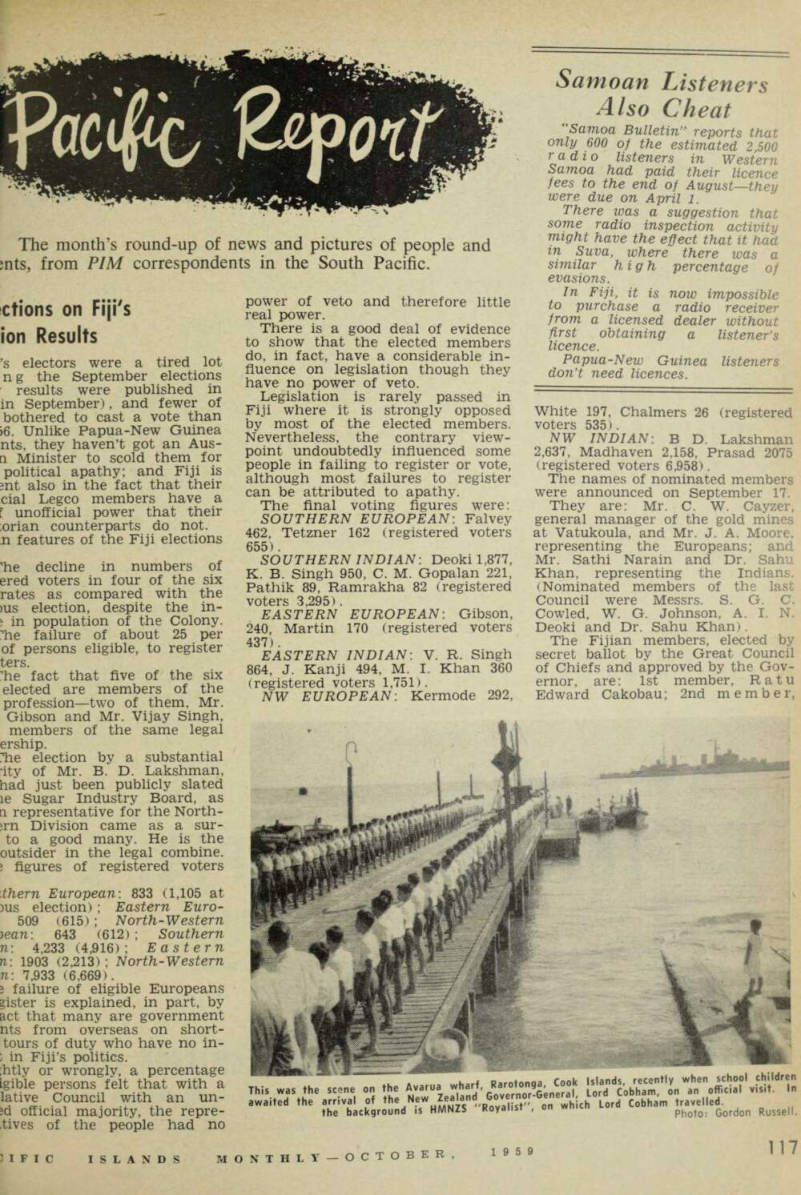
This was the scene on the Avarua whart, Rarotonga, Cook Islands, recently when school children awaited the arrival of the New Zealand Governor-General, Lord Cobham, on an official visit. IN the background is HMNZS "Royalist", on which Lord Cobham travelled. photo: Gordon Russell.
K. K. T. Mara; 3rd member, Panaia Ganilau; 4th mem emesa Sikivou; and sth mem lavuama Vunlvalu. official members are the ial Secretary (Mr. P. D. maid); the Financial Secre (Mr. E. R. Bevington) the n g Attorney-General (Mr.
Lewis); Secretary for Fijian s (Mr. C. R. H. Nott) ; the or of Medical Services (Dr.
Dill-Russell); the Commis of Labour (Mr. N. Pearson); troller of Customs (Mr. R. A. 0‘ the Postmaster-General J.’a. Marais); the Account eneral (Mr. J. F. Griffiths); irector of Public Works (Mr.
Common); the Conservator rests (Mr. J. R. B. Angus) ; Director of Lands, Mines Jurveys (Mr. D. T. Lloyd); rector of Education (Mr. J. G. r); the Director of Agricul- Mr. J. M. Watson) ; the Act jputy Financial Secretary (Mr.
Bain) ; and the Acting or-General (Mr. J. F. W. ) .
H. Maurice Scott remains sr. On the occasions when the er does not preside over the ber, his place is taken by the nor, Sir Kenneth Maddocks, role as President.
If Costs To
; That Letter
i the sharp rise announced in sts of Australian postage and than telephone calls, a good business concerns are sharply mining their expenditure in s kinds of office activity. Some sting results have been ed.
Adelaide firm has calculated >st of preparing and sending le business letter, cost is based on the assump lat the executive who dictated tter receives £2O for a 40-hour and that the typist gets £lO sek. Actually, in each case, the je cost is probably higher, this basis it is calculated that me of the executive on one -dictating it and then revising gning it—is eight minutes, and equals 16 pence, i time taken by the steno er was 15 minutes —and that 5 pence. was calculated that all the “overhead” in connection with two operations—supervision, ince, rent, light, depreciation, and so on—amounted to 10 vas reckoned that the cost of ;ationery was lid, and carbons ribbons about one-fifth of a 7- ;h postage at the new Aus n rate of 5d per letter, we get al cost of preparing, producing
livering the letter a fraction 48 pence. 3 inflationary spiral continues ig upwards, it seems possible h e expensive stenographic of carrying on communica ill be discarded. Already, in ties, correspondence is carried DUgh a voice recorded on a y-prepared bit of plastic— is sent directly to the other and played back to him. If leans could be found of pre and filing such records for ce purposes, such a system be introduced at a cost con ly less than 4/- per cona tion.
igrants Cause
ation Fall
nett gain in population in an Samoa from natural in of births over deaths has re been about 800, but mlgra ) Hawaii and the United is now resulting in a slight decline in population ration from the territory has tially increased since Trans i Airlines commenced its service. About 1,262 people air in the past year, and the preceding year. De s were at the rate of about 0 persons per flight recently nting to 300 persons in July- Pan American Airways also ncing fortnightly flights to in October, and with the class at $248 to San Fran cis cheaper than by sea— parture rate will probably further substantial increase.
ow Makes
/vn Paint
lint manufacturing company, by New Zealand interests, for business in temporary es in Matua Street, Walu >uva, early in September, ciated with Superior Paints
and Specialty Finishes (NZ) Ltd. of Auckland, the new company, Fiji Paints Ltd., has been preparing for business in Fiji for some time.
Special formulae have been developed for tropical use and the paint has been under test by exposure to the sun on test panels in Suva for months past. Following these successful tests, the company is now in production.
The administrative director of the new company is Mr. D. Hourigan, and Mr. R. M. Calder is technical director. Both are New Zealand ex-servicemen, and Mr. Calder served in Fiji in the artillery during the war.
The company will only employ a small local staff at first but plans to move into permanent premises
at Walu Bay later. Most of the mixing process will be by machines operating around the clock.
Norfolk Is.' NZ
Ambassador
One Sunday in August, a big congregation at St. Barnabas Chapel, Norfolk Is., and many more residents in their homes, listened to a church service broadcast from the Anglican Cathedral in Welling ton, NZ.
Some months ago, the Dean of that Cathedral visited Norfolk Island on a health trip and was so enamoured with its way of life and hospitality that he said he was going to be an ambassador. (Oven
o visitors from Fiji were at a recent if the Polynesian Association in Sydney.
Mr. Everett Riley and Mr. T. Singh Ranjit.
Photo:Tele-Photo.
collected words and music of I of the traditional local , induced his church choir to them, and on this broadcast blk Island service, as a thrill for Islanders, and lably the congregation in gton and listeners in other )f NZ, appreciated the service,
iesia Moves
Chinese Retailers
n effort to replace the Chinese storekeeper with Indonesian nepers, the Indonesian Gov nt in September introduced of laws designed to drive alien retailers out of business. number of Chinese in >sia is variously estimated at \l million to three million. )ly the latter figure is more correct. ever, it is estimated that 500 Chinese leave Indonesia month, to return to life in . As against that, the Chinese rate in Indonesia is very high ; estimated that the increase per cent, per annum, n many Pacific countries, the >e village store is an estab institution in Indonesia. It the villagers most of their i needs; buys from them their s rice and other products; and nearly aways is there a small equipped with chairs, where Hagers gather for a chat and lolly-water.
Indonesian Government’s lan probably will put 25,000 of
these small Chinese traders out of business. It could be part of a general plan to force the Chinese out of Indonesia.
Because it is based on the as sumption that there will be Indo nesian villagers to take the Chinese places, it will not succeed.
Soekarno planned that Indo nesians should take the place of the Dutch merchants, traders and planters when they were driven out. But it was Chinese, not Indo nesians, who replaced the Dutch traders. There are few Indonesian villagers capable of running a village store.
More for Pago Pago
Cannery Workers
As a result of recent wage hear ings in Pago Pago, American Samoa, the minimum rates for the 400 cannery workers at the Van Camp tuna cannery have been raised to $0.75 per hour.
The average wage is thus now $3O a week or $1,440 a year.
The average rate of pay in other fields is about $750 to $BOO a year.
However, not all cannery employees are on full-time work. The numbers employed vary with the fishing.
Fiji Official Support
Of Birth Control
There are indications that argu ments in favour of birth control have been accepted by the Indian community of Fiji. (Over)
[?]a-New Guinea division of the Country Women's Association now has a new hostel at Here it is, just after being officially opened by Mrs. D. M. Cleland, wife of the P-NG Administrator. Photo: W. D. Hutton.
social and economic com ms created by the rapid i of the Indian community ecognised by the Indian ; themselves, and the system pulation control —which in illy is now the policy of the iment of India itself —has jiven much attention.
Director of Medical Services i (Dr. P. W. Dill-Russell) recently that birth control had been opened officially
in the Fiji towns of Suva, Lautoka and Labasa and that already hundreds of people were taking advantage of them.
Members of Fiji’s Legislative Council have urged that wider publicity be given to the fact that the services of such clinics are available.
Now They Can Hear The
Voices of The Coastwatchers
The voices of some of New Guinea’s most famous Coast watchers, giving some of their own stories and viewpoints, have been recorded for posterity. And what is more, some of the recordings are to be sold to the public.
The recording follows the official dedication of the Coastwatchers Memorial Light at Madang, New Guinea, on August 15, when most of the more famous Coastwatchers, including their leader, Commander Eric Feldt, were present (see PIM, August, September).
The recording happened this way; Among the invited guests at the ceremony was the war-time Director of Australian Naval In telligence, Commander R. B. M.
Long. Knowing that the ceremonies would be unique and claiming the principal participants as friends, Commander Long took with him a tape recorder in the hope of obtain ing a record which he could play to Coastwatchers who could not be present.
He obtained the full dedication ceremony, and an additional two hours of impromptu interviews by the majority of the Coachwatchers.
These men all wanted copies of the tape. To meet this demand, what started out as a minor venture by Commander Long culminated in the production of three double sided microgroove discs, each side running for an average of 22 minutes. , ..
One of the discs gives the full record of the dedication ceremony, the other two discs carry the im promptu talks by Coastwatchers and other officials. The discs of the Coastwatchers’ voices are, of course, unique, and probably will remain so for it’s hardly likely that the war time men, who did such remarkable work behind the lines in the Pacific, reporting enemy movements at great personal risk, will ever be together again in such a group.
Commander Long, who is these
days the head of a Sydney firm of consulting engineers, has a limited number of the discs which he says he is willing to sell to re cover some of the editing and pro cessing costs. We can imagine that they will not be left with him very long.
He should be contacted direct at his address, R. B. M. Long, Esq., c/o R. B. M. Long Pty. Ltd., Con sulting Engineers, 86 William Street.
Sydney, Australia. The cost of the dedication ceremony is £A2/10 -. plus mailing charges, and the Coastwatchers’ talks (two discs) £AS, plus mailing charges.
Tongan Whale-Steaks
Are On The Table
Officers of the Tongan ship Aoniu reported in Suva at the beginning of September that the season’s
Islands Weddings
Among recent marriages in Papua-New Gumea were, left, Mr. and Mrs. William Coburn (she was Miss Helen Gill) shown he re wlth Re v.
Father J. Dwyer after a service in the Catholic Church in Rabaul; top right Mr. and Mrs. E.
Niehinen (nee Pat Saunders) at Taurama Chapiel, Port Moresby; and, right, Mr and Mrs. F.
Smyth (nee Miss J. Hannan) at the Catholic Church, Port Moresby.
Photos: C. H. Meen and Papuan Prints.
whale catch—for the table only-y been satisfactory. About six m had been taken at Nukualofa, , footer was taken at Haapgc August, and a couple had been I j at Vavau in the north.
More Petroleum Storage t
For New Guinea
The Vacuum Oil Companyi pounced in September that it ' instal another bulk oil termini Papua-New Guinea—the new' stallation being at Madang a :b a cost of about £AIOO,OOO.
At present, Madang is sei from Lae, where bulk st )< facilities were built in 1950.
When complete, Madang stf will take care of 280,000 gn of aviation gasoline; 160,000 g:? of petrol; 35,000 gallons of ken and 280,000 gallons of disti Drum filling and cleaning fao will also be available.
All these petroleum product} be taken to Madang direo £ Vacuum tankers.
Fiji Copra Could
Be Better
The Fiji Department of Ag]£ ture’s report for 1958, just publil indicates that the Fijian prodb are losing a good deal of rrn through insufficient care in copra production.
The report says that betwee per cent, and 60 per cent, oft copra is produced on private pl;I tions and the remainder by H villagers. Of the plantation o 60 per cent, is good quality (H and FM 1) and the remaindee ferior (FM 2 and below). Equiw
ages for the Fijian-produced
ire 35 per cent, and 65 per e ratio of good to inferior Fijian crop had been the ; the plantation crop a mini f £lO,OOO more would have lid out to Fijian producers, ort says.
Natives Now
ng Coconuts
w is officially estimated that D per cent, to 25 per cent, of 1,000 tons of copra produced ;ar in the Territory of Papua iw Guinea is made and sold natives. r Administration officers’ ,s, the natives are making oconut plantations. It is ed that in the last five years U million palms have been . by village producers, r official estimates indicate ie amount to be received in lendar year by both Euro ind native producers from sold through the Marketing will be the largest in the of the Territory.
for a Kavieng
mediate School
5, which will take six years iplete, have been approved ie Utu Intermediate and cal School, four miles from g, New Guinea, school is situated on one of >st beautiful spots on the New I east coast road, with fring- I, good fishing, and a ground itball, cricket and baseball, ik-sak buildings it at present 48 general and 19 technical ts. The latter are learning s trades under Mr. Victor i, a former instructor at ma Training School, Rabaul. principal for the last five has been Mr. Cecil Ashley, as recently packing up ready
to leave with his wife and daughter for Sydney. Mr. Ashley’s place at Utu is being taken by Mr. Tom Maddocks, from the Milne Bay school.
The intention is to bring the school up to 240 boarders from the New Ireland area, and to house them in modern buildings. The technical students are doing the building work as part of their train ing, and are making pretty good progress, although none of them had ever done any brickwork be fore. Two new classrooms, a Euro pean dwelling, storeroom, workshop and two ablution blocks will probably be ready by Christmas; and the administrative office and block will be ready in two years.
The plan allows for the brightest trainees on the technical side being sent on to the Malaguna Technical School at Rabaul, to swell the supply of apprentices available to the New Guinea Islands. There is a grow
ing demand for qualified apprentices by private enterprise, in addition to those who can be absorbed by the administration.
But some Europeans in Rabaul feel that much of the present train ing of native students with up-to date machinery is wasted, because only primitive tools are available to them when they go back to village life Meanwhile, Mr. George Harring ton, principal of the Malaguna school, has spoken of an interesting experiment that will start next year.
This is a special boat building workshop where selected students will learn to build craft from dinghies for small ships and gov ernment trawlers to 40-ft cutters.
They will learn under two Euro pean instructors and one Papuan.
Another move is forecast in the announcement that the Adminis tration of Papua-New Guinea is to purchase a training ship for naval
[?]ell-known Fiji resident Monty Griffen, [?]hed in Sydney with Edward Whippy of Fiji. —Tele-Photo.
who will learn to become , masters and engineers, resent most of the masters of I’s numerous small ship fleet iropeans working for the big lies or for the Chinese plan owners. new Administration training ill be of steel, 90 ft long with team and a draft of close on Engines of 312 h.p. will drive crews to give a speed of 10 ling afloat will be given to cadets to qualify as officers, vill be taught navigation and iship, others marine engin- They will only become eli ’or examination for coastal s and engineers on comple a four-year course.
Hawaiian
jlture Compared
md the Hawaiian Islands are ' comparable in land-mass Lmate, though Fiji has less land mainly due to its being up into many more islands, t is interesting to compare riculture of these two terri it statistics show that Fiji total land mass of about 9 acres of which about 830,000 ; actually usable for purposes than forestry at present. has a land mass of about 0 acres, of which about 0 acres is usable for other irestry. r: In 1958, Hawaii had 222,000 is compared with 168,000 in ipples ; Hawaii had 74,800 Fiji had 230 acres. tables, excluding Dalo (taro): , 3,740 acres; Fiji, 25,000 nas: Hawaii, 1,000 acres; 000 acres. e: Hawaii, 6,800 acres; Fiji, is. idamia nuts: Hawaii, 3,100 Fiji, nil. a: Hawaii, nil; Fiji, 165,000 )f palms under harvest.
Hawaii, 90 acres; Fiji, 31,200 (taro) : Hawaii, 590 acres; 1,500 acres. a: Hawaii, nil; Fiji, 1,500 Dlanted (5 acres in bearing). ts: Hawaii, 66 acres; Fiji, 150 value of Hawaiian agricultural e last year was $276,000,000 $22,000,000 on the previous igar strike caused a drop of ,000 in the value of raw exported—its value was 0,000. However, this loss was offset by increased earnings pineapples, diversified crops, ck, and livestock products,
though hog and poultry farms con tinued to go out of business.
Canned pineapple declined but fresh pineapple exports increased to a level of 14i million pounds weight Hawaii’s exports included some in teresting items unknown to Fiji.
Some 63 million pounds of prepared coconut chips (like potato chips), 35 million pounds of edible coconuts, seven million pounds of shredded frozen coconut flesh, five million pounds of coconut “syrup”, and a million pounds of frozen coconut milk were included in this category.
There were also substantial ship ments of pawpaw (papaya) in puree, balls, chunks, slices, nectar base, etc. —canned or frozen. Guava jams and jellies, and nectar, as well as similar products from other fruit, were also included.
One of the rarer items was poi— the fermented breadfruit paste eaten in various parts of Polynesia shipped fresh, bottled, and canned to the United States. Honey and beeswax were also represented.
Many of Hawaii’s small industries, including agricultural industries, are a direct result of the huge tourist industry which makes the produc tion of exotic foodstuffs and floral items, for example, worth while.
Position Vacant on
Penrhyn Island
The Cook Islands Administration was advertising for a Resident Agent for Penrhyn atoll late in August.
Recent vacancies for such posi-
lave been advertised only DUt the present position was ed in New Zealand as well, salary scale allows a maxi ;arting rate of only £NZBBS urn, plus £2O location allow fith free house and heavy e. uld be one way of getting from the hurly-burly of life; or ideal for someone mted to write a book. But ;ople, these days, want more ae equivalent of £A2O per live in such splendid isola racancy is the result of Mr. ;uarau reaching retirement has completed 40 years of in the Administration.
rouble in
Copra Board
? investigations were re to be under way at Nuku ?onga, in September, into the misappropriation of a sum ut £lO,OOO of Tonga Copra funds over a period of seven money had allegedly been at in numerous small sums copra delivery notes, ing the completion of na tions, a Tongan member of iff has been suspended.
Ik Is. Has Some
Shipping Weather
September weather pre- Burns Philp’s Tulagi com ber unloading at Norfolk After lighterage workers )iled for almost a week in ous conditions, the Master i that he could not delay any
longer and sailed for Vila, New Hebrides.
At that stage, fresh water supplies on Tulagi were calculated to last only five more days—which didn’t leave much to spare for getting to Vila. (Water is generally taken on at Havannah Harbour, adjacent to Port Vila).
As a result of the weather, 30 tons of NI cargo and one car were still on Tulagi when she left. A shortage of sugar and flour immedi ately developed in local stores and
these commodities were being rationed.
Not much relief can be expected till Tulagi calls again. Damadora del Mar, the 750 gross tons freighter owned by Captain E. Savoie’s company, arrived at Norfolk Is. on September 24 after being delayed by the same bad weather, but she carried 900 drums of petrol and only 15 tons of general cargo.
Some Aid for Fiji
Export Industries
Where the cost of imported materials involved is not less than half the cost of the finished product, no Port and Customs Service tax will in future be levied on goods manufactured in Fiji and exported.
The Government says it hopes this measure will further encourage the establishment of local export in dustries in the Colony. The Govern ment gave an undertaking that this amendment would be made at its budget session last December, and the amendment became law on August 7.
The exemption has also been ex tended to Fiji-brewed beer, and it will also apply to copra imported from other territories for milling.
There is also an exemption on the many empty oil drums which are constantly imported and re-exported to neighbouring Island territories after being re-filled at the Fiji bulk oil terminals.
Other similar containers, such as sacks, are included in the exemption.
sitors to the Polynesian Association in Sydney were Monsieur R. Klima, of Papeete [?]h his family, Madame Klima, daughter Manuela and son Rudolph. With them, on the [?]rs. John Canning, who was Lorna Brotherson, also of Papeete. The Klima family is now holidaying in France.
Photo: Tele-Photo.
"PIM" readers sa„ Mr. and Mrs. Keith Spooner (left) in the September issue, but Mrs. Spooner, formely Pamela Gilmer, was then in bnrial array, cutting her wedding cake with her husband.
But that photograph was taken after their marriage at a civil ceremony in Noumea, New Caledonia, performed by the Australian Consul ' Mr . Ro dney Hodgson. Here is what the civil marriage cere mony looked like—Mr. Hodgson on the right. The photograph was sent along by Noumea corres pondent Fred Dunn because he says, it is worth recording. It was the first marriage ever per formed by an Australian Consul in Noumea.
Photo: Fred Dunn.
is v. Authority—
d by Round
fight over Fijian boxer e Varasikete —with Authority ; one corner and Varasikete’s ter, Mr. Jerry Adams, in the corner —has now entered its lonth, and some commentators i say Mr. Adams has a few lead. trouble started in April when kete flattened Tonga heavy ;Kitione Lave in one round at ijian’s home town of Nadi, months later, Lave had his je by flattening Varasikete i the first round at Nadi, but las nothing to do with the . See also Sports Review (p. r Varasikete had accom i that first famous king hit e more experienced Lave, the ’s friends devised a fitting ation. This took the form of Dening bowl or two of the onal yaqona (the Fijian name ,va) which is not intoxicating, ; was followed by a bout of Ir inking. > mixture is not particularly ng, but when later, the action itensified by adding, unknown rasikete, weighty quantities of X) his ale, the boxer reacted coming very drunk indeed, this condition he was later ng a course to his village and dthin the confines of it when ce officer, passing in his car, id him and told him to get s he did; but when apparently wned on him that he was arrest he got out and made
The officer, not unnaturally, pursued and overtook him. In the ensuing attempt at his appre hension, Varasikete aimed a straight right at his adversary, but, his tim ing and footwork at this stage being not quite up to his Lave fight standard, it was not effective.
The officer retired, and, procur ing reinforcements, re-arrested the boxer in the village.
When Varasikete appeared in court, to the original charge of be ing “drunk and disorderly” were now added the formidable ones of “escaping from lawful custody” and
‘assaulting a police officer”
The magistrate, after a stern warning, considered that in view of the extenuating circumstances the offences would be dealt with by a substantial fine. The latter was amassed from friends, the boxing hero became a free man, and the incident might have been con sidered closed.
But the Varasikete knockout feat had been big news in the boxing world and one result was an offer to fight the New Zealand heavy weight champion in Wellington.
This offer was accepted.
What happened then is a matter for argument. According to Jerry Adams, although Fiji certainly granted Varasikete a passport, the police cabled his record to the New Zealand Immigration authorities in these words (says Adams) :
Mosese Varasikete Con
Victed Drunk And Dis
Orderly Assault Police
Officer Escaped Lawful
Custody, Will You Issue
Permit.
Not surprisingly, says Adams, the reply from New Zealand was that the entry permit was not approved.
Adams in the last few months has been publicly accusing the Fiji police of having failed to point out the extenuating circumstances of the conviction, as a kind of police revenge on the boxer for his rough stuff. But he can’t get anybody to admit it. “Authority” has told him that the decision to admit the boxer or not had been one for the New Zealand authorities. But Adams has not been satisfied with that answer, “Justice”, Adams says publicly, “is being spitefully denied Vara sikete”.
He has given up writing further
are the girls of St. Trinians —more or less—with school master Ray Gruber, at an RSL Fancy Dress Ball in Port Moresby. They were a winning group.
to the Colonial Secretary in id in September announced was going to take the matter i the Secretary of State for onies, in Whitehall, and refer to British Prime Minister lan.
Flying Saucer
n Town
can priest, Rev. Father i Booth (“Bill”) Gill, of received a lot of publicity in ber as a result of flying reports. ething very unusual is hap around the Goodenough Bay he said in Brisbane, on his Melbourne, where he will p teaching in an Anglican After more than eight years Guinea he has finished his ary work there, t from the Press, Father Gill 30 met in Brisbane by two rs of the Queensland Flying Research Bureau, the Brisbane Courier-Mail interview on September 18: sr Gill, 31, made world news he reported from Boianai L n Mission, Papua, that a of 12 people, including him ad seen three flying objects le mission station just after on June 27. ight pages of closely typed p, which included sketches.
Gill described how one of ing objects, larger than the carried four figures which and exchanged signals with servers on the ground, report gave details of times, of witnesses, and descrip )f flying objects seen around eodenough Bay area, on the east coast of New Guinea, on 11, 26, 27 and 28 this year, sed in sports clothes and smok pipe, Father Gill was quite nt that what he had seen hther a normal aircraft nor a hovered for a while at 450 he said. “When it left, it d the 30 miles across the bay f a second, before disappear e four figures in the craft were mded by light, which did not
touch their outlines. This may have been because they were wearing some kind of suit.”
Father Gill said that since June 27, when the figures in the “saucer” waved to men on the mission, there had been “three or four reports a week” of people sighting strange flying objects, or mysterious lights, mainly in the Goodenough Bay area.
“Patrol Officer Bob Smith, of Cape Vogel, north-east of the bay, reported that he saw a disc of light coming towards him one night,” said Father Gill.
“It got bigger and bigger, and finally seemed to disintegrate.
“On August 25, the night before
Visiting Guam and the US Trust Territory of the Pacific Islands re cently was Dr. Richard Seddon, executive officer for Social Development with the South Pacific Commission (left). With him here is Dr. Robert E. Gibson, the Trust Territory's Director of Education, and Mrs.
Gibson. Dr. Gibson will be among prominent visitors to an education seminar in Port Moresby in November. He will deliver the Camilla Wedgwood Memorial Lecture.
Photo: P. C. Sanchez.
I left, I saw a strange light swing ing back and forth across the sky like a pendulum.”
Father Gill said that until the time he left there had been 50 “sightings” of unidentified objects in 90 days.
“One returned to the same spot each night for a week,” he said.
Father Gill is carrying with him documented records of “sightings”, signed statements by witnesses, and sketches of objects seen by both Europeans and natives in his area.
Most of the reports concern objects seen at night.
“The only report of a flying object seen in the daytime came from schoolchildren and their teacher, at
Menapi, on July 21,” said Father Gill.
“They saw a silver disc streak across the sky at high speed.
“Not one of the dozens of objects reported has ever been heard to make any noise.”
Trail of Medals Follows
M. Soustelle
Most political hatchets were temporarily buried during the whirl-wind, medal-scattering visit to New Caledonia in late September of M. Jacques Soustelle, Assistant Minister to French Premier Debre.
Primary cause of M. Soustelle’s visit
was the opening of New Caledfc £AIO million Yate Dam.
It must have been a very t M. Soustelle who climbed into Lancaster of the French Fie©' Arm at Noumea on the afteie of September 26 to be flow/ Papeete, Tahiti.
M. Soustelle had spent crowded days in New Caledonia its environs. He had been ke: a very tight schedule complicate the fact that the plane of the • lar TAX service bringing himr 12 hours late.
M. Soustelle arrived at Tom aerodrome early Sunday moic September 20, and was immediately to the Ma£ aerodrome near Noumea. Follol an official reception the Mill boarded the helicopter of the M Co. and he was wafted to thee Coast centre of Poindimie, 350 C metres from Noumea.
After an official reception r distribution of medals the Mill returned to Noumea by the copter arriving late in the eve Following official receptions hes again took to helicopter on Moo travelling to Yate where he offifl opened the Yate hydro-elel scheme. In a speech he pointer the importance of Yate in Caledonia’s economy. The outn the scheme will enable the smir at Noumea to double the outpq nickel and also permit the smtr to compete on the world mo without any subsidy from i Metropolitan government.
In the following days a Soustelle, travelling by air, viv the three Loyalty islands, I Lifou and Ouvea. He also vh the New Hebrides where he lists to deputations of French plae discourse on their miseries.
M. Soustelle was reported as a
M. Soustelle (right) being presented w album of photographs of the new Yat after the inauguration.
Photo: Fred
ed that a plan was being to transfer surplus popu rom Tahiti and Vao to rich, drgin, New Hebrides land, ■w Caledonia’s national day, er 24, M. Soustelle presided ary review, visited by air the hnes and in the late after fisted at a folk lore carnival aea. Next day he visited it Coast centre of Bourail.
Minister was received with sm wherever he went. New ians forgot their political ;es and received him as the representative of De Gaulle han as the leader of the party (UNR) which is the lemy of the party in power JC Assembly.
Medal Scattering
astelle left a trail of medals, fact that the French are >t decorated people in the There are medals for every of activity in public life, fisit was marked by great pomp. Flocks of gendarmes 1 and followed him almost ere. His speeches contained important—just the usual ties—but more than once he d his visit as “fact finding tact making”. loumea Leftist sheets called ourist trip” and took the • to task for wasting the ;axpayers’ money. The sheets led to mind the days when a Leftist sympathiser—even e” Leftist.
M. Soustelle appeared be tie Assembly Territoriale, it M. Ohlen pointed out the ’s grievances, due mainly to usal of France to define the powers of the local lent and the French by—a source of endless > and bitterness between the
Assembly and the Governor of New Caledonia. The Minister gave no concrete answer, but passed off the questions.
He was approached by a deputa tion of Viet Namese on the ques tion of their repatriation. They were referred to his “technical officer”, this latter gentleman dis cussing the question for over an hour with the deputation.
Though nothing has been released officially it is rumoured that the negotiations on this subject between France and Hanoi have progressed, the North Viet government having accepted “en principle”, that they will receive the Viets from New Caledonia.
M. Soustelle will take back to France a picture of a warm hearted people who have a deep affection for the Motherland
Tahiti's Warm Welcome
To M. Soustelle
A lengthy description (with photographs) of Tahiti’s warm wel come to M. Soustelle arrived from our special correspondent as this issue went to press. The material will be published in November.
The French Minister was lavishly entertained in the districts of Tahiti and in nearby islands.
many men decorated by M. Soustelle. [?]r. Jacques Barrau, New Caledonian [?]ive Director of Economic Development [?], and (right) New Caledonia Customs Boisson, well known by sea travel lers for his courtesy.
Photo: Fred Dunn.
Formal History
i Island of Bau
was a rustling of the pages iry on the tiny island of ji, in September, when for ; time since 1853 a Vuniyalu ■mally installed. The title, nakes the holder the chief the Fijian chiefs, was be en Ratu George Cakobau, reat grandson of the King i, who ceded Fiji to Queen had been no formal in n of the Vunivalu since akobau had been installed 1853. s purely a Fijian ceremony obody not in Fijian dress come, and the scene on the land, headquarters of some worst cannibal excesses in days, was one of reverence, ices hushed. g the hour-long ceremony vas presentation of tabua, and gifts—some from the touring rugby team, for and Fiji have long been ;ed.
George Cakobau had in fact univalu since the death in his father, and some people little puzzled by the decision ve the ceremony of instal it this stage. nented the Fiji Times, in a iy phrased editorial: “The for the decision to hold the ny have not been made but it is abundantly clear lere is no question whatever the right of the Vunivalu re the ceremony if he should re. the same time, it is not an
intrusion into matters which are exclusive interests of the Fijian people in general and of Bau in particular, to comment that among some sections of the people there has been a certain amount of con
troversy over the need for such a ceremony.
“Apart from the argument that the ceremony is in effect merely a visible confirmation of a hereditary honour which the Paramount Chief has held for years and which could not be challenged in any circum stances, there has been a good deal of discussion in some Fijian quarters about the economic factors in volved.
“Nothing of the sort could con ceivably have happened in 1853, and that there have been such dis cussions is an indication of the ex tent to which the economic squeeze is affecting the lives and outlook of many of the indigenous people.”
Mr. Chipper Tells Them
What He Thinks
Mr. John Chipper, timber miller and business-man of many parts, was elected to P-NG Legislative Council in September on the votes of those who decided that there was no better way of censuring the Australian Government’s handling of New Guinea affairs. For Mr.
Chipper was pledged to resign if elected As with his two fellow elected members, also pledged to resign, Mr Chipper’s maiden speech in the Legco, in late September was also his last, but Mr. Chipper apparently decided he had best get everything off his chest while he had the pri vilege to do it. It all came as some thing of a shock to other Legco, members, and to not a few people ° U Among the points Mr. Chipper made in his first and last speech U0 * e, rhat instead of the Minister referring to private citizens; custs” the boot was on the other foot, and that the Minister and
[?]ers of taro, turtle, roast and live pigs and cooked foods of the ceremony of installation of the Vunivalu. At right, nivalu and Tui Kaba himself, Ratu George Cakobau, QBE.
Photos: Rob Wright, Fiji PRO.
f you, who contribute so ler than words to the eco evelopment of these Terri the time-servers, the ;, the woollythinkers are sts who are so relentlessly ig the plan of private en without which these Terri mnot survive”, t land had not been pro yeloped and that no policy i implemented that would native and European resi- Drking in partnership, t the Administration’s of the liquor question had eak and shilly-shallying”, t the Administration had Donsible for the low morale mblic service, and had to ired for the inter-depart antagonism that was ever and “for the insobriety ■al of headquarters staff ey visit my electorate”, it the Administration had i produce workable Native Ordinance and solve the problem, and had failed into the indigenous popu ny sense of responsibility immunity in which they d from which they took Administration had to be for its endorsement of a lat was developing a race tnployable, dishonest, cor [ uncontrollable people who thority in contempt and poken or written word is less, where survey pegs are r inviolate in a community ic law can be broken with r and the District Service an be lied to, taunted and is excrement”, dipper also had something bout some police officers in among other matters hipper said the basic ob of the Taxpayers’ Associa *e to have the Tax Ordi emoved from the Statute > press for appointment of ssion to report on finances, and cost of living; to ob equitable system of taxa press for introduction of lervices, if income tax was stained; to secure adequate tation of the people in non-official representation executive council, appoint a Standing Committee on , and a Territory represen i Federal Parliament, irer and Acting Assistant trator, H. H. Reeve, replied ne of Mr. Chipper’s state vere “irresponsible and un i”.
Chipper has suggested Ad ition servants are criminally their duty”, he said. “I r ,e Mr. Chipper to prove Is is so I know it is not, it were the Administration
would do its utmost to stamp it out. ‘T thought it a pity that mem bers newly sworn should resign so soon. From the standard of the speeches today I am not sure it is not the best thing they could do.”
Mr. Hasluck's Defence
Some of the points made by Mr.
Chipper were answered by Minister Hasluck in Parliament on Septem ber 30 in a long speech—too late for inclusion here. A summary will appear in next issue.
P NG Repeats Show
Success Down South
For the first time, Melbourne saw a part of P-NG at its Royal Agri cultural Show, held in September, The display was a modified version of the very successful exhibit put on at the Sydney Royal Show last Easter ( PIM , April), the first time that had been done.
The same sort of success attended the Melbourne display. Melbourne’s show is not as big as the one Sydney turns on each Easter, but the New
exhibit attracted a constant of interested visitors and no reason why next time ,e of the Sydney NG exhibit transferred to Melbourne, irne saw about half the Sydney display. One of the ouses had been left behind, * native members of the team had gone back home, so, it was one of the most attractions at the Show, . John Stackhouse of the ient of Agriculture, Port , who arranged the exhibit ey and took it to Brisbane n to Melbourne, was kept iswering the thousands of s about everything con vith New Guinea, was a big emphasis on the of employment in the es.
ira" Tragedy:
> Recommendations
of the disappearance of the coastal vessel Muniara, hands about July 16 this >uld not be definitely as d, the Marine Board of ound on October 5. It was :, however, that she had in a swell, ioard decided to take action the owners of the 63-tons >r failure to have a qualified aboard the vessel, •a, a photograph of which in the Shipping section, ie, was owned by Steamships Co. of Port Moresby).
Board also recommended t least one coastal radio in the Territory should n a continuous 24 hour m shipping frequencies. from being understaffed, rd found that the vessel was hy in all respects for the d voyage when it left u for Port Moresby.
Sea Collisions All
Over the Place
Within a month of the BSIP Government vessel Kovala sinking another Government vessel, Margery (see shipping section, this issue), there was news from Suva of a similar ill-met-by-moon light occurrence there.
The small, 30-year-old, wooden vessel Gaunavou, owned by Mr.
Arthur Evans, of Suva, and com manded by Captain Luke, was sunk several miles off the Suva main passage at about midnight on Sep
tember 27-28, when she came into collision with the Public Works De partment’s new steel Hongkong built, maid-of-all-work, Degei II outward bound for Kadavu.
Gaunavou was bound inward from Lomaiviti with copra and other produce. She sank almost immediately following the collision but fortunately all aboard were picked up by Degei 11, which was commanded by Captain R. McCaig.
This was the third accident in recent years where vessels navigat ing the Suva main leading lights have come into collision. Adi Maca sank following a collision with Tui
P-NG exhibit at Melbourne's Royal Show.
Kauvaro during the war yeas more recently Chum and Adi I had an inconclusive contest surviving.
Degei II appeared to have s only superficial damage to her board bow in the latest encc There will be a Marine 800 quiry and, if found necess? formal marine inquiry.