Acific Shipping And Cruising Yachts
pp. 103-117 · Read in the full issue
As reported in late news in September PIM, the British omon Islands Government smallships fleet was further de ted on the night of September 9, when Margery was sunk m extraordinary collision with another BS1P vessel, Kovala.
\GERY left Honiara for Auki, [alaita, shortly before mid- Lght on the fateful night, for fht to nine hour trip; Kovala Aiki, sailing in the reverse on, about the same time. ,gh the chances were about to one against that they literally meet in the middle, it trying to, that is what they ;ntly did, somewhere off Gela orida Island) at 3 a.m., on was a clear moonlight night, irovidentially calm seas. meeting was disastrous for ry, which is believed to have within about 15 minutes. ila, originally the High Corn tier’s touring vessel, was not ;ed; 47 people were aboard argery at the time, including Europeans. The vessel also 1 a full cargo of cement and or the Public Works Depart building programme at Auki. rgo was salvaged.
All passengers were safely trans ferred to the Kovala but not before some excitement when one of the two dingies on the Margery started to sink, due to the bung not being firm.
At the time of the collision, local smallships Vululu and the Baruku saw the ships together, but as-
sumed that they had only stopped for a “talk”.
Some misunderstanding seems to have existed when the Kovala, after leaving the area to proceed to Honiara, was ordered by the Marine authorities in Honiara to return to the locality of the collision and continue the search for the Margery, accompanied by the SDA vessel Vinaritokae and a Government launch sent from Tulagi.
This raised some doubt as to when the Margery did sink but it appears that it was lost within minutes. .
The loss of the Margery .which was attached to Malaita district, will severely interrupt the expansion
programme now being carried out at Auki in relation to the new road being built and additional workshops under construction.
Following so soon after the loss of the Betua and the Melanesian disaster, last year, the BSIP Gov ernment could ill afford to lose this vessel.
With the return of the Coral Queen to Honiara from Brisbane after major repairs, the BSIP ship-
Dine position has been slightly re lieved but the string of mishaps which have occurred in the past vear have raised the question of whether it would be better for all Government ships to operate during daylight hours as far as is practic ab Considering the number of people aboard the Margery, and the lack of life-saving equipment carried, the fact that the sea was calm pos sibly averted another disaster.
• One Of Those Ships:
Kovala, involved in C < 9 l )^ S o P d f" scribed above, is that skeleton in the cupboard” vessel with the un baLaunched in January, 1949 at Sydney, faults in design prevented
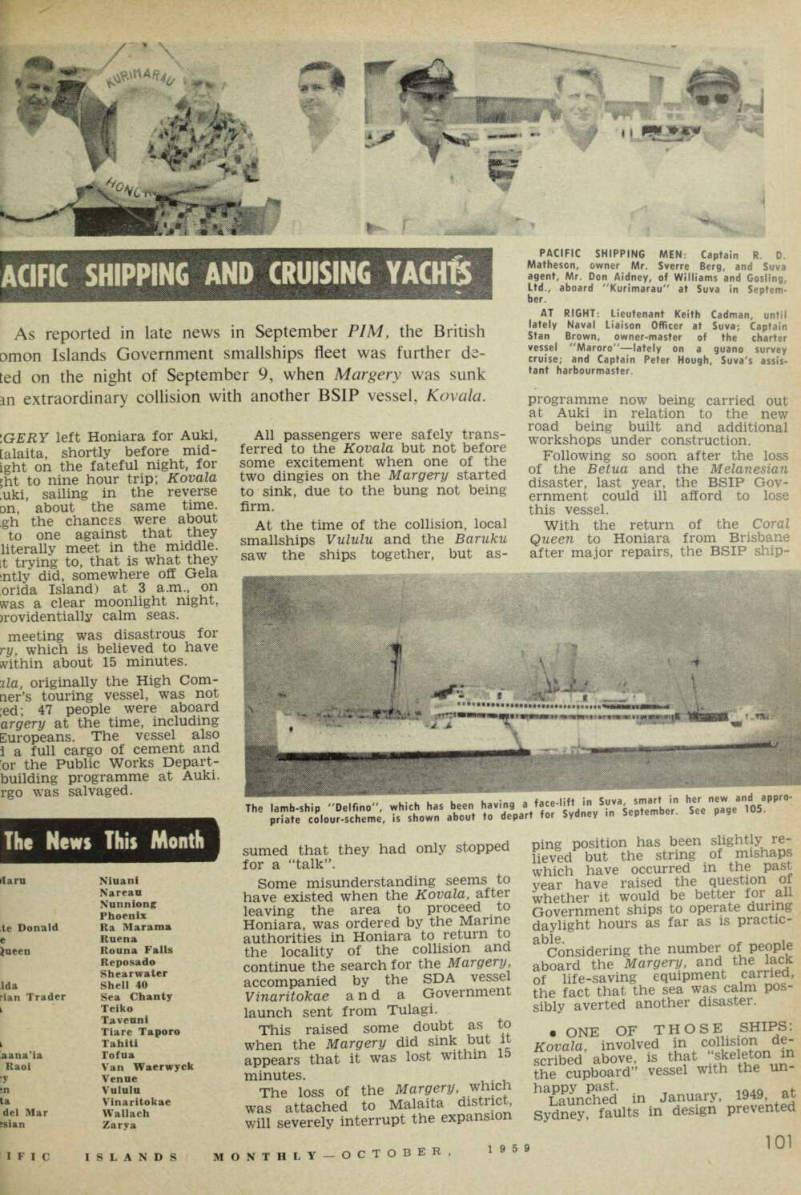
Pacific Shipping Men: Captain R. D.
Matheson, owner Mr. Sverre Berg, and Suva agent, Mr. Don Aidney, of Williams and Gosling, Ltd., aboard "Kurimarau" at Suva in Septem ber.
AT RIGHT: Lieutenant Keith Cadman, until lately Naval Liaison Officer at Suva; Captain Stan Brown, owner-master of the charter vessel "Maroro" —lately on a guano survey cruise; and Captain Peter Hough, Suva's assis tant harbourmaster.
The lamb-ship whieh has beer having a face-lift in Suva, smart in fer new and appro priate colour-scheme, is shown about to depart for Sydney in September. See page 105.
ctually reaching her BSIP iment owners for five years he launching. money laid out on the Fiji iment vessel Ra Marama, is pale into insignificance when red with the funds poured lis 70-ft wooden craft. Since entering service Kovala, until eems to have behaved her irly well. loniara marine inquiry will 3ss affix the blame in the iber incident which resulted rgery going down in a re -13 fathoms.
BSIP Government recently tsed a sister ship to Margery reen —from the GEIC Gov nt. Built about 1945 and ring 60 ft by 16 ft, these M ;raft are about 60 tons gross, is nett, and have a hold ty of 960 cu. ft. They are :d with best NZ kauri.
Othing But The Best:
VLaana’ia is the name of the Dil barge built in Auckland d-September for the Tonga ament. ce Tungi, Tonga’s Premier, i Suva in September that the was a little joke on his part, Tongans will understand.
English it might be translated lean “superior oil”—usually d to a certain fine grade of it oil used for annointing the barge will not be towing that of oil —but the builders in that they wanted a name for aft, though unpowered lighters arges usually are only given a er or some identifying letters, is name seemed as fitting as
There has been a good deal of speculation as to whether the Tonga Government tug Hifofua, with her 500 bhp motor, is going to be equal to the task of towing this barge satisfactorily on ocean voyages, when fully laden. Hifofua was due in Auckland on October 11 to take delivery, so this question may soon be answered.
• Japs And Tongans Agree:
Just as in the case of the two vessels built in Holland for Tonga, a strict tapu against women board ing during construction, or prior to the official Tongan ceremony of commissioning a ship, will also apply to the tuna longliner Teiko, now building at Ujiyamada, Japan.
“I think this is a nice custom,”
Prince Tungi said in Suva recently, “and the Japanese builders under stand and respect it and will strictly enforce it.”
• Joining The Queue: The
GEIC Wholesale Society’s twin screw, 504-ton Moana Raoi, one of the most modern and attractive vessels in the Islands trade today, is due in Suva under Captain L. V.
Rowe early in November for survey.
Captain Rowe will then hand over the command to Captain Vic Ward, who has been on furlough.
• Zarya Is Coming; The 580-
ton, 111-ft Russian non-magnetic schooner Zarya, expected in Pacific waters last year, seems to be head ing this way now. According to
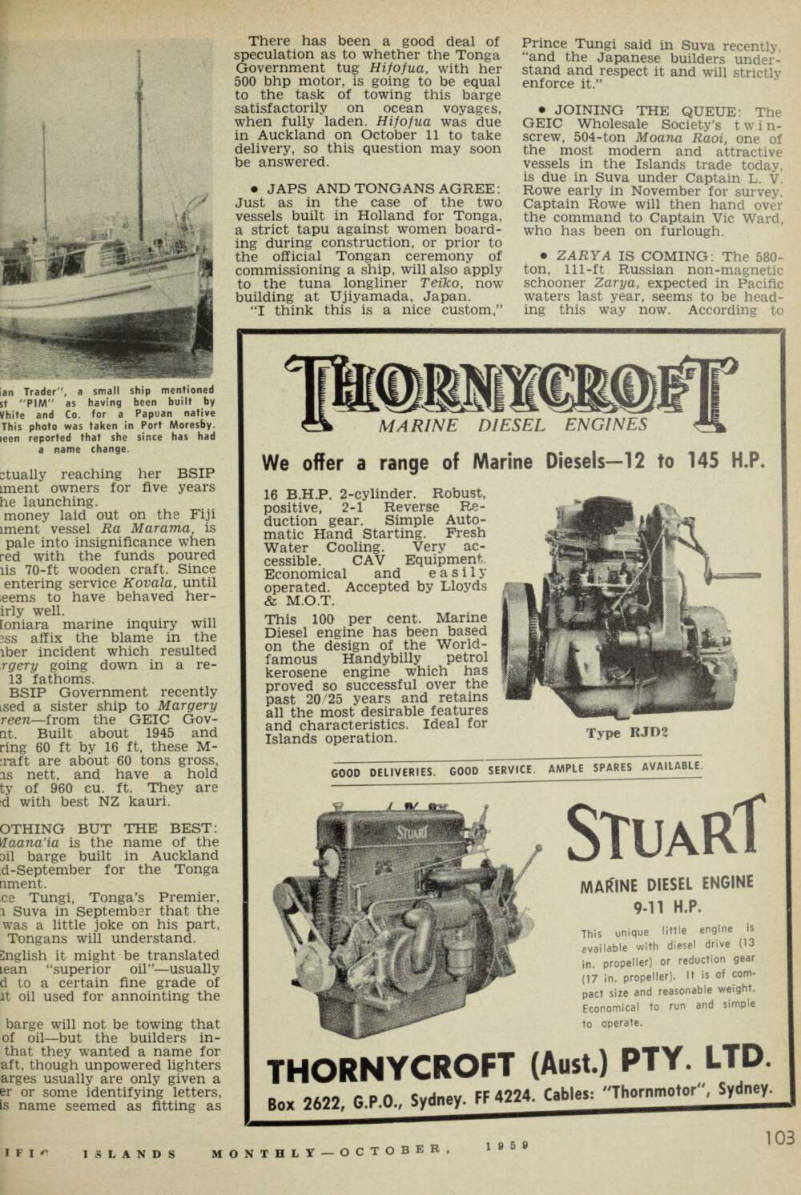
an Trader", a small ship mentioned st "PIM" as having been built by Vhite and Co. for a Papuan native This photo was taken in Port Moresby, teen reported that she since has had a name change.
Radio, the three-masted, ooner sailed from Odessa Black Sea late in July on cement of an extensive ruise. Ports of call are not xcept for Wellington, NZ. built in Finland in 1952, iil area of 7,850 square ft, 5 topsails. She has a jib th four headsails. The 300el auxiliary motor, made if gunmetal and other non ; metals, is used only when y necessary. ear the schooner —believed sizeable non-magnetic sur ;l in the world today—made etic survey cruise in the and Indian Oceans, calling ern Australia. She is fitted ntinuously recording flux gnetometers, which register izontal and vertical com of the earth’s magnetic 1 also the total field, tic declination is continu corded in conjunction with compass which establishes th. In addition, there is a us recording of ocean by a deep-range echo jnetic survey of the Pacific le and Zarya’s work should >e to mariners. During the . aerial magnetic survey of Id, including parts of the was made by American and n organisations.
Sre’S A Long, Long
Captain Arthur Lucas, of 14-ton, lamb-liner Delfino, Suva in September that on ith-bound run from San after delivering the first ' Australian lambs, his ship a trail of 350 tons of sheep
manure across the eastern Pacific toward Hawaii. Worth $5 a 100-lb sackful in United States, it had to be dumped due to quarantine regulations there —b eca u s e the lambs had been fed on Australian fodder and there was a danger of introduction of plant or animal disease.
To capitalise on this by-product of the trade, Captain Lucas said that in future the fodder may be purchased in San Diego. It will then be permissible to land the manure.
After considerably extending the blower and suction fan systems to improve ventilation in the lower and hotter decks, and changing a few crew members in her “home” port, Delfino cleared Suva on September 5 for drydocking in Brisbane and then to take aboard her second load of lambs at Sydney. Strict
quarantine will again apply when the ship calls at Suva, northbound. • GARLIC IS OFF: A consign ment of over 360 crates of Egyptian garlic and a few crates of onions, which had been lying in a Suva wharf shed for a month, while the importers’ lawyers and the Depart ment of Agriculture argued the regulations, was shipped out for Singapore, where it had come from, by Van Waerwyck early September.
The produce was barred due to foot-and-mouth disease danger from Egypt. It was to be dumped at sea by the Department, but some am biguity in the regulations saved it from this fate and permitted the importers to re-export it.
• Another Bottle: A Memory
of that, handsome Chilean naval four-masted training schooner Esmeralda, which called at Papeete and Apia about five years ago came with a bottle found on the windward side of Gau Island in the Fiji Group 50 miles east of Suva early in September.
The bottle, which contained a drift-message form, prepared in Spanish and English by the Chilean Navy, was a demonstration of how not to launch such a message.
The form had been enclosed in a small plastic bag, but if this had ever been sealed it had burst with the heat of the sun. The cork had not been sealed and had partly rotted away to allow water to enter.
The writing on the form was in almost illegible pencil, and part of it had been destroyed.
About all that could be made out with reasonable certainty was the name of the launching ship— Esmeralda and the. launching longitude—l3o degrees west. The date was illegible and the latitude appeared to be either 4 degrees or 40 degrees, but whether north or south was not readable.
There was no knowing how long the bottle had lain on the beach
[?]el Mar", ex-"Kokoda", just before she left Port Moresby to take up her new duties for Captain "Milo" Savoie. See page 114, this issue.
A recent Port Moresby portrait of the light-house tender, "wallach" whose life story was outlined in June and August "PIM's". "Wallach" is the only P-NG tender, adn usually operates out of Samarai, as that is considered about the most cetral of all Territory ports for a job that takes in the whole of P-NG
It may have been launched leralda’s cruise to Tahiti, or e other time. It is believed
he 3,040-ton Spanish-built
;r has made a more recent from Valparaiso to Japan >rth America. But the form ;en returned by the Suva r Master to the address in and some further informa iy eventually be forthcoming.
) Gross On This Lady:
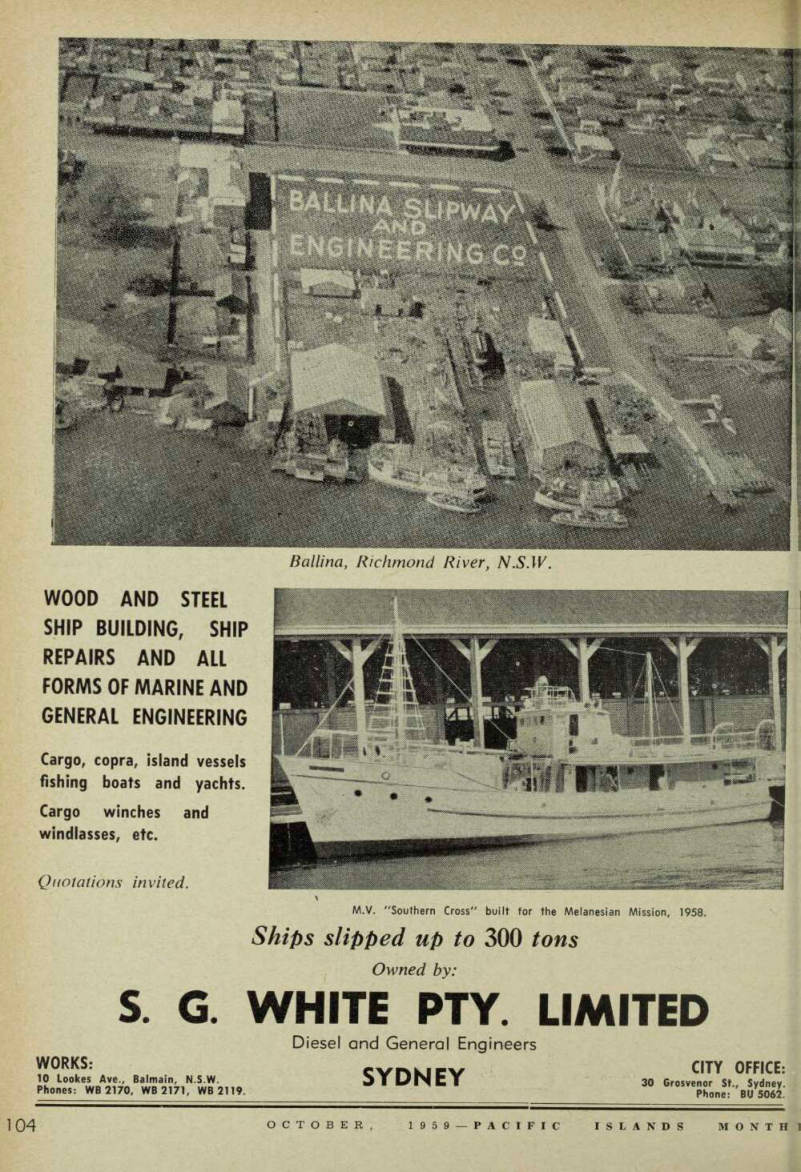
j are a good many un ■ed ships in the Pacific trade but rarely is one vhich does not possess some f documentation giving a for the gross tonnage. The Government vessel Nareau, in Suva for survey, is one vooden hull, built by Ballina t & Engineering Co. in 1950, ved to be a standard naval ype, similar to the former ead Sugar Co. vessel Ruena, traded in the Solomons until sed by the Australian Gov it, converted into the medical craft Indaustral, and given Indian Government for ser the Andaman Islands several go.
Nareau’s superstructure is different to that of the •d GPV. Her nett tonnage is s 79, and Captain W. Farrell, is been her master for most time since she was launched 10 rejoined her at Suva in her after overseas leave, ,es her displacement tonnage and her gross at perhaps 180. vessel came south from i under command of the Superintendent, Captain G. s, with Mr. Willie Poznanski e, and Mr. Titivalu as Chief er. au, which carries a crew of told, is powered by a pair i bhp Crossleys. Work at ; Boatyard, in Suva, included lation of the port engine bed had been giving trouble.
The Ton
-3: Talks on an international ave lately been proceeding in empt to reach agreement on idard method of defining a tonnage and to end the pre onfusion of methods. e port or canal authorities, 3sent, levy charges on one 1 and some on another and andardisation would certainly important repercussions on ‘sign of foreign-going ships, the uninitiated, here are of the better known methods cribing ships: iweight tonnage—the number g tons of cargo that a vessel irry to bring her down to her placement tonnage—the ton
nage of water, at 35 cu. ft to the long ton, displaced by a vessel when fully loaded.
Gross tonnage—the total enclosed space in a ship in cubic feet, divided by 100.
Net tonnage—the gross tonnage less the cubic capacity of the non earning spaces (engine-room, bunk ers, accommodation for crew, etc.) figured at the rate of 100 cu. ft to the ton.
Burden tonnage (now rarely used) —the volume of the cargo spaces in cu. ft divided by 100 and multiplied by 5/3.
Deadweight tonnage—at present almost invariably applied to tankers
only, when describing ships—and displacement tonnage, often applied to passenger liners by their owners and agents who like to use large figures—are the two most useful descriptions. But it is well to re member that a super-tanker with a very big figure after its name may not be any largpr than a passenger liner with a much smaller figure.
• Again In Service: The 304-
ton wooden twin-screw vessel Kulu, sold by BP (NG) Ltd.. Rabaul, to G & M Shipping Service of that port last January, made her first local voyage under the new owner-
July-August. Kulu is one standard Australian-built, ie 300-tonners.
Baul Round-Up: Back
ce from this port is the 52- Venus, out of action for 15 is following grounding at -with a substantial bill still ttled by the unofficial native itive which owns her there.
Government trawler Rouna illowing refit in Rabaul, has i to service in the Sohana, ville, area. Nivani, a similar las taken her place at the berth.
Ouble In Quitting;
Dnth we reported that the g Shell-40 was quitting the When this appears she may risbane, but she was having in quitting in September. , fortnight’s wait for fair , the 61-ton motor tug Suva at 2 p.m. on September □ days later she radioed her for assistance and BP’s de i their 515-ton, Suva-based latanui, under Captain L. W.
n, an experienced towage
mi cleared Suva at 4 p.m. iday afternoon, September up with the tug at mid ind had her back in port i.m. on the Tuesday. The blocked fuel lines, tug had been laid up for nonths and harbour trials en satisfactory, but in the as which were running out edim e n t was apparently up in the tanks and caused t blockages. Following a it, Shell-40 was to again Brisbane via Noumea late ber to begin her new life coal barges on the Brisbane Captain Henry Simpson, of ras in command.
Ill Tidying Up: Though
scrap metal organisations iccessively taken their turn war wrecks which litter ns beaches, there are still recks on offer. y, the BSIP Government has Dnsidering how it can have wrecks below the high-water removed from Western and Solomons beaches, likely customer for the p is a Japanese salvage firm is currently operating round nville, and which has in its intention of surveying jtructions later this year.
LYING A LOOK: A prospec istralian buyer was in Suva -September looking over the uva-built wooden ketch ■a, 128 tons, which has been p and for sale for a long ist.
I in Suva’s Bay of Islands, •year-old Whippy-built vessel en well cared for by a full aretaker staff since her lay
up. The Australian was said to be interested in the ketch as a fishing vessel or mother-ship for fishing operations, presumably in Australian waters. She would require some alterations if the sale eventuated.
• Hard Bargaining; There
was some hard bargaining in Auckland in September as the result of a dispute between the USS Co., owners of the 5,299-ton Islands vpcqpi Tnfvn and the NZ Seamen’s TTnfnn 1 ’ fc>eamen s It centred round a bosun and a seamen which the Chief Officer did not wish to re-engage when the ship signed on a new crew following her annual survey.
Under the system of crew-hiring,
the Union insisted that the men must be accepted. There was a deadlock and it seemed that the ship might be tied up. So that this would not happen the Union agreed that these two men stay ashore for a voyage pending arbi- S io s’ w^ as^ r ’ J 2f p - H* parson, and his Chief D - Woolaston, also
T ? Is T Wi
l a tely of the freighter Waiana, and Mr G R sherlock made the Sep .
v^ ge -
When this was written the case was stlll unsettled,
• The Old Method: When
Asahi Maru No. 7, of the Tenyo Maru No. 3 tuna fleet came in to
’or rudder repairs late in PlM’s roundsman, through rpreter, obtained a good deal Tnation from Fishing Master Sakai, who has been in the s for 20 years, with the last ears in this 95-ton wooden out there was a general ill round at the reply to one questions. > he use this for determin best fishing grounds,” PlM’s nan said to the interpreter au Island student training Central Medical School) g to a large sea-water
thermometer in the chart room.
The reply came back: “No, tell him I use this’*—and Fishing Master Sakai was unsmilingly tapping his head.
Leaving Kesannuma on April 25, Sakai had ordered the navigating master to head for New Zealand waters. The catch there—delivered in successive voyages to the mother ship stationed near Fiji—had been good, he said. During September a large part of the two tuna fleets was operating in those southern waters, and the mother ships had
MEN FOR A TOUGH JOB. —Perhaps only the fittest survive, but there was nothing with the physique of the crew of "Asahi Maru No. 7", a typical tuna longliner, which [?] Suva for rudder repairs at the end of June. The vessel had left Japan on April 25, it for the rudder trouble, would not have touched land again until she arrived back [?]ki in November. Inset left is Fishing Master Fusao Sakai, and right Captain Toshiro Radio operator Fujio Morita, front with camera, was the only man who could speak much English.
[?]ard bound from the Trans-Pacific Race, "Anitra-5" of Sydney called briefly at suva [?]ust, lying alongside the Sydney yacht "New Silver Gull". From left: Magnus Halvorsen, Gowland, Trygve Halvorsen, and Des Ashton of New Guinea, who went on by air from Fiji.
gradually south to about 30 i latitude. use Asahi Maru No. 7 had tected to touch a foreign port
ly port—during her planned
lonths’ cruise, the vessel had ;arance papers. This is itly standard practice with vessels. The ship’s Register, ly required to be surrendered authorities on arrival in a port, was mounted in a ight frame on the deck-head chart room. A letter in from the mother ship fish nager clarified the situation, tuna cargo had been dis i into the mother ship two rior to arrival at Suva, but ssel had many cartons of bait-fish aboard—a variety ish about a foot long, known ry (cololabis saina) —the g of which is an industry of round Japan.
3Hing, Not Teaching:
i Pago correspondent reports e masters of the two Korean based there with the Jap una fleet are more willing to imoans along to teach them la longlining game than are janese masters, possible that there is more space in the Korean ships, vas certainly no visible means ommodating extras in the Maru No. 7 mentioned above. crewmen spend their brief ,rs in a fo’c’s’le Al ft high double deck of bunks. The ( Master and Captain each bunk with a sliding door as in the chart-room. The radio •r, in with his equipment, 2d to be best off of the lot, tiny cabin. One cruise under conditions, disregarding the worked, could be enough for lamoan trainees.
Louble Down Below:
i Hugh Williams’ 135-ton obiri broke her intermediate laft late in August while
bound for Manihiki from Rarotonga, but was able to reach the northern atoll at reduced speed and carry out temporary repairs, before dis charging and returning to Raro tonga minus passengers, under re duced speed.
Meanwhile another Cook Islands vessel, Taveuni —almost a sister ship to Macuata mentioned else where—has been in Papeete for several months past undergoing a major refit. It is believed that a new engine is being installed to re place the existing Crossley model, for which spares are now hard to get.
Captain Andy Thomson, that veteran of the Cook Islands trade, was to take command in September of the old schooner Tiare Taporo. which was returning to the Cl from French Polynesia, where Charlotte Donald has taken her place in the A. B. Donald/Etablisse ments Donald Tahiti services. Cap tain Thomson has been living ashore on his Rarotonga property for several years past—except for occasional trips to Tahiti.
ottr qtjtpo artt ■R’TT'MT'N’TN'Ti''• Two con temporary maritime journals h ave recently raised the question the use of the definite article preceding a ship’s name, and as the comment could apply to this column, it may be timely to explain why the definite article is rejected here, It is true that some 0 f the best respected maritime writers have in the past used the definite article, but it will probably not be denied that for a very long time a ship has been considered as feminine in the English language—whether the name happens to be a feminine one or not - Perhaps, originally, all British
The 34-ft. Port Moresby sloop "Sagitta" (left) was recently completed there after three years of spare time work by a local resident—but unfortunately our PM ocean-yachtsman, S. E.
Bradfield, did not say who the new yacht owner was.
The 96-ft. motor yacht "Reposado" (right) up on the slips at Pago Pago in September.
Owner-skipper Brian Neil, who has his family and a considerable crew on board, exchanged her for his former motor-sailer "Manawanui" some months ago. "Reposado" is now for sale if the right customer comes along. —Pan American Prints.
Crew of the Canadian yacht "Sea Chanty", Photographed in Pago in September. From left to right: Roy Kempel (owner-skipper), Lyle Monk and AI Cherrington. They are making a leisurely way towards towards Sydney. See also picture Page 115. -Pan American Prints.
ship names were feminine. OC count alone we consider it inor to refer to a ship as, for extx “the Alice”. The ship is r Alice —not “the Alice”. It mx reasonable to say “the ship „ but it is certainly not necesa( except in the case of, say, “thri London of London” in a j<t that normally does not e italics or inverted commas foio names, where some confusion i occur.
However, PIM feels—and most shipping men agree— tif it more acceptable not to U!i definite article immediately pq; ing the ship’s name; a lady isu —not “it”, or “the”.
• Another Maria Del ,
Burns Philp (NG) Ltd.’s KS. which was purchased recentr Captain E. Savoie, left f Moresby under her new nair August and is now at her ne —trading around the New He' and to Wallis Island. Captain! re-christened her after one earlier ships (sold to Australiii terests some years ago) an Kokoda becomes the second del Mar.
In Port Moresby before she she had a complete overhir complete paint job and a isation of master’s and other as modation.
This 224 gross tons wooden i was built by Norman Wright,,J bane, in 1946, and since hasj in service for BP’s in P-NG w She is a twin-screw motor equipped with two sets of R's Ruwolt diesels.
News of Cruising Ya«
• BABOON: We have had a letter from L. John Prisch, owner-of this Acapulco schooner, mm briefly in August PIM. He says thri left Acapulco on April 27 and Taiohae Bay, Nukahiva (Marques May 29. After a look in at Tail they reached Tahiti on June 16 ann he wrote on September 17, they t anchor at Tautira Bay. On board cruise, apart from himself, were hi Frances, First Mate and cook; Bill I of Long Beach. California, as na’t George Zimmerman of Laguna Beaus Charles Ehlert, of Illinois.
Skipper John gives some interest!, tails about this venerable schooner the unromantic name: She is ( overall, staysail rigged with a squas on the fore. She is a re-rigged Neo “40” designed by Burgess and M 1888. She has been a fully commin pleasure craft ever since then as had a remarkable racing and < career on both coasts of America, her second cruise to the Pacific—tt to Honolulu in 1935-36 under the cm; of Robert French, a Los Angeles a s Prisch believes that if she is i oldest yacht in commission, she isi close to it. Her present cruise was a plished without auxiliary power kind and was successful in every BABOON will be left in the hann paid crew which will sail her backd States while Mr. and Mrs. Prisch o on to Europe with their four child] more orthodox means. They will bri
ca for some time—but they hope back to the Pacific for more ocean before too long. )ENIX and the Reynolds’ were in > again late August in Honolulu further court case was proceeding lel to the entry of this yacht into shall Is. nuclear-test closed zone, nolds was found guilty of an mder American law as applied to nationals in a Honolulu court, ht an appeal against the sentence Francisco court and won it. The Energy Commission appealed that ruling and the case was re ick to Honolulu. ;ynolds’ feelings on this subject, 7 in relation to freedom of the loubtedly have wide support, but lovernment contends that in these icn it is considered essential that ests be carried out for national -and until such time as some in al control and inspection system ished—it is not too much to ask nationals submit to the restric rnovement involved. Dr. Reynolds ver, also basing his defence on it the tests are polluting the seas abited non-American territories, ter evidence was ruled as inad by Judge John R. Ross who heard it case. The result of this case known at time of going to press.
HTTI of Honolulu with Lorin ,nd New Zealand crewman Peter board, arrived at Rarotonga from late August. Smith and TAHITI •emaining there indefinitely, as a igineer at the local motor garage accepted. lEARWATER of Brisbane with Nettleton and Teilen, moved off ira September 9, bound Nukualofa, Raoul Island, thence northern NZ d home.
INIONG, the big motor cruiser re i August as at Port Moresby, was slip in Rabaul a little later for painting. Our Rabaul corres gives the owner’s name as Kard. rt Moresby reported it as Ezzard. the owner will clarify. [MERE of Sette, France, last re orthbound from Tarawa, called at Guam, and arrived Yokohama In September, Tarawa residents word from Jean and Suzanne then at Singapore, that the yacht ioon be headed back for the A most unorthodox cruise—both and season.
[?]anty", en route for Sydney. See picture page 113.