Hope, (Says a Golfer)
pp. 89-101 · Read in the full issue

While There’s Golf There’s Hope, (Says a Golfer)
By A. D. Blue
New Guinea is a country of paradox and surprise, says Mr. A. D. ie, chief engineer of the MS “Chengtu”, who contributes the follow r views on that big Territory. It was an unpleasant shock for him find, he says, that the natives are playing such an insignificant rt in their country’s affairs . . . even allowing for their extreme zkwardness they are not being used to their full. This state of ngs, he says, is a sad reflection on the Administration. However, could be worse, says Mr. Blue, who spent 18 years in Nigeria, ere is one aspect of life in New Guinea which is surprisingly good, d that is the state of golf . . .
There are people in the world who would relate a country’s ace in the world to the consumption of electricity per head population. By this standard New Guinea would come pretty w down the list. I prefer to judge by the state of a country’s )lf courses and the standard of their golf, and by this yard ick, New Guinea ranks surprisingly high.
TER having played golf in nost parts of Nigeria it was a Peasant surprise to find New ea courses so well laid out and tained. nsidering all the difficulties sed by tropical conditions and in, New Guinea’s courses are a ; credit to all concerned. They greatly superior to any in ria, or in British West Africa whole, where sand greens are srsal. en the Ikoyi course at Lagos, ably the oldest and most popu in West Africa, has putting ices of sand treated with oil. r these it was an especial >ure to putt on the well-kept 3 greens of New Guinea, far I have only played on the tal courses of Papua and New lea Lae, Madang, Port *sby, and Rabaul —and only v the Highlands courses by say. I am, however, looking ard to experiencing Highland at Goroka and Wau in the re with keen anticipation, re of Nigeria’s most sporting ses is at Buea, a little over > feet up the Cameroons ntain. Here the superb views, :ing over miles of banana and Dalm plantations to the Bay of ra, and the invigorating atmos •e, are memories which will re ti with me for a long time. *om all accounts golf in the fiands of New Guinea must be r similar to golf on the leroons Mountain.
"Grossly Neglected"
yen in golf, however, I found r Guinea’s manpower grossly lected. One of the pleasures flaying golf in tropical countries
is that in most of them caddies are available for a modest shilling or two per round, whereas in Britain or Australia only the very wealthy can afford them.
Only at Port Moresby did I find the employment of caddies usual, although I noticed that at Lae some of the players used their house boys as caddies. Surely, local youths could be found for this pleasant chore, and since golf is played mainly at week-ends and in the evenings, it would not interfere with their schooling.
This, to my mind is the greatest example of the non-utilisation of native skills in New Guinea. I can think of no association between the native peoples and the Europeans likely to be more beneficial to both than that between golfer and caddie. Some of the greatest men in the world started life as caddies —James Braid, J. H. Taylor, and
Andrew Kircaldy, to mention just a few.
This lack of caddies is one aspect of the game in which New Guinea lags behind Fiji—in fact, it is the only aspect. Whereas I was pleasantly surprised at the stan dard of golf and golf-courses in New Guinea, where I understand the game is a postwar creation, it was just the opposite in Fiji.
In Suva especially, I expected to find a really good course of 18 holes. I found instead a nine hole course, which although well main tained, was not un to the standard of either Lae, Madang, or Rabaul.
Lautoka—the only other course in Fiji on which I have played— has certainly a fine layout, being
(Continued on page 99)
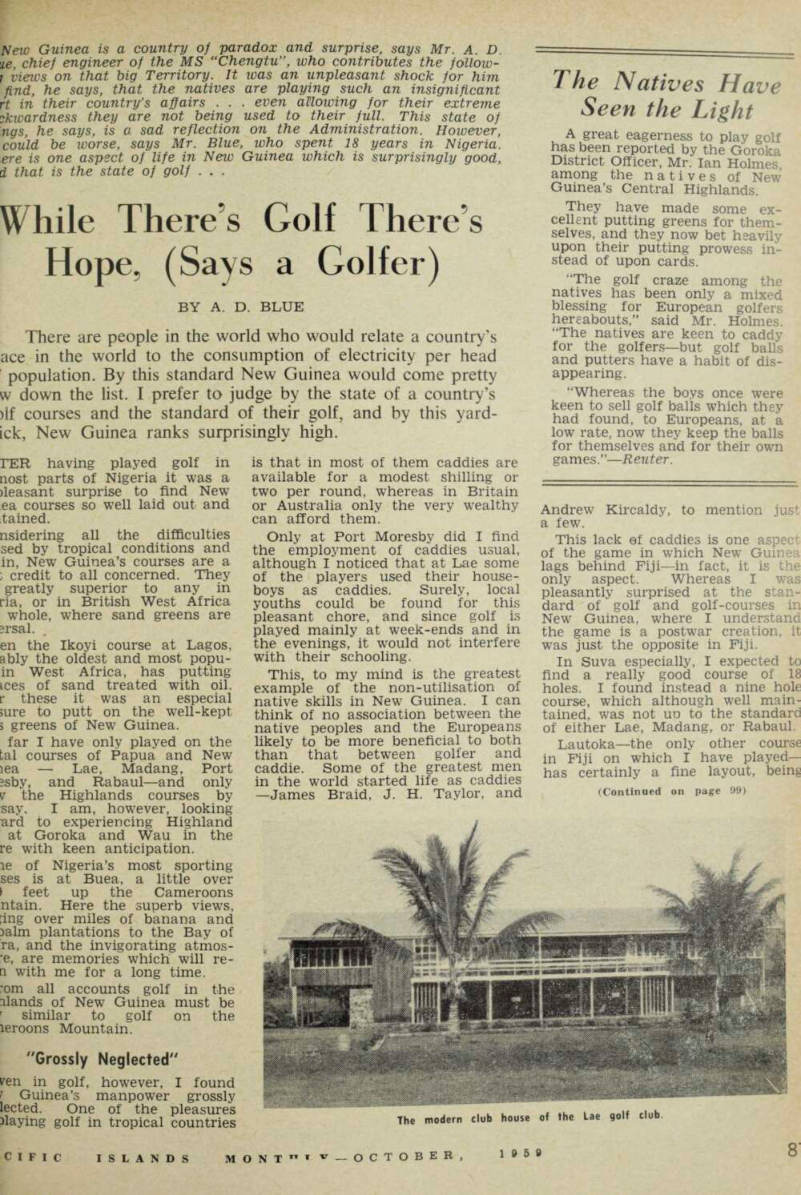
The modern club house of the Lae golf club.
most desirable building sites. Not only do golfers demand—and usually obtain lush meadows, gently rolling hills, and attractively tree-lined fairways, but also long distance views of sea, river, or mountain range.
New Guinea’s golf course archi tects have made the most of their opportunities in this respect, and all the courses are in pleasant sur roundings. Even at Port Moresby —where local terrain and conditions are against them—something credit able has been achieved.
Unimpressed by Threesomes
The prevalence of threesomes, which seemed especially rapid in Lae and Madang, was one aspect of golf in New Guinea which did not impress me favourably.
The only possible recommenda tion for this form of play is to enable as many players as possible to enjoy the game. I think this objective could be attained by using alternative tees during the peak periods.
Perhaps my tastes are old fashioned, but to my mind a three some is not nearly so enjoyable as either a singles or a foursome, and from the point of view of enabling as many people as possible to enjoy the game what can beat the old fashioned foursome?
It is in no carping spirit that I describe the club house facilities of the New Guinea courses as being on the Spartan side.
They are, however, little if any inferior to the two Fiji courses on which I have played—Suva and
Lautoka; and considering that New Guinea’s courses are all of postwar creation the people are to be congratulated on what has been achieved in a few years.
New Guinea’s golfers have very wisely concentrated their resources on the courses themselves, leaving club house facilities to be improved as funds permit. In the present healthy state of the game this time is not far away.
There are, however, two little amenities lacking in most of New Guinea’s golf club houses, which could be provided at very little cost.
These are a copy of the Golfers’
Year Book, and one or two sets of dice. In my opinion these are a “must” for a club house.
Without the former, how can arguments on the history of the game and on the exploits of past and present-day giants be settled without recourse to bloodshed?
Let me recommend to all golf club committees in New Guinea that they subscribe to this in valuable publication, and also that they ensure that particulars of their own courses are included in the next edition. In this connection I would also suggest that much more adequate mention of golf and golf facilities in books such as the Papua and New Guinea Handbook and the Pacific Islands Year Book is necessary.
Given these additional amenities there is no doubt that golf has a bright future in Papua and New Guinea, although it may be premature to prophesy early participation in either the Canada Cup or the Eisenhower Trophy.