The Happy Timing Of
pp. 87-88 · Read in the full issue
How The Bible Reached Samoa
The Happy Timing Of John Williams
By R. W. Robson
It was not very late in the night of August 29, 1830. But lights were out on the tiny missionary schooner Messenger Peace (hand-built by Rev. John Williams in Rarotonga); d the two LMS pioneers, Williams and Barff, were asleep.
; little ship rocked gently on le quiet waters of the lagoon, pposite Sapapalia village, in •n Savaii, Samoa. ! missionaries were tired after strenuous days ashore at the luarters of Malietoa Vaiinupo, about to become paramount if Samoa. There had been long with Malietoa and his brother lelangi; and eight Tongan and Islands “teachers”, with their had been established in s ashore—the very first people ;roduce Christianity in Samoa, i two pioneers had earned their repose on the little Messenger.
Samoans called it “the pray hip”) idenly there arose a clamour was neither godly nor holy, hn! John! Help me, John! I >eset by devils!” It was the voice of the Rev. Josiah Barff. its came on. There was an out-
cry among the Polynesian crewmen.
Williams hurried from his tiny cabin with a candle.
Then shrieks turned to laughter.
Big-chested John Williams literally roared. Next day, he told it all in his diary.
How And Why He Was Beset There were vampire bats in that end of Savaii. The missionaries, in trigued, captured a half-dozen for study, and hung them by their hind claws to a cord in the main cabin.
When lights were out, and all quiet, the bats proceeded to explore.
One fell into a barrel of treacle, and crawled out, unable to fly.
The other bats liked the sweet taste of him. They fell upon him en masse, and unitedly licked him.
The entreacled bat, very resentful, tried to escape; and a mass of bats, fighting and licking, tumbled into Barff’s cabin, and into the beet of the quietly-sleeping missionary.
Nothing in Barff’s experience had prepared him for this.
The bats were all over him. One, making queer noises, and sticky, became entangled with his beard. He seized it, and it bitjhirn, painfully. He could see nothing—it was pitch dark.
The South Seas were then un
charted and unknown. A man never knew what he would meet up with next, in those strange lands.
Unquestionably, this was an in cursion of small devils.
The Rev. Barff lifted his voice and howled for aid.
Lights came and showed the en treacled bat now in a corner, fight ing furiously, but still being licked.
Barff and his bed were covered with trc^clG The Rev. Williams, a very human lovable man, laughed until the tears ran down his face. * * * As I stood on a bluff above Sapa palia, and tried to visualise the spot where Messenger of Peace had anchored, almost exactly 128 years before, I remembered the incident as told by Rev. J. J. Ellis and Williams.
Williams's Arrival: Perfect Timing
Not far away, in the village square, I could see the huge monu ment which bears testimony to the LMS achievement m bringing Christianity so early to this lovely ar wimams° had been Angularly lucky, and his timing was perfect A particularly vicious specimen of
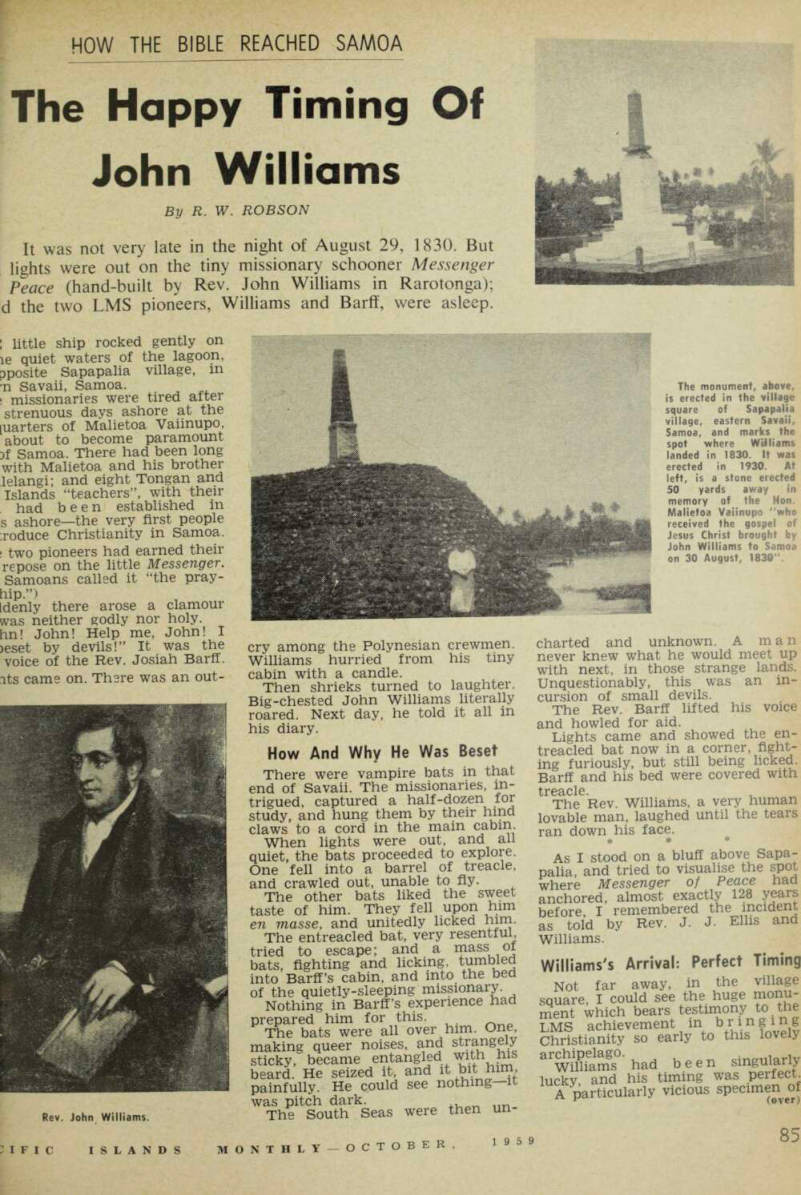
Rev. John Williams.
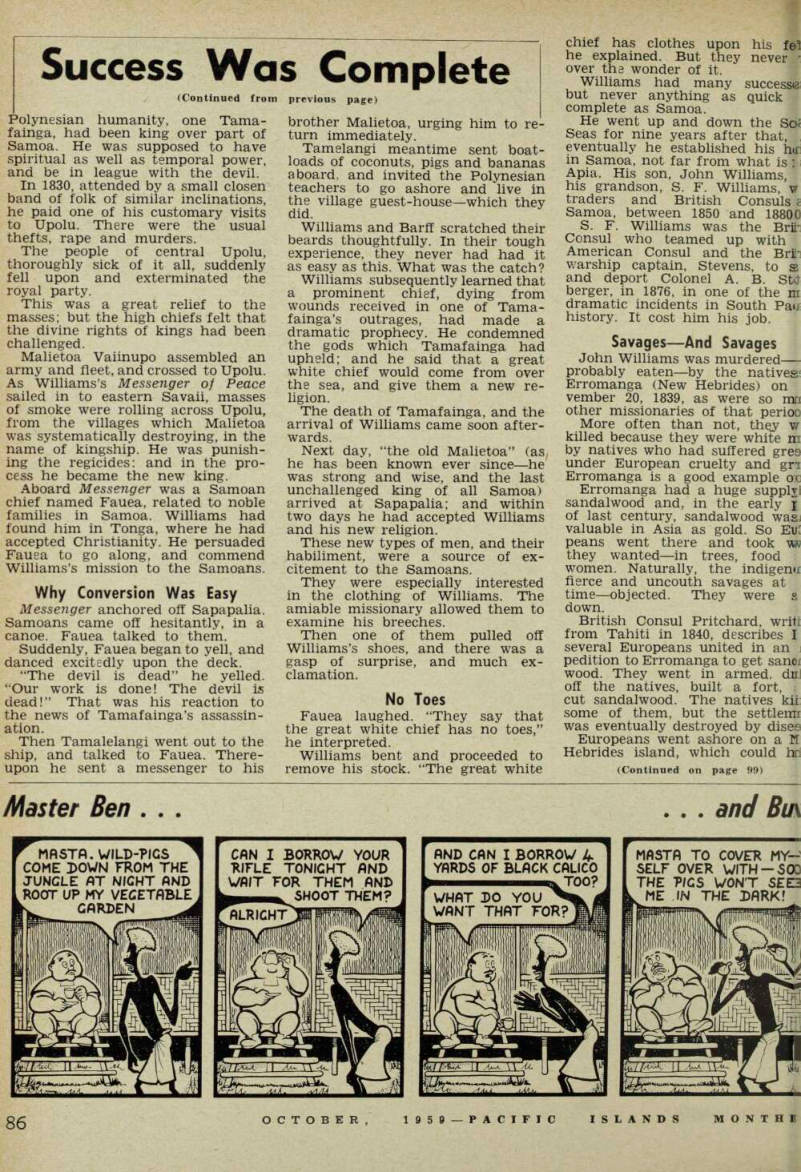
The monument, above, is erected in the village square of Sapapalia village, eastern Savaii, Samoa, and marks the spot where Williams landed in 1830. It was erected in 1930. At left, is a stone erected 50 yards away in memory of the Hon.
Malietoa Vaiinupo "who received the gospel of Jesus Christ brought by John Williams to Samoa on 30 August, 1830".
Polynesian humanity, one Tama fainga, had been king over part of Samoa. He was supposed to have spiritual as well as temporal power, and be in league with the devil.
In 1830, attended by a small closen band of folk of similar inclinations, he paid one of his customary visits to Upolu. There were the usual thefts, rape and murders.
The people of central Upolu, thoroughly sick of it all, suddenly fell upon and exterminated the royal party.
This was a great relief to the masses: but the high chiefs felt that the divine rights of kings had been challenged.
Malietoa Vaiinupo assembled an army and fleet, and crossed to Upolu.
As Williams’s Messenger of Peace sailed in to eastern Savaii, masses of smoke were rolling across Upolu, from the villages which Malietoa was systematically destroying, in the name of kingship. He was punish ing the regicides: and in the pro cess he became the new king.
Aboard Messenger was a Samoan chief named Fauea, related to noble families in Samoa. Williams had found him in Tonga, where he had accepted Christianity. He persuaded Fauea to go along, and commend Williams’s mission to the Samoans.
Why Conversion Was Easy
Messenger anchored off Sapapalia.
Samoans came off hesitantly, in a canoe. Fauea talked to them.
Suddenly, Fauea began to yell, and danced excitedly upon the deck.
“The devil is dead” he yelled.
“Our work is done! The devil is dead!” That was his reaction to the news of Tamafainga’s assassin ation.
Then Tamalelangi went out to the ship, and talked to Fauea. There upon he sent a messenger to his
brother Malietoa, urging him to re turn immediately.
Tamelangi meantime sent boat loads of coconuts, pigs and bananas aboard, and invited the Polynesian teachers to go ashore and live in the village guest-house—which they did.
Williams and Barff scratched their beards thoughtfully. In their tough experience, they never had had it as easy as this. What was the catch?
Williams subsequently learned that a prominent chief, dying from wounds received in one of Tama fainga’s outrages, had made a dramatic prophecy. He condemned the gods which Tamafainga had upheld: and he said that a great white chief would come from over the sea, and give them a new re ligion.
The death of Tamafainga, and the arrival of Williams came soon after wards.
Next day, “the old Malietoa” (as he has been known ever since—he was strong and wise, and the last unchallenged king of all Samoa) arrived at Sapapalia; and within two days he had accepted Williams and his new religion.
These new types of men, and their habiliment, were a source of ex citement to the Samoans.
They were especially interested in the clothing of Williams. The amiable missionary allowed them to examine his breeches.
Then one of them pulled off Williams’s shoes, and there was a gasp of surprise, and much ex clamation.
No Toes Fauea laughed. “They say that the great white chief has no toes,” he interpreted.
Williams bent and proceeded to remove his stock. “The great white
chief has clothes upon his fel he explained. But they never • over ths wonder of it.
Williams had many success® but never anything as quick complete as Samoa.
He went up and down the Soi Seas for nine years after that, eventually he established his h.r in Samoa, not far from what is j Apia. His son, John Williams, his grandson, S. F. Williams, w traders and British Consuls k Samoa, between 1850 and 18800 S. F. Williams was the Brii Consul who teamed up with American Consul and the Brii' warship captain, Stevens, to s and deport Colonel A. B. SM berger, in 1876, in one of the m dramatic incidents in South Pau history. It cost him his job.
Savages—And Savages
John Williams was murdered— probably eaten—by the natives: Erromanga (New Hebrides) on vember 20, 1839, as were so mn other missionaries of that perioc More often than not, thqy w killed because they were white m by natives who had suffered gres under European cruelty and gn Erromanga is a good example o:c Erromanga had a huge supply i sandalwood and, in the early i of last century, sandalwood was valuable in Asia as gold. So Eu; peans went there and took m they wanted—in trees, food ; women. Naturally, the indigenu fierce and uncouth savages at time—objected. They were s down.
British Consul Pritchard, writ! from Tahiti in 1840, describes I several Europeans united in an pedition to Erromanga to get sanoi wood. They went in armed, dn off the natives, built a fort, : cut sandalwood. The natives kii some of them, but the settlerrn was eventually destroyed by dises Europeans went ashore on a PI Hebrides island, which could hr.
(Continued on page 99)
Master Ben . . .
. . . and Bu[?]