Selling Fiji Bananas
pp. 65-67 · Read in the full issue
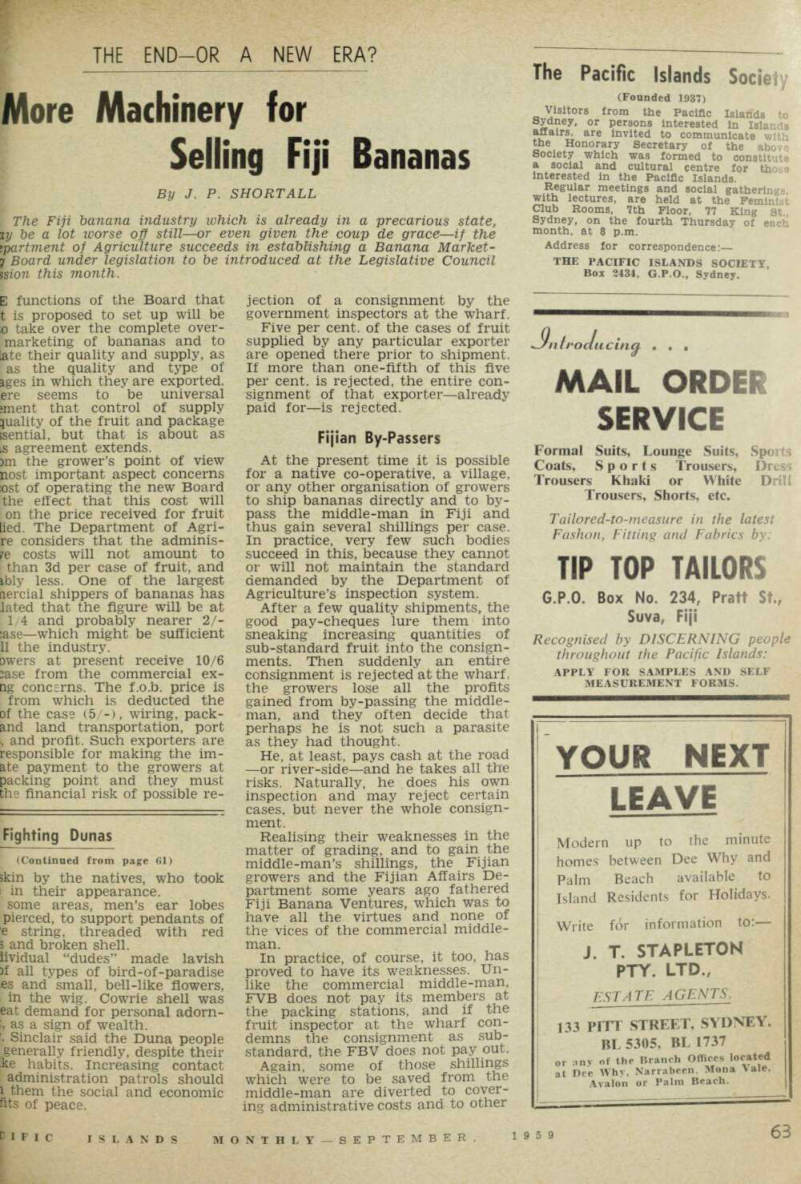


The End-Or A New Era?
More Machinery for Selling Fiji Bananas
By J. P. Shortall
. The Fiji banana industry which is already in a precarious state, jy be a lot worse off still —or even given the coup de grace—if the •partment of Agriculture succeeds in establishing a Banana Market -7 Board under legislation to be introduced at the Legislative Council ision this month.
E functions of the Board that t is proposed to set up will be o take over the complete over marketing of bananas and to late their quality and supply, as as the quality and type of ages in which they are exported, ere seems to be universal ;ment that control of supply quality of the fruit and package isential, but that is about as is agreement extends. )m the grower’s point of view nost important aspect concerns ost of operating the new Board the effect that this cost will on the price received for fruit lied. The Department of Agri re considers that the adminis ie costs will not amount to than 3d per case of fruit, and ibly less. One of the largest lercial shippers of bananas has lated that the figure will be at 1/4 and probably nearer 2/- :ase—which might be sufficient 11 the industry. owers at present receive 10/6 :ase from the commercial ex ng concerns. The f.o.b. price is from which is deducted the of the case (5/-), wiring, pack and land transportation, port and profit. Such exporters are responsible for making the im ate payment to the growers at packing point and they must the financial risk of possible re
jection of a consignment by the government inspectors at the wharf.
Five per cent, of the cases of fruit supplied by any particular exporter are opened there prior to shipment.
If more than one-fifth of this five per cent, is rejected, the entire con signment of that exporter—already paid for—is rejected.
Fijian By-Passers
At the present time it is possible for a native co-operative, a village, or any other organisation of growers to ship bananas directly and to by pass the middle-man in Fiji and thus gain several shillings per case.
In practice, very few such bodies succeed in this, because they cannot or will not maintain the standard demanded by the Department of Agriculture’s inspection system.
After a few quality shipments, the good pay-cheques lure them into sneaking increasing quantities of sub-standard fruit into the consign ments. Then suddenly an entire consignment is rejected at the wharf, the growers lose all the profits gained from by-passing the middle man, and they often decide that perhaps he is not such a parasite as they had thought.
He, at least, pays cash at the road —or river-side —and he takes all the risks. Naturally, he does his own inspection and may reject certain cases, but never the whole consign ment.
Realising their weaknesses in the matter of grading, and to gain the middle-man’s shillings, the Fijian growers and the Fijian Affairs De partment some years ago fathered Fiji Banana Ventures, which was to have all the virtues and none of the vices of the commercial middle man.
In practice, of course, it too, has proved to have its weaknesses. Un like the commercial middle-man, FVB does not pay its members at the packing stations, and if the fruit inspector at the wharf con demns the consignment as sub standard, the FBV does not pay out.
Again, some of those shillings which were to be saved from the middle-man are diverted to cover ing administrative costs and to other
y causes for the betterment of
Ijians.
for a lot of Fijian growers, is no better—or not much— the middle-man, who pays less but pays it on the nail.
I, the lure of those shillings ns. and under its magnetic pull I little ventures and co rves continue to by-pass both ind the middle-man. In so do tiy hurt themselves and the ;ry as they learn the hard way ;he overseas buyers are insist a certain standards and that ji Department of Agriculture’s tion branch is determined to at these are met for the good ! industry.
ndividualism Encouraged
first sight it seems extra iry that the Fiji Government, I sired FBV for the good of ijian growers, should permit s to by-pass this organisation reasing numbers. The explana irobably is that the govern wishes to encourage Fijian iuality and initiative and a-exporting co-operatives are ered part of it. nwhile, there is no doubt at at the small shippers are re f the revenue both of FBV f the very few surviving com il exporters. exporters are licensed to buy as in strictly specified areas, ich establishes a bond of £lOO security against infringement, existing out-dated ordinance, the basis of this license they ; to handle all non-FBV con ents within their separate Now they see the co-operatives sutures” that keep springing mply as infringing their is, although the law makes no ion for protecting them, er the proposed legislation, the la Board will be the sole ex , and the middle-men will be id to the status of licensed 5 and, in effect, agents of the replace the middle-man’s per supervision at the packing ’» the new legislation proposes [-arm methods of remote con rhese include seizure of sub ird fruit and containers, fines to £5OO for attempts to by the Board, and the appoint of inspectors with very wide s. 1 FBV is still to continue, Jgh it may be considered that I vanish when Fijian growers ' progressed sufficiently to e their own business. Still, it 'd at this stage to understand me functions of the proposed i and the FBV could not be ■ned in a single body to save ustrative costs. 5 Proposed Banana Marketing will consist of a chairman and members, all appointed by the nor. Three of the members will
represent the interests of “supoffice ’ “duHng ll the “g o v
Slealure" Anneal a?ainst itl de-
cisions regarding quotas, etc. will be only to the Governor.
High Cost of Boards With a quota of 200,000 cases of bananas per annum acceptable by New Zealand, the cost of operating this Board, according to the government’s estimation—based on the 3d per case mentioned earlier — is £3,000. The existing inspection system—without a Board—at the Suva wharf costs about £4.000 per annum to operate.
An outside estimate of the cost
of operating the proposed Board conservativel y ** at about £l3*oo per , a nnu m. The manager alone
furlough costs' ! alar;
minimum of staff and opeSg costs would absorb the balance. This sum would represent about 1/4 per case - Even if a portion of this cost is to come from some existing reserve fund or other government source it is going to cost the taxpayer money.
But if it is eoimr to comp from the proceeds of the sale of bananas, this added burden could ring the death knell of the Fiji banana in dustry.