Csr Co.’S Grave
pp. 55-57 · Read in the full issue


Doubts About Sugar's Future
Warning To Fiji
In a very frank statement, published by the Colonial Sugar Refining Co., Ltd., in The Fiji Times of July 17—after its officers had had a confidential discussion on finance with the Fiji Board of Wages Inquiry —the company virtually gave notice that its situation in Fiji might, in certain circumstances, come under grave review.
“T N the light of recent ( trading ) JL results, and the prospects for the future, the company is becoming increasingly anxious about the extent to which ... it will be justified in devoting its .. . resources to Fiji . . .
"In the face of the unsatisfactory market prospects for sugar , the high price of cane, and the high price of operating the mills, it can hold (to say the least ) no optimistic view.”
The Board of Wages Inquiry, set up by the Government of Fiji under the presidency of Mr. Honeyman, a London barrister, to examine the sugar industry in Fiji, and par ticularly sugar-industry wage-rates, heard much evidence in June and July. x .
The basic hourly wage rate for sugar-mill labourers, up to this time, was 1/5. The Board was expected to announce its finding on the claim for a higher rate, on August I—see1 —see elsewhere in this issue.
The CSR Co.’s statement was made by its Fiji manager, Mr. L.
M. Sherwood, and it occupied 62 newspaper columns. It traversed the sugar unions’ claims before the Board; and the following is the section dealing with the general situation:
Board Shown Finances
“At the request of the Board the Company presented, in con fidential session, financial data relating to its operations in Fiji.
I have the authority of Dr. J.
Vernon (the general manager of the CSR Co. Ltd.) to make the following statement.
“This is based upon the financial data confidentially tendered (to the Wages Board) and upon the general manager’s view of the company’s Fiji business, but it is not advanced as a plea of inability to pay wage rates that are proper in the context of Fij’i.
“(a) In neither of the last two vears (the first of which was the year of abnormally high sugar pnce and of satisfactory production level) was the rate of profit on the (Over
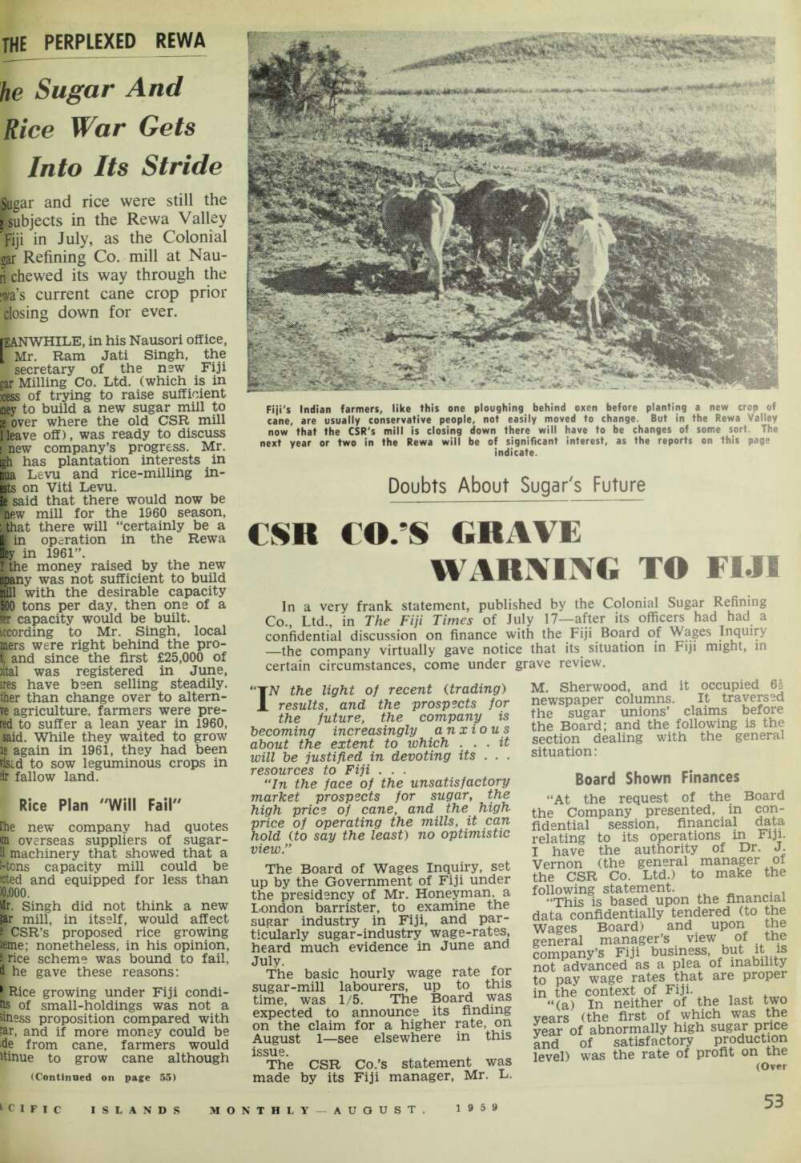
Fiji's Indian farmers, like this one ploughing behind oxen before planting a new crop of cane, are usually conservative people, not easily moved to change. But in the Rewa Valley now that the CSR's mill is closing down there will have to be changes of some sort The next year or two in the Rewa will be of significant interest, as the reports on this page indicate.
, of the company’s assets in ln fact it did not t the interest rate paid on raised by the Fiji Govern in recent years and this rate low bank rate. >th the Government loan rate H and the bank rate are below Interest rate ruling in Aus fand therefore the result of jusiness in Fiji compares very lourably with the rate of est and profit looked for by Investors for commercial in icnt
rUnsatisfactory Profit"
The company therefore re- I its recent profit in Fiji as fcfactory; and states that its iects for profit in the future not regarded as adequate to I the further and continued il investment that will be Ible for the progress of the in l le company has been provid- Ilarge flow of capital for its pterprise in recent years and bunched certain capital pro fmost of which will be com 1. it the company may not be to keep on committing capital ji (desirable though it may be 'the point of view of the in j and of the Colony) because jrospects of such capital re ig its real value and providing late returns are not apparent, higher the cost level in Fiji ower become the attractions pital and the justification for ■ovision.
"No Optimistic View" ) In the light of recent results the prospects for the future, ompany is becoming increas anxious about the extent to I in view of its responsibility areholders and in other direc it will be justified in devoting nancial, managerial, adminis e, technological and other re bs to Fiji. le company adds that in recent it has closed down its pine enterprise and is now in the ss of closing down Nausori IMill. It had expected by these and by expanding production I other Mills, in place of the jatisfactory cane growing and k area on the Rewa, to ‘tidy nd consolidate its position, hopes that this will be the [but, in face of the unsatis p market prospects for sugar, igh price of cane and the high of operating the Mills, it can (to say the very least) no listic view. ie company makes this state with great regret; because it een established in Fiji for over sars, has deep roots and at aents there, and has tried not only to discharge its vari
cus responsibilities, but to foster the development of the Colony.
“The company also makes this statement after due consideration and with a full understanding of its gravity, but nevertheless as its con sidered judgment of the position.
“This view, of course, does not mean that the company is making any precipitate decision, or intends to cease trying to find ways to be constructive in Fiji.” > \ An engagement of interest an nounced in June was Miss Marie Reid, of Macksville, NSW, and Mr.
Evan Cleland, son of the Admin istrator of P-NG, Brigadier D. M.
Cleland, and Mrs. Cleland.