Rice War Gets
pp. 55-59 · Read in the full issue
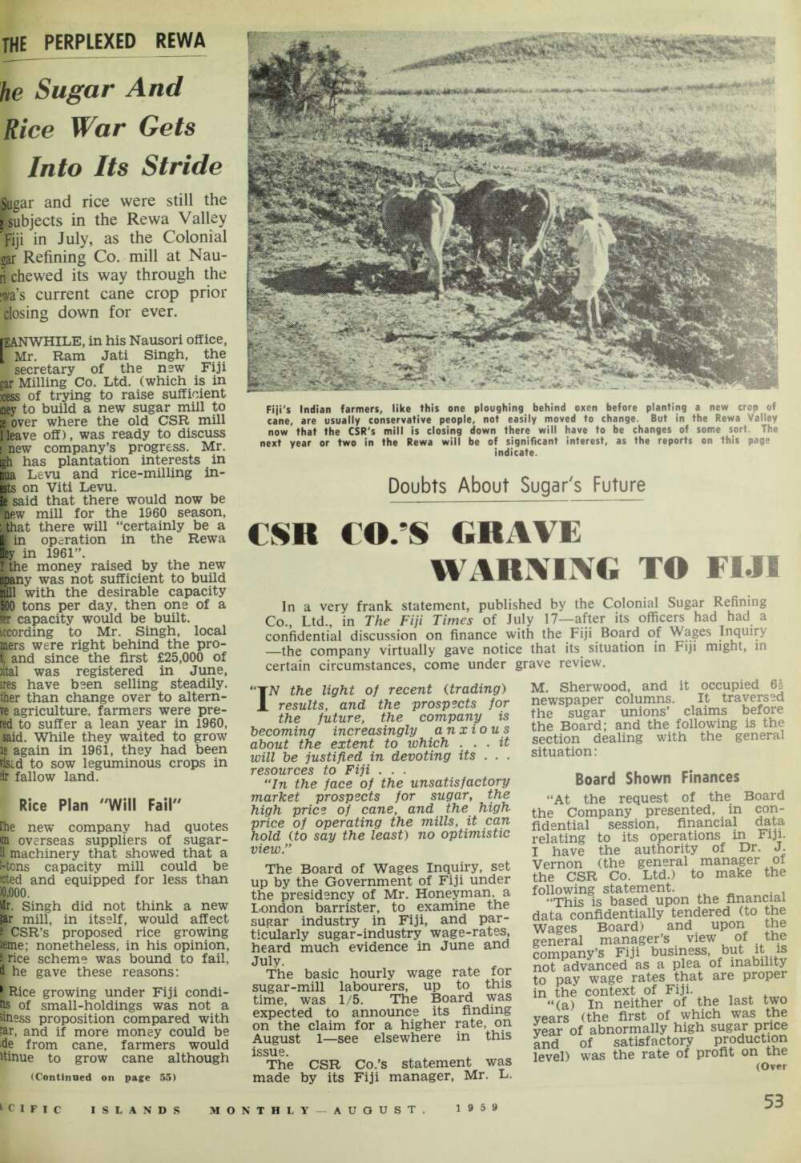


The Perplexed Rewa
[?]he Sugar And Rice War Gets Into Its Stride
Jugar and rice were still the [subjects in the Rewa Valley
Fiji in July, as the Colonial
gar Refining Co. mill at Kau
ri chewed its way through the
;wa’s current cane crop prior closing down for ever. [EANWHILE, in his Nausori office, I Mr. Ram Jati Singh, the secretary of the new Fiji gar Milling Co. Ltd. (which is in ms of trying to raise sufficient ney to build a new sugar mill to * over where the old CSR mill I leave off), was ready to discuss I new company’s progress. Mr. igh has plantation interests in Qua Levu and rice-milling in ests on Viti Levu. e said that there would now be iiew mill for the 1960 season, ; that there will “certainly be a in operation in the Rewa By in 1961”.
Fthe money raised by the new apany was not sufficient to build nill with the desirable capacity 500 tons per day, then one of a ser capacity would be built, iccording to Mr. Singh, local mers were right behind the pro- IT and since the first £25,000 of Jital was registered in June, ires have been selling steadily, ther than change over to altern ?e agriculture, farmers were pre red to suffer a lean year in 1960, said. While they waited to grow le again in 1961, they had been fiscd to sow leguminous crops in sir fallow land.
Rice Plan "Will Fail"
Ohe new company had quotes «n overseas suppliers of sugar- II machinery that showed that a l-tons capacity mill could be «ted and equipped for less than 10,000.
Hr, Singh did not think a new jar mill, in itself, would affect r CSR’s proposed rice growing ieme; nonetheless, in his opinion, I rice scheme was bound to fail, d he gave these reasons; [Rice growing under Fiji condi &s of small-holdings was not a siness proposition compared with far, and if more money could be ■de from cane, farmers would itinue to grow cane although
(Continued on page 55)
many would continue also to grow some rice for their own use and to sell the surplus. • The CSR’s announced buying price for padi at £3O per ton was ‘completely unrealistic”; most rice farmers would have no trouble in obtaining £35 to £4O per ton from alternative buyers, on present in dications. • Although there will be a pro tective tariff on imported rice from January 1, 1960, there will be no internal protection for the CSR scheme, and as the CSR is handing
its Rewa holdings to the Gov lent in exchange for other land he dry side of the island, the rice mill will have to depend •ely on rice produced by in ndent growers who will sell to aest market.
lo Rice Industry to Protect
Fiji, in July, rice consumers the Government were mani ng a certain amount of concern it the whole situation, lere was general criticism of the that the Government had de- Ito protect rice from January 1, , when, in fact, there would be no industry to protect. This f (so say the critics) should ;ome into force until six months , by which time it will be clear her the CSR rice scheme is f to come to fruition or not, when it will be possible to see her there is sufficient local rice icet all requirements, ich will depend on what hap in the next few months to the of the year, when rice planting Id be in full swing, did not appear certain in July the CSR would go on with its scheme: According to state s made publicly by the com \ it apparently matters very to the CSR whether it goes rice milling on the Rewa, or right out; and, according to Ram Jati Singh, it doesn’t er to the Rewa farmers either. r , according to him, are deter d to grow cane. ernment Does The Worrying the same time, there are a f people still unconvinced that Fiji Sugar Milling Co.’s plans come to anything—and that's irry for the Government, the sugar-mill plan falls igh, or a mill is established and ;s a failure —and there is no rice project or some alternative itry to take its place —there are ! to be a lot of dissatisfied in farmers in the Rewa Valley d it is inevitable that they will ie the Government for their )les. ie new sugar company directors out their plans at a meeting Government officials at Nausori uly 18 but there was no Gov lent statement following the
Ing.
ie Indians would be made happy, purse, if they could get their new sugar mill —with [Government taking full re sibility for seeing that the tne worked. ds might not please the CSR very much; and it would, no >t, be a totally undesirable de
velopment from the Government’s point of view.
On the other hand, there is the Governments real fear that, in certain circumstances, the Rewa Valley could become a depressed area, with all the attendant political implications, in Fiji’s present state of delicate economic balance.
There are enough smart Indians behind the new sugar scheme to figure that out, and to realise that, if they can remain solidly behind their sugar-or-nothing policy for the next 18 months, and get some sort of mill going, it would probably be the lesser of two evils for the Government to see that it keeps functioning.
Meantime, as at end of July, 1959, it was obvious in Fiji that the people carrying most of the worries in the sugar-or-rice controversy in the Rewa Valley were the framers of policy in the Fiji Government.