Territories Talk-Talk
pp. 35-37 · Read in the full issue
By Tolata
LET KEITH McCARTHY take a bow for his factual itory in the autumn issue of Quadrant describing the Rabaul trike of 1929.
E gives that 30-year-old labour ruction a topical build-up by referring to Willy Gavera’s matum last October, voicing dis sfaction of the pay and condi is for members of the Auxiliary ision of the Territory’s Public vice.
Let us hope that the dispute will i to the satisfaction of all parties ut in any case William Gavera I his comrades are fortunate that 5 is 1958 [sic] and not 30 years lier,” writes McCarthy. [e then describes that the “official id has changed much since that ly Rabaul morning in 1929 when hing disturbed the serenity of town.” fo morning teas, no wash-wash pared; no reveille from the Police Tacks and Major Ayris counted y 19 police on the morning ade—the remnant of the night’s id. flth an economy of words, Earthy then describes the events ch prompted Sumasuma and Seant-Major Rami to organise Rabaul native labourers to ;e the most efficient stop work lonstration known in the Terri l ie tells of the tactics adopted by j. J. H. Margetts and Father irgerhausen, of their co-operation h police officials and of the quick ion of Inspector Ball, Colonel Istab and the ADO, J. H.
Donald. He describes the Com sion of Inquiry, under one-time ninistrator Brig. Tom Griffiths, findings and eventual punish its awarded the ring leaders. fcCarthy records two truly lesque utterances; At the inquiry i strict disciplinarian and ex rdsman, Bruce Ball, had re ’ked; “After all, the strike is the litional Australian way of achiev things. Why be so upset about one?” nd the author writes: “Years r, Ball said to me: ‘You know, had the Tolpuddle martyrs in land. One of these days the pie will erect memorials to Rami ■ Sumasuma.’ ” nd WB might have something ■e after all. . . . John Walstab, Police Superintendent, Jerry tonald, the ADO, Rev. Margetts Brig. Griffiths have all gone
to their rest. Ball still enjoys his brisk walks and now strides up and down the Kentish hills with much the same vigor, I expect—despite his 76 years, as when he strode along the bush tracks around Kombiu and Namanula.
One of these days I shall look forward to a book from Keith McCarthy, written in his inimitable style and illustrated by his own black and white sketches.
Queen Emma's
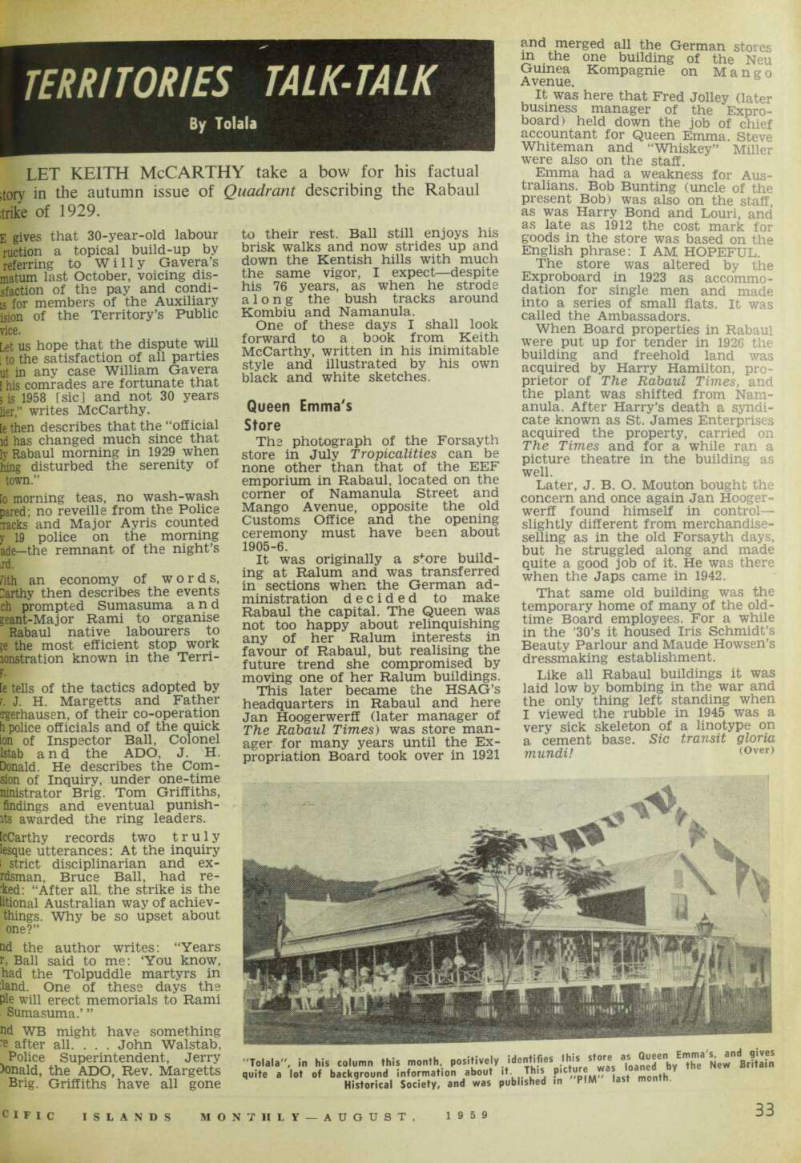
Store The photograph of the Forsayth store in July Tropicalities can be none other than that of the EEF emporium in Rabaul, located on the corner of Namanula Street and Mango Avenue, opposite the old Customs Office and the opening ceremony must have been about 1905-6.
It was originally a store build ing at Ralum and was transferred in sections when the German ad ministration decided to make Rabaul the capital. The Queen was not too happy about relinquishing any of her Ralum interests in favour of Rabaul, but realising the future trend she compromised by moving one of her Ralum buildings.
This later became the HSAG’s headquarters in Rabaul and here Jan Hoogerwerff (later manager of The Rabaul Times ) was store man ager for many years until the Ex propriation Board took over in 1921
and merged all the German stores in the one building of the Neu Guinea Kompagnie on Mango Avenue.
It was here that Fred Jolley (later business manager of the Expro board) held down the job of chief accountant for Queen Emma. Steve Whiteman and “Whiskey” Miller were also on the staff.
Emma had a weakness for Aus tralians. Bob Bunting (uncle of the present Bob) was also on the staff, as was Harry Bond and Louri, and as late as 1912 the cost mark for goods in the store was based on the English phrase: I AM HOPEFUL.
The store was altered by the Exproboard in 1923 as accommo dation for single men and made into a series of small flats. It was called the Ambassadors.
When Board properties in Rabaul were put up for tender in 1926 the building and freehold land was acquired by Harry Hamilton, pro prietor of The Rabaul Times, and the plant was shifted from Narn anula. After Harry’s death a syndi cate known as St. James Enterprises acquired the property, carried on The Times and for a while ran a picture theatre in the building as well.
Later, J. B. O. Mouton bought the concern and once again Jan Hooger werff found himself in control — slightly different from merchandise selling as in the old Forsayth days, but he struggled along and made quite a good job of it. He was there when the Japs came in 1942.
That same old building was the temporary home of many of the old time Board employees. For a while in the ’3o’s it housed Iris Schmidt’s Beauty Parlour and Maude Howsen’s dressmaking establishment.
Like all Rabaul buildings it was laid low by bombing in the war and the only thing left standing when I viewed the rubble in 1945 was a very sick skeleton of a linotype on a cement base. Sic transit gloria mundi! <° ver >
"Tolaia" ,in his column this month positively 'dantifies this store as Queen Emma's and gives quite a lot of background information about it. This picture was loaned by the New Britain Historical Society, and was published in "PIM" last month.
0 Many
cts For the first time the UN Trustee ip Inspectors have commented ton the “multiplicity of religious issions in NG”.
Other subjects of their criticism ,ve been quickly replied to by mberra heads, but a rather linous silence has prevailed over e alleged confusion caused by the imerical strength of varied toilers the Lord’s New Guinea Vineyard.
In Sydney, Seventh Day Pastor G. Stewart rushed to the de ice of the missionary activities, ifining his remarks, in a letter the Sydney Morning Herald 7.59), principally to the work of ; pioneer missionaries during the ys when there were only ree or four denominations repre ited in the contest for souls. He ds by contending “that the find (s of the UN Mission are not lording to facts”. 3e omits to mention, however, it in 1957 there were no less than separate Mission Societies regist id in NG (though admittedly not of separate denominations), but art from the principal societies — Anglican, Methodist and 11 he r a n—many little known ssion activities had been launched which most Australians had never in heard. Many of them hailed m the Land of the Stars and ‘ipes. ’astor Stewart does not deny the 1 Mission’s claim of confusion in i native mind. Such a state does st amongst many of the primitive >es (and some not so primitive) ose mentality and theological ming have failed to grasp why " sect claims Sunday as Sunday, lie another plugs for Saturday, 1 the finer teachings of transub ntiation seen in relation to the 'eminent edict to stamp out can alism. The primitive is a stark terialist.
The time is long overdue for an official inquiry into the confusion of denominational teachings and the sectarian jealousies which exist both in Papua and New Guinea.
Footnote : I remember that as far back as 1931 I sent a story to PIM dealing with the topic of “Sectarian Bitterness”, deploring the keen com petition for souls at that time. Long before the advent of the Apostolic Church Mission, Assemblies of God, Christian Missions in Many Lands, Jehovah’s Witnesses or the Sola Fide Mission or Church of the Nazarene.
Too Many
Laws “The number of ordinances and regulations which they [the P-NG
Legal staff] were required to drsh was too much physically for them said Administrator Cleland, accord ing to a newspaper report, when commenting on need for greater control for the safety of vessels ar sea, following the disappearance 0* the Muniara.
This is not the first time mention has been made of the multiplicity (popular word these days, appar ently) of ordinances in the Terri tory.
One is reminded of the remark by that wise Roman Emperor, Tacitus, who in the third century said; “When the State is most corrupt then laws are most multiplied.”
How simple life would be had we but the Golden Rule and the Decalogue to guide us. No good, of course, for the legal eagles.
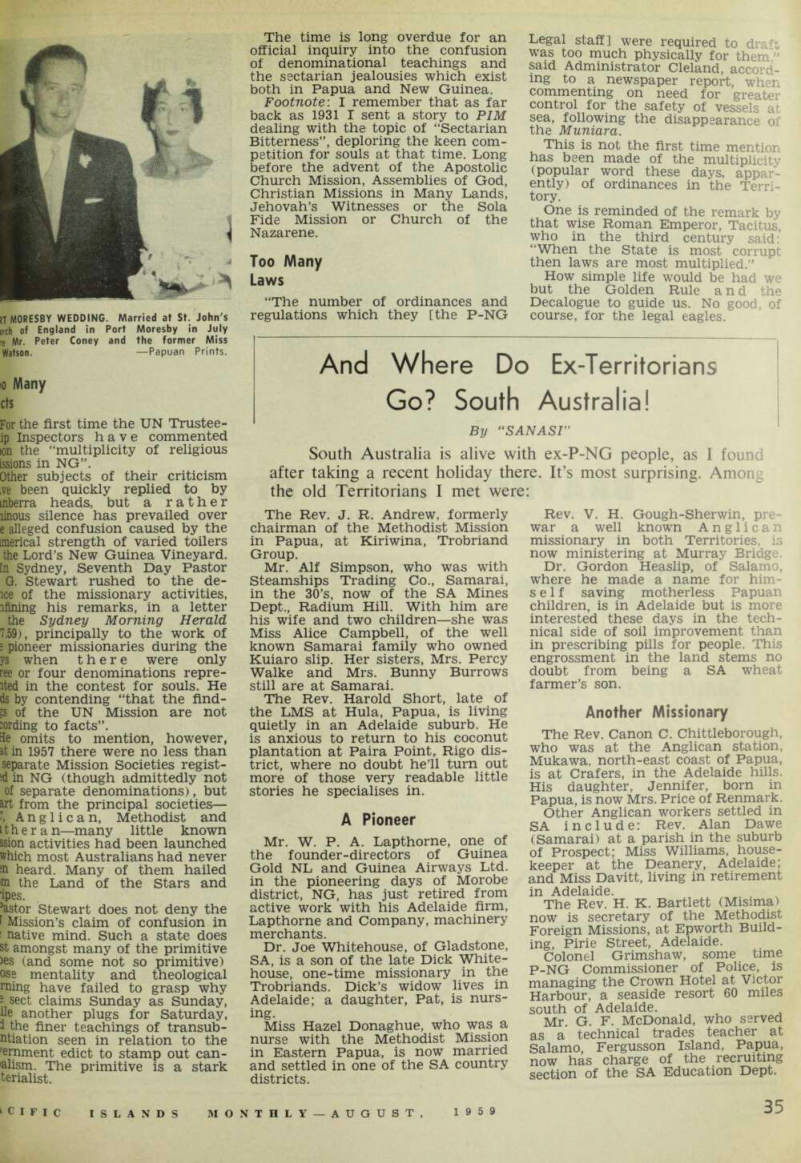
[?]T MORESBY WEDDING. Married at St. John's [?]rch of England in Port Moresby in July [?]e Mr. Peter Coney and the former Miss Watson. —Papuan Prints.