The Editars' Maillag
pp. 29-31 · Read in the full issue
/hat is Meant By
Love" in Tahiti?
Who gave the title, “Island of ove", to Robert Langdon’s excel nt new book on Tahiti? One of IM’s editors, in June, put the ame on a sales-hungry publisher.
But Author Langdon won t have that way—“lt was my idea,” he lys.
“And why not?” he goes on, “It , attractive. It is justified by the mtents of the book, particularly ie early chapters.
“And it is historically justified, id not Bougainville himself call ahiti ‘La Nouvelle Cythere’ because reminded him of the Greek oddess of love?
“And is there any island in the orld which more deserves the title sland of Love’ than Tahiti? If so, have yet to hear of it.”
Depends upon what is meant by •e”, of course. There can be a it more to the term than the unseating lagoon-side capers which ave given the lovely island of 'ahiti its remarkable fame.
What the publishers and the uthors who burble about Islands fe these days really mean is sex, ot love, and in this respect the uthors and publishers of a couple f generations ago were a great deal lore exact.
When Malinowski wrote his andard work on the erotic practices r primitive people (the Trobriand slanders) he didn’t dress it up in a )ur-colour cover of a bare-breasted ula girl and call it Love in the outh Seas. It came in a plain aper cover and was called The exual Life of Savages. We daresay lalinowski was an old-fashioned loke who thought he knew the dif irence between love and sex.
'ore Primitive
ave Art
Does anyone know anything of 16 cave drawings of Inorahn, uam? There has been a revival of iterest lately in ancient native untings, carvings and anything else 'at could possibly be construed 5 . primitive writing or word nntings, and Chester S. Cole, MC, USN, contributes something >out a little known cave in Guam.
He has sent a pencil drawing of le figures (which look rather like 'e match-stick, line-men one drew 1 kindergarten) and has this to 'y about them: “I learned of them through a lad !r vmg in my ship who comes from 16 village of Inorahn, a short
distance from where the cave is located.
“The markings were not carved into the wall, but were marked in some sort of white lime-like paint, I believe that most of them have been renewed to facilitate photo graphing by a team that was said to have come to investigate the new finding. The markings are about two to three inches tall, except two interlocking figures which are about three and one half to four inches tall. The sun-like figure on the left would have been in line with where the sun rises to the person who drew it. No one that I talked to in Guam had any idea of the significance of the markings.
“I realise that more than likely, interested parties already have heard about this cave, but I pass this information on to you for what it might be worth.”
About Those New
Guinea Pubs
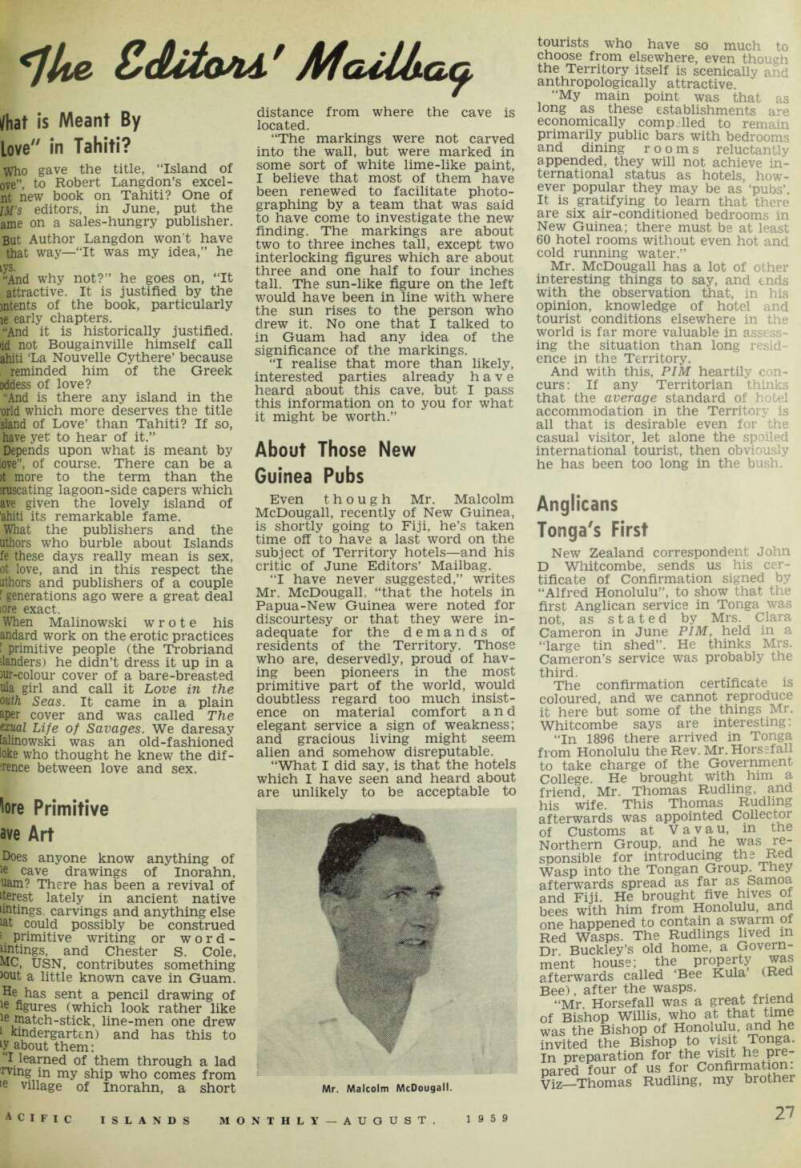
Even though Mr. Malcolm McDougall, recently of New Guinea, is shortly going to Fiji, he’s taken time off to have a last word on the subject of Territory hotels —and his critic of June Editors’ Mailbag.
“I have never suggested,” writes Mr. McDougall, “that the hotels in Papua-New Guinea were noted for discourtesy or that they were in adequate for the demands of residents of the Territory. Those who are, deservedly, proud of hav ing been pioneers in the most primitive part of the world, would doubtless regard too much insist ence on material comfort and elegant service a sign of weakness; and gracious living might seem alien and somehow disreputable.
“What I did say, is that the hotels which I have seen and heard about are unlikely to be acceptable to
tourists who have so much to choose from elsewhere, even though the Territory itself is scenically and
anthropologically attractive.
“My main point was that as long as these establishments are economically compelled to remain primarily public bars with bedrooms and dining rooms reluctantly appended, they will not achieve in ternational status as hotels, how ever popular they may be as ‘pubs’.
It is gratifying to learn that there are six air-conditioned bedrooms in New Guinea; there must be at least 60 hotel rooms without even hot and cold running water.”
Mr. McDougall has a lot of other interesting things to say, and ends with the observation that, in his opinion, knowledge of hotel and tourist conditions elsewhere in the world is far more valuable in assess ing the situation than long resid ence in the Territory, And with this, PIM heartily con curs ; If any Territorian thinks that the average standard of hotel accommodation in the Territory is all that is desirable even for the casual visitor, let alone the spoiled international tourist, then obviously he has been too long in the bush.
Anglicans
Tonga's First
New Zealand correspondent John D Whitcombe, sends us his cer tificate of Confirmation signed by “Alfred Honolulu”, to show that the first Anglican service in Tonga was not, as stated by Mrs. Clara Cameron in June PIM, held in a “large tin shed”. He thinks Mrs.
Cameron’s service was probably the third.
The confirmation certificate is coloured, and we cannot reproduce it here but some of the things Mr.
Whitcombe says are interesting: “In 1896 there arrived in Tonga from Honolulu the Rev. Mr. Horssfall to take charge of the Government College. He brought with him a friend, Mr. Thomas Rudling, and his wife. This Thomas Rudling afterwards was appointed Collector of Customs at Vav a u, in the Northern Group, and he was re sponsible for introducing the Red Wasp into the Tongan Group. They afterwards spread as far as Samoa and Fiji. He brought five hives of bees with him from Honolulu, and one happened to contain a swarm of Red Wasps. The Rudlings lived in Dr. Buckley’s old home, a Govern ment house; the property was afterwards called ‘Bee Kula (Red Bee), after the wasps.
“Mr Horsefall was a great friend of Bishop Willis, who at that tune was the Bishop of Honolulu, arid he invited the Bishop to visit Tonga.
In preparation for the visit pre pared four of us for Confirmation.
Viz —Thomas Rudling, my brother
Mr. Malcolm McDougall.
-harles a Honolulu lad who came rtth Rudling, and myself. The jishop arrived with Mrs. Willis and leir adopted son, a young Chinese id named Yam Sang Mark. This r am Sang Mark was later ordained, nd assisted the Bishop in Tonga.
Ie married a Tongan girl of the , a ng family; they left Tonga, his rife died in Honolulu and he fterwards married again to a Ihinese girl. He is now a Canon a one of the Anglican churches i Hawaii.
“Yam Sang Mark was added to ur list, and so on April 24, 1897, je were Confirmed in the then [ing’s Chapel, Nukualofa. This was he first Church of England service ver held in Holy Tonga.
Tt was on this visit that Bishop Villis was approached by some :ongan Chiefs and asked to return nd establish the Church of Eng and in Tonga. At this date the Rev.
Shirley Baker had not yet returned 0 Tonga after being deported. The Jishop returned to Honolulu, but ater went back to Tonga and estab ished the Anglican Church.”
Fhe Hagen Monument
s At Hagen
At the time Editors’ Mailbag was sking, in May, on behalf of a re ired Territorian, if anybody knew rtiat had happened to the Hagen lonument from Count von Hagen’s rave near Madang, one of PlM’s Hiring editors was staring the miss ig monument in the face at Mount [agen. The monument, of the Ger lan eagle in bronze, was in the ffice of Western Highlands District tommissioner lan Skinner, who has ome plans for it. The story of how 1 got there and what will happen 3 it, we hope to tell shortly. rom a Family
msing the Pacific
A cruising-yacht family like the ergusons—Jacque, Jack and Lonny, bout 12 are almost (repeat, Jlmost”), enough to make crusty liters of Pacific Islands magazines elieve again that sailing a small fip is the right way to see the orld.
The Fergusons, American, and ieir yacht Te Matangi, have been 1 and out of PIM pages, mostly rising yachts section, for well over year now. They last reported from arotonga, but since have left for onga.
Writes Jacque, of their stay in
rench Polynesia;
‘‘The island of Tahaa should be on the itinerary of every cruis- S yacht. Each bay, while being ttfiar, is still different. Even the ! °Ple are different. The French
officials are rather strict and when going from island to island, or even around one, we made a point of reporting in, although you actually need no permit after you once obtain the big green sheet from Papeete.
“In every village we visited for any length of time, from one week to two months, I played my accordian for them. Not that I’m any great shakes at playing the squeeze box, but the natives would sit by the hour fascinated as my fingers flew over the buttons and keys. In one pi ac e, called Haamene on Tahaa, I left the instrument over
night in the Tavanna’s house Children would stand by it; the adults would run a finger over the case almost with reverence. Hard to believe—yet true.
"... The day finally came when we sailed for Rarotonga. We sailed out the wide pass (from Borabora) • by evening we were at the southern tip of Maupiti, and by midnight, under the bright moonlight, we were well southwest of her. After six days of good sailing we made Avarua—arriving quite late in the evening with just enough light left to tip-toe into Avatiu to secure for the night.”