He Escaped Through
p. 81 · Read in the full issue
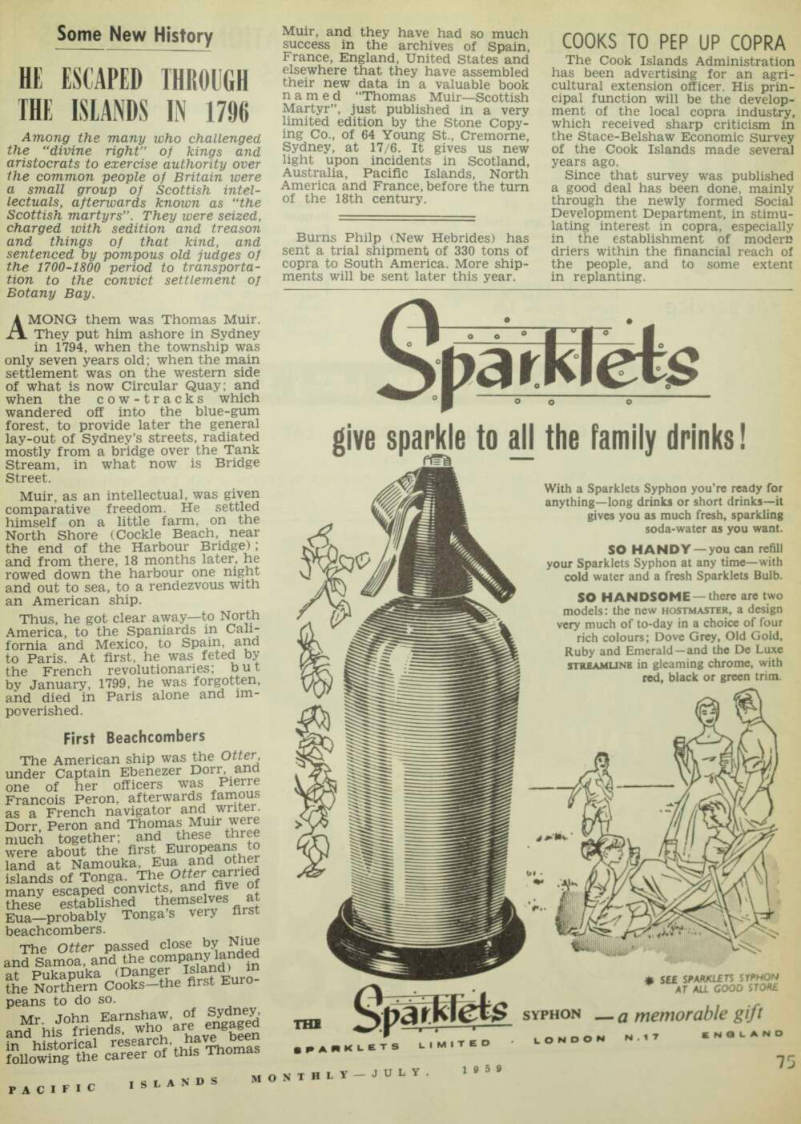
Some New History
The Islands In 1796
Among the many who challenged the “divine right” of kings and aristocrats to exercise authority over the common people of Britain were a small group of Scottish intel lectuals, afterwards known as “the Scottish martyrs”. They were seized, charged with sedition and treason and things of that kind, and sentenced by pompous old judges of the 1700-1800 period to transporta tion to the convict settlement of Botany Bay.
AMONG them was Thomas Muir.
They put him ashore in Sydney in 1794, when the township was only seven years old; when the main settlement was on the western side of what is now Circular Quay; and when the cow-tracks which wandered off into the blue-gum forest, to provide later the general lay-out of Sydney’s streets, radiated mostly from a bridge over the Tank Stream, in what now is Bridge Street.
Muir, as an intellectual, was given comparative freedom. He settled himself on a little farm, on the North Shore (Cockle Beach, near the end of the Harbour Bridge); and from there, 18 months later, he rowed down the harbour one night and out to sea, to a rendezvous with an American ship.
Thus, he got clear away—to North America, to the Spaniards in Cali fornia and Mexico, to Spain, and to Paris. At first, he was feted by the French revolutionaries: but by January, 1799, he was forgotten, and died in Paris alone and im poverished.
First Beachcombers
The American ship was the Otter, under Captain Ebenezer Dorr, and one of her officers was Pierre Francois Peron, afterwards famous as a French navigator and writer.
Dorr, Peron and Thomas Muir were much together: and these three were about the first Europeans to land at Namouka, Eua and other islands of Tonga. The Otter carried many escaped convicts, and five of these established themselves at Eua—probably Tonga's very first beachcombers.
The Otter passed close by Niue and Samoa, and the eompany landed at Pukapuka (Danger Island) m the Northern Cooks—the first Euro peans to do so.
Mr John Earnshaw, of Sydney, and his friends. who are engaged in historical research, have been following the career of this Thomas
Muir, and they have had so much success in the archives of Spain, France, England, United States and elsewhere that they have assembled their new data in a valuable book named “Thomas Muir—Scottish Martyr”, just published in a very limited edition by the Stone Copy ing Co., of 64 Young St., Cremorne, Sydney, at 17/6. It gives us new light upon incidents in Scotland, Australia, Pacific Islands, North America and France, before the turn of the 18th century.
Burns Philp (New Hebrides) has sent a trial shipment of 330 tons of copra to South America. More ship ments will be sent later this year.