They're Still Arguing Their
pp. 75-79 · Read in the full issue

Mystery of the Easter Island Talking Boards They're Still Arguing Their Way To A Solution
When Easter Island was discovered by Europeans in 1722 it was found to be populated by simple tribesmen not markedly different from the other Polynesians of the South Seas; and by gigantic stone statues that peered down from the cliffs. It represented then as now a complete enigma.
EASTER Island’s second mystery was not discovered for another 140 years, and then by a French missionary sent to Easter Island from Tahiti by his Bishop, about 1864, to care for the pitiful remnants of islanders left over from the blackbirding raids of Peruvian slavers.
When Father Eugene Eyraud visited the natives in their poor huts he found sticks and flat wooden boards completely covered with rows of tiny incised symbols between one-third and half an inch long.
The natives knew nothing of the meaning of the symbols and were using the boards for firewood and for canoe building. But a number of them were subsequently salvaged and have intrigued scientists and cryptographers ever since.
Ahead of Heyerdahl?
Although he paved the way in the best selling Aku-Aku, Thor Heyerdahl has not, as yet, produced the “definitive study” of Easter Island that was promised and which will, amongst other things, explain what he thinks is the meaning of the rongorongo boards that have confounded the experts since 1864.
So it might have been with the idea of getting in first, that Thomas Barthel, of the University of Hamburg, wrote an article in the Scientific American, June, 1958 issue, explaining in layman’s language that he believes the mysterious carved characters mean.
Barthel commenced his Easter Island study in 1953, and his university is to publish his magnum opus on the subject. In the mean time he has had the satisfaction of giving said his piece in a popular magazine which probably claims as many readers as Mr. Heyerdahl can command, because it is a glyph to gooseberry that the points on which the two scientists will ultimately agree will be purely coinciental.
Mr. Barthel does not, for example, think that the carved boards prove that the original Easter Islanders came from South America: while Heyerdahl, who has a fixation
about his pet theory, is scarcely likely to allow the characters to dis prove that the Polynesians couldn’t have come from Peru.
Plain or Red Indian
If they don’t agree, Messrs. Barthel and Heyerdahl will be in good com pany. The Easter Island talking boards and drawings therefrom have been going the rounds of museums and universities and have been pored over by savants and scientists for over 90 years, and no two people have yet agreed completely on what they do mean.
In the 1930’s two Frenchmen (MM Metraux and de Hevesy*) were slugging it out with scientific
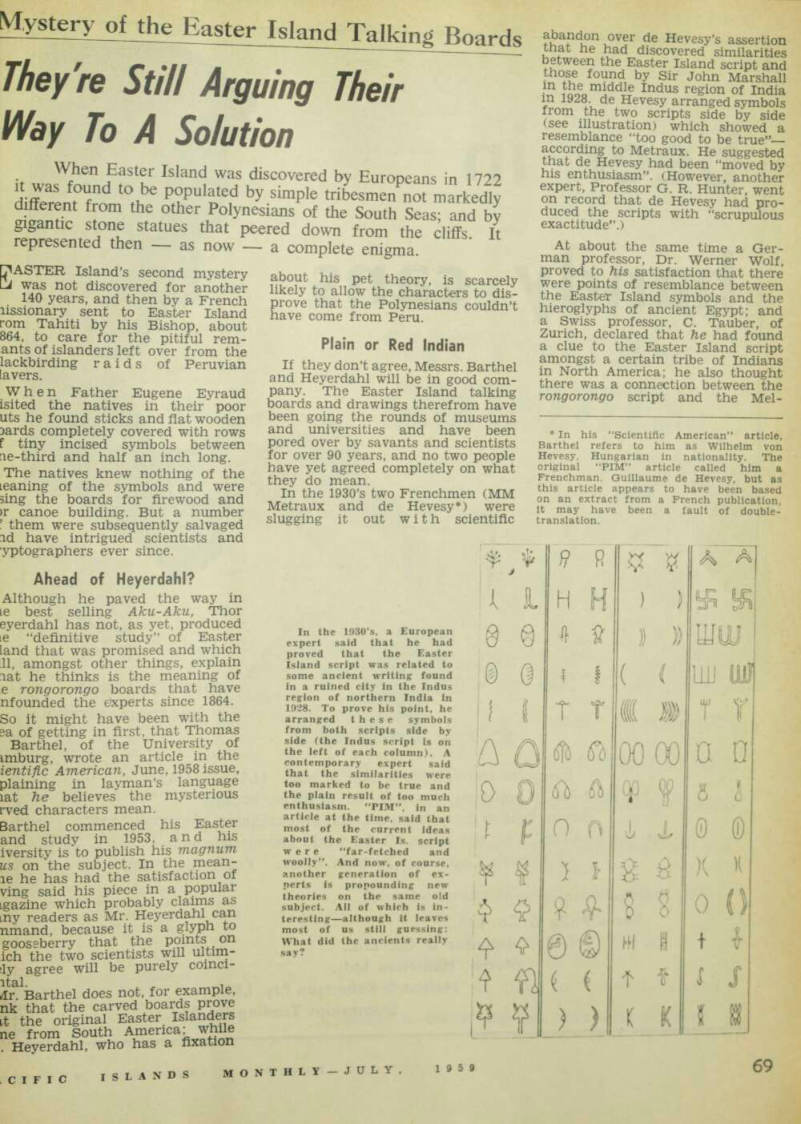
abandon over de Hevesy’s assertion that he had discovered similarities between the Easter Island script and those found by Sir John Marshall in the middle Indus region of India in 1928. de Hevesy arranged symbols from the two scripts side by side (see illustration) which showed a resemblance “too good to be true”— according to Metraux. He suggested that de Hevesy had been “moved by his enthusiasm”. (However, another expert, Professor G. R. Hunter, went on record that de Hevesy had pro duced the scripts with “scrupulous exactitude”.) At about the same time a Ger man professor, Dr. Werner Wolf, proved to his satisfaction that there were points of resemblance between the Easter Island symbols and the hieroglyphs of ancient Egypt; and a Swiss professor, C. Tauber, of Zurich, declared that he had found a clue to the Easter Island script amongst a certain tribe of Indians in North America; he also thought there was a connection between the rongorongo script and the Mel-
*In his “Scientific American” article, Barthel refers to him as Wilhelm von Hevesy, Hungarian in nationality. The original “PIM” article called him a Frenchman, Guillaume de Hevesy, but as this article appears to have been based on an extract from a French publication, it may have been a fault of double translation.
In the 1930’s, a European expert said that he had proved that the Easter Island script was related to some ancient writing found in a ruined city in the Indus region of northern India in 1928. To prove his point, he arranged these symbols from both scripts side by side (the Indus script is on the left of each column). A contemporary expert said that the similarities were too marked to be true and the plain result of too much enthusiasm. “PIM”, in an article at the time, said that most of the current ideas about the Easter Is. script were “far-fetched and woolly”. And now, of course, another generation of ex perts is propounding new theories on the same old subject. All of which is in teresting—although it leaves most of us still guessing: What did the ancients really say?
Melanesian, pre-Polynesian, history of Easter Island.
In a long article on the subject at this time, PIM dismissed all the professors and their theories as "probably far-fetched and woolly” — and then the war cut Europe off from Easter Island. The subject of the island’s mysteries had a long rest until the 1950’s.
Memory-Ticklers
And, so to Heyerdahl and Barthel.
The latter, according to his Scientific American article, thinks that, fundamentally, the rongorongo boards were cues or memory-aids; and, because the symbols reverse direction in alternate lines, that they might be an elaboration of the notched and carved sticks that other Polynesian groups have also used as memory-ticklers.
Barthel was a cryptographer dur ing World War II, and thus introuced to the business side of in terpreting strange scripts, became also interested in the academic side of it. He helped to decipher the writing of the Mayas, and then, in 1953, became interested in the even bigger puzzle of the Easter Island script.
Analysed 12,000 Signs
With the co-operation of univers ities and museums around the world, ?e finally collected together in his study in Hamburg something like ,000 signs for analyses. “Under the magnifying glass,” he writes in the Scientific American, “the tiny symbols show surprising elegance and beauty—precise and complex detail yet boldly drawn. They made up a teeming world of little running men, flying birds, turtles, celestial objects and strange geoetrical forms. To reduce the multitude of signs to an orderly list that could be analysed and dealt with atistically, I identified the signs numbers. This cataloguing work is long and tedious, but by the time it was finished I was well enough acquainted with the symbols to begin to see some patterns.
"I now had to decide what the ns stood for —alphabetical letters, lables, words or ideas. . . Since e Easter Island inscriptions had hundreds of different signs, I judged what each represented a whole word idea.”
Then came the more difficult task of finding out meanings, and in this I had to follow—to a surprisingly successful conclusion —a trail that s almost 100 years cold.
Only Partly Fake
One of the earliest students of the ,rds was Bishop Jaussen, a French missionary at Papeete, Tahiti, who had four of the boards sent to him by one of his priests on Easter Island, into whose province the
mystery island then came. Bishop Jaussen learned that, then living in Tahiti, was an old Easter Islander named Metoro, who claimed to have been trained as a rongoronao man.
He hunted him up and asked him to read the tablets.
With little hesitation Metoro picked up the tablets in turn and chanted from each of them a song in the Polynesian language. Elated, the Bishop' wrote it down, but when he translated it into French it made only gibberish and although he tried to match the words sung by Metoro with the symbols on the board, he did not succeed in desciphering one of them.
Metoro was dismissed as a fake. when he took up the task in 1953, Barthel was soon convinced that the only link between the tablets and the past was the muchdiscredited Metoro and he “clutched at the faint hope that he might not have been a complete pretender”.
However, by now Jaussen's transcription of the songs had completely disappeared and no one knew whether they were still in existence. The search began in Tahiti,
continue through France and Bel
gium and ended in triumph in a monastery in the village of Grottaferrata, near Rome, where the dusty notebook bearing the four songs of
Metoro, written in Jaussen’s shaky hand, were finally found.
That notebook became Barthel's Rosetta Stone. He compared Metoro’s chants with the inscriptions on the wooden tablets and gradually a few of the signs became identifiable with consistent meanings: “As I worked through Metoro s four tablets, I began to see why his songs had turned out to be mere gibberish. Metoro had been in the position of a schoolboy asked to explain a university textbook.
Possessing only a rudimentary knowledge of the old script, he had read some of the signs correctly but guessed wrong on most of them, so that his over-all translation of the text was meaningless.”
Barthel continues "The Easter Island writing had not matured, to a phonetic system which could reproduce an entire spoken Consequently the tablets had to re duce the songs of rongorongo men to an abbreviated form, like a telegram.
"The tablet was a kind of cue card consisting of catchwords which gave the singer only the gist of his
verses: he had to fill in the missing words himself. Naturally this makes it difficult for us to reconstruct the full story epitomised in the tablets.
Nevertheless, read in the context of what we know about Polynesian folklore, they tell a great deal.”
And what do the talking boards tell?
According to Barthel, mainly they are religious and ritualistic, with no mention of the ancient historical events of the island, or how or why the giant statues were made.
They are eulogies to the deities; instructions to priests; some of them speak of mythological sub jects—such as the myth common to all Polynesia of the beginning of the world, when Tane separated earth from sky and put up props to hold heaven in place. Most of the tablets speak only of males, and females only when the tablets are strongly preoccupied with fertility...
“These texts always call a spade a spade, and a translator has to render them with delicacy.”
Then the scripts link Easter Island with other parts of the South Seas and in mentioning important food plants that do not grow in Easter Island, and in giving correctly the names of other Polynesian islands “leave no doubt that the settlers to Easter Island came from somewhere in the heart of Polynesia, perhaps Raiatea. . . They also seem to dis prove conclusively the recent theory of Thor Heyerdahl that the Easter Islanders came from Peru.”
Who invented the extraordinary script, and why it survived only on Easter Island, must remain, says Barthel, a matter of conjecture.
“We can theorise on this subject from two different points of view: One view would suggest that the script was a spontaneous, inde pendent invention by a group of Polynesian intellectuals who kept it as their own secret possession; the other concept, holding that human culture has grown only gradually by the diffusion and cross-fertilisa tion of ideas, would argue that the Easter Island writing developed from some earlier writing system.
“Speculating along the first line, we might suppose that a particular group of rongorongo men some where in Polynesia, created the script and took their private system of writing with them to Easter Island. Their invention might well have been the result of experiments with notched sticks used as memory aids...
“On the other hand, everything we know about the early writing Systems in the Old World indicates that they borrowed or developed from one another. In the Easter Island writing we can see some faint re semblances to certain ancient Chinese scripts. Possibly the Chinese and the Polynesian writing were both connected with an ancient cultural centre somewhere in southeast Asia.”
In the public mind it is Easter Island's images, and not its talking boards, that make the island famous. Here is one of the images set up on a modern base. Below is a typical group of Easter Islanders.