fiji talanoa
pp. 49-54 · Read in the full issue
Vakatawa Talks Of This And That
Drinking habits are changing in Fiji. And the opening of the Suva brewery rather than the abolition of the permit-system for Fijian and Indian beer-drinkers, has had a lot to do with it.
THE dire predictions that moral and social disaster would follow the freeing of beer from the permit system have not been justil by experience.
There has been no noticeable inase in drunkenness. Although rly all clubs and hotels report 'eased beer sales, a lot of this ue to the availability of draught r from the Suva brewery, which opened at the end of last year, fter years of beer only in bottles cans, local judgment is that ight is the drink, here are those who still prefer seas bottled or canned beer, but brewery output continues to eat the pile of over a million les assembled before brewing n, and the directors are a bit arbed about the slow rate of rn of empties. lough beer consumption in gen has gone up in Fiji, sales of ts have dropped, and the ncial Secretary will doubtless do i interesting arithmetic at the of the year when he comes to ice excise returns against re i revenue from import duties, ing away with permits for beer indoubtedly removed what was istant source of racial resent . Fijians and Indians of educa and standing found it humil ? to have to produce a permit time they ordered a glass of while their European (and Jse) companions suffered no restriction. jre have been some interest de-line developments in drink abits since the restrictions were id and since hotels have offered ?ved facilities. the new Club Hotel at Suva, instance, the special lounge including one which is fully conditioned, are attracting far custom than was anticipated, nge patrons in Fiji were for almost exclusively Europeans, lew lounges, with furnishings irroundings of the luxury type prices to correspond) are at ig patrons of all races. It is f those quiet social changes tend to go un-noticed but all help to reveal the pretty spirit which characterises relations in Fiji.
Duty-Free
Shopping for Tourists A tourist-minded Government has decided to open a duty-free shop in the new terminal building at Nadi Airport.
Like its counterparts at Shannon and Amsterdam and elsewhere in the world, this shop may well at tract a lot of visitors from overseas.
It should be a special attraction to people from New Zealand, where import restrictions have emptied shops of so many overseas goods.
The duty-free system is already working quite extensively in Fiji, through the draw-back facilities offered by a number of firms.
Cameras, watches, projectors, transistor radios and Scotch whisky at prices well below the ordinary retail cost are among the visitors’ favourite purchases.
The system is simple. The traveller places his order and pays for the goods, the shop-keeper arranged the custos formalities of refund of duty or withdrawal from bond, and the goods are delivered aboard the ship or aircraft at or after the time of departure.
In a Legislative Council debate on customs concessions, some members hinted at a semi-racket on the
part of the more greedy storekeepers.
Reputable firms give the traveller the full benefit of the refund of duty. Others, so it was alleged, are reducing the ordinary retail price by only a part of the amount of duty refunded. In this way, they increase their own profit, and while the visitor does get some price benefit he does not get as much as it was intended when the draw back procedure was streamlined to attract him and his fellows to Fiji.
Army is In But
Navy is Still Out
There is some suspicion that there was an element of inter-Service rivalry in the decision to disband the Fiji Royal Naval Volunteer Re serve.
The move to cut down the size of the armed forces was in line with general policy throughout the Com monwealth, but the Immediate reason for the move in Fiji, how ever, was the need to save money.
The New Zealand Chiefs of Staif, who are the Governor’s advisers on
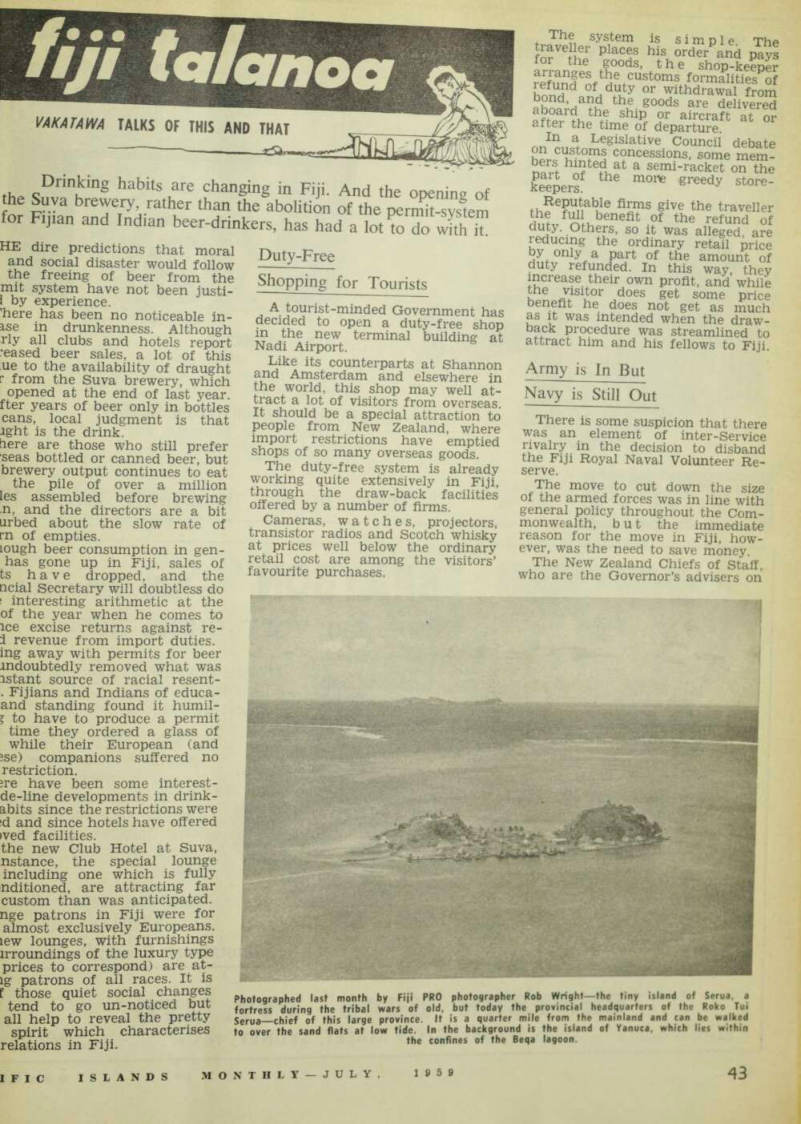
Photographed last month by Fiji PRO photographer Rob Wright—the tiny island of Seroa, a fortress during the tribal wars of old, but today the provincial headquarters of the Roko Tui Serua - chief of this large province. It is a quarter mile from the mainland and can be walked to over the sand flats at low tide. In the background is the island of Yanuca, which lies within the confines of the Beqa lagoon.
military matters as Fiji comes withn New Zealand’s defence orbit were asked how the reduction in strength should be made.
They sent one representative, and one only, to Fiji. He was the Army head. The principal representative of the Chiefs of Staff in Fiji is also the head of the Army in the Colony All this could have had an effect on the eventual recommendation that the Army in Fiji be kept— although in greatly reduced form— and the Navy disbanded.
Nobody pretends that, if war actually came, Fiji could be fully protected by its own Army and Navy, with the help of the RNZAF from its Laucala Bay base.
There is good argument, how ever, for keeping at least a skeleton aval organisation alive in a country of many islands, and with tradition of pride in Her Majesty’s Navy.
The argument for a naval force applies also to internal security.
In an archipelago there is no more effectively mobile force than a group of trained men who are able to handle boats.
In the case of the FRNVR, there is a further argument. Under a en and enthusiastic group of ?icers a body of young Fijian and rt-European men of quite out ?nding spirit had been created. It ,s a blow to their pride when sy were suddenly told they were not wanted.
Yet another thing which made the reserve of particular value was its contribution to the job of completing the survey of Fiji waters.
This contribution has been much valued by officers of New Zealand Navy survey vessels operating in i. The Captain of HMS Cook was overcome with indignation at decision to destroy the Reserve ,t he wrote a letter to the Fiji ties expressing his views in no certain terms.
This dreadful departure from the procedure of Going Through innels left various gentlemen in h places on the verge of apoplexy I the Navy became still more un ular with Authority, ut not with the people of Fiji, he genuine regret of all com lities found expression in the ss, and later in the Legislative Conucil when Mr. J. N. Falvey introduced a motion suggesting that Reserve should be kept alive in snuinely effective form and not as a semi-social organisation.
Could Give
> Undertaking”
The Government, faced with the that its policy was obviously Dpular, paid lip-service to the Lon but the Colonial Secretary
was careful to make no real cessions.
He "could give no undertaking” that the Reserve’s headquarters building would be retained for training. The answer, he said seems to be “in some sort of vol untary association”, and he hoped that the people concerned would be able to form such an association and that it would be successful.
There the matter rests at present.
The officers and men who have built up the Reserve wish to carry on, but the officers feel strongly that unless there is a definite programme of training, and un less they have a specific part to play in the external defence or internal security (or both) of Fiji the organisation and the eager spirit of service (with all that means in a group of young men) which they have built up will gradually fade away.
They have been given an oppor tunity to state their case. Whether it will be listened to by the Gov ernor and his advisers remains to be seen.
The Burns Commission
and Birth Control
A side-effect of the Burns Com mission, which begins a full-scale enquiry this month into population
problems of Fiji, has been the stimulating of public interest in the question of birth control There has been some lively corre spondence in the Fiji Times, with views fairly sharply divided.
In general, opposition has been on religious grounds only, and that the basis of Roman Catholic views. Indian corre spondents have been firmly in favour of family planning, and women s voices have been fairly evenly divided.
One feature of the general in terest in the Colony is that it has disclosed a considerable lack of knowledge of contraceptive tech niques, especially within the Indian community. Some of the meetings to create interest in the work of the Burns Commission have turned into clinical lectures when some one in the audience has said, “What exactly is this birth control we have been hearing about?”
Merchants and chemists report a sharp rise in contraceptive sales since the general discussion began.
Meanwhile the Medical Depart ment’s family planning clinics con tinue to operate without any par ticular publicity.
The department takes the view that in these matters it is best to spread the news through advice by doctors or nurses or by getting clinic patrons to tell their friends
New Guinea's Farewell to
Popular Orme Denny
Adventurer in the
st-Hidden
mountains
The District Commissioner of obe, New Guinea, wiped a v which sweated gently at the lory of it. “I’ve been a long in Lae,” he said. “If I’m y. I’ll be there a while longer.
I shall try to get out, quick, ver they start to farewell ner Orme Denny!
COCKTAIL parties and club functions, public and private presentations—and at nearly one I had to say something Orme. He and his wife are ? our dearest old friends, but awfully tired of praising them, d then,” added Mr. Niall, tically,” I had to go across to Moresby and do it all over again." ’ch just about gives the re of the popularity of Cap tain Orme Denny, Area Manager in Guinea for Qantas Ltd., and fe. He has just retired from s service; and they have gone
to live in Australia.
Orme Denny came into Australian commercial flying via the RAAF, over 30 years ago; and in 1931, when the then small and struggling Queensland and Northern Territory Aerial Service (QANTAS) folded up their Brisbane-Townsville service, Denny was the pilot who lost his job.
That was how he came to New Guinea—a pilot for Guinea Airways.
That was where he first made acquaintance with Wau, Salamaua,
Moresby and Lae; and where he was associated with famous airmen like Bob Gurney, Jerry Pentland, Ian Grabowski, Eric Chater and Tommy O’Dea.
None was more famous than Denny—he had his own remarkable adventures among those uncharted, mist-hidden, central mountains of the big ugly island. He was among the first airmen into the Central Highlands, and he was the first man to put a plane down at Madang.
He had the usual quota of forced landings in unexpected places—on a sand bank in the Markham River, and on a Kerema beach. (Over)
At left latest photograph of Captain and Mrs. Orme Denny, taken as they left Sydney on their world tour in July. In the old photograph above, taken from an issue of "PIM" of more than 20 years ago, pilot Denny on the right , was photographed in the goldfields with a group of well-known Territory people of the day—Mr. Frank Fraser, Mr. James Stewart, Mrs. J. Spence and Mrs. McKenzie. Stewart was killed not long afterwards.
He once went down hastily at Bulwa, while carrying two Guinea Airways directors. The success of the landing, plus the tight Orme Denny grin—famous in an emergency—brought him an unexpected increase in salary.
Denny was back in the Qantas service, piloting planes between Australia, Asia and Europe, in 1938, and thus became deeply involved in the critical air operations of the early days of World War II, north of Australia.
Later, he was away out over the Pacific, helping “the gang” to bring the sorely-needed Catalinas from America to Australia. That was a famous company of fliers —Captains Lester Brain, P. G. Taylor, “Scotty”
Allan and Orme Denny.
By early 1942, the Japs were all over New Guinea, and our airmen had some difficult tasks.
Captain Denny was given charge of operations designed to rescue European refugees who had man aged to get through to Mount Hagen—they did 18 successful rescue flights in radio silence and without weather forecasts. , It was Denny who organised the great native sing-sing at Mount Hagen airfield: hours of stamping hardened the rain-soaked ground] and allowed him to take off with bigger loads!
Denny was in charge of Qantas flights into Moresby and Milne Bay during the most hectic days of the Japanese invasion. He actually got the last flight out of Milne Bay one hour before the Jap landing. He subsequently took the first flight of the “bully beef bombers” into Jim bora, and was in charge of the operation into Dobodura and Popon detta during the battles to regain the Japanese beach-heads in the Buna-Gona area. He was then posted as Chief Pilot, based on Bris bane, for the courier services to New Guinea, carried out by Qantas under charter to the US Army.
Historic Crossing
Denny was in the historic Indian Ocean crossings. He was appointed in February, 1944, Superintendent of the flying-boat operations, and he received the special Qantas Gold Star for long-range operations. In November, 1945, he opened the Syd ney-Noumea-Suva service of the
Empire flying-boats.
Captain Denny gave up flying in 1946 and entered Qantas adminis tration; he became Assistant Opera tions Manager, Line Manager for New Guinea and the Islands, and then Area Manager in New Guinea in 1952. He was one of New Guinea’s most successful operational and administrative airmen.
A small-built man, he made a few fierce enemies and a thousand friends; and he has left an indelible mark upon New Guinea aviation.