Territories Talk-Talk
pp. 43-47 · Read in the full issue


By Tolala
Wot! No adventures in these modem times? That seems to be the opinion of an official of a big Islands firm B.P. to be exact who said that the spirit of adventure was vanishing in Australia, and the number of young men applying to go to the Islands had almost dwindled away since World War II.
SAID B. P. Chairman, Mr. James 1 Burns, in his annual report to shareholders: “Nowadays we often have to wait up to five months before filling a position, unfortunately the young man in Australia is not inclined to go to the Islands as conditions here Australia] are more attractive in art and entertainment”.* It seems that the unpopularity of at “demon” Colonialism has had influence on diminishing the rit of adventure, and the present-day average male prefers the comforts of civilisation to the vations of the pioneer, This impression is underlined en one hears the present-day demands in “jungle” areas for modern “homes”, air-strips, twoway radios and refrigerators, admittedly all very nice and com fortable, but not always practical.
How much of Papua or New Guinea would have been brought to pre-War II stage of develop ment had such demands been made the white settlers?
gin—Revised
In my May Talk-Talk I made mention of Mrs. D. M. Cleland ig “eager to revise and/or idge the much maligned Pidgin English”, and her desire to call meris” women.
My comments were based on a report in The Rabaul Times. have since received a letter from Mrs, Cleland who writes: . On the contrary, I am an enthusiastic supporter of Pidgin the ‘Neo-Melanesian language’ ch I think can develop into a ? lingua franca) and love jring into arguments with its ?actors, though I think English should be taught in the schools and not think that Pidgin is a sub stitute for English or vice versa.
When “PIM” checked with the Big in June, it was stated that after Mr.
's statement was published, the any was inundated with applica tions from eager young men. This bit of paper publicity had done more to ilate interest in jobs in the Islands all their newspaper advertising in t years.
“However in my talk, the point I was making was quite otherwise.
During the course of it I made a plea for speaking of the Tolai women as ‘Women’ when using English, but said it was perfectly right and proper to use ‘Meri’ when speaking in Pidgin.”
Mrs. Cleland then goes on to describe how, after many visits to Rabaul, she has become aware of the great “difference in the social development of the men as com pared to the women. . . . The difference ... is more apparent than in most areas of the Territory and could seriously add to all the well-known existing strains in that district. The European women can help the native women so much in lifting themselves up to their husbands’ standards, even by their attitude towards them. To refer to them as ‘meris’ and not ‘women’, when speaking of them in English may seem a little thing, but it immediately seems to dismiss them as people of little account”.
An instance is then given by Mrs.
Cleland of her visit to some villages, accompanied by an Infant Welfare Sister who told her of the wife of one of the leading Rabaul natives who refused to enter hospital to have her baby, preferring to go alone into the bush.
The greatest assistance in this drive for equality would be the green light from the Tolai fathers and husbands of these native women. But will they be prepared to give it? It took the white race males a few centuries to make up their minds about the equality of the sexes—and even now they are not too sure about it.
Historical
Dates The date of the Nakanai massacre was mentioned in May Talk-Talk.
Someone had said it was in 1930.
I plugged for circa 1926. There comes a letter now from Jock Mackay, of Madang district, who writes: “To assist you in the Nakanai massacre, I will give you the correct details. In the first place I was present. A/PO, now retired.
“It was towards the end of November, 1926. Word reached Rabaul that six people, Nicholls, Britten, Page, Fischer, Marley and Collins had been killed at a village called Sananga, a few miles from Tarobi Bay and a village named Tarobi. I was stationed at Kokopo as PO; Ted Taylor was DO, New Britain, and also stationed at Kokopo. About 24 hours later— perhaps a bit more—we sailed on MV Vanapa, accompanied by Mark
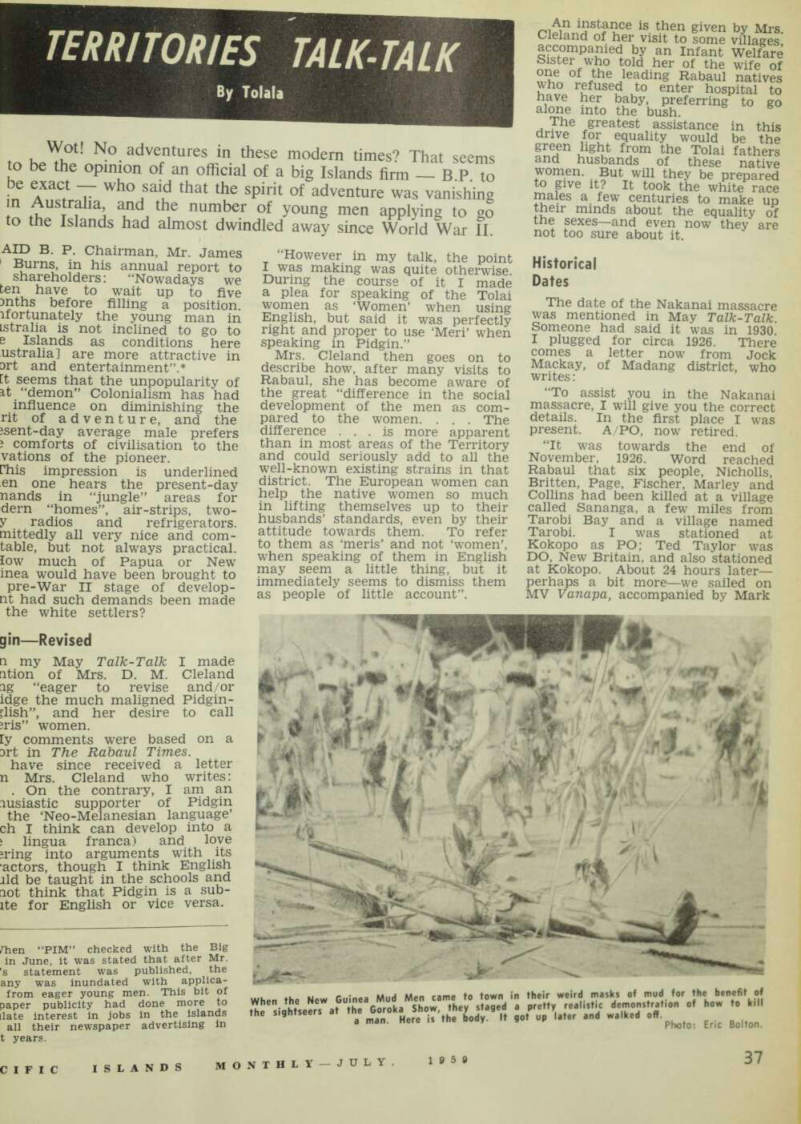
When the New Guinea Muod Men came to town in their weird masks of mud for the benefit of the sightseers at the Goroka Show, they staged a pretty realistic demonstration of how to kill a man. Here is the body. It got up later and walked off.
Photo: Eric Bolton.
Pitt who was a medical assistant; Hughie Mackenzie was the captain of the ship. (Later Lt. Com. during the War and now deceased).
As we were approaching Tarobi Bay we sighted a small schooner approaching us; it had a red lap lap flying from the masthead. I mentioned it to Ted and the others, shortly we came alongside her; it was a Japanese fishing boat from Rabaul.
“The first thing we saw was rnie Britten (who was supposed to be one of the victims) sitting on the hatch. He told us what had happened, then proceeded on to Rabaul. We continued on and anchored at Tarobi.
“The next morning Nicholls (also supposed to be a victim) turned up and continued the story. Ted and Mark Pitt, the day we landed, proceeded to Sananga and discovered the bodies of the four hers (Page, Fischer, Marley and ollins); their bodies were decomposed and spears were sticking what was left of them. ... A few days later Ted went to Rabaul and reported his find. Dr. Cilento me out with Mark Pitt, collected the bodies and they were sent to Rabaul for burial.”
Three months later, so Jock writes, he built the first base camp at a place in Nakanai called ilutu. Ian Mack (later murdered by natives in Morobe) was with him at the time.
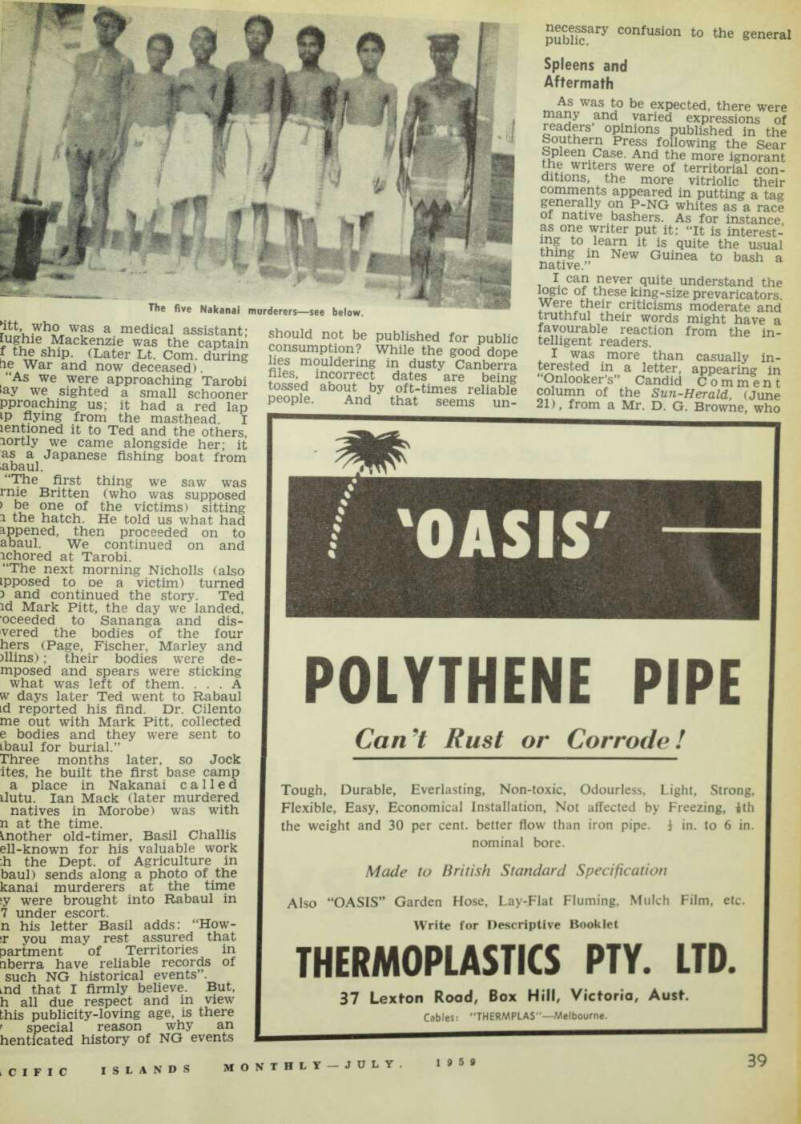
Another old-timer, Basil Challis well-known for his valuable work with the Dept, of Agriculture in Rabaul) sends along a photo of the Nakanai murderers at the time they were brought into Rabaul in 7 under escort.
In his letter Basil adds: “However you may rest assured that Department of Territories in Canberra have reliable records of such NG historical events”, ind that I firmly believe. But, with all due respect and in view this publicity-loving age, is there r special reason why an authenticated history of NG events
should not be published for public consumption? While the good dope lies mouldering in dusty Canberra files, incorrect dates are being tossed about by oft-times reliable people. And that seems un
necessary confusion to the general public.
Spleens and
Aftermath
As was to be expected, there were many and varied expressions of readers opinions published in the Southern Press following the Sear Spleen Case. And the more ignorant the writers were of territorial con ditions, the more vitriolic their comments appeared in putting a tag generally on P-NG whites as a race of native bashers. As for instance, as one writer put it: “It is interest ing to learn it is quite the usual thing in New Guinea to bash a native.”
I can never quite understand the logic of these king-size prevaricators.
Were their criticisms moderate and truthful their words might have a favourable reaction from the in telligent readers.
I was more than casually in terested in a letter, appearing in "Onlooker’s” Candid Comment column of the Sun-Herald, (June 21), from a Mr. D. G. Browne, who
The five Nakanai murderers—see below.
am that in 1913 he “was employed by the Germans in Bougainville Solomon Islands, as instructor to cadets sent out from Germany to e trained for plantation managers and overseers.”
On one occasion, he said, he found it necessary “to give a native labourer a thrashing for insubordination and insolence.” Some weeks later a German government inpector and magistrate called at his ace and the chastised native com plained.
Browne explained that such punishment was officially recognised by the British Solomons (where he had been stationed for some years) it the German official informed him that “control of public conduct, whether of white men or natives, is the sole function of the Ger an government.”
He was fined 100 Marks and warned that if it occurred again he would be dismissed and deported, appealed to the then Governor, ?Solf. . . The fine was not collected and the charge not recorded . . but I was given strictly to understand that I was not under y circumstances to take any action against a native.”
That is certainly a good plug for for German administration, which s so often been termed “harsh and unfriendly” towards the native people. have cudgelled what I am pleased call my brain and for the life me I cannot recall a D. G.
Dwne in Bougainville in those /s. I lived in that area from August, 1912 to late in 1915. There were few Australian planters there those years and I certainly never trd of a non-German planter in icting German cadets. >r. Solf (as “Onlooker” himself nts out) was Governor of Samoa il he went to Germany in 1911 become Colonial Secretary. In 3, Dr. Hahl was Governor of NG, owed by Dr. Haber.
Furthermore, in those days of sparse white population and greater ation from Government stations, plantation managers were issued ;er thorough screening) with Discplinary Permits (Diziplinar lubnis ) which permitted the ier to deliver canings to re itrant native labourers up to strokes. etailed records had to be kept these punishments and were revoked by a visiting government ial if any complaints were laid , native who had been punished, held such a permit but seldom to use it, as the mere fact of natives knowing a plantation ager held such an authority ed towards the maintenance of pline. The German Kiap in was Captain Doellinger, and
he would tolerate no mal-treatment of natives.
So, Mr. Browne's letter to me presents some anomalies.
The Ferdinand
Light
Most readers will remember the code word Ferdinand, coined by Eric Feldt when the Coast Watchers were being organised. And what a strength they were during those anxious war years! But from murmurings I hear from Up Yonder it seems that all is not quite so well organised as should be for the opening ceremony of the Coast Watchers' Light Memorial at Madang on August 15.
There have been varied difficulties to overcome: a lag owing to liquidation of the contractors; lack of publicity generally and problems of transport and accommodation for those desiring to attend the ceremony. Somewhere a shot in the arm is indicated to pep up arrange ments. If the memory of any particular body of men, who fought for our freedom, should be perpetuated then that body is the Coast Watchers Incidentally, I hear from a re liable source that a cheap edition of Eric Feldt’s The Coast Watchers is to be published by a New York firm. This is indeed news for copies of this fine record of gallant actions are as rare as hen’s teeth.