Self-government For W. Samoa
pp. 35-41 · Read in the full issue
Un Mission Outlines Some Problems
Will Be To Schedule
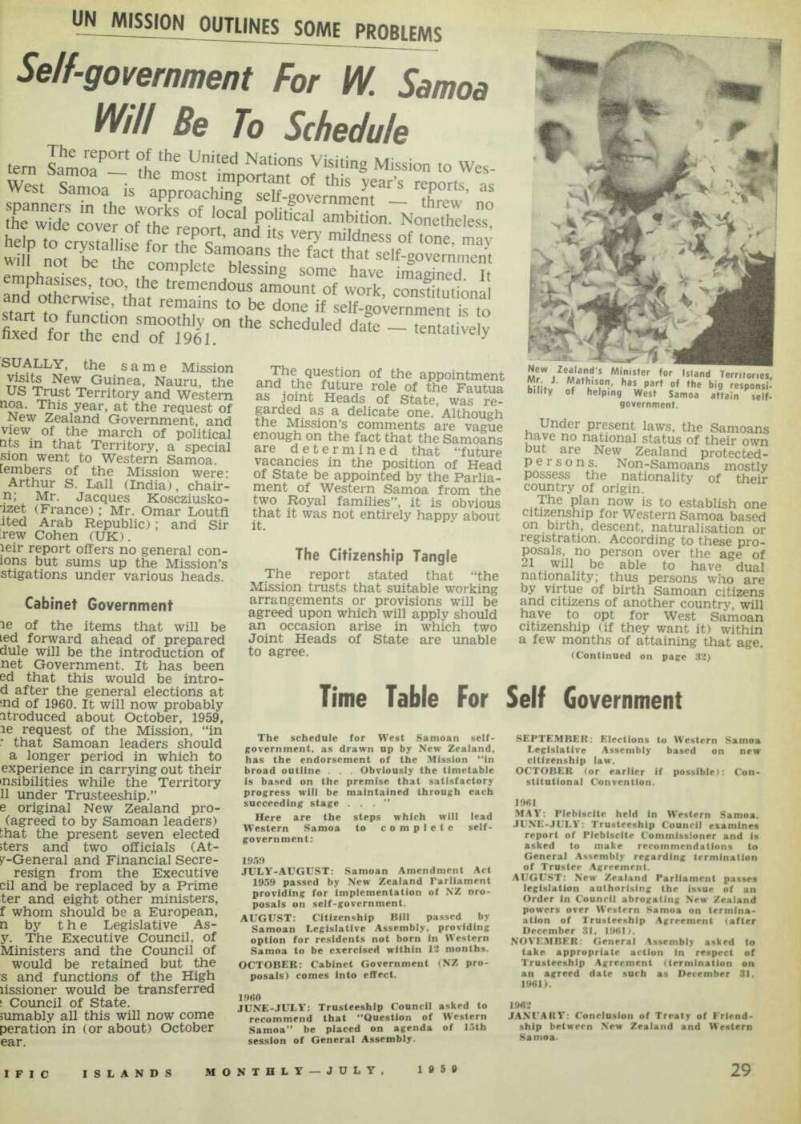
The report of the United Nations Visiting Mission to Wes tern Samoa — the most important of this year's reports, as spanners in the works of local political ambition. Nonetheless the wide cover of the report, and it very mildness of tone, may help to crystallise for the Samoans the fact that self-government will not be the complete blessing some have imagined. It emphasises too, the tremendous amount of work constitutional and otherwise, that remains to be done if self-government is to start to function smoothly on the scheduled date — tentatively fixed for the end of 1961.
USUALLY, the same Mission visits New Guinea, Nauru, the US Trust Territory and Western Samoa. This year, at the request of the New Zealand Government, and in view of the march of political nts in that Territory, a special Mission went to Western Samoa, Members of the Mission were- Arthur S. Lall (India), chair man; Mr. Jacques Koscziuskotizet (France); Mr. Omar Loutfi United Arab Republic); and Sir Andrew Cohen (UK), Their report offers no general conditions but sums up the Mission’s investigations under various heads.
Cabinet Government
ie of the items that will be carried forward ahead of prepared schedule will be the introduction of net Government. It has been ed that this would be intro d after the general elections at end of 1960. It will now probably introduced about October, 1959, at the request of the Mission, “in ? that Samoan leaders should a longer period in which to experience in carrying out their responsibilities while the Territory 11 under Trusteeship.”
The original New Zealand pro- ? (agreed to by Samoan leaders) that the present seven elected ;ters and two officials (At torney-General and Financial Secretary resign from the Executive Council and be replaced by a Prime Minister and eight other ministers, f whom should be a European, n by the Legislative As y. The Executive Council, of Ministers and the Council of would be retained but the s and functions of the High Commissioner would be transferred i Council of State, Presumably all this will now come peration in (or about) October ear.
The question of the appointment and the future role of the Fautua as joint Heads of State, was re garded as a delicate one. Although the Mission’s comments are vague enough on the fact that the Samoans are determined that “future vacancies in the position of Head of State be appointed by the Parlia ment of Western Samoa from the two Royal families”, it is obvious that it was not entirely happy about it.
The Citizenship Tangle
The report stated that “the Mission trusts that suitable working arrangements or provisions will be agreed upon which will apply should an occasion arise in which two Joint Heads of State are unable to agree.
Under present laws, the Samoans have no national status of their own but are New Zealand protected persons. Non-Samoans mostly possess the nationality of their country of origin.
The plan now is to establish one citizenship for Western Samoa based on birth, descent, naturalisation or registration. According to these pro posals, no person over the age of 21 will be able to have dual nationality; thus persons who are by virtue of birth Samoan citizens and citizens of another country, will have to opt for West Samoan citizenship (if they want it) within a few months of attaining that age.
(Continued on page 32)
New Zealand's Minister for Island Territories,
Mr J . Mathison, has part of the big responsi bility of helping West Samoa attain self government.
SAMOA'S PROBLEMS — Cont. from p.29 The Mission urged that the legis- 1ation regarding citizenship be shaped up without delay and the whole matter clarified sufficiently long before the 1960 elections as to allow prospective citizens to know where they stood. The present frame work of citizenship was prepared by the Working Committee on Self Government, but, as the Mission report points out, under the “transitional provisions” it gives residents of Western Samoa no auto matic right to opt for West Samoan citizenship without going through the cumbersome business of natural isation.
The Mission urged that persons
who had resided in the Territory for a reasonable period be given a period after the coming into force of the legislation, to decide whether or not they wanted to opt for West Samoa citizenship. [As in other countries people who are not citizens will not have the right to vote].
Another matter to be clarified is the electoral system. At present the five European members are elected by universal adult suffrage and the 41 Samoan members by vote of the matais or heads of families. The Samoans are evidently content to let this system continue, but the Mission fundamentally is against the matai system ("open to undue influence and pressure"); and is not keen on a separate European roll
(“based on racial distinction”).
The Samoan leaders have stated that they will “consider the Mission’s suggestions”.
Land and Human Rights
The Mission found that considera tion had not yet been given to the question of including some pro visions concerning human rights in the Samoan Constitution. It, there fore, suggested that the Constitution contain provisions on the lines of the Universal Declaration of Human Rights and the Constitutions of other states.
The Mission also suggested that the Council of State should issue a statement on the land policy of the future Samoan State, as in inter views with the Mission many repre sentative groups and individuals had expressed concern regarding the situation after the attainment of self-government, particularly the security of tenure over land which they held as freehold or under lease from the Government or the Samoa Trust Estates.
Samoan leaders assured the Mission that these fears were groundless. After the departure of the Mission from Samoa the follow ing statement was issued by the Fautua with the approval of the Working Committee on Self-Gov ernment : “Land and other property rights in Western Samoa which are held in accordance with the law will continue to be respected. It is the intention to make due provision to this effect in the Constitution for Western Samoa. This applies to the land and property rights of all sections of the Community.”
Public Service and Judiciary
The Mission spent considerable time over the question of Western Samoa’s Public Service and the Judiciary. As far as the latter is concerned, it is generally agreed that the existing system of appoint ing judges from New Zealand satisfactory, for the time being.
The Public Service, however appears to be a shoal upon which Samoa’s new ship of state will strike early trouble. It is evideit from the report by the Mission, and statements from the Samoans them selves, that there is considerable ironing out to be done before Samoa knows clearly where its Public Service is going.
On the one hand, the Mission had numerous complaints from Samoa) public servants about the disparity of their salaries in comparison with those of imported Europeans. On the other hand there is an equal amount of evidence to show that Samoa might be in real trouble over the difficulty of attracting skilled personnel—such as doctors and teachers—from abroad. And overall there is the fact that at the present stage of economic develop ment Samoa cannot support a mon
pensive or enlarged Public Ser vice.
The Education Department is a case in point. Already 20 per cent, the Territory’s budget is devoted education but this is far from adequate. Samoan leaders told the Mission that the financial implications of a policy of free and compulsory education were too much for the Samoan economy to bear d that they hoped that New Zealand would continue its educational aid after independence.
The Mission ultimately “... formed the opinion that the educational iation in Samoa is not satisfac tory for a territory that is soon to self-governing or independent.”
The Mission pointed out also elsewhere in the report that the position likely to get worse rather than better in that the population is inincreasing at one of the highest rates the world. Within the next 20 years it is expected to double its present 102,000 —with a very high proportion of young people who, le they require considerable public expenditure on their behalf, themselves economically unpro ductive.
Enlisting Village Rivalry
Samoa had, said the Mission re- :, “basically a subsistence economy of abundance.” The Samoan social system is such that everyone gets sufficient to eat and the family takes care of the sick and the aged. However, the report makes it quite clear that the Mission considers that if Samoa is to survive as an independent, modern e it will have to do something r e constructive in economic ming.
The Mission attributes the poor cultural methods of the Samoan ant farmer partly to the ex ve fragmentation of holdings the small degree of security to industrious who hold their land
only at the discretion of a superior matai.
The Mission feels that Samoa needs a long-range, comprehensive programme of development and that the best way of achieving results would be to enlist the strong com petitive spirit between villages and districts-the same sort of rivalry that has directed the building of churches, schools and other community projects.
When and How It is a requirement of the UN Charter that self-government be attained through the freely ex pressed wishes of the people con
cerned — which is generally accepted to be a plebescite of all adults. This cuts across the Samoan matai system and required a considerable amount of discussion by Samoan leaders. However these leaders evidently decided that with their goal within reach, this was not the time to stick rigidly to tradition, and before the Mission had left the Territory a meeting of the Fautua and Legislative Assembly had resolved: “This meeting of the Hon. Fautua and Members of the Legislative Assembly, having now given careful consideration to the procedure for the termination of the Trusteeship Agreement and in particular to the need to satisfy the General Assembly.
This was the meeting place of the Fono of ?ipule, disbanded in 1957. The building is used these days as a meeting house for the Samoan Legislative Assembly. It's passing through some historic times.
L the. United Nations, that the request for the termination of the Agreement is in accordance “with the freely expressed wishes of the people,” recommends: 1) that a plebiscite should be held in which the people ofWesten Samoa would be asked whether or not they agreed to the termination of the Trusteeship Agreement and to the en actment of the proposed constitution, and Treaty of Friendship with New Zealand. 2) that all persons over the age of 21 should take part in the plebiscite.”
As the Mission report points out, desire for self-government is by no means unanimous in the Territory. The 3,500 people of the alealili district, for example, had assured the Mission that Samoa was not ready for self-government for at least another 10 years, and the Mission had heard similar exexpressions of opinion elsewhere.
The Mission made it clear that it as for the people themselves to decide for or against self-government; and that they should also
decide when self-government—if
that was the general wish—should come into effect. “A plebiscite would settle the wishes of the Samoan
people . . . beyond dispute.”
Samoan—NZ Relationship
Finally, the report has something say about the future relationship between Samoa and New Zealand.
Samoan leaders have always in tended that there should be a close relationship between their country and New Zealand after the attainment of self-government. This view was initially set forth in the ;ition of 1947 to the United Nations ? self-government and was more specifically expressed in the resolu tion of the Constitutional Convention of 1954.
During the Mission’s visit this aspect of affairs was discussed with Samoans and subsequently a meeting of the Fautua and the Legislative Assembly adopted the following resolution: L) This meeting believes that it is in best interest of Western Samoa to enter into a Treaty of Friendship with New Zealand. Consideration of the terms such Treaty should be undertaken be the termination of the Trusteeship agreement but ratification should not take place till after the termination of Trustee ? in order that the two parties to the Treaty shall possess equal status. ) This meeting considers that the Treaty should deal with matters of ex al affairs and defence but would pre to await a Memorandum being pre ?d in New Zealand before expressing views in greater detail. ) It is considered that the right of Government of Western Samoa to con trade negotiations on its own behalf ild be clearly stated and defined in the Treaty. ? Specific provisions for the terminaof the Treaty, if this should at any be desired by one of the parties, Id be included. ? It is recognised that there are likely
to be a number of administrative matters concerning which Western Samoa and New Zealand will continue for some time to be closely associated. Such matters should be dealt with in some manner less formal than a Treaty in order that they can be easily modified or terminated when desirable.
The Zealand authorities emphasised to the Mission on its return to NZ, that Samoa’s attainment of self-government would be in no way conditional upon its concluding with New Zealand a relationship agreement or Treaty of Friendship, as it might be prefer able to describe it.
New Zealand envisaged the Treaty of Friendship as a short document recognising the independence of
Western Samoa declaring the goodwill between the two countries and dealing with the conduct of Western Samoa's external relations by New Zealand the extent and as may be agreed upon by Western Samoa. There would be consultations between New Zealand and Western Samoa on matters of external affairs which concerned Western Samoa. === Ratu Edward Cakobau, Deputy Secretary for Figian Affairs, re turned to Suva late June after long leave in England. He called in at Christmas Island on the way home to meet Fijian servicemen stationed there.