Unanswered Queries In
pp. 33-34 · Read in the full issue
Those Stubborn Tolais!
The Raraul District
From R. W. Robson, in New Guinea One of the minor mysteries the background of the rela tionship between the Hasluck Administration of New Guinea and the “difficult” Tolais of the Gazelle Peninsula, was the arrival and departure of Mr. Ted Taylor, veteran District Officer I a popular official of Time ore.
THE Hasluck regime in 1958 inintroduced the detested head-tax (£2 per head, paid by all Terri an males, European, Chinese or native—although some classes of natives were given reduction or nption). section of the Tolais refused to The unhappy District officials ed inevitably to their duty, and aduced force. Two Tolais were by police at Navuneram in August, 1958.
There was an inquiry by the Chief Justice (whose long and thorough report, by the way, still idden from public scrutiny by iamentary procedure). The is’ attitude towards Europeans -and still is—ugly.
"Welfare Officer"
About the end of 1958, Mr. Taylor 'ed in Rabaul, apparently with carte blanche from Minister Hasluck. He and his wife were provided with a house on Namanula a car, secretarial assistance,
an office. He travelled all over the District, and talked to innumerable people.
"What is Ted up to?" asked the intrigued Rabaulites. Some insisted that he was planning a new heaven and earth for the Tolais.
"Mr Taylor has come here as a Welfare Officer attached to the Department of Native Affairs'" announced District Commissioner Foldi.
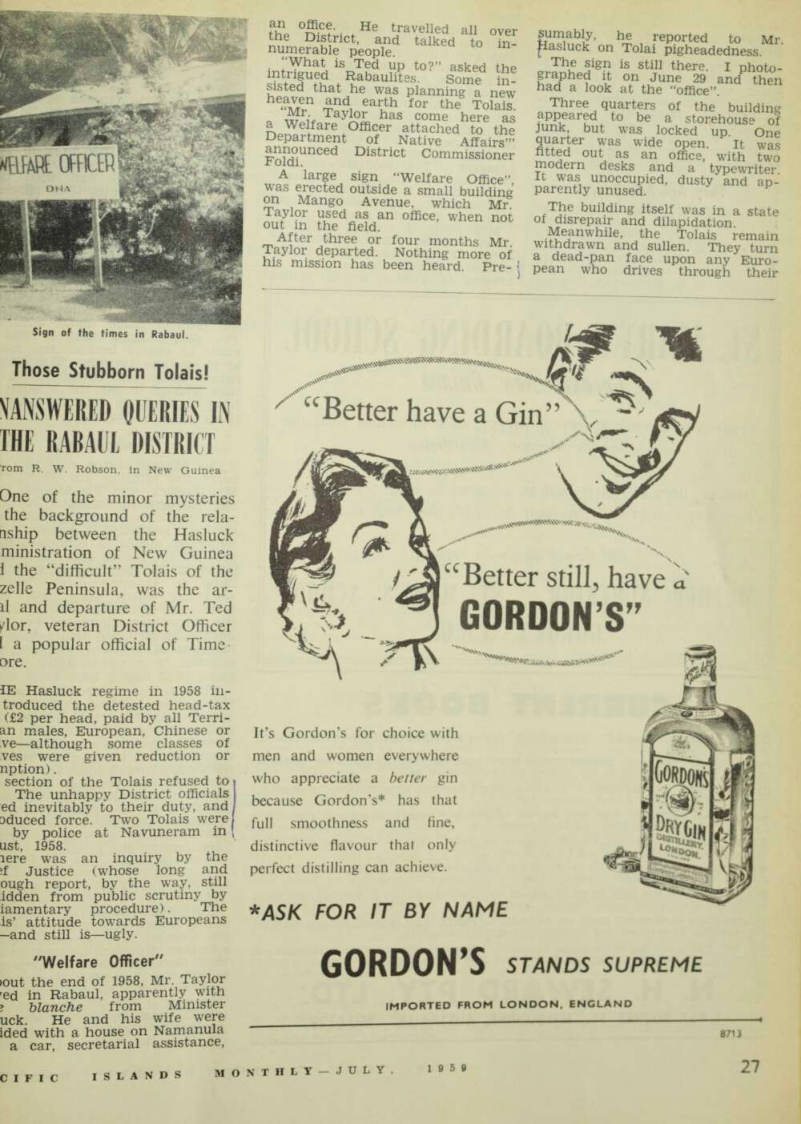
A large sign “Welfare Office” was erected outside a small building on Mango Avenue, which Mr.
Taylor used as an office, when not out in the field.
After three or four months Mr.
Taylor departed. Nothing more of his mission has been heard. Pre-
sumably, he reported to Mr.
Hasluck on Tolai pigheadedness.
The sign is still there. I photo graphed it on June 29 and then had a look at the “office”.
Three quarters of the building appeared to be a storehouse of junk, but was locked up. One quarter was wide open. It was fitted out as an office, with two modern desks and a typewriter.
It was unoccupied, dusty and apparently unused.
Sign of the times in Rabaul.
villages and waves to them a friendly greeting.
Did they eventually pay the dis puted taxes? Officialdom does not know —or won’t say. The Tolais have received many urgent com munications from the Hasluck Administration and they have been “compensated” for the loss of the two men shot by the tax collectors’ police in August.
They Are Anti-Pegs
Their temper is not co-operative.
There have been some nasty in cidents lately in connection with the work of survey teams in this district. Officials—obviously afraid of Top Brass vengeance—will not talk; but it is known that, after
the surveyors go out and put in their pegs, the Tolais pull out the pegs and throw them away—in our Society, almost a criminal offence.
There is a dispute current in Matupi village about some land.
The Administration claimed it is Crown land, and had it pegged ac cordingly. The Matupis pulled out the pegs.
Angry officials lined up the Villagers. “Yes” said the villagers, "we pulled out the pegs. So what?” (or words to that effect).
Presumably, officialdom is still trying to find the answer.
Meanwhile, if anyone would like to be a liaison man between un happy District Administration and stubborn Tolais, he at least is assured of a nice, empty, central
office, and a fine big “Welfare Office” board which now appears to be a superfluity.
Sydney,
The United Nations visiting Mission to New Guinea speaks of the Navuneram troubles in its re port released in June—and gives a hint on what the Government ex pects to get from the work of Mr.
Taylor. The Mission said that dur ing a meeting it had with the people of Navuneram their spokes man said that many Adminis tion things were not very good, In the Government schools “no good work or progress has been taught the people”. There were no subjects that taught people how to run a business. Some local people had formed a co-operative which later “fell down” because they had not learned much about business.
The people knew that it was a waste of money because the man agers had no training. The Nayu neram spokesman ended by saying they wanted to ask the Mission to have America or England to take charge of the people.
"Weaknesses"
The Mission stated that in Can berra the Minister for Territories, Mr. Hasluck, told the Mission that the Navuneram incident revealed some weaknesses of the Adminis tration: basically it revealed the imperfect means of communication between the people and the Admin istration. The Administration “would have to examine every possible weakness which may have con tributed to the events”. He said that the Navuneram Commissioner (Mr.
Justice Mann) had found that the question of taxation was only in cidental to a much wider dispute going back over a number of years The Mission added that among the matters relating to Navuneram that the Minister said he was now giving attention to included tax ation, the problem of land shortage measures “to bring closer contact with the natives”, local Government Councils, the problem of Native Affairs officers assuming magisterial functions, the too-frequent transfer of officers, and measures to improve communication between the Admin istration and the people.