Pocific Report
pp. 117-150 · Read in the full issue

. , Th f mon th’s round-up of news and pictures of people and .vents, from PIM correspondents in the South Pacific.
Killed in NG
p Explosion
wenty-one people were killed the same number injured in vak Harbour on May 12 when 300-ton Busama blew up in a es of violent explosions. ie was unloading drums of fuel Vewak, which has no port facil ;. A winch lifted drums from the 1 into the water where natives tn to the beach pushing the ns ahead of them, lere was a first shattering ex ion aboard the Busama shortly r 10 a.m., with flames soon roar -200 feet into the air and sur d’s struggling in the water among ling cargo ; the time, a 20-year-old cadet ’s officer, John Edwards, was ag a motor boat from his ship, Malekula to the shore. He im iately turned back, and with e native Police bandsmen he with him, began to rescue the uggling men, despite the tendons heat from the burning and danger from further ex ons. The party rescued six sur rs. tiile Edwards and the bandsmen ed out rescue work, the Dis- Officer, Mr. T. W. Ellis, and Agricultural Officer, Mr. J. :e, and a native crew, leapt into >rkboat and started to pick up vors at no lesser risk to them s. d the townspeople of Wewak organised themselves into iteer fire-fighting units, ly one of the 21 dead was a op e a n—the Busama’s First er, George Riik, of Sydney. But reports of the tragedy were ised and many early Press re published in Australia and eas gaves the names of other peans as being “dead”, too. 3 included Mr. Dan Anthonson, B usama’s chief engineer, who his death report in Lae a few later. 5 Busama’s master, Captain Greggor, told a PIM corre lent in Lae when he arrived
from Wewak, still shocked, that there was no doubt in his mind that the explosion had been caused by one of the natives lighting a match and exploding the fumes.
He said that they had had a leak ing drum on board and the hatch had been sealed down and crew members warned of the danger.
During the nine years of carrying fuel they had often experienced leaking drums.
Captain Greggor was ashore when the explosion occurred and heard the first explosion at breakfast. But somebody had suggested that the locals were dynamiting fish and no notice was taken until more ex plosions occurred.
Acting Second Engineer Tan Mok Sing, dazed and shocked, had just come ashore and he indicated all the crew had been caught on the ship.
It was from this information that the confused report of Anthonson’s death arose.
Captain Greggor said he owed his life to Mr. George Rio, who had delayed him ashore to have break fast. Rio, crocodile shooter and col lector, had signed on as crew.
Dan Anthonson said he owed his life to Mok Sing. He explained he had been in his cabin when the first explosion occurred. He had rushed out and was met by a wall of flames. But he got to the deck and found Mok Sing there looking for the first mate, George Riik.
He and Mok Sing had both jumped into the water where Mok Sing had climbed into a nearby dinghy and pulled Anthonson —who cannot swim—a board. But the
Capt. M. J. Greggor, Master of the "Busama".
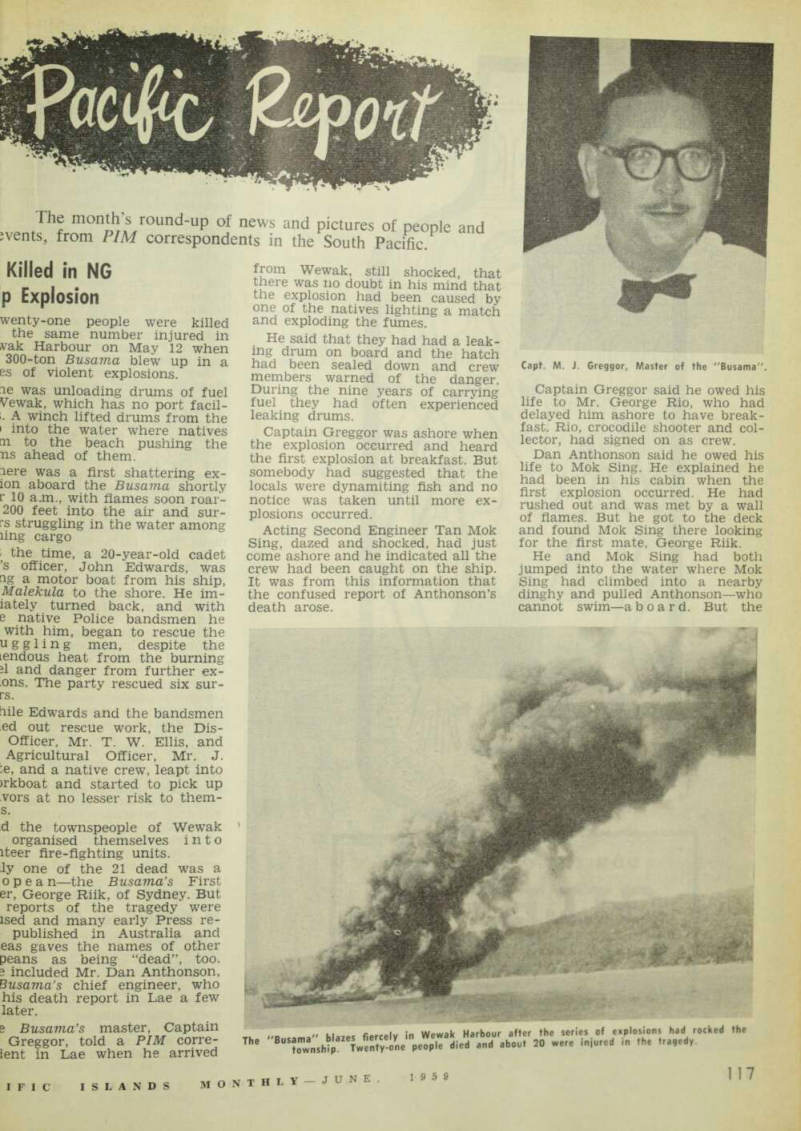
The "Busama" blazes fiercely in Wewak Harbour after the series of explosions had rocked the township. Twenty-one died and about 20 were ijured the tragedy.
dinghy was too hot and they both got into the water again, and eventually got ashore.
A marine enquiry into the tragedy began at Wewak in late May.
Fiji Manganese Has Its
Ups and Downs
Although 22,500 tons of manganese ore valued at £F402,400 were ex ported from Fiji in 1958, lowei overseas prices this year wil probably mean a considerable droj in the value of ore shipped. The quantity exported is not expectec to reach last year’s figure.
Most Fiji manganese goes to USA to United Steel Corporation (o: one of its camouflaged subsidiaries) Nowadays, USC can pick and choosj its source of supply at lowest rates since world supply exceeds presenl demand. Indicative is the price o: around £FI2 per ton, f.0.b., Lautoka against last year’s £FIB and £FI9.
One large mine at Nasaucoko Sigatoka Valley, operated by Con solidated Manganese and Mining Co of Fiji Ltd., closed down at the em of 1958 because it was uneconomical Ore is still being shipped inter mittently by another concern, Fijial Ore Co. Ltd., but is mainly from the accumulated stockpile. Charterd vessels usually load the manganese in drums lightered out to the shij off-shore at Lautoka.
Latest development was the shira ment from Suva to Japan of 88( sacks of manganese from diggings at Cicia, Lau Group Banno Bros. (Fiji) Ltd., (off-shoa of a well known pre-war JapaneiS Pacific firm) handled the consign ment.
The presence of manganese in th| Colony was long known but it wan not until 1948 that exports got undel way, as a result of exploitation ii a primitive way by a Fiji-Indiai company. Other companies, sorn> with overseas capital, became In terested and a managanese “boona ensued for a few years, with creasing exports at good prices. I Most of the manganese is from open cut mines, often not readi® accessible. Haulage costs to the shin ping point have taken any creaiji off the returns. Weather in tit north-west section of Viti Levu h£ at times been against the industrr too: mines were flooded and toe rential rain caused road washawayr
He Spent 16 Years
In Netherlands NG
More than 400 people attended! farewell function in Hollandia t Netherlands New Guinea’s Direct® of Health, Dr. J. Bierdrager, wit left NNG last month after mofi than 16 years service in the tem tory. High tributes were paid t Dr. Bierdrager as a man of forte sight, who has clearly left his mam in the Dutch Territory.
Ithough the real development of G did not start until 1950, Dr. rdrager first came to the Terri -7 as far back as 1932, when he i director of Mission Hospital at oei. He was in that position il 1936. e spent the war years as a ;oner-of-war, but was back in G in 1947 as medical adviser to Netherlands Petroleum Company Sorong, where he remained until I. e was appointed Director of Ith at Hollandia in 1954. r. Bierdrager was a member of Research Council of the South ific Commission and has repre :ed the Netherlands at other in .ational meetings.
Button Factory
r a Song
ie Fiji trochus button industry, blished by two separate com ics under a restricted licence ngement granted by the gov nent as a protection to a new :rprise, is just about dead. )me batches of unfinished iks are being made and exported -sionally, but the Laut o k a hinery—or most of it —is avail to anyone elsewhere in the ids w r ho feels that conditions such that an industry could ive. ie price of trochus in Fiji, even ts present rather low level, is to be too high to permit corn ion on the world market. Mr.
D. Lakshman, owner of the :oka factory, said that the hinery was of the most modern nan type when installed, lere was a great deal of secrecy jealousy in the button making ness and his operatives had to
a lot of experimenting befpre
mastered the art of producing hed buttons. He would be glad ain the staff of any co-operative
or organisation which took over the plant.
Mr. Lakshman said that there appeared to be a possible opening tor a button making industry based in New Zealand territory, with the present import restrictions into that country limiting imports from Fiji and elsewhere. No doubt New Zea land would give protection to such an industry based,' say, in the Cook Islands.
They're Going to Control
Fiji Lotteries
Laws governing the control of lotteries in Fiji come into force on July I—but, in some directions, their effect may be the reverse of
what was intended.
One of the purposes of the new law is to limit operators’ profits and to divert a larger share to charities which derive a useful percentage of their operating funds from this source.
Now, however, there are already signs that fewer lotteries will be operated and that less, instead of more, funds will be available for charitable work, because operators just won’t operate if they don’t get enough profit—and it seems that under the new laws no profit is allowed.
The amount allowed for expenses “must not exceed those actually in curred, or 10 per cent, of the whole proceeds, which ever is the less”.
Whatever the merits or demerits of
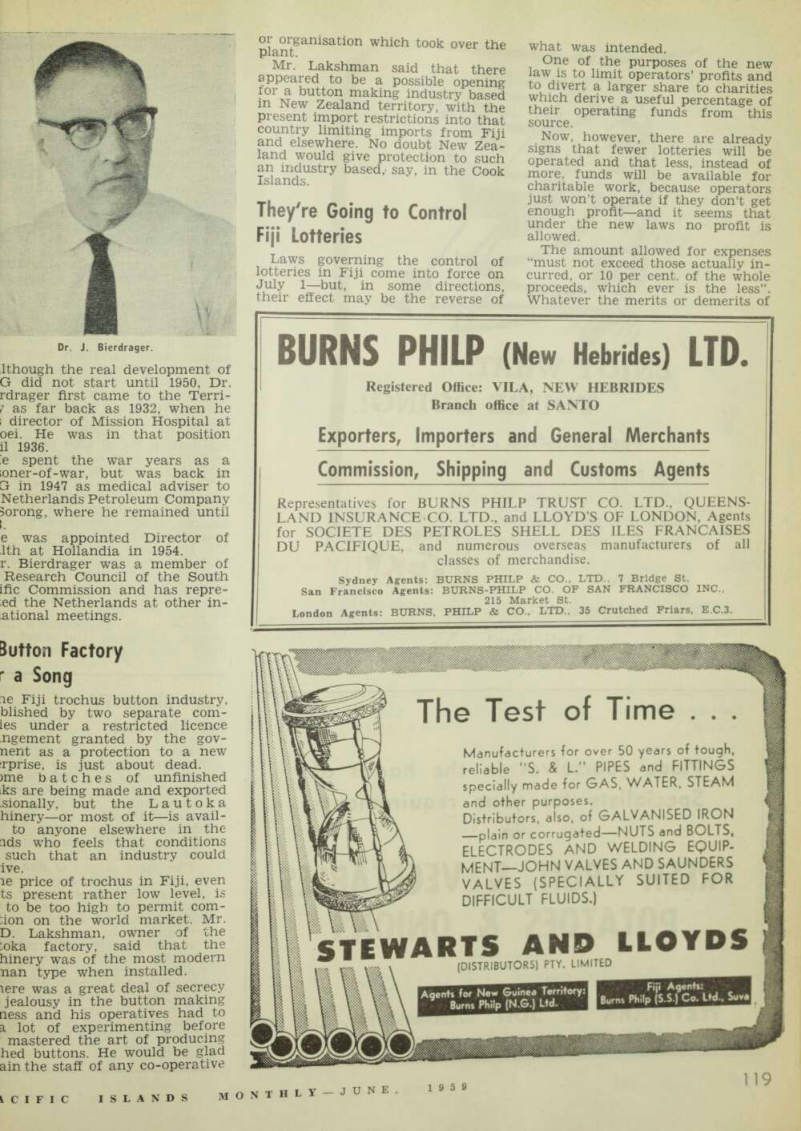
Dr. J. Bierdrager.
lotteries, the share that goes t( charity will certainly be reduced ij the number of lotteries operated bj various organisations falls sub stantially—as seems likely to be th( case.
The new law provides for threi categories of lotteries —the bazaa: lottery where tickets must be sol( and the lottery drawn during som( entertainment; a society’s privah lottery—where the sale of tickets i confined to the membership of th) particular society and the proceed! are for purposes not connected witl gaming; and a society’s publii lottery—where tickets may be soU publicly and the proceeds are in tended for sports, cultural activities or other purposes of a non-com mercial nature.
The prizes are limited to a tota of £l,OOO, the total value of ticket to £5,000, and no ticket may b( sold to a person under 16 or by i person under 14. There is a regis tration fee payable by the promote! of a public lottery. There an numerous other minor provisions.
An agent for an overseas lottery-] Australian State lotteries pleas« note—will be required to pay i registration fee of £250 per annum and in this case no tickets may bi sold to a person under 21.
The new regulations have been on the way for a couple of year; and are the outcome of a campaign against lotteries instituted by Polid Commissioner Beaumont in 1957 Mr. Beaumont was of the opinion that Fiji had far too many lotteries and that there was far too littj control over a practice that had goi out of hand—and PIM was inclined to agree with him.
However, he displeased a lot o) people, including the local Suvi daily newspaper, which wrotj
torials about him and what he >posed to do. The crux of the ole thing appears to be that Fiji ; no social security system, and -t some charitable institutions re therefore come to rely heavily the profits that come from ;eries. In the same way, as Fiji i small community with the over elming majority of people in the y low income brackets, it has J been a convenient way for sing money for sports clubs and er social enterprises, n the ultimate analysis it is trly wrong that sport or charit s institutions should be financed this way. But in Fiji, as else 3re, organisers have taken the ms that come readily to hand ivercome a problem that is more te than the rightness or wrong s of gambling. Most countries done gambling in one form or 'ther, and divert profits or taxes reon to good works, he answer might be, of course, a State lottery of some kind, may once a year instead of all the dl lotteries that now take place, i all the charities that now efit from the small lotteries get : their share of the big one. ut as was pointed out in Fiji he time of the 1957 controversy, Colony is probably not large ugh to support a State lottery how—even if the missions didn’t the idea in the bud at the out
:ommodation is Tonga's
irist Problem, Too
lot of people would like to visit ga for more than just the few rs that the Union Company s have in port—and Fiji Air s is ready to take them there, at the present time there is a single hotel or boarding house lable to tourists at Nukualofa, le former Beach House board
i?«W«SS?^pJSfby a a , ?£jS were P drawn*?® *11” the "request* 1 of Zealand" 88 " G ° Ve “ 6 in N it Tet n^ecently a the ee Tongan
ernment^as^een^havS™?alks with
an overseas hotel organisation to could* h? rS^fw?* 01 ? a £rangement can tal woufd^hniiH^ 7 ? vei ? eas good hotel ld (Sep d n f£ te a gooarounst notch (See p.4S). moment Tonga is virtually closed to tourists, unless they have friends there who are able and willing to accommodate
S““i "* i 4 ls necessary that the When aFiji Airways aircraft made » “ pr “ Whe^fo^ofe
¥o°r£a? ".«S? JWV£
males. On this occLton thP tSiJJ Government made available a gov ernment house, temporarily g£n °ccupied pending the arrival of an official from overseas, but this arrangement would not be available regularly Mr. C. Ritchie, Manager of Fiji Airways in Suva, who travelled to
nga in the April flight, said that a’amotu Airfield—now only used ularly by New Zealand Civil lation Administration DC3 air ft in the course of their quarterly :ck of Islands radio facilities — 5 in first-class condition, and ild be completely satisfactory for :on aircraft operations. The •on was just the aircraft to idle the traffic that would appear be offering if the accommodation blem could be overcome. The fare ,rged on the April flight was that ; charged by Teal —£Fl 7 single ut that would not necessarily be fare if fairly regular non eduled flights were made. The rter rate, for anyone organising 3ur party, was £5O per hour for Herons, and on this 400-miles tit from Nausori the payload ild be 2,500 lbs. The payload ies from 3,300 lbs for a 100e flight to 1,400 lbs for a maxi n range flight of 900 miles. On Nausori-Tonga route this would resent about a dozen passengers . their luggage, and the flying e is about 21 hours.
'eading the Dutch
ssage in America
acification of Dutch New Guinea be completed within seven to :h t years, Dr. Jean Victor Jruijn is currently telling Ameri radio and luncheon meeting iences. eßruijn, Director of Native lirs in the Netherlands New nea Government at Hollandia, is man who achieved fame as the ogle Pimpernel” of World War he was a one-man commando ; behind Japanese forces in Wissel Lake region of Dutch r Guinea, playing hide-and-sepk i large forces of Japanese who ted him without, fortunately,
Succoss
i the United States to deliver Netherlands New Guinea re ; to the UN Committee on Non f Governing Territories, Dr.
Deßruijn also made a speaking tour across the nation, part of a Netherlands Government scheme to combat anti-colonialist belief, which makes many Americans favour Indonesia in the continuing dispute over NNG. In San Francisco, where he began his tour, Dr. Deßruijn made numerous radio and television and public-speaking appearances.
One-third of NNG is not yet con trolled, he said. But the intensive
Dutch patrolling programme will re sult in complete pacification by 1967 “should Netherlands sov ereignty be continued”. Self-gov ernment for Dutch New Guinea will follow pacification at a time when the people are able to express them selves on the form their independ ence will take.
“It is beyond human power to predict the shape of future human behaviour,” the anthropologist said.
And, he continued, it is thus beyond human power now to predict when the native people of Dutch New Guinea will be ready to determine their own future and the form their government will take.
One of the most important and ■essential steps that will precede this, Dr. Deßruijn said, is the need for Papuan peoples to learn to work regularly and to save, instead of following the working habits of village life. “If they are to stand alone in the modern world, they must learn to produce for world markets things the world wants: this can only be done with regular and systematised working habits.”
Racially, culturally and even in flora and fauna, Netherlands New Guinea is not related to Indonesia, Dr. Deßruijn has been telling American audiences. Indonesian de mands for West New Guinea, he
work is progressing steadily on Madang's 86-foot-high bomb-shaped Coastwatcher's Memorial lingthouse, being built in memory of the men who kept track of enemy troop and ship move ments along the New Guinea coast during the war.The is how it looked in early May.
The latest of a pair of International ambulances just sent from Australia to Lae, New Guinea.
This makes a total of eight Inter national ambulances now being operated throughout P-NG by the Administration.
The latest two have been built on a shorter wheel base than the previous six, and are ex pected to be even more suited to the twisting NG roads.
s, are based on demands for otiations, with a requirement t negotiations begin with Dutch cement to surrender sovereignty. 3 cannot even talk to them on premise—that we yield — be se we cannot sell people like mch of cattle,” the Dutch official 3. s part of the Papuan education ards self-government, he said, 35 the 65 administrative districts, ilar to sub-districts in Papua r Guinea, are now in charge of :ve patrol officers. The native "ol officers, trained in a school Hollandia, are fully responsible their districts and for admin ring justice in the areas, he said, ch district officers, he said, 3rvise their work and offer ad
no Beetles Don't
id The Estimates
)r every ton of copra produced, growers pay 17/6 to a fund to e war on the Rhinoceros beetle /ctes Rhinoceros ) on Viti Levu id, which by damaging coco palms is a real threat to the ny’s £F3,000,000 a year copra ■stry. though the beetle infested part imoa and Tonga for years, none found in Fiji—until 1952. With K loan of £20,000, the Rhino, le Eradication Board was set to control and wipe out the A tax (subsidised by the Gov ient) of £2 per ton was levied jopra-growers, reduced to 10/- 954 as the original loan was id, but subsequently increased
Vi 1958 when it was seen that further control efforts were necessary (The UK loan was paid back, early in the period).
Copra producers learnt with dis may in April that, because of lower income due to reduced production of copra, the Rhino. Beetle Board had curtailed the activities of its control teams. Some 60 field workers were recently retrenched and anti beetle treatment ceased in a number cf infested areas.
Control work now is being con centrated on vessels and port areas (so the beetles won’t be carried to Vanua Levu, Taveuni or Lau, the main copra islands) and in the most beetle-infested districts.
The onus now is more than ever on land-holders to carry out their obligations to destroy potential breeding-places (rubbish heaps, rotten logs, stumps, etc.).
Fiji’s finances might indeed be tight but Rhinoceros beetles couldn’t care less and will merrily go on breeding. Beetle control does seem to be one direction in which a little more Government money might be channelled: or the planters themselves should raise the ante— the jackpot at stake is too valuable to let go by “too little, too late”.
Sago Industry
Planned for NNG
Two Dutch experts from a big starch factory in Holland have just completed investigations that may lead to the establishment of anew sago industry in Western Nether lands New Guinea, in the Vogelkop region.
Working with a team of 25 natives, they found that good quality sago could be produced mechanically and that the raw material pre sented few processing problems.
The product would be sold on West European markets.
Their report recommended that a factory building be started in 1960 near Jamarema village, on Metamani River, Inanwatan. There are enormous sago areas in this swampy coastal area, and the palms are a variety without horns, making the trunks easier to handle.
When the sago mill goes into production, probably in 1961, it is calculated that 20 Dutch tech nicians and 750 NNG labourers will be employed.
What's HE Looking At-
-Them!
the chap with the bag over his head is a BBC television cameraman in action with all his gear at the Royal Hotel, Levuka, fiji. The occasion was an islands night of dancing and singing by Rotuman and Samoan girls and men. As the BBC man pointed his camera at the attractive Rotuman dancers. Fiji PRO cameraman Rob Wright pointed HIS camera at the BBC man.
to Ex-Servicemen
Some Action
French Ex-Servicemen’s Asso on was formed at Santo, New rides, in April and Gallic )ur was appeased. It happened way: st before Easter, M. Pechoux, i Commissioner for France in Pacific, went across from nea to New Hebrides, and a tail party was given in his >ur at Santo Club, grettably, the local French inistration forgot to invite any ree French veterans to the affair; ey made a strong protest against fact that while those who ht in North Africa and France Vorld War II were ignored, J-quarters of the 125 guests non-Frenchmen. Among them, ritisher heading a delegation the Japanese fishing estab lent at Palikuio and a number hinese residents, noyed and irritated, some ex cemen went uninvited to see High Commissioner and ex ed their displeasure. A former French fighter himself, M. oux ordered an immediate in cation. Soon afterwards, the d French Administration edly requested the locals to a French ex-Servicemen’s nation. They won’t miss out time.
Should Be Cheaper
he S. Pacific
present developments in the i Pacific petroleum products
distribution system are any indica mn^ 0ll 4?°V ld be Reaper soon in Tonga Western Samoa, and the Cook Islands.
Shell and Vacuum have been looking into the matter of establish ing huik oil tanks at Apia and Nukualofa, the oil to be hauled from Suva by the new Tonga govern ment ocean-going tug Hifofua, and associated oil barge still building in Auckland.
So far as Apia is concerned, oil has been supplied there in drums from Suva by Shell and Vacuum.
The recent freeing of dollar cur rency in Western Samoa has had the effect of allowing Standard Oil of California, who already supply Papeete and Pago Pago, to supply Western Samoa with oil in drums at a somewhat lower price than the opposition.
To meet this challenge, Shell and Vacuum would supply in bulk—if the technical details can be ironed out.
Across in Rarotonga the Resident Commissioner indicated to the Island Council at a recent meeting that South Pacific Trading Co., a local firm, would be given sympa thetic consideration in their applica tion for the lease of a piece of crown land for a bulk oil installa tion on the foreshore between Avarua and Avatiu, opposite the Mormon Mission station.
This company’s schooner, Tiare Maori, has been bringing in oil in drums from Standard Oil’s Papeete terminal over the past two years, and this has been retailing at a substantially lower price than the Shell product supplied in drums from New Zealand.
One of the reasons for this is that the freight rate on empty drums from the Cooks to New Zealand is prohibitive, whereas the empties can be sent from Rarotonga for filling at Papeete at an economic figure.
It is not known what provision South Pacific Trading Co. is mak ing for the transport of bulk oil to the proposed Rarotonga tanks, but there have been coconut radio reports that the company has been looking into the relative merits of a plastic oil bag for the schooner’s hold, or a plastic towing-tank, or some other type of oil barge. There have also been reports from New Zealand that Southern Cross Ship pi n g Company’s Suva-registered 470-ton tanker Verao, probably the only tanker in South Pacific waters not owned by an oil company, normally running molasses and whale oil across the Tasman, might be available for the movement of oil cargoes to small ports from time to time. Verao, however, was reported to be for sale, complete with her work contracts, in recent months.
Over the past year or so bulk oil installations have estabhshed of wnninra and at Palikuio tuna, flshtag base in the New Hebrides,
ing underfed about this healthy Nether- New Guinea baby. Holding him is Dr. D, [?]elaar, who is head of the malarial control section of the NNG Government.
of which have brought the of certain oil products down ;antially.
ich Frieds on Menu
in—From Tasmania
restricted export of Australian oes to New Caledonia has been led after a break of 18 months, g which few consignments were rted by Noumea merchants. :rency difficulties were the n given by the French Gov ent for the almost-total em- I. )-level negotiations went on in for the resumption of the , and the recent easing of im prohibitions in France was red by the lifting of the potato stions, and some others, in Caledonia. j man who breathed a sigh of at the announcement was Rt. lohn McEwen, Australian Min for Trade —now he will have peace from Mr. Gilbert e, Labour Whip in Federal ment and member for Wilmot, mia. Acting on behalf of the mian Potato Marketing Board, >uthie has been questioning, ig and pressing in the House le New Caledonia trade re ion for more than a year, mia normally sends about sacks of potatoes to the i Colony each year.
They're Settling Back
Into Tin Can Island
A permanent settlement has been re-established on Niuafo’ou, north-western-most island of the Tonga group, and soon there will be a radio communications station there again.
Just after the war there was a major volcanic eruption on this island. A good deal of damage was done and the population was evacu ated to Eua Island, south of Tonga tapu. For a year or so there was no one living on the island—which is better known as Tin Can Island from its former method of trans ferring mails by sealed can from ship to shore with the aid of a swimmer. After most of the volcanic activity had died down, copra making teams were taken back for short-terms, but no women or children were allowed to return and there was no permanent settlement.
Now some 300 people, including children, have returned perman ently.
The Copra Board’s new Aoniu is taking stores there and uplifting copra every two months. Lately production has been at the rate of
about 150 tons per trip and it is ex pected that a radio station for com munication with Nukualofa will be re-established this year. There have also been discussions on the pos sibility of sending a school teacher to the island.
At Niuafo’ou all cargo has to be handled by boat. Two surf boats for this are left at a sheltered port on Keppel’s Island to the eastward.
At right, on board the "Tulagi" from Sydney to Honiara, Mr. and Mrs. J. A . Rrooks. With sons David, 6 , and Allan, 5, and daughter, Heather, 2. Mr. Brooks will work as a carpenter in Honiara and Mrs. Brooks will take a post as teacher.
y are picked up by Aoniu there taken to Niuafo’ou and later irned to Keppel’s, as it would be cult to haul them out at afo’ou.
ricuitural Science
iws The Way
iat money spent on agricultural arch is money well spent for the re community, is shown in a 5W of progress in Hawaii made he Dean of the College of Agri
ire, University of Hawaii.
; a result of advances in tech gy over the past 25 years, the iw says, the average farm worker lawaii now produces 2.4 times tiuch food and fibre than was - a quarter century ago. Crop Is per acre have been increased 3 per cent., and the productivity ivestock and poultry has been Jased by 50 per cent, i hour’s take-home pay, despite tion, now purchases nearly J as much bread, 33 per cent. ! steak, twice as much chicken, ; as much milk, three times as V oranges, and three times as V canned tomatoes. t only has the price of food i in relation to earnings, but selection of food is much more d, and it is claimed that the ige “homemaker” who works save several hours per day now archasing packaged pre-cooked ; and even entire meals, us, says the review, agricul research in Hawaii has bene the city dweller as much or than the farmer who produces staples of life. search in Hawaii has not been ;ed only to increasing output quality of farm products, but to the marketing side and all spects.
i of Birth
frol in Pacific
making at the Fourth South ic Conference in Rabaul a a delegate, Mr, Semesa Sikivou,
£ hat acceleration of health nnnS 5 . Could result in overpopulation in some of the Pacifir ?esourn^ es ™ hich had limited resources. This was a very bie problem which placed the people in a dilemma. p p He said: “Your conscience tells you that social services are good and make for better living, but on the other hand you have to deal with the natural consequences of such services. If you promote increased population through health projects you must also make provision for these additional people”
Mr. Sikivou explained that he was not for a nmment advocating a return to primitive customs as regards the health and care of women and children, but pointing out that improved health care presented problems which had to be faced.
The answer for those Territories which could not support a larger population lay, of course, in family planning—birth control—but experience had shown that the less educated people were, the more difficult it was to get them to realise that brakes on population increase must be applied when there were not the resources to provide for more people.
Mrs. H. Jacquemin, representing French Polynesia, said that in some of the Eastern Pacific Territories, progress in infant and maternal welfare services was already creating a serious problem of excess population. On Wallis Island during a three month period in 1958 there had been three deaths as against 100 births.
Both delegates were discussing a paper on the role and function of customs and beliefs in relation to infant and maternal welfare.
nr -r
US Trust Territory
hi.. '
Under Fire
„ ? n ® + of • tha best known anthro pologists in the United States says r ne S lect of the Pacific * sla rf ds Trusteeship Territory is a national disgrace”, ■ la ’ he said, “is making a relatively greater effort” in the Territory of New Guinea than the united States is making with its Ce n tral Pacific dependencies. The t i P e °P le of the Micronesian Isl ands, he says, were far better off nnder Japanese rule than they are today.
Professor George P. Murdock, Yal f University anthropologist and past president of the American Anthropological Association, spoke m San Francisco at a University of California lecture series on “The Pacific World.” He has been a recognised authority on Truk, due north of New Britain in the Central Carolines, since he headed the huge us Naval anthropological expedi tion to the Pacific in 1947.
“ The United States has done a perfectly abysmal job in the Trust Territory,” he said. “We have been niggardly, have given the people much less than the Japanese gave them, have allowed altogether too little for resources to do an effective job and have left the administration completely understaffed.”
While pouring out mililons in foreign economic and military aid, he said, the United States “is fail ing miserably in the two areas—the Ryukus and the Micronesian Islands—where we have local and moral responsibilities to the people.”
When the islands were under De
ahitian member of the Polynesian Associa of Sydney, Mademoiselle Vilna Hinano [?]anui (right), at an Association function Miss Pauline Sullivan, of New Zealand [?]d M. Celestin Tokoragi, of Faaa, Tahiti. —Tele-Photo.
rtment of the Navy control before •1, he said, the administration s able to do a better job because not only had more money but ild call on all the Pacific re irces of the Navy. Since the De rtment of the Interior took over ponsibility, he said, “almost noth ' in the way of funds” has been »vided. j ack of money, he said, has ced the administration to drop staff anthropologists it formerly intained in each administrative trict. The excellent tropical agri tural station established by the )anese at Ponape in the Eastern •olines “has been allowed to go ruin.”
'here have been only “limited •rts” at fostering native trade I industry although handicrafts uld and could be fostered for Drt income. Fisheries and cannery astries should be promoted as 1, he continued.
'he administration, he said, is i out of step with the Micro ians’ desire for education. There said, and some students are be sent to the Hawaiian Islands higher education. “But schools the islands are below what the Ditions of the natives call for, quality of the teaching is smal and the opportunities (for lents) are just not there,” he ed.
:ord Sugar Crop
Fiji
ccording to an estimate of the i of sugar-cane in the Fiji 3 season now about to corn ice, the crop in the Lautoka and awai mill areas should alone ied the total crop record of past •s. reatest yield for the total crop in 1958, when 1,531,304 tons of 3 was crushed. The total for is predicted to be 2,075,000 tons ane. le estimates for the individual areas, and the dates on which 3 mills were to commence crush are as follows: Nausori, 141,000 , June 16; Rarawai, 562,000 tons, 26; Labasa, 282,000 tons, May Lautoka, 954,000 tons, May 26: mg, 136,000 tons, June 2. vourable weather, new varieties cane, and good cultivation tices are responsible for the rd crop.
|hter Signs
tew Caledonia
sign of New Caledonia’s brighter omic outlook is the re-entry service of the Nickel Corn ’s motor ship Quebec, which been laid up for nearly a year ise of the slackening demand lickel.
Rushwood. which has been on charter to the Nickel Company ° re and coal between Caledonia and Australia, has and o^h» retU , r , n ! d , t 0 her owners and Quebec will take over.
Cooks Oranges Leaving
Sourer Taste
Mr. C. Ross Walker, general manager of Fruit Distributors Ltd., the organisation importing the entire Cook Islands citrus crop into New Zealand, made an inspection tour of the plantations in May— and was less than enthusiastic about Cook Islands oranges.
Mr. Walker said that the Cook oranges were falling a good deal desirable standards but that his organisation—a company formed by all the main fruit im porting and wholesaling firms—was forced to accept them as New Zea land was committed to supporting the Cooks citrus industry.
There were better oranges avail able—from Australia for example— and they could be landed more readily at a greater variety of New Zealand ports due to better shipping connections, thus greatly facilitat ing distribution throughout the country.
Because Cook Islands oranges are not up to the general standard of
other imported oranges, the price this year had been slightly reduced A Cook Islands announcement said that the price to growers this year would remain the same as last year and that the Fruit Control Scheme —and the New Zealand tax payer—would absord the loss re sulting from the lower price agreed by Fruit Distributors Ltd.
The price to growers varies frorr a maximum of 17/7 per li bushel case of oranges in the size-rangf of 126 to 250 fruit per case, foi first grade fruit, down to 10/10 pel case for smaller fruit in the second grade category. Sound mandarins and tangerines bring 13/11 per two thirds bushel case, regardless oi fruit-size.
The price payable to Cook Islands growers for bananas—which are still in low production—is fixed at 11/2 per ll bushel case. From the abov« prices the growers have to find the cost of cases—about 7/6 —and mee certain other costs.
Changed His Residence
Lost His Trip
Clause 94 of the French laboui code raised its ugly head again ii New Caledonia in April—but wa suitably dealt with.
This clause, which gave Nen Caledonian employers quite a shod when it was brought out for aj airing some months ago, provides that, under certain circumstances employees from Metropolitan France are entitled to paid holiday in France every three years.
In April, a M. Jean Casarol appeared before the Noumea!
Labour Tribunal, and appealed tc the authorities to direct hi employer to pay for his and hf wife’s repatriation expenses a stipulated in Clause 94.
The Tribunal denied M. Casarolil application on the grounds tha after eight years’ residence in Nef Caledonia, in which time he ha himself brought out his wife, i could fairly be considered that M Casaroli had changed his resident*, habituelle, and could now be com sidered to be a real New Caledonian!
And Was It The Last
Of The Great Singsings?
The NG Highlands’ singsing tc end all singsings (predicted in PlM\ May, p. 143) came off at the be ginning of May. It was at Ogelben# airstrip, four miles from Mourn
Hagen. I
There was one day of spectacular dancing, when 1,500 Mogei with ceremonial dress and spears?; met another 1,500 Jiga tribesmelt on the strip. They are traditional* enemies—or they were until civilisarj tion came to the Highlands just be fore the war. But although 3,000' warriors took part in the dancings
lother 20,000 to 25,000 natives rned up to see the tribesmen go rough their act.
That made it the biggest native ganised singsing at Hagen since 41, when George Greathead was DO there.
There was possibly a bigger crowd 1957, when the Australian Gov nor-General, Field Marshal Sir illiam Slim, paid an official visit, it that was an officially organised igsing, and the May effort was e which started in the minds of e native participants seven years o.
Since then, the preparations have en going on, quietly at first, but ilding steadily, until three years □ anybody closely connected with 3 native people in that area knew it what was developing was going be big. There were small cere mies as part of the mounting emonial cycle, with gift exchanges pigs and shell to settle outstand r, debts. \s the time for the culminating ■emony in May came closer, on id outside Hagen the native jple drove thousands of pegs into i ground, each peg representing pig for payment.
Deneral restlessness was felt as ■ away as Port Moresby, where jhlands men working as con act labourers, received im ■fect reports of what was happen : and wanted to go home and be it. But as it turned out, the big gsing affected very few of these t wasn’t in their area, it Hagen, in May, after the emony on the airstrip had ended. ;y were saying that the finale to i seven years of activity would ae in the following few weeks en thousands of pigs would be ed—some men killing as many 10, 50 or even 90, such was their ilth.
biJ h Hagra re staXr%£ > a a OfThe SSSVSgi in JSS Civilisation is catching up in NG and the Highlands people are becoming more involved in trade and outside interests, and cannot afford
SSi °® eheji l?
Sid thov 1 ag / e i- They nuf on ey pv°p°n d « b hi»° Unt d d 0n t 0 return d bBB dance m TW-. eu . . . ,-eo«l? tS w saic *’ kut civilisation for them is advancing so
‘ ast that ‘hey may eventually find hombings. 6 telklng thr ° Ugh their tl /ii i ■■
They II Leam HOW To
TU«:. n 'Tint I noir Own orate Government and UNESCO, Islanders will be trained to use small off-set Panting plants cost lnB between EA2.000 and £A9,OOO— which are within the reach of Pacific Islands requiring an in
idual small press-run printing ers. They can be used to pro ;e everything from Government mmstration forms to coloured 00l text books, and will enable duction of booklets, pamphlets I other material at low cost for ill language groups. .ccording to a preliminary report de by the SPC, the Honiara itre is to be run for three years ning groups of 12 students for year periods. Territories send students will be required to pay 7 part of their transportation no other expenses, erritories will be asked to isor two trainees each so that 7 will not only be dependent on student and also so that lents will have companionship, he course will be open to per ; nominated by SPC member jrnments and may be selected a government employ, the sions or private printing com ies.
r of the
)ra Crossings
iva cynics were having a lot of )le fun in May over the Battle he Giants, who were trying to some advantage out of Suva’s particular type of zebra street sings.
April there had been cries of from Suva pedestrians when were confronted with new ing obstacles like the lanes and dabouts that suddenly appeared the Triangle, in the centre of city. te anguished cries in May, how came from Suva business hi ts—or some of them —when saw pedestrians being chan d away from their doors, va’s main stream of pedestrian ic flows from the centre be city to and from the bus inal and nearby markets. Like strian traffic everywhere, it
tends to follow the shortest route which in this case involves some lengthy jay-walking outside Burns Philp’s store.
The city fathers and the police decided that this pedestrian stream should be routed via two pedestrian crossings.
W. R. Carpenter & Co. were just then opening their big new store in Rodwell Road, located some distance off the jay-walkers’ route, and a shade off the route governed by the new pedestrian crossing which would offer the shortest route to the waterfront and markets,
though not necessarily to the bus terminal.
So located, W. R. Carpenter & Co. naturally sought to have this par ticular pedestrian crossing moved along Rodwell Road to draw the main stream of pedestrian traffic to their door. Such traffic would have had to cross an intervening street—Robertson Road—to reach the Rodwell Road crossing outside Carpenter’s.
Apart from that, there seemed plenty of evidence that pedestrians bound for the wharf and markets would not, in fact, make the further diversion to Carpenter’s crossing but would keep right on jay-walking across Rodwell Road outside BP’s— though a few of the more law abiding might have taken the extra walk.
But the city fathers turned thumbs down on the Carpenter crossing and established it on the other side of Robertson Road, and nearer BP’s corner.
Then came the opening day for Carpenter’s new store. The rest is told in the minutes of the City Traffic Committee’s May 20 meet ing: “The Committee discussed the actions of W. R. Carpenter & Co.’s publicity campaign on its opening day . . . when . . . both by verbal exhortations over an amplifier system, and also in a brochure cir culated to the public, invited them to disregard the pedestrian crossing
Naked rebellion in Suva streets. The City Fathers think it's to be "deplored" (that's official), but Suva citizens got a lot of laughs out of it. See below.
nd to walk straight across Rod rell Road to Carpenters shop ntrances; but in addition . . . placed utside the council car park . . . lacards . . . right in the entrance 3 the pedestrian crossing, thereby artly blocking it, which notices in ited the public to disregard this rossing. , . .
“The committee considers that ich a means of publicity is to be eplored . . . particularly since it ivited the public to disregard the roper safety mesaures and traffic lies of the council. . . and re >mmends that a strong letter of msure be sent. , .”
There were some further very rong sentences calling for an )ology from the company, and tere the matter stood at the end May.
Meanwhile the other crossing :arer the city was transferred from argaret Street to Marks Street, lere it just happens to feed the destrian traffic right to the doors Deputy Mayor (currently Acting ayor) Stinson’s business premises with the accusations which that volved.
ji Water Has
II Turned Sour
Suva city’s water supply developed very bitter taste in the latter rt of May. The cause: A report a firm of overseas consultants, ;ssrs. Price, Waterhouse and Co., it the present cost to the rate yer of 3/9 per 1,000 gallons is newhat less than adequate. [Tie Fiji Government, as a result the heavy criticism of pricing thods used by the local Public >rks Department, brought the isultants into the picture.
Tie consultant s independent re ‘t proved a shocker. The public re expecting some reduction of
Insf P nH iSti |i g heavy water barges, instead, it seems the PWD is Bmounf a 2 g *J y a subst antial f a ». Q a ?l ra epayers are now T he PW° had found that the present 3/9 per 1,000 gallons should be laised to 3/11 to cover costs. But the consultants have fixed the figure at 4/6.
Lautoka and Labasa received even worse shocks.
In the case of Lautoka, the exist ing charge is 3/9. The PWD had conceded that this could be reduced by a penny, but the consultants, turning a heavy thumb down on
that figure, have fixed the actual cost to the government at 4/75.
Labasa’s present charge of 3 6 deemed to be correct by the PWD—but the consultants found that 4/45 is called for.
The water supplies in Fiji’s other mam towns were to have been similarly investigated but the gov ernment decided to save the cost when the three above investigations had indicated the shortcomings of the PWD’s own methods of price fixing.
The cool evening shower has moved into the luxury bracket, and a number of people are feeling that a return to the old galvanised tank might be a good idea. (Over)
When Mr. Keith Bradford of Port Moresby ar [?]ived in Lae recently with a contract to con [?]rete the deck of the Lae wharf, he decided [?]hat what Lae also needed was another bus. [?]lere it is. It takes all-comers on town circuits, and also makes a weekly trip to Bulolo and [?]ack—fare 15/- each way. The Bulolo service is especially popular with the natives.
Photo: Pat Robertson.
NG Will Appeal
Tick Case
Mr. Mick Leahy, of Zenag, has t got his tick-damages (£4,000 and sts), yet—although when he ssed through Sydney in late April thought that he had. (May PIM. 138).
Mr. Leahy sued the Administra n for what he alleged was neglect his cattle in that Administration vants had allowed them to become ested with ticks.] ?he Secretary for Law in the rritory has, very courteously, •ught us up to date on the sub t, as follows; On January 23, 1959, the Chief tice delivered judgment in the ipn M. J. Leahy v. The Adminis iion and others, and at the same e granted a six weeks stay of cution to enable the Adminis ;ion to consider an appeal, rhe application for leave to appeal made ex parte to the High Court Sydney and on April 16, 1959, an si* was made granting leave to eal. A copy Notice of Appeal was ed on Mr. Leahy on May 1, , by delivering it to his address service at the offices of Messrs, ley Jones and Kirke, Port esby. It is expected that the sal will be heard at the sittings tie High Court, commencing at ley on August 18, 1959. : will be seen therefore that the sment appearing in the Pacific ids Monthly is not true. As the ication for leave to appeal was
made within the time allowed by the High Court Rules, the only ex planation which is conceivable, is
that Mr. Leahy assumed that when exnirS S i ay v, of execution had xw thout hlm being served ?. Notlce ° f Appeal, that the <■ f 0r +v, appe fi had ex P ire d and Administration had accepted the judgment of the Chief Justice as a final determination of the matter.”
TV For Suva—
Maybe Later, Not Yet
“TV? For Suva?” Mr. John Stannage, manager of the Fiji Broadcasting Commission, made a rude noise. “That’s my answer to that rumour,” he said.
With him in his Suva office at the time was Mr. W. L. Harrison, chief engineer of the New Zealand Broadcasting Service, who had just arrived in the liner Orcades. His appearance had fanned rumours that there was some talk of a Suva television service in the offing.
The rumour had generated some heat, as a lot of people felt that with the PWD paying off men by the hundred in recent months, now was scarcely the time for contem plating the extravagance of a TV service in the Colony.
Mr. Stannage laid the rumour firmly to rest. “To the best of my knowledge, he said, there hasn’t even been the faintest suggestion
[?]OLLANDIA's Gig NIG NEW HOSPITAL. A view of the new pospital at Hollnadia, Dutch New Guinea, which will be opened on july I. Comprising 34 brick buildings, on a hillside plateau over- Looking Humboldt Bay and the port area, it cost the equivalent of over A1,050,000. In the [?]eneral hospital, 12 wards named after famous medical men can accommodate 350 patients. In [?]ont, the red-tiled main building houses the administrative section and library, specialists [?]-ray division. Houses have been completed of senior doctors, as well as living quarters for he matrom and 23 murse. Native murses-in-training and laboratory assistants are housed in hree roomy boarding buildings, with separate school-rooms.Fifteed more house will be con structed for members of the technical division and for marred mative male nurses.
that we, or any other organisation, would institute television transmissions here.”
had'
broadcasting “system ThouVvTry
rS be tog made to the training of local people, especially on the technical side.
Would a TV service be necessarily very costly? Wasn’t it true that the American Armed Forces Radio Service had stations operating at such places as Midway Island; and hadn’t they recently developed a compact, self-contained, push-button type of TV transmitter?
Mr. Stannage and Mr. Harrison agreed that a low-power transmitter with a signal radius of, say, five age from a properly placed trans mitter.
But the matter of programming Y° Uld /i r i? ed v. F ? rces Ra ?i° bably had access re sources of film uld be h TV services, except at great cost, There were also many other things to be taken into considera
tion. New Zealand was about to come to grips with these, Mr.
Harrison said. There were the questions of who was to control such a service, whether it was to be self supporting, and whether the country could afford the overseas currency involved in the importation of re ceivers, or parts for the manu facture of TV receivers.
Then there might be strong opposition from movie theatre operators, and from newspapers which feared encroachment on their advertising resources—unless, as in Australia, the newspapers were allowed to buy into the TV services.
All in all, there’s nothing to in dicate that Suva will be having a TV service for a long time yet.
No Five-Day
Week Yet
Rejection of a five-day week for Fiji mine workers (but with the right to appeal on this issue after the sugar industry inquiry’s find ings had been published); the same pay rates for Indians and other Islanders, as for Fijians; and a premium of 3d a shift for workers
1 the midnight to 8 a.m. shift; ere the main features of a ruling ven by Mr. D. M. N. McFarlane. le arbitrator in a labour dispute tween the Fijian Mine Workers lion and the Emperor Goldmin g Company in May.
Mr. McFarlane has been accepted sole arbitrator by both parties.
Mr. McFarlane said in his find ?s that no figures, worth taking ;o consideration, had been pro ced by the Union showing any preciable rise in the cost of liv > since the last Award, rhe Union had sought a five-day >ut not necessarily 40-hour—week : the arbitrator found that this s not justified “having regard to \ method of work at the mines”
Tie arbitrator said in his judg nt that he noted that from Me mber, 1957, to December, 1958, the ployer had made increases in pay 421 persons other than Euro ns, and that the mining com y was in the habit of systematic reviewing wages and had con ied to make increases in specific is month by month, he matter of sick pay benefits, it agreed between the parties, ild be held over until after a ng had been given by the board bring into the sugar industry, r. McFarlane ruled that the iges in conditions embodied in present judgment would apply rom March 15, 1959, until March 1960.
Second Thoughts
On "Rice Yellow"
A pest called “Rice Yellow” has been attacking rice crops in Fiji again this year—and seems to be increasing.
Areas worst hit have been the
Sa ™?avu districts of &^’v?S d Lfvu 1S PreValeM ln thf?H?L y 5? rs ago ifc was thought tack hv dlS6ase was a simple It iSsect b wi?h V ?J7 Small lea f-hopper • nan l e of Sogata /urcz/era. These insects are almost pre^nt ’ but under certain denh^Jn 115 their numt) ers will sud denly increase enormously. In small numbers, their activities sucking f®f ces trom the base of the riel thp unimportant, but when nionf l mes increase greatly the plants become “anaemic” and die lln ™f, at least was the theory— until this season. Now the experts are not so sure. are areas in the North West where the hoppers are not in excessive numbers but the disease is present, and the circumstances under which it occurs are far from clearly defined.
There seems to be some evidence that where the rice is growing in stagnant water the disease strikes heaviest—but then again there are badly affected areas on dry land.
Fortunately, the disease can be easily controlled with the use of DDT or Dieldrin, so long as these insecti cides are used at the first signs of trouble. The badly affected rice plots are those where this action has not been taken. (Over)
Mr. N. Lament, Deputy-Director of Agriculture, said that his Depart ment was not greatly perturbed; the betting was that within a month, the disease, which was generally seasonal, would be well on the de cline.
Would it be an important factor in connection with the proposed CSR rice project in the Rewa Valley? No. . .. .
Nevertheless, many individual Indian farmers are going to be down on their rice harvest this year.
However, the Department of Agri culture was apparently making a new assessment of the situation in mid-May and was ready to admit that the disease might be somewhat more serious than first thought.
A statement said “it is confirmed that the position is serious for some people” and indicated that the De partment was making efforts to arrange a measure of relief, perhaps by finding some farmers other plots for temporary use. The situation was worse in the Bua area of Vanua Levu.
Two Reports of
"Long Pig"
They have been eating people in the South Pacific again. Two re ports in May, from Vila and Port Moresby, told how a small group of Big Nambas employed on a Santo Plantation killed and apparently ate a Wallis Islander who was a fellow employee; and how a group of Papuan hillmen swooped on a village in the upper Purari River area and killed and ate the village policeman.
The details: Some Big Nambas, who can be a treacherous people (they are from Malekula Island) were employed on the New Hebrides plantation, to gether with Wallis Islanders (Polynesians, and superior to the
primitive Big Nambas). J
One day in April, the plantation management gave two W all i s Islanders a gun and ammumtionj and sent them into the bush after pigeons; and, for some reason, a few Big Nambas were with them.
Deep in the bush, the Big Nambas suddenly attacked the Wallis Island ers. One was killed, and the othea escaped.
Some time later, the second Wallis Islander led a party back to the spot. There they found parts of the body of the Wallis Islanders and evidence that other parts of the body had been eaten. 1 Police were soon on the job, ana a search commenced for the Bil Nambas; but PIM, in late May, hai had no report on whether they ha<| been found. , , , J The Papuan cannibals are irons an area not under direct Adminia tration control. It is in the Gun District, and the dead man, ObU, received a token wage from trw
for the responsibility ■ reporting any trouble in the llage—Matuari, which is not far om Bwata, an APC oil search site.
After they had attacked the llage, the cannibals chased the re aming villagers to the APC Camp.
Later ADO A. Jeffries and 10 tive police went out from Kikori d arrested the killers after an
;ht-day walk.
rhe incident was the first reported anibal killing in P-NG in almost "ee years.
ley're Performing Over
e Performing Rights
n Sydney in May a suburban her shop owner got his name in newspapers following his ha lation with the Australasian Per ning Right Association, which ited to charge him a fee for ping a radio in his barber shop.
! Association collects copyright
for composers and musicians, he barber said he had the radio his own entertainment, not his omers’, and if the Association I’t like it, he would move the o into the hall of his own house, re, it so happened, he and his omers could still hear it, any hile this was going on, Mr. D. B. innon, Wellington (NZ) repre ssive of the Association, was iji and Western Samoa, taking ik at barber shops and places * said in Suva on the return
journey that he had found “very little’’ infringement of copyright taking place in Samoa. But in Fiji— ah, that was a different story!
“Have you noticed a strange hush about some of the larger buses to day,” he asked a PIM representative. (Normally, Indian music is blaring from many of these Indian-owned vehicles as they travel the roads).
“Well, I’ve just informed the bus proprietors that henceforth they’ll be paying the copyright fees on the music,” said Mr. McKinnon.
The 40-odd radio equipped buses in Fiji are now liable to pay one guinea per annum each.
The same applies to factories em ploying up to 50 persons.
In future, thanks to Mr.
McKinnon, Fiji’s clubs will have to pay 2/- per 100 persons hall capacity for each dance or entertainment using music—unless the music is composed locally by a person not wanting copyright coverage.
Adaptations of other existing music, “swing” arrangements and similar variations on some old com positions will be all chargeable; in fact virtually all music will be chargeable.
For performances taking place in public halls, the body conducting the functions is liable to pay. but the collection of copyright fees is
simplified (explained Mr. Mc-
Kinnon) , if the owner of the hall can be induced to raise his hiring charges—so as to include the fee.
Negotiations to have this done are now taking place with the Suva Town Hall people. The City Council
Miss Gina Thomsen, daughter of Mr.and Mr. and Mrs. Herman Thomse, of Apia, was recently married in the Catholic Cathedral, Mulivai, Apia, to Mr. James Moore In this wedding group (left to right) Mr.Loyd Noble, Miss Florence rasmussen, the groom and bride, Miss Myra Helg and Mr.Bill willians.Flower girl and page bou ate are wins Daphne Thomson and Clarence Nelson.Mr.
Moore is senior technician at Apia Radio.
would pay a flat annual rate, based on the size of the hall and the average number of functions which take place there each year.
Owners of juke boxes will have to pay £6/10/- a year—but from in quiries made by PIM the very few jute boxes operating in Suva are grossing something like £I,OOO a year each —so the owners are not likely to whimper unduly.
“Of course,” Mr. McKinnon said when this figure was mentioned, “you’ll find this fact will very soon become known—then everyone will rush to buy juke boxes and no one will make anything.”
High Copra Price is
Not News Any More
During early May the price for copra, c.i.f. London, reached nearly £St.lo3 per ton —a price that a year ago would have produced a sensa tion (it was then £Stg.7o per ton).
This year, after months of boom prices it produced scarcely a ripple on the mill-pond.
By the end of May, price was back to £Stg.94/5/3 per ton, but the aver age for the month was £Stg.99/17/6, c.i.f. UK/Continental port.
It is on this average that the
New Guinea Copra Board will calculate its final payments tc planters for May, 1959. According tc the chairman of the P-NG Copra Board, in his monthly bulletin, the final price to producers will be something like £ABS per ton, de livered P-NG main ports.
During May, the final payments in respect of 1958 were credited tc producers’ accounts by the CMB: and during June a price adjustmenl of £A2O per ton (that is, £A7S foi top grade) on copra delivered ir January, February and March, 1959 will be credited to planters. Mean time, the tentative main ports price remain unchanged—£Ass, £AS4, anc £AS3/7/6 for the three grades.
Upon looking into his crystal-bal in May, Mr. McDonald made these observations re future trends: Some first-hand probing into the Philip pine’s copra position gives the impressioi that the fall in production is almost en tirely due to drought conditions that hav prevailed for about two years.
However, the wet season has just se in, with good rains, and indications ar that the long drought has broken. It wil take at least until January, 1960, however before there will be any marked improve ment. with production probably up t 1956 levels, but well below the peak o 1957, Exports in recent years have been: 1954 tons oil equivalent. 1955 597,000 tons oil equivalent. 1956 727,000 tons oil equivalent. 1957 784,000 tons partly estimated. 1958 tons forecast. 1959 Exports in the first quarter totalle only 89,000 tons against 135,000 ton in January-March, 1958.
The way was cleared in May fo: the Suva copra crushing mill t( handle copra other than from Fij (meaning, presumably, Tonga anc Western Samoa). A port anc customs service tax of 3i per cent, which would have to be imposed or any copra imported for crushing was lifted by proclamation.
“It is hoped that this may resul in extra earnings for the Colony from processing of copra fron other territories,” said a Govern' ment statement issued at the time, The copra mill operated in Rabaul
of P-NG. We are a private enter prise people, and the fostering of in dividual enterprise is a basic tenet of our economic philosophy ”
He revealed that eight years ago an arbitrary ruling” had placed a severe curb on European develop ment through what is now the Eastern Western and Southern Highlands—not more than 10 blocks were to be made available to Euro pean settlers throughout the whole area. But he had considered this too restrictive”, and today, he said, there were 94 European-owned plantations in the Eastern Highlands and 40 in the Western Highlands.
ViP Treatment For A
Canberra Man
For some time now, ever since the Dutch and Australians started a closer liaison between their two New Guinea territories, the Dutch have been anxious to get senior Can berra officials to have a close look at things on the NNG side of the border. Australian External Affairs Minister Richard Casey has paid a brief visit, and many senior officials from the P-NG Administration have made tours, but there has been nobody from the Australian De partment of Territories in Can berra.
In May, the Dutch finally got the kind of visitor they wanted —Territories Department Secretary C. R.
j, by Coconut Products Ltd, (a bsidiary of W. R. Carpenter) re med crushing in May after a nporary shut-down in March >ril. However, it is not being >rked at full production.
ill The Greatest
iow On Earth
joroka Annual Show, in the NG ghlands, has come in four years be looked on as a spectacular jnt, and this year’s show, at the i of May, didn’t let the side down. >re than 1,000 Europeans and 000 natives turned up—the Euro ms from all parts of P-NG— :ing the town’s accommodation to ; hilt. Goroka airstrip became najor air terminal, for there are proper roads in from the coast. ?he mud men came to town again latives wearing mud masks and h their bodies covered in clay, ike and Lizard men from Ryufa appeared for the first time, idministrator D. M. Cleland, who med it. took the opportunity to ;h a barrow about the Adminis tion’s treatment of settlers —a tter calculated to arouse interest the Highlands, where many ilers have varied complaints •ut Administration neglect and : of sympathy for their problems. 1 would like again to give the to the old canard which keeps pping up,” he said. “It is not the icy of the Australian Govern it to drive private enterprise out
Lambert, who was given VIP treat as ferried from one end of NNG to the other In a fortnight, they showed him everything from Merauke and Fakfak (where Indonesians made an armed landing in 1953), to Sorong, Manokwan, Biak, Seroei and Hollandia and to places which nobody looks at much. 0 1 a high ranking official from Canberra may be con sidered as being most important ” said an NNG official release. And the Indonesian newspapers were quick to discuss its implications, too •Australia, not Holland”, reported one newsagency, “is now the main obstacle to a just solution of the West New Guinea question.”
These Customers
Were Satisfied
Once in a while some American millionaire or near-millionaire goes grizzling back home to the States complaining about everything asso ciated with South Pacific tourism, and he often gets a lot of news paper space to say so. So it’s pleas ing to have the tour director of a top ranking American organisation speak nothing but praise on behalf of himself and his party of wealthy tourists.
The tour director in this case was Edward P. Goodnow, representing Donald L. Ferguson conducted tours
of New York. The interests of the party were handled in Fiji by Hunt’s Travel Service.
Mr. Goodnow said that the tour had its misfortunes —but not in the South Pacific. Originally a party of 20 men was booked, but through death and misadventure, urgent business matters, etc., the party was reduced to a mere five by the time that it reached Fiji early April.
From there on things had been “the best—just the best”. The Iparty was absolutely satisfied with the hotels where they had stopped in Fiji, Western Samoa, and Tahiti.
How about the political troubles in Tahiti?
That question created a roar of laughter from the Americans.
“Political troubles—h ec k! You mean to say they’ve had political troubles? No siree, I don’t believe it. They’re too much occupied with having fun over there to bother about politics, that’s for sure,” one
of the party volunteered. “Man, that’s really an island, yes sir, really an island. We’ve been wandering round for 3i months—Africa, Aus tralia, New Zealand. Heading back home now—but these parts will do me. Man!”
Fire Destroys BP's
Santo Headquarters
A fire on May 8 completely de stroyed the store, bulk-store, and offices of Burns Philp (New Hebrides) Cos. Ltd. at Luganville, Espiritu Santo. There was sub stantial loss of stock.
The 248-ton Nikau, which had just completed an extensive overhaul in Suva and was loading for Vila, was standing by on May 9 for further advice from the New Hebrides as to urgent cargo required there as a result of the fire. Her loading pro gramme was to be amended accord
ingly.
The first co-operatively owned kiln-type copra dryer recently went into production at Aitutaki Island, Cooks.