The Month's New Reading
pp. 88-99 · Read in the full issue
With Judy Tudor
The book drought that has persisted almost since the new year, broke this month into a flood of near-pre-Christmas proportions.
HALF the new books come from well-known authors, and with the exception of one —a light novel about contemporary India by an Indian author —present no unusual styles, and few eccentricities.
John P. Marquand is back; so are Jon Cleary and Alistair Maclean; the new-comers write like veterans and everything is right in the best of worlds. Or as near as darn it.
The Matriarchal
Stranglehold
Perhaps things would be a little less confusing for his readers if John P. Marquand, like Graham Greene, divided his books into “enter tainments” and novels.
Marquand has two distinct phases: The Mr. Moto type of thriller (Stopover Tokyo ); and his serious novels in which he turns a jaundiced although slightly indulgent eye upon the American way of life.
Women and Thomas Harrow is of the latter type and although Mr.
Marquand seems tied up and a little ponderous with his own weight of words at the beginning, the story develops under the sure hand of a master into one of the best Ameri can novels for a considerable time.
For once in a while we can endorse the decision of that disembodied voice, the Book Society, which made it their “Choice”.
Harrow was brought up by relatives after the death of his parents, and latterly by a spinster aunt in a New England country town. Without too much effort he became, while very young, a successful playwright.
Harrow is devoted to his work — or his art, if you like that better.
It is, as with most men and few women, the real core of his exist ence. But he also has all the desires, urges, native curiosity and talent for dalliance that beset the male.
Women, therefore, impinge them selves upon the existence of Tom Harrow and although they may still not touch that inner core, they effect enough of the outer casing to alter the whole sequence of events.
When the story opens, Harrow, in late middle age, is living with his third wife, in a period-piece house that he has set up in the New Eng land town where he once lived with his aunt.
Due to over-generous divorce settlements on wives One and Two;
and a complete disregard of economic affairs in general, he finds himself at this stage of his life virtually on the verge of bankruptcy, and haunted by the idea that, as a play wright, he may be on the downward grade.
From the portrait of wife Three, there emerges a woman who is com pletely unsure of herself but con vinced that as Number Three in stead of One or Two, she has man aged to get the worst of the Harrow bargain.
Of wife Two there is little re corded, beyond a general opinion in
the Harrow circle that she was a bitch.
Of wife One, Laura, there is a great deal, as most of the narrative is in retrospect and she is the love of his life. There is, of course, a tremendous effort on the part of Harrow, if not Marquand, to ration alise Laura’s extraordinary obses sion with security into some form of fine character, when she is, in fact, no more attractive as a per son than wife Three, and distinctly less honest than wife Two.
If Laura is supposed to represent any kind of peak in the hag-ridden American social pattern, the state of that Nation is even worse than we thought.
In a more civilised country than America, Thomas Harrow’s various escapades would not have led in evitably to matrimony and thus he would have escaped most of physical and economic consequences that threatened to wreck the thing with which he is most concerned —the writing of plays.
The American preoccupation with marriage is extraordinary. As a sacrament it must lose most of its value after three or four trials and easy dissolutions; and even as a legal contract it has value only for the female partner in that it gives her a weapon with which she can extort blood-money of one sort or another.
Maybe when the American male can get the better of the American female he’ll do a better job of deal ing with more complicated human mechanisms like Mr. Khruschev and his friends.
(Women And Thomas Harrow.
Published by Collins. Australian price, 20/-.)
The Bastard Country
ALTHOUGH Jon Cleary has never been our very favourite Aus tralian writer, we’ll go so far as to say that his latest —Back of Sunset —gets highest marks yet for readability and makes a great deal more sense than his previous effort (Green Helmet ) which was about the life and loves of a professional racing-car driver.
Film rights of the new novel have already been bought by Paramount, who should be suited admirably as the story has all the angles, the incident and drama necessary for; a successful movie. It is based on the Flying Doctor Service, a piece' on Australiana which has won a lot of deserved attention, although notj previously from any of Australia’s best writers —too many of whom are concerned with producing artistic! novels, rigorously purged of tha gum-tree element which in ourj highest cultural circles is something too unspeakably parochial to thinla about.
Cleary’s story is of a young Macquarie Street specialist who goes to Winnaminka on a whim, and be|
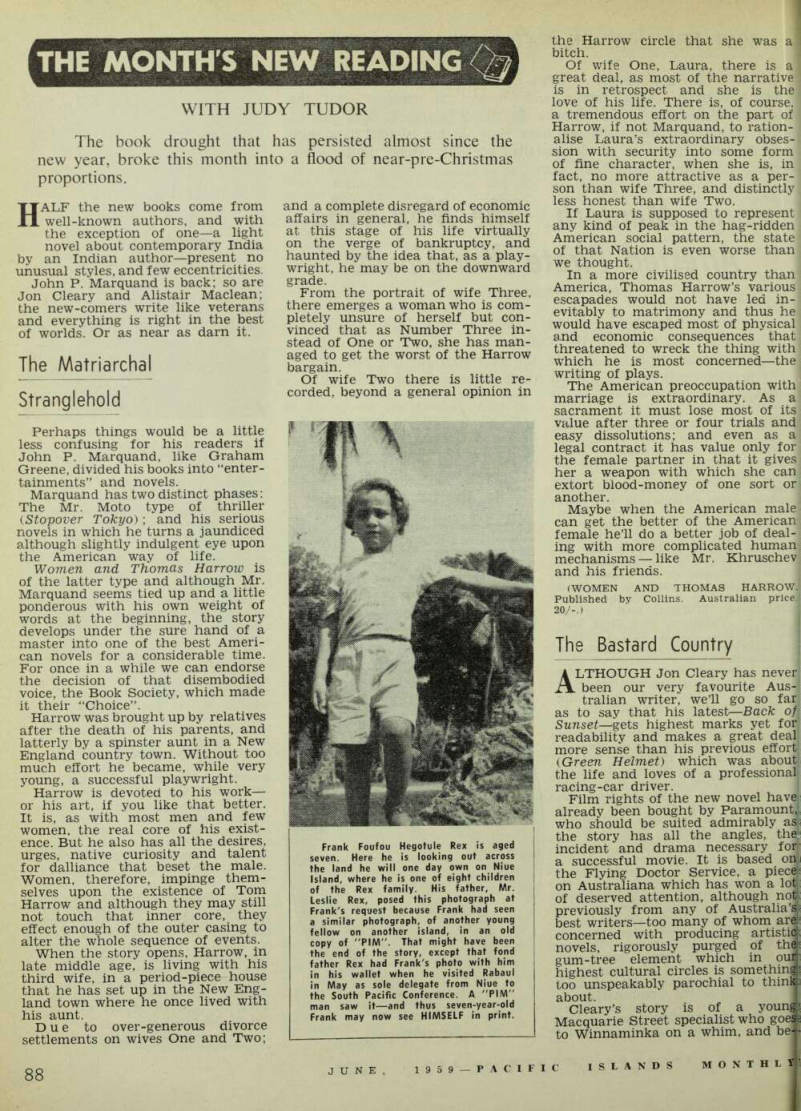
Frank Foufou Hegotule Rex is aged seven. Here he is looking out across the land he will one day own on Niue Island, where he is one of eight children of the Rex family. His father, Mr.
Leslie Rex, posed this photograph at Frank's request because Frank had seen a similar photograph, of another young fellow on another island, in an old copy of "RIM". That might have been the end of the story, except that fond father Rex had Frank's photo with him in his wallet when he visited Rabaul in May as sole delegate from Niue to the South Pacific Conference. A "RIM” man saw it —and thus seven-year-old Frank may now see HIMSELF in print.
ire he can do much about It finds mself with the job of local Flying octor in a practice as large as 'ance but somewhat less popu ted.
It was, as he was told by every le within his first 24 hours in innaminka (which has a lot of e characteristics of Derby, WA) bastard of a country. He .11 thought so, even when he de led that it offered something more tisfying, if less lucrative, than acquarie Street.
It is said that Cleary will write 3 next novel with a New Guinea :ting. This should be interesting, only to see if he has learned ything since he wrote his first he Climate Of Courage ), and lieved scrub typhus was a con gous disease.
BACK OF SUNSET. Published by lins. Australian price. 18/9.)
gger Than Life,
id Twice The Fun
ROBABLY the book critics will be full cry after Alistair Maclean for having turned out hriller again ( The Last Frontier) tead of another grim documentary 3 HMS Ulysses, the book that de him famous overnight.
Jut if the new novel does not ain those first dizzy heights, at st it gets as far back along the d as The Guns Of Navarone (the ond Maclean) and blots out the rd ( South By Java Head ) that leared merely silly, t is a great advantage when read of strange countries and in dible happenings not to know y much about either. It is pos e, therefore, that to anyone liv in Hungary, The Last Frontier Id be as clearly ridiculous as ■th By Java Head was to any who had lived out the war rs in that part of the globe. ;’s a cinch, anyway, that Maclean I’t have too many readers be d the Iron Curtain, and all the ers will probably find it exciting ugh to forget whether it is iible. People with logical minds aid stick to reading philosophy leave thrillers for those whose ginations have the required mnt of airlift. r. Jennings, a gifted scientist, has e over behind the Iron Cutrain it becomes the task of Michael nolds to snitch him back. The ie set for the snitching is a atific congress held in Budapest the goings on that take place ireen the time Reynolds gets into igary and when he returns safely >ss the border, on the last page, enough to boggle the imagina it as Jimmy Edwards might say, t’s wrong with a good old fie now and then?
HE LAST FRONTIER. Published by ns. Australian price, 18/9.)
Something to
Tempt the Appetite
I IKE a good Parisian gown, The i Tangerine has flair, sophistica non, cut and line—and a basic down-to-earth practicability.
Most novels written in one language lose something when translated into another, but if this one does it shows to no discernible extent—for which we can perhaps thank the good craftsmanship of the author, Christine de Rivoyre, and the sensitive understanding of her translator, Norman Denny.
i Tangerine has the particular Kind of craziness that Anglo- Saxons dismiss as “French”, for want of a better description; the Kind of zany sophistication that set apart Gigi from most of the other motion pictures produced in the last 12 months.
D Li , ke J Gigi>s famil y. the menage Honiara was two sizes larger than life unconventional, extraordinary and wholly delightful. All except Georges, husband as well as cousin of Severeine, for he was all realistic French hotel-keeper, and also kept the family equilibrium. Georges, however, is rather the surprise packet of the piece and produces in the end a fine appreciation
life a la Boulard which must unique in the annals of holy itrimony, even when it’s with a ench touch. staking love made Severine ngry; that is why she frequently t Georges to sleep it off while 3 descended to the big kitchens the hotel in the small hours of ; night. These early morning sts became family social events which younger brother and sister i Grandmama made frequent Dearances to eat and drink glori ;ly until the morning. ’o one of these parties, bidden re by young sister Baba, came ii, a Spanish duke, who was a sst at the hotel. Toni and erine seemed destined by Fate to lovers, and the fact was gener r accepted, particularly by Toni I Severine. ut fate had already been at work, k in Spain a few months previ ly, when Toni and Baba had I a very brief encounter, un ;unately, with permanent results. >a’s expected baby may not have nged Toni’s habits but it changed thinking, with far-reaching ct on the Boulard family, he climax of the whole story les when the tribe accompanies 1a to the “best nursing home” in is, and having routed the two ched nurses and the doctor, take session of the labour-ward and st Baba to be delivered of her d. there is a moral in this story s probably that strong person ti e s like Grandmama and erine can sometimes be short in ihology. oubtless nothing like The gerine could happen except in rench novel; but it is pleasant his dull world to just imagine, etimes, that it could.
HE TANGERINE. Published by Hart 3. Australian price, 18/9.)
re I'Amour
Fahiti
’TER all the millions of words that have been spilled about Tahiti it is a surprise to have )w author, Robert Langdon, say he was inspired to write a : on the same subject because liti’s varied and colourful story never been told before in a ie book.” hat wasn’t a surprise was the of the book —hold your breath wait for it — Island of Love! hat this reviewer has been Ing for, for years, of course, is ok about Tahiti which does not ain, somewhere in the title ir the word “love” or the word adise”. 1953, so the story goes, Lang visited Papeete for the first as a fireman on a New Zea ship. From that chance en
counter Tahiti become something ?LnifoH bby r anc * the Present volume resulted. Langdon does not, of course write like a ship’s fireman, and it is unlikely that he is one, except in so far as it helps him to get from here to there.
Apart from the title, which is a matter of personal prejudice, there is nothing wrong with his book.
It is a well-written, easy to read, chronology of Tahiti from the time that it was discovered by Europeans up to the present. It even does what the author says he set out to do in the beginning (and which this severe critic thought impossible), that is, unearthed new facts about Tahiti and collects just about everything that had ever been known about the island into one book.
The research that Mr. Langdon undertook to do this must have been prodigious, and although one suspects that he was not very long in Tahiti himself he has managed to winkle out from somewhere ex haustive details of certain incidents of Tahiti history that are little known even to students of Pacific history. For example, he goes fully into the Prichard affair, a cause celebre that at the time brought France and England almost to the brink of war.
Tahiti produces things other than love. Phosphate, vanilla, coconuts — for instance. But so far as the rest of the world is concerned, it might just as well not. The pattern of things was set from the moment Captain Wallis discovered Tahiti in June, 1767.
It took a few days for things to be straightened out between the sailors and the natives, but from there on, according to George Robertson, master of one of the two vessels in the expedition, every one caught on very well.
The sailors could not “help feast ing their Eyes with so agreeable a sight” as the young girls, and per ceiving this, and to help the entente cordiale along, “the old men made them stand in Rank, and made signs for our people to take which they lyked best and as many as they lyked. And for fear our men have Tgnorant and not know how to use the poor young Girls, the old men made signs how we should behave to the Young Women. This all the boat’s crew seemed to understand perfectly well, and begd the Officer would receive a few of the Young Girls on board. At the same tune they made signs to the Young Girls that they were not so Ignorant as the old men supposed them Which all goes to show, of course, how useful sign-language can be when travelling in a foreign C °But thus encouraged, an Irishman had soon set up price, as Master Robertson put it, being one small nail “each time ’. ted It was perhaps to be expectea that a certain amount of fame
road should accrue to Tahiti :er the men of Wallis’ expedition t back home and spread the news Dund; what is more surprising, rhaps, is that the fame has jwballed down the centuries until hiti has become no more and no s than the astral manifestation some masculine dream-state, out all proportion to the small tnd’s economic and strategic im :t upon the world. ..angdon’s book is not particularly icerned with love; it might better described as a short, and quite :ellent, history of the Island and me of its more famous visitors, t publishers these days have a y exact idea of the cash value title and dust-jacket—and the tics who think love in the South is is much the same as love any ere else are outnumbered by usands of avid book buyers who )w better.
SLAND OF LOVE. Published by sell. Australian price, 27/3.)
3 Girl Who Had
ht Luck Signs
IE fact that it is the alien poppy amongst this month’s crop of more orthodox wheat, ild mark Music For Mohini out, my event, but the story has its i merits, simply as a novel, i the last few years there have i dozens of books by Indians, ;t Indians, and Africans, most of ch have earned praise from the ics, if for no other reason than : the critics were not sure what 7 were about, or understood little he strange idiom in which they 5 presented. Primitive art has a of appeal to certain people, tiere is no mistaking Bhabani ttacharya for a Western writer, his story of Mohini, the young an girl caught up in the ggle between old and new a, is essentially a story and it Dt necessary to enter some extra msion in order to appreciate the t of it.
Although Mohini at 17 was a radio singer, daughter of ’ an en
lightened University professor, Til
the ancient devices had to be em ployed in order to arrange her marriage. There followed the bride viewmg, the long and intricate pre nuptial rites, the comparing of horoscopes and the “luck” signg, and finally the marriage and the journey to the husband’s Big House ox-car t and palanquin.
Although the journey took a couple of days in time, Mohini’s journey in effect is back through a couple of generations to a house hold ruled by the old-fashioned orthodoxy of a mother-in-law. How ever, this is no story of a spiritless child-wife forced to conform to the ancient patterns. Mohini is a charming heroine with a mind of her own. Time marches on, even in India, although the immediate result often is, as elsewhere, com promise. (MUSIC FOR MOHINI. Published by Angus and Robertson, Ltd. Australian price, 17/6.)
Sex Fiend
In the Epicene
AS it remarks on the dust jacket that Dominant Third is the first time that Elizabeth Hely has ventured into this field of writ ing, it is obvious that she has written also in some other genre— as they call it. She does very nicely with her first venture with a psychological thriller, however, and so far as we are concerned, she may continue.
The psychological thriller may be distinguished from the common-or garden Whodunnit by the fact that it is not necessary not to know who did it. So, it is clear, early
m the piece who strangled Laura, and so changed the life and character of her husband Mark Needham.
The story then resolves itself into what Needham is going to do about it; what Antoine Cirret, of the Surete, is going to do about it: what Andree, who is half in love with Mark, and Alec Trevor, do about it.
Finally there are the reactions and thought-processes of sex maniac Jean Theodore Bondet, on the surface, the ultra respectable grocer of the eighth arrondissement in Paris.
Most of the action of the story takes place in Paris —probably be cause such a large band of eccentrics feel more at home with that back ground. Dominant Third has all the characteristics of a good thriller —suspense, pace, action and plot.
It also has wit and excellent characterisation. (DOMINANT THIRD. Published by Heinemann. Australian price, 18/9.)
The End of
The Rainbow
ALTHOUGH it has a theme that a Reader’s Digest editor might have conceived, Ralph Allen manages to deliver Peace River Country without slopping over into sentimentality, and in so doing presents a North American way of life as different from Mr.
Marquand’s as the moon is from green-cheese.
This is not a story about the Peace River Country—apparently a large tract of land in the Canadian Rockies. But is the story of an unattainable land of milk and honey that Peace River came to mean to Bea Sondern and her two
lildren; and to a lesser extent, to *r husband, Chris.
Perhaps the best thing about this ory is its portrayal of human silience. If Allen had treated it lother way, he could have had all s characters as subjects for the ychiatrist’s couch: They all had asons enough.
Chris Sondern was a compulsive inker, and although they all loved si, Bea was convinced that they d to leave him. Chris, for his rt didn’t mean to follow them, t he usually did and when he Light up, they moved on again, rhey moved on across the route the Canadian Pacific Railway vays towards the Peace River untry, through a string of un 'ely prairie towns indistinguish le one from the other, except by hr utilitarian names Elevator, >ose Jaw, Dobie, etc.
Sally, aged 10, was the natural ;rovert; Harold, at 11 suffered the tures of hell in his buifetings h life (but would likely have fered similarly should he have ?d the fur-lined life of a ilionaire’s son); Bea’s super imism was out-distanced only her lack of talent on the prac il side. ler obvious helplessness black iled the ladies of one town into ing her their washing—and they 'e morally terrorised into con ning to do so even when she led coloured sox with their best ;n sheets. he also was a sucker for get i-quick advertisements and at time is knitting a lot of odd •d sox on a patent knitting shine. When we leave them —at gary—it’s April, and they are ;ing out to sell Christmas cards commission. s old ladies are fond of saying, ; early acquaintance with the e facts of their own peculiar might “come back” on the dren later on. But it is hard imagine any person who had d in such close intimacy with haracter like Bea turning out be anything but a first class :en.
EACE RIVER COUNTRY. Published Hodder and Stoughton. Australian , 15/6.)
at's New in Paper Backs
JONGST the spate of paper backs this month, these new releases from Pan and Fontana ;e a varied collection to suit all ss. (Ours from William Collins Limited).
ETTA: By Erskine Caldwell who has ararily deserted the Tobacco Road of >awdy South to present something a more sophisticated—if still sex ry. As it says on the cover—for her d become a drug, an insatiable crav- That should please the Caldwell fans •nn into some tens of millions. (Great
THE BODY IN THF iircidv .
Agatha Christie, written in the golden period of Christie, before she had been formed into a limited liability company Miss Marple officiates at this one whs was first published in 1942. (Great END OF THE CHAPTER, by Nicholas Blake, one of the latter-day experts in the Whodunnit business who in his spare time " * P° et - <° r maybe he’s a poet and writes Whodunnits to keep the wolf from the door). This one is about a publishing firm —very respectable, until someone was found on the premises with her throat slit (Fontana, yellow). ' th N Tn E ? A i? GE: by Norma "
W«f»r L k K th f l! te , indicates this is a Western about Montana where the bad from it (starring new teenager’s heart-
Digest Hardy Kruger), and the Reader’s K condensation. German pilot von Shot d ° Wn durin & the Battle of fhlt S g f j ned more fame by the fact I* Was ‘ he ° nly POW of the British Si 0 “ anaged t ® Mca Pe to fight again with Germans. (Fontana, yellow). . T ” E AFRICAN CHILD, a book of child h°°d m f™ orie s by Camara Laye, a young „ eg r° of Fren ch West Africa who went to Pans and becam e completely bewildered * different set of cultural values, (Fontana, yellow).
YOU CAN ALWAYS nrrrif o WNISTBR ERRAND are two offerings ly Pet er Cheyney. (Both Fontana, yellow).
LETTER FROM PFKrvr' k « , „ (Great Pan). (Over)
From Here To Eternity, By James
n p S ’ t l h t, St u ry ° f America on the verge Pearl Harbour, that does not need any reduction in the English-speaking world ie novel was first published in 1950 and w makes its appearance unabridged in ; new Fontana Monarch series. f Y , EARLY LIEE ’ by Winston Churchill. i s „ b ° ok as originally published in 1930 en the Churchill star was somewhat in ipse. It has got more attention in its ter years when it has been republished various forms. It is, of course, the r y of the great man’s first 25 years !? a iM 1S » o*nS 0 * nS were Just beginning to stallise. (Fontana Monarch). :HE LONG ECHO, by Douglas Ruther d, who follows the modern practice of ng abroad for interesting background murder. This one takes place in the lian mountans. (Fontana, yellow).
HE LONG WALK, by Slavomir Rawicz , pr °J . sev |" Poles who escaped from I- y , ®l beria and the Russians by klnBf -r,u° oo miles through Mongolia, na , Tibet and to safety in India. Only r of them survived but this, has with -h been described as the greatest escape y in history. (Great Pan).
™ Plain Man’S Book Of
IYERS, by Dr, William Barclay, a dis uished British scholar and preacher. written to help those who wish to '-and apparently don’t know how to itana, black). )ok s that have been reviewed before in VI over the last few years, in library ions, and which now appear as paper is are: THE BIG STORY, by Morris t (Great Pan); THE GREEN HELMET.
Jon Cleary (Fontana, yellow); THE E OF THE FIERY FINGERS, by Earle iley Gardner (Great Pan); and THE *LD OF SUZY WONG, by Richard »n (Fontana, yellow). istralian price of above are: Fontana arch, 7/6; Yellow, 3/6. Pan, 3/-; Pan it, 3/6; Great Pan, 5/-.