Tropicalities
pp. 81-82 · Read in the full issue
Pacific Islands Monthly
Magazine Section
Tie-time in Suva! lOME of Suva’s residents are still I unfamiliar with the ground rules in the city’s comparatively ;w Club Hotel. At the hour when 3w Zealand’s hotel bars are hoing with the cry “Time gentle en, please!” a discreet card is ing proffered to clients in the üb’s elegant cocktail bar advising em that it’s six o’clock and that is are now called for.
An American guest receiving the rd one recent evening, bridled mewhat, surveyed the room, anted an accusing finger at a cal couple who had also been ken unawares.
“Say, how about them?” the man Dm America demanded firmly and idly of the card-tenderer.
While the accused hastened to Dth the tourist with the explana m that they were drinking as fast they could and then getting out, tray with a selection of ties rived and the hard-currency in, still snorting, was fitted out cording to the rules!
Suva's Hibiscus Festival
Now Established
IHE business-promotion gimmick oi tne annual “festival” is now firmly established in Suva, icre organisational work is already full swing for the fourth ccessive Hibiscus Festival sche led to take place from September to October 3. rhe Adelaide Steamship Co. is aning a special cruise to Fiji from stralia this year to coincide with ; big event. The cruise ship moor a, 11,000 tons, will be in Suva ir the last three days of Septem- Svents will include a barbecue fht at Nukulau Island when there 1 be a major exodus from the city join the fun. The little island 1 be flood-lit and two dance ads will dispense music to suit mood.
'Jumciors other events, from flat and power-boat regattas to npetitions and parades ~a P ts, and special Fijian and Indian rhts in Albert Park will irantee an almost non-stop ipo. The Festival will end with ball and the election of Miss )iscus 1959.
The Governor, Sir Kenneth Maddocks, is patron. Mr. Reg Spowart, of the reporting staff of Fiji Times, has been appointed or ganiser, and Mr. Peter Tourell, deputy Town Clerk, is secretary.
Never Send A Boy On A Man's Job THERE’S a tale that came in from New Guinea the other day that we’d like to hear the finish of.
It’s the story of the native con stable who was given the job of escorting an indigene from one of the coastal corrective institutions to a calaboose in the Highlands.
When the pair got to the air strip, the purser reported that the
aircraft was overweight and there was only room for one on the High lands flight.
So the constable took the seat himself.
Two days later, after a walkabout in strange surroundings, the foot sore and hungry indigene presented himself at the District Office and asked what happened next. . . .
These Robbers
This is not an Islands story. But it is written by veteran Islander Christopher Wager; and it wins a place herein because of the humour of it: I USED to call, a few years ago, on a man who had an office in a building handy to one of the big Sydney newspapers.
On one call, I had that day’s paper open at the page showing details of the current cricket match “Find the Ball” competition where the newspaper had removed the flying ball from a cricket photo-
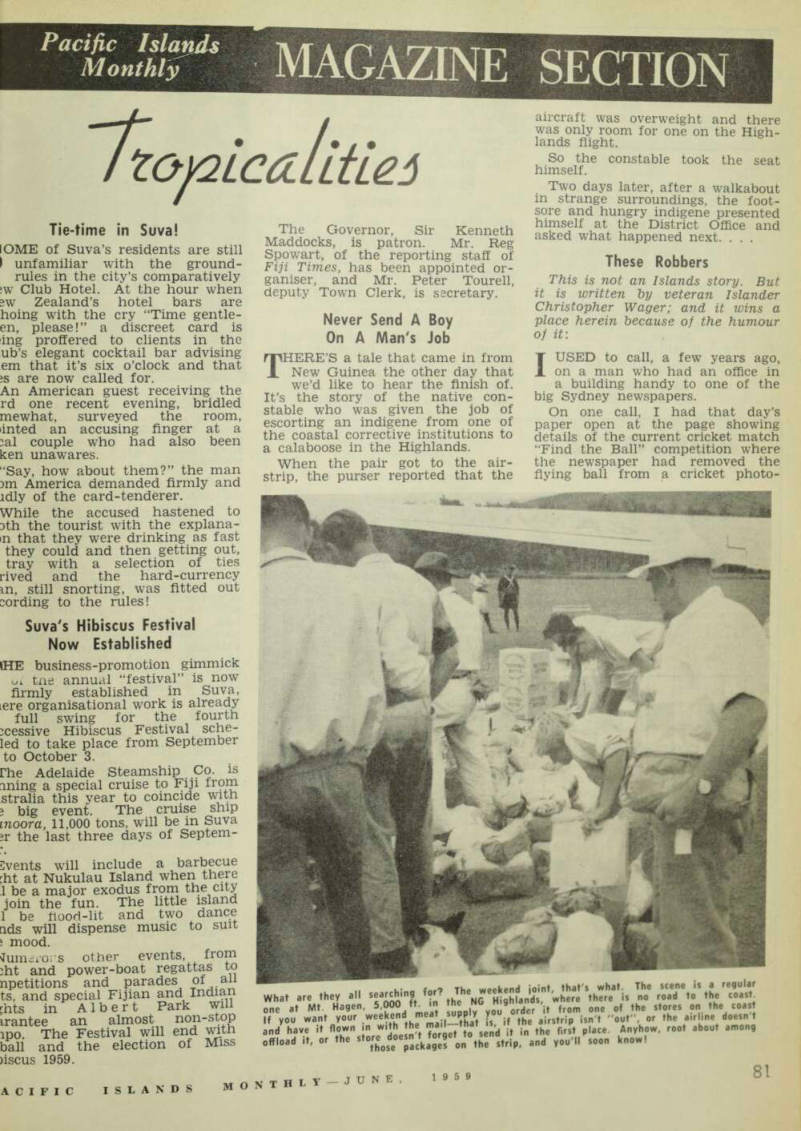
What are they all searching for? the weekend joint, that's The scene is a regular one at Mr. Hagen, 5,000 ft. in the NG Highlands, wher there is no road to the coast if you want you weekend meat supply you order it from one of the stores on the coast and have it flown in wint the mail-that is if the airstrip isn't "out" or the airline doesn't offload it, or the store doesn'tforget to send it in the first place, Anyhow, root about among those packages on the strip, and you'll son know!
graph and the reader had to put it back.
My friend asked me if I was put ting in for it and said: “Let me tell you something. I know a bloke in the office over there. I got to know him at the pub on the corner and, every day, we used to have a yarn over a few beers.
“One day, he asked me if I wanted to win £350 and, when I said ‘Too right’, he said he could bring a copy of the untouched photograph over to me during the lunch-hour with the ball still in it, if I would undertake to put in and go halves with him.
“I jumped at it, and the photo graph was duly produced. We got
to work on it with a pair of com passes, measured it carefully and got the ball absolutely on the spot, on one of the forms.
“Although I put in fourteen of them, most of them just missing it, and one or two right off it, just to make it not too glaring. Seven bob it cost me, and I never got a cracker.
“Don’t you touch it,” he added.
“The Bloody Game’s Crook!”
First Highlands Council
Is a Mouthful IN the presence of the visiting UN mission and 5,000 natives, the Agulizakiva - Gwivahani Council, first Native Local Govern ment Council in NG Highlands, came into being at Goroka recently, when District Commissioner H. P.
Seale presented badges of office to newly-elected councillors.
With a population of 10,000, the Council area covers 190 square miles in Asaro Valley, mainly north-east and south-east of Goroka township.
The unwieldly name was selected because it combines the word
“leader” in two prominent local dialects.
Not since last year’s agricultural show ( PIM, July, 1958) has Goroka seen such a colourful, ceremonial occasion of dancing and feasting.
It represented, too, the slow but continuous blending of new customs and old in the Highlands—each councillor wore neat khaki shorts and shirt or tailored rami, while half the huge concourse of native spectators wore European-style clothing and half the traditional elaborate head-dress and dance garb.
Not overlooked in the excitement of the new council, retiring village officials (luluais and tultuls ) re-j ceived certificates recording their services, when they handed in their; badges. The DC thanked them for their work in preparing the Asaro people for the new system of local government.
How To Assimilate Them TWO P-NG Administration blokes j were talking about plans for new native liquor laws, accord-i ing to the story that we heard. The two couldn’t come to an agreement on whether it was sensible that only natives living permanently “after the European fashion” should be allowed to drink.
“How can anybody tell whether they are going to live that way permanently?”, demanded one chap, leaning on the bar.
“I can give you 47 names right now!” said the other bloke, eyeing him off coldly.
“They’re serving life sentences in New Guinea boobs!”
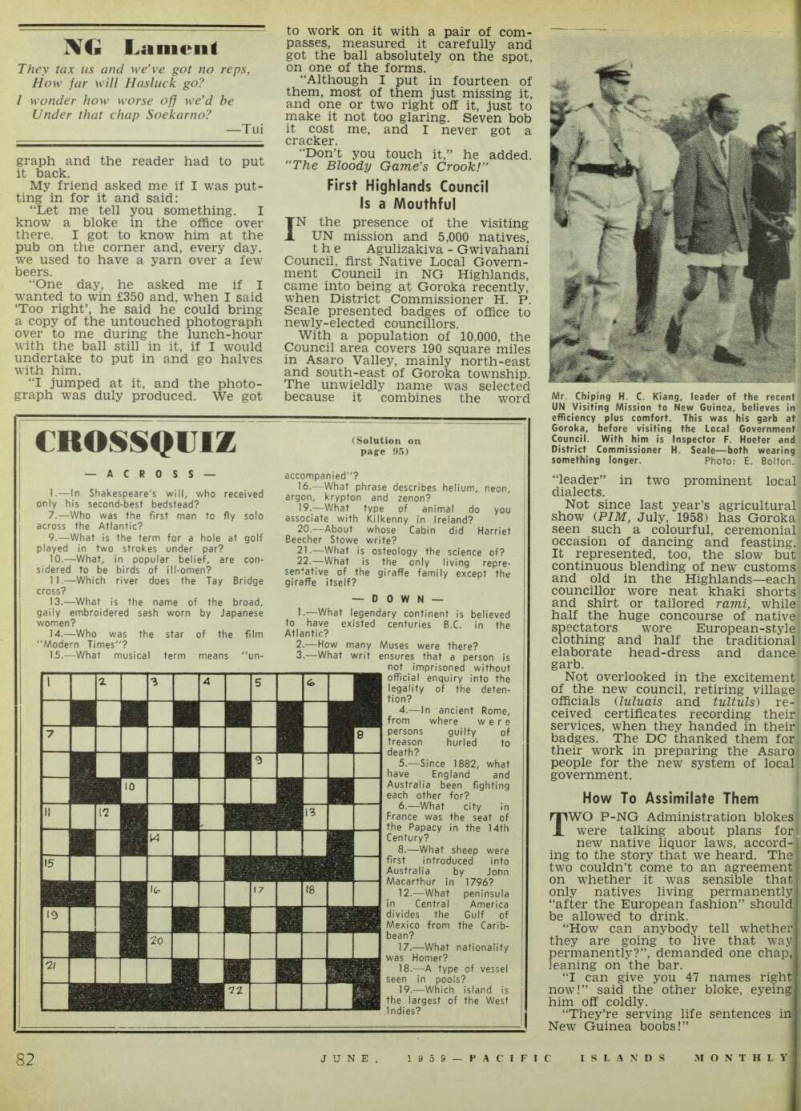
Mr. Chiping H. C. Kiang, leader of the recent UN Visiting Mission to New Guinea, believes in efficiency plus comfort. This was his garb at Goroka, before visiting the Local Government Council. With him is Inspector F. Hoeter and District Commissioner H. Seale—both wearing something longer. Photo: E. Bolton.