They’re Getting Steeper and Tougher
p. 61 · Read in the full issue
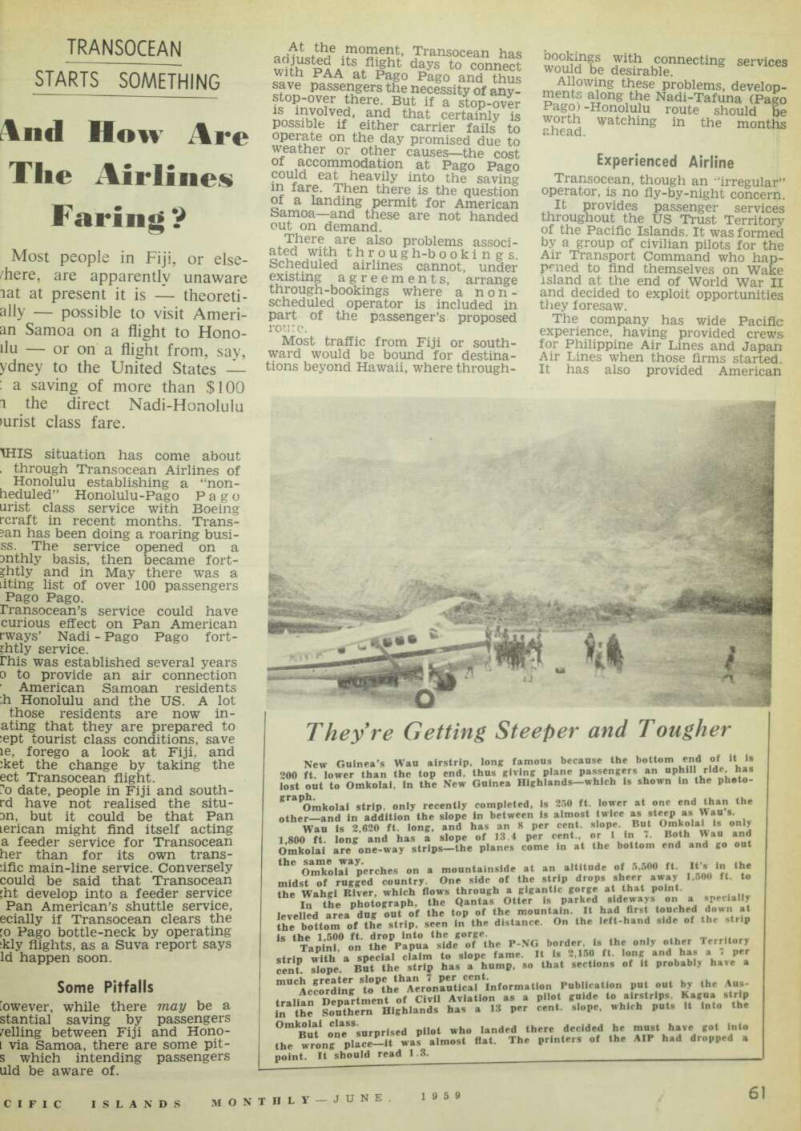
New Guinea’s Wan airstrip, long famous because the bottom end of it is 200 ft. lower than the top end. thus giving plane passengers an uphill ride has lost out to Omkolai, In the New Guinea Highlands—which is shown in the phatostrip on , y rec ently completed, is 250 ft lower at one end the other—and in addition the slope In between is almost twice as steep as Waus.
Wau is 2,620 ft. long, and has an 8 per cent, slope. But Omkolai is only 1 800 ft long and has a slope of 13.4 per cent., or 1 in -. Both Wau and Omkolai are one-way strips—the planes come In at the bottom end and go out thC Ornkolai* perches on a mountainside at an altitude of 5,500 ft. It’s in the midst of rugged country. One side of the strip drops sheer away 1,500 ft. to the Wahgi River, which flows through a gigantic gorge at that point. * In the photograph, the Qantas Otter is parked sideways on a specially levelled out P of the top of the mountain. It had first touched down at the bottom of the strip, seen In the distance. On the left-hand side of the strip ,S 'WiiT'n ST&SSJT'* P-NG bord.r, .. Ih. on,, o.h.r T e „«.r, wlth’a snecial claim to slope fame. It is 2,150 ft. long and has a . per cent! dope. fiSt the strip has a hump, so that sections of It probably have a mUC According S to D the Aeronautical Information Publication put out by the Aus- Denartment of Civil Aviation as a pilot guide to airstrips Kagua strip in th? SoXrT Highlands has a 13 per cent, slope, which puts it Into the ° mk R, l^ l pilot who landed there decided he must have got Into the wrong place-it was almost flat. The printers of the AIP had dropped a point. It should read 1.8.