At Last, A Clear Account
pp. 45-49 · Read in the full issue

An Official History Written With Full Sense of Drama At Last, A Clear Account Of The War In New Guinea
Today, after a lapse of 17 years, in a book entitled tralia in the War, 1939-45, Southwest Pacific Area First Year we get the first clear, authentic, well-documented account of what actually happened in New Guinea and the Solomons in
lITHERTO, it has been a patch work story, assembled from many sources, inadequate in aces, over-emphasised in others.
All we knew in 1942-43 was that e Japs, in their treacherous at ck on Pearl Harbour in December, 11, without declaration of war, had aced the United States at a ?mendous military disadvantage, id caught the small South Pacific tions unprepared and undefended, ithin a few days, this cruel and thless enemy was sweeping down •on us through the New Guinea d Solomons archipelagoes, and the iropean communities there were her prisoners or refugees.
The Japs came south in a two □nged thrust through Micronesia Dne prong extending into lomons and intended for Fiji and w Zealand, and the other through w Guinea, and pointed towards pua and North Australia.
Strength Crippled
America’s naval strength was nporarily crippled at Pearl Har ar, and she had little wherewith convoy troops to the South cific. The appearance of General tch’s division in New Caledonia :ly in March, 1942, was a miracle improvisation and swift action.
Australia’s good fighting divisions re either in the Middle East or ight in Singapore.
All we knew in those bleak days 17 years ago was that we in the nth Pacific were practically de iceless, and that Japanese land, . and air forces were rolling down an us, in a terrifying way. 7he picture was all confusion lecially in the early half of 1942.
Ve heard of battles and cam gns in the Solomons, in Midway md, in Milne Bay, in the Coral t, in the Kokoda, Buna and Wau as of New Guinea; but we had means of knowing if or why or v they were inter-related. All we
Stralian War History—South
-3T Pacific Area—First Year. By
ley McCarthy, 30/-. Published by Aus tralian War Memorial, Canberra.
knew was that although the Japs were hammering hard in the New Guinea-Solomons area, we some how were escaping invasion south of the Australia-New Caledonia-Fiji line.
Presently, as 1942 passed, Ameri cans came southeast-about in ever growing numbers, and those excel lent, battle-trained Australian divisions came home from the Middle East, and went straight into the New Guinea jungles; and our danger slowly faded.
We Weren't Told But we never were told exactly how it all happened. Necessary censorship, on the one hand, and the very human anxiety of Top Brass to cover up its mistakes and
muddling, on the other, threw a sort of veil over the whole picture.
Here is the full story, set out very clearly, every incident and de velopment in sequence, and told in good literary style, with a full sense of its great dramatic value.
The writer is Dudley McCarthy, well known in New Guinea Admin istration, and now an Assistant Secretary in the Department of Territories. He worked 10 years on this book.
In scholarship, in Army experi ence, and in knowledge of the Southwest Pacific, he is well quali fied for this historical work; and he has produced a book that should be preserved upon the shelves of every man and woman who, as civilian or serviceman, was in any way interested in this war era in the Southwest Pacific.
It is not only an authentic history.
It also is a fascinating story of how Americans and Australians, in partnership, turned chaos and de feat into overwhelming victory.
We Were Expendable Interesting angles of strategy show up in places, although not necessarily emphasised by the author.
For example, in the view of the British war-lords, we of the South Pacific were expendable—we, along with other over-run countries, would have to await liberation until the end of the war, if the war lords considered it necessary. (Over)
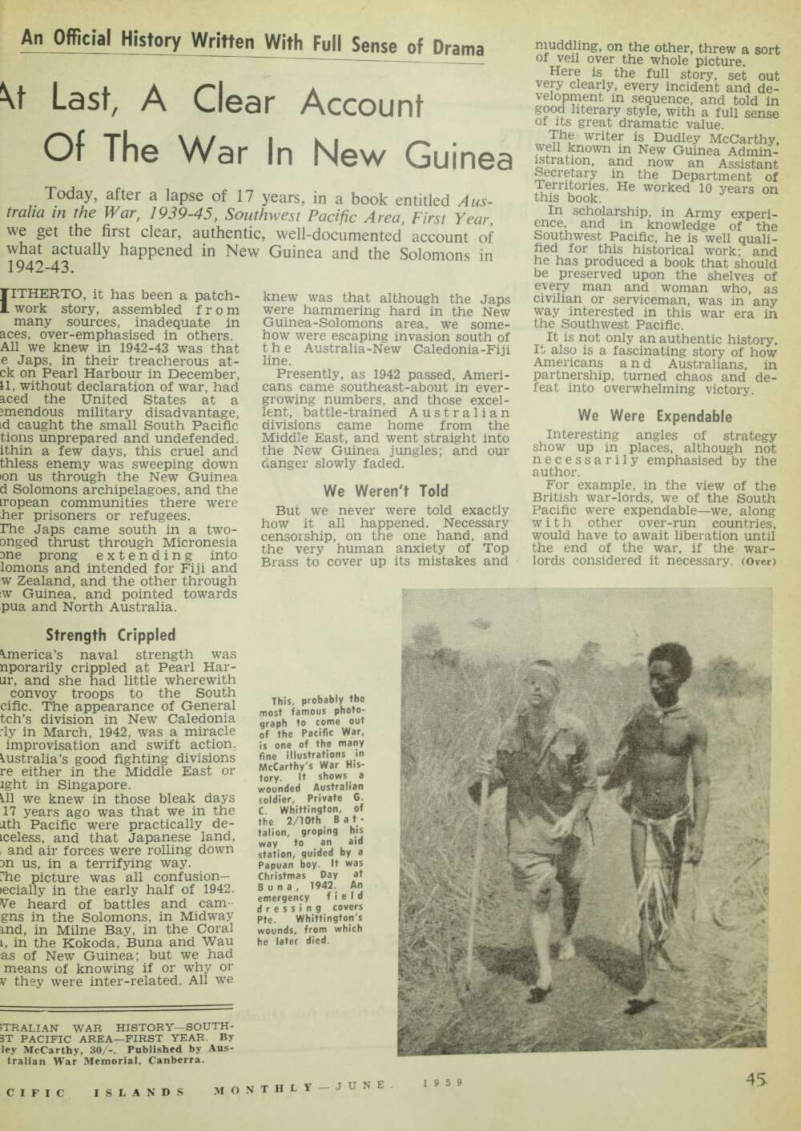
This, probably the most famous photo graph to come out of the Pacific War, is one of the many fine illustrations in McCarthy's War His tory. It shows a wounded Australian soldier, Private G.
C. Whittington, of the 2/10th Bat talion, groping his way to an aid station, guided by a Papuan boy. It was Christmas Day at Buna, 1942. An emergency field dressing covers Pte. Whittington's wounds, from which he later died.
Perhaps, in the opinion of Ameri n leaders, also, we were expend le. Possibly, the Americans did t come racing around through the utheast Pacific to save us from 3 Japs because America loved us, t because Australia and the ath Pacific countries were the ;al jumping-off place for the at :k on Japan.
Ve shall never know. What we know is that, in the most critical ir of our South Pacific history, »st of the South Pacific countries re saved by the Americans from 3 horrors of invasion by Japanese, rhis book shows us the close ationship between the Solomons 1 the New Guinea campaigns— d by what narrow margins we aped disaster in those campaigns, the early days before the lericans and Australians had ated their organisations for re orcement and supplies.
Jany people have wondered why I Japanese blundered so badly in iding their forces into Milne Bay, i why they fought the battle ;re so inefficiently. This book es the answer. Much of the Jap ce ear-marked for Milne Bay was erted elsewhere, because of Jap ses in the Solomons; and the ces which were sent there were ; ashore in the wrong place, t is clear that the successes ned, at great sacrifice by the tericans in the Solomons, dis ated and weakened the cherished
Japanese plan for the capture of Port Moresby and North Australia.
What induced the Japanese to undertake that lunatic expedition across the Owen Stanley mountains, via Kokoda? This, again, was con nected with Japanese set-backs in the Solomons.
The margin between victory and defeat of the Americans in the Solomons which actually meant the margin between invasion and non-invasion of Australia—was so narrow that we look for the decid ing factors in the Solomons cam paign.
The book shows that one was the grim fighting quality of the United States Marines, who battered their way into Tulagi and Guadalcanal; and another was the fact that Coast watchers Paul Mason and W. J.
Read, although hunted and harried by Jap scouts and native traitors, somehow stayed there for months in the jungles on top of Bougain ville, and counted the Jap bombers flying south.
Thus the American Air Force had two hours’ radio notice of what was coming; and what arrived was decimated by American fighters which fell upon them out of the high clouds.
This careful book shows, as noth ing else could have done, the value of the service rendered by Mason and Read.
The hammering they received at Guadalcanal crippled the Jap effort at Kokoda and Milne Bay and Buna. Their final withdrawal from Guadalcanal caused them to try again for Port Moresby by building up their forces at Lae and Wau— there seems little doubt, in the face of this record, that the Jap High Command believed it could reach the South Coast of Papua via the Morobe Valley and Lakekamu-Bull dog route; hence that strange thrust from the New Guinea coast, via Mubo and the long-forgotten track past the Black Cat mine into Wau.
There is no more fascinating chapter in the book than the events
rrounding the Battle of Wau, and e description of the way the Aus alian gunners came straight off e big planes on Wau airfield, id began blazing away with their -pounders at the Japs, now swarm- I over the Crystal Creek-Wilde antation area.
New Angles on Old Story This is a volume of over 600 pages, id every page holds a story of in rest to every South Pacific man 10 lived through that critical riod. It is impossible to summarise But here are some of the events and conditions that are clearly and thoritatively described, in most ses for the first time: • The ignorance of the General aff of conditions on the Kokoda ail. • The way in which the Anglican ssionaries from Gona were cap red, and tortured and murdered the Japs. • How crack Japanese troops at Ine Bay were defeated in that igle battle by inexperienced Aus ilian militia-men. • The way in which Commander- Chief Douglas MacArthur nagged the Australian generals, who re doing their best with untrained sn and inadequate equipment. » How Australians and Ameri is put through that road from i Lakekamu and Bulldog, across iredible country, to the back of ie Creek —now, presumably, for :ten and overgrown.
• * th ? Kan ga force, built up in the Morobe district at first from untrained, scattered Australian volunteers, grew into a deadly weapon, which played an important part in the ultimate defeat of the Japs in the Wau-Lae area.
It is generally known that some general officers, both American and Australian, broke rather pitifully under the terrific strain of jungle warfare. (When one reads Mr McCarthy’s description of the con ditions under which these armies had to fight and march and sleep, one wonders that more personnel did not collapse.) But the author says little of the failures of Top Brass. On the contrary, his book—which, of course,
becomes the permanent official re cord of this section of a great war —presents practically all the gen erals in a very favourable light.
There is a little section of the book which describes General Tom Blarney as a commander of “sagacity”, “strength”, “ability”, “greatness”, and “generally un appreciated humanity.” The “old man” would himself have been the first to call that a rather-one-sided picture.
This reviewer, having examined scores of war histories, would de scribe Mr. McCarthy’s war history as the most accurate, well-balanced and readable book of the kind he ever has seen. Our congratulations
to the author