* Skippers
pp. 27-28 · Read in the full issue
The Editors' Mailbag
lose Old
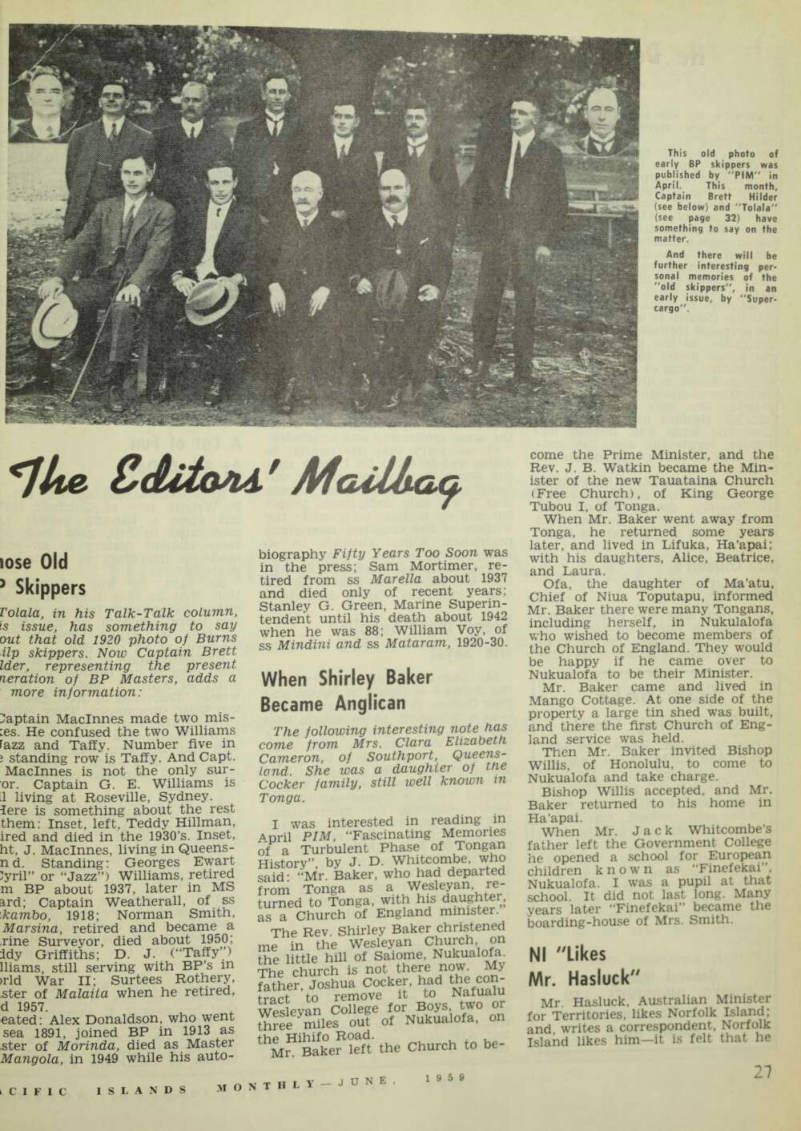
Tolala, in his Talk-Talk column, is issue, has something to say out that old 1920 photo of Burns Up skippers. Now Captain Brett
Ider, representing the present
neration of BP Masters, adds a more information: Captain Maclnnes made two mis :es. He confused the two Williams razz and Taffy. Number five in i standing row is Taffy. And Capt.
Maclnnes is not the only sur er. Captain G. E. Williams is 1 living at Roseville, Sydney, lere is something about the rest them: Inset, left, Teddy Hillman, ired and died in the 1930’5. Inset, ht, J. Maclnnes, living in Queens nd. Standing: Georges Ewart Jyril” or “Jazz”) Williams, retired m BP about 1937, later in MS ard; Captain Weatherall, of ss kambo, 1918; Norman Smith, Marsina, retired and became a rine Surveyor, died about 1950; idy Griffiths; D. J. (‘‘Taffy”) lliams, still serving with BP’s in irld War II; Surtees Rothery, ,ster of Malaiia when he retired, d 1957. eated: Alex Donaldson, who went sea 1891, joined BP in 1913 as ster of Morinda, died as Master Mangola, in 1949 while his auto
biography Fifty Years Too Soon was in the press; Sam Mortimer, re tired from ss Marella about 1937 and died only of recent years: Stanley G. Green, Marine Superin tendent until his death about 1942 when he was 88; William Voy, of ss Mindini and ss Mataram, 1920-30.
When Shirley Baker
Became Anglican
The following interesting note has come from Mrs. Clara Elizabeth Cameron, of Southport, Queens land. She was a daughter of the Cocker family, still well known in Tonga.
I was interested in reading in April PIM, “Fascinating Memories of a Turbulent Phase of Tongan Historv” bv J. D. Whitcombe, who fafd- ‘‘Mr Baker, who had departed from Tonga as a Wesleyan, re turned to Tonga, with his daughter, as a Church of England minister.
The Rev. Shirley Baker christened me in the Wesleyan Church on the little hill of Saiome, Nukualofa The church is not there now. My Sther, Joshua Cocker, had the con tract to remove it to Naiuaiu Wesleyan College for Boys two or three miles out of Nukualofa, o th M. H ßakefleft the Church to be
come the Prime Minister, and the Rev, J. B. Watkin became the Min ister of the new Tauataina Church (Free Church), of King George Tubou I, of Tonga.
When Mr. Baker went away from Tonga, he returned some years later, and lived in Lifuka, Ha’apai; with his daughters, Alice, Beatrice, and Laura.
Ofa, the daughter of Ma’atu, Chief of Niua Toputapu, informed Mr. Baker there were many Tongans, including herself, in Nukulalofa who wished to become members of the Church of England. They would be happy if he came over to Nukualofa to be their Minister.
Mr. Baker came and lived in Mango Cottage. At one side of the property a large tin shed was built, and there the first Church of Eng land service was held.
Then Mr. Baker invited Bishop Willis, of Honolulu, to come to Nukualofa and take charge.
Bishop Willis accepted, and Mr.
Baker returned to his home in Ha’apai.
When Mr. Jack Whitcombe’s father left the Government College he opened a school for European children known as “Finefekai”, Nukualofa. I was a pupil at that school. It did not last long. Many years later “Finefekai” became the boarding-house of Mrs. Smith.
Nl "Likes
Mr. Hasluck"
Mr. Hasluck, Australian Minister for Territories, likes Norfolk Island; and writes a correspondent, Norfolk Island likes him—it is felt that he
This old photo of early BP skippers was published by "PIM" in April. This month.
Captain Brett Hilder (see below) and "Tolala" (see page 32) have something to say on the matter.
And there will be further interesting per sonal memories of the "old skippers", in an early issue, by "Super cargo".
He Defends New Guinea Hotels More Letters From The Editors’ Mailbag
is working for the best interests of residents “with never the wave of the big stick”.
Latest occasion for this mutual admiration was in late May when Mr. Hasluck accompanied Cardinal Gilroy to the Island to officiate at the opening of the new Roman Catholic church. After these cere monies, the Administrator and Mrs.
Leydin gave a luncheon party, etc.
Earlier the same day, Mr. Hasluck ... “met members of the NI Ad visory Council and discussed various matters with them. It transpires, as we have thought for some time, that the Council is not happy about the proposed Norfolk Island Council Ordinance, to the tune of 7 to 1, and would prefer to carry on with the existing form of Administration, with preferred, a little more say in the matter of spending locally raised moneys. One gets the impression that Mr. Hasluck has no desire to force the issue and impose un popular legislation and the out come may be that a referendum will be held.”
Wacko—as they say in the purlieus of Woolloomooloo. But what a pity Mr. Hasluck doesn’t extend this beneficence to New Guinea and hold a couple of referendums there.
Mr. Gibson's
Fan-Mail
The fact that the Fiji Govern ment sent a European—Mr. H. B.
Gibson—to the South Pacific Con ference at Rabaul as one of its three
delegates, came in for a lot of critic ism from some quarters. So did Mr.
Gibson. But he also had his fans.
No less than two Rabaul Terri torial (and that’s a pretty big score for the Territory on such a subject as the SPC) have written letters about it. One calls himself White Territorian; the other Old Territorian.
Says White Territorian: “The delegate who spoke most sense at the SPC was Harold Gibson—the European from Fiji who moved to delete the word ‘indigenous’ from the recommendations regarding the various suggestions for the advance ment of the peoples of the Pacific, and the substitution of the word ‘locally born’. If the SPC is de signed only to help and protect the indigenous people, I see no sense in continuing it.”
Old Territorian expresses much the same sentiments and concludes: “I am sorry that the motion to delete was defeated for I think that the South Pacific Commission will fail if the idea ever becomes current that it will help ‘indigenous’ people but will do nothing to promote the welfare of the countless immigrant population which abounds in so many parts of the Pacific. It is typical of the spirit existing in Fiji that Mr. Gibson was backed by his own ‘indigenous’ Fijian delegate.”
Every Want Supplied
(He Says)
Mr. Charles J. Fonceca springs to the defence of hotels in Papua and New Guinea in a letter from Rabaul —as a follow-up to an article that appeared in March PIM, and a letter to the Editor in April PIM.
But just for the record, let us get this straight: The original PIM article was about Tourism—with a capital T—as a money-earning in dustry catering for international tourists who, irrationally perhaps, expect to find a dim relationship between the hotels in Pacific Islands and those they get in, say, Rome, London or Hawaii. And in this con text we are very much afraid that the majority of P-NG hotels do not “cater for every possible want of the traveller”.
This is what Mr. Fonceca says: As a resident of New Guinea since 1946, when I joined the Adminis tration straight from the Army after seven years of active war service with the Permanent Army in Aus tralia, and slightly later with the 2nd AIF (also service in 1914-1918 show), I take very strong excep
tion to the remarks of your corre spondent, Malcolm McDougall.
Right throughout the years I have been resident in this Territory I have received nothing but courtesy and all the possible amenities from the various) hotels.
From the days (1946) of the old Hotel Moresby (Bottom Hotel) through the Hotel Papua to the old Cecil, commanded by dear old Ma Stewart (you will remember it was the AWAS barracks during the war) ; across the Butibum (one plank bridge) right up to the up to-date pubs at Boroko (Port Moresby), New Cecil (Lae), Madang, Goroka, Wau, Pine Lodge (Bulolo), Rabaul Ascot (with six air-con ditioned rooms); Cosmopolitan (Rabaul); Kappi’s new pub at Kavieng—every possible want of the traveller is catered for.
I detest people without real Terri tory experience expressing uncon firmed opinion. I might add I have just completed 3 h years manage ment of Rabaul’s leading hotel and feel qualified to express my opinion.
A Lot of Fun
At Bd. A Day
In a letter dated April 7, Mr. K., P. Wright, now of Quirindi, NSW,, but once a banana grower and. pastoralist in Fiji, goes back over 1 some ancient history in an entry made in his diary of precisely 53: years before.
He says, by way of explana tion, that at that time labour was: either indentured Indian, under a, five years’ contract, at one shilling: a day; or Fijian, mostly from,.
Kadavu, at 8d per day.
Evidently some of the Fijians hadJ been playing up, because under the; entry of April 7, 1906, Mr. Wright; wrote: “Delivered to Joeli, Seru and!
Qio their summonses. They refused to take them so I got my father as witness, and called out each mam and read his summons then put it: on the door-step. Joeli, the; turanga ni cakacaka put them out; with a stick”.
An entry two days later says: “Father went to Suva and engaged* Humphrey Berkeley’s services for the 11th”.
And under April 11: “Court cases; heard, Berkeley appeared. Defen- • dants fined 6/- ea.”
After the passage of 53 years it is; still possible to see that Joeli, Sera j and Qio must have had a lot of;; fun; but it cost them the equivalent]; of nine days’ pay to have it.
A note from Mrs. Elsie Noble.
Caldwell, of Los Angeles, reports}? that her new R. L. Stevenson book,!, in which much new biographical ! material is incorporated, will be published in August, by the Uni versity of Oklahoma Press.