New Company Wants
pp. 21-22 · Read in the full issue
If Or When It Gets Going New Company Wants Old Sugar Quota
While the Colonial Sugar Re fining Co. goes ahead with pre parations to establish a rice-mill in place of its old Nausori sugar cane crushing mill, which will close down permanently at the end of the current crushing sea son some time next December,
the Fiji Sugar Milling Co. Ltd.,
which planned to step into the
breach, is having some difficulty
in raising the necessary money.
THE new company, with a nominal capital of £1,000,000, was regist ered in Suva last December, and was formed by Indian cane planters and others interested in the sugar industry in the Rewa Valley.
The company’s share issue is divided into 40,000, £25 shares. No confirmation of the number of shares sold could be obtained early in June.
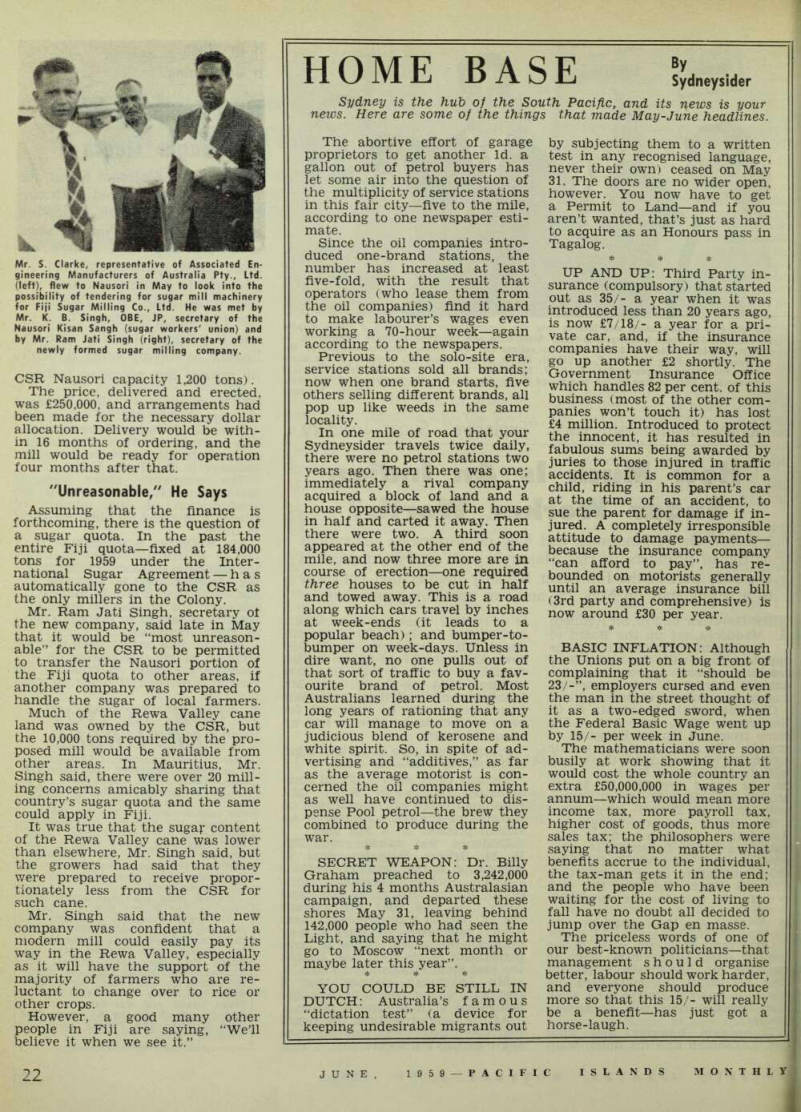
Mr. S. Clarke, a representative of one of Australia’s largest engineer ing combines —Associated Engineer ing Manufacturers of Australia Pty.
Ltd—was in Fiji late in May to in vestigate the company’s machinery requirements and to prepare a quote at their invitation.
A quote had earlier been received from an American company for mill machinery capable of crushing 500 tons of cane each 24 hours (present
CSR Nausori capacity 1,200 tons).
The price, delivered and erected, was £250,000, and arrangements had been made for the necessary dollar allocation. Delivery would be with in 16 months of ordering, and the mill would be ready for operation four months after that.
"Unreasonable," He Says
Assuming that the finance is forthcoming, there is the question of a sugar quota. In the past the entire Fiji quota—fixed at 184,000 tons for 1959 under the Inter national Sugar Agreement has automatically gone to the CSR as the only millers in the Colony.
Mr. Ram Jati Singh, secretary of the new company, said late in May that it would be “most unreason able” for the CSR to be permitted to transfer the Nausori portion of the Fiji quota to other areas, if another company was prepared to handle the sugar of local farmers.
Much of the Rewa Valley cane land was owned by the CSR, but the 10,000 tons required by the pro posed mill would be available from other areas. In Mauritius, Mr.
Singh said, there were over 20 mill ing concerns amicably sharing that country’s sugar quota and the same could apply in Fiji.
It was true that the sugar content of the Rewa Valley cane was lower than elsewhere, Mr. Singh said, but the growers had said that they were prepared to receive propor tionately less from the CSR for such cane.
Mr. Singh said that the new company was confident that a modern mill could easily pay its way in the Rewa Valley, especially as it will have the support of the majority of farmers who are re luctant to change over to rice or other crops.
However, a good many other people in Fiji are saying, “We’ll believe it when we see it.”
Mr. S. Clarke, representative of Associated En gineering Manufacturers of Australia Pty., Ltd. (left), flew to Nausori in May to look into the possibility of tendering for sugar mill machinery for Fiji Sugar Milling Co., Ltd. He was met by Mr. K. B. Singh, OBE, JP, secretary of the Nausori Kisan Sangh (sugar workers' union) and by Mr. Ram Jati Singh (right), secretary of the newly formed sugar milling company.