Contribution
p. 20 · Read in the full issue
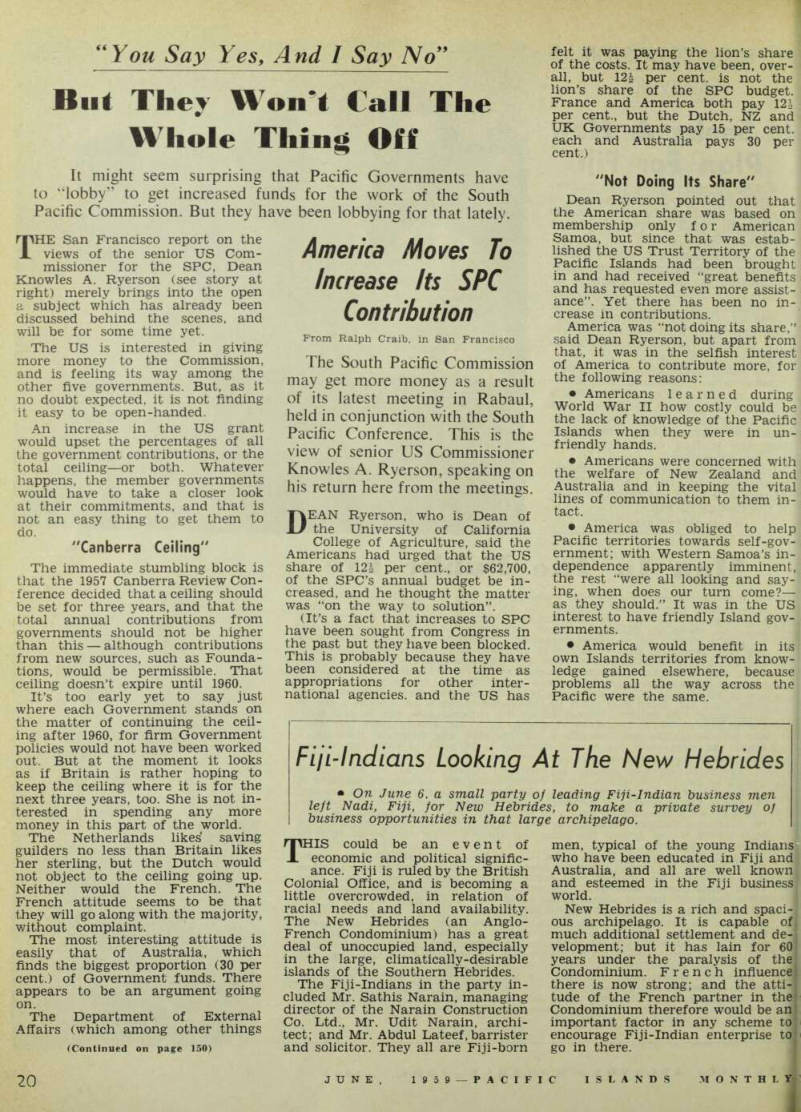
America Moves To Increase Its SPC Contribution
From Ralph Craib, in San Francisco The South Pacific Commission may get more money as a result of its latest meeting in Rabaul, held in conjunction with the South Pacific Conference. This is the view of senior US Commissioner Knowles A. Ryerson, speaking on his return here from the meetings.
DEAN Ryerson, who is Dean of the University of California College of Agriculture, said the Americans had urged that the US share of 12i per cent., or $62,700, of the SPC’s annual budget be in creased, and he thought the matter was “on the way to solution”. (It’s a fact that increases to SPC have been sought from Congress in the past but they have been blocked.
This is probably because they have been considered at the time as appropriations for other inter national agencies, and the US has
felt it was paying the lion’s share of the costs. It may have been, over all, but 12 i per cent, is not the lion’s share of the SPC budget.
France and America both pay 12 h per cent., but the Dutch, NZ and UK Governments pay 15 per cent, each and Australia pays 30 per cent.)
"Not Doing Its Share"
Dean Ryerson pointed out that the American share was based on membership only for American Samoa, but since that was estab lished the US Trust Territory of the Pacific Islands had been brought in and had received “great benefits and has requested even more assist ance’’. Yet there has been no in crease in contributions.
America was “not doing its share,’’ said Dean Ryerson, but apart from that, it was in the selfish interest of America to contribute more, for the following reasons: • Americans learned during World War II how costly could be the lack of knowledge of the Pacific Islands when they were in un friendly hands. • Americans were concerned with the welfare of New Zealand and Australia and in keeping the vital lines of communication to them in tact. • America was obliged to help Pacific territories towards self-gov ernment: with Western Samoa’s in dependence apparently imminent, the rest “were all looking and say ing, when does our turn come?— as they should.” It was in the US interest to have friendly Island gov ernments. • America would benefit in its own Islands territories from know ledge gained elsewhere, because problems all the way across the Pacific were the same.