Papua-New Guinea Legco Votes
pp. 55-59 · Read in the full issue

It Was Their Big Day Papua-New Guinea Legco Votes Itself Into Income Tax
From a “PIM : ’ Correspondent, in Port Moresby.
“What beats me,” said the droll resident who had been ting in the public gallery of the Legislative Council, “is the jctacle of these Administration bods voting themselves a :rease in wages at the very time their lords and flaming mas s in Canberra are voting themselves an increase.”
HIS reference, of course, was to the fact that Federal Parlia ment has just paid it self hand some salary increases; and here in Port Moresby today the Canberra controlled Legislative Council has use d exactly the Same bulldozer tactics to introduce the Income Tax Bill, and reduce everybody s wages, including its Own.
Unlike their Canberra masters, the P-NG public servants who make UP the official majority of the Coun cil have not enjoyed their part in today S events. .
They live a lot Closer to the WOrK ing man than the Canberra politicians do, and some official ears are a i re ady red from the things that are being said around town at this ““'is-I already have proof of it! — more than one official member Who has been given the TOlindS Ol {he domestic kitchen, with the little woman demanding to know just what Canberra could possibly have done if a handful of official mem bers, including her man, had re fused to ride on the Steamroller. A Very good point, tOO, although 1 doubt if any one is game to put fn fbp tp<?t 1 t-» *■ __* fHrmo-btc at the end But those thoughts at tne ena of the day. The day began nice a Big Day should.
The Big Day
Out at Konedobu, senior officials hurried about the quadrangles, wearing suitably serious faces; the radio telephone from Canberra kept barking; Treasurer H. H. Reeve, whose Big Day it really was—he’s a long-time advocate of Income Tax for this Territory—tidied up some details while sitting at the Assistant Administrator’s desk (Dr. John Gunther was ill, and is going on leave, anyhow, this week); Admin istrator Donald Cleland held one interview after another, culminating in a full Executive Council meet ing at 11 a.m.—three hours before the important Legislative Council meeting was scheduled to begin.
The “Old Man” was in top form and confident all morning. . . a state of mind no doubt assisted by the knowledge that after a long series of “outs” with Territories Minister Paul Hasluck, he has now become Hasluck’s white-haired boy again.
Away from all the commotion—at that moment, anyway was Dr.
Gunther, in bed with pneumonia, and not at all well. . . his condition probably not made any easier by his knowledge that, after a long period of being the white-haired boy, he’s now heading the unpopularity poll with this extraordinary Minister, who seems unable to love both of his top NG officials at the one time, although both work over-hard in his interests.
Plenty of Activity
There was plenty of activity, too, in the Opposition’s camp.
The three elected members and the nine nominated members met separately to plan their campaigns.
The elected men’s campaign was the more spectacular although in the end result it may be no more important. At the suggestion of Elder Statesman E. A. James they decided they would walk out of the Chamber as soon as the bill was introduced. They then worked out a Press statement to be released right after the walk-out.
The nominated members agreed on a statement to be made in Council on their behalf by B.
Fairfax-Ross, and a letter to be sent to the Governor-General following the meeting.
By lunch-time the stage was set.
The canvas chairs at the rear of the big hall quickly filled up with local people taking time off from Administration and business to see what the show had to offer.
What Could He Do?
Brigadier Cleland, always early, arrived at 1.30, and at a quarter to two, as he sorted papers at his raised desk on the floor of the Chamber, Jimmy James went up to him and informally broke the news that the elected members would walk out. The three agreed to tell him this beforehand, out of courtesy.
Cleland gave a wry smile and said, “Thanks, Jimmy”. (Over)
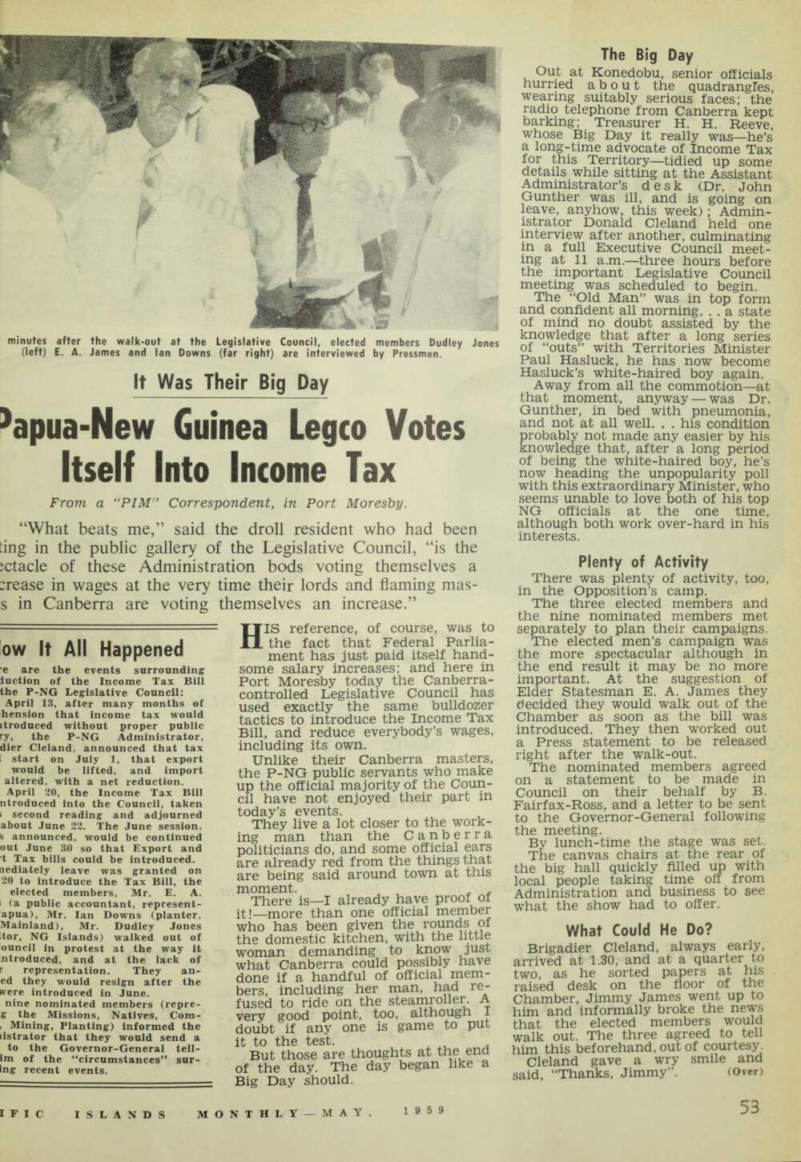
minutes after the walk-out at the Legislative Council, elected members Dudley Jones (left) E. A. James and lan Downs (far right) are interviewed by Pressmen.
the last few weeks he had ; the long air flight to Canberra back several times over this lion issue, and he had got to stage where new developments something of an anti-climax, r the rest of the Chamber, ?h, there was a hushed air of 3tancy as the session was form declared open and two new al members sworn in. iude Champion took the seat of er Director of Civil Affairs, S. rgan, who has retired; and :tor of Posts and Telegraphs, W. ?r, took the place of the former tor of Forests, J. Me Adam, who recently. hadn’t been intended to swear ie Champion in at this session, he Government wasn’t going to :au g h t short-handed. Tom amslaw was on leave, and Dr. her would normally have been it, too. it happened, Dr. Gunther d up smiling. (“You should be d!” said a reporter. “Go on!” 3unther with a grin. “Wouldn’t this for quids!”) ns the Government had 15 against the 12 that could be d if all the nominated and d members voted together. And was how the voting was.
To The Vote seek leave,” said Treasurer J, standing up straight at his “to introduce a bill for an lance to impose a tax upon in -3 and to provide for its assess and collection.” leave granted?” Cleland the House.
'e!” came the shout. “NO!” the reply, amid laughter. ;all for a division,” said Jimmy s. course, there was no doubt the result —but at least the s would go down on the is. the hands were being counted, id from his high chair possibly ;d, if nobody else did, that the elected members were clear lie papers from their desks.
James was last to zip up his brief case Downs had already left his outside—to save himself the em barrassment of forgetting it in the walk-out and having to go back in for it.
When they had counted the Noes , that was the end of the session for James & Co.
They got up, made a smart left turn and quickly walked across the Chamber and out the nearest door —just like that.
As they left, the public gallery came to life with a great burst of applause—the kind of applause that one associates with the stamp-and whistle demonstration for a popular win at the stadium. That applause was meant to be heard.
In Contravention
As it died down, Fairfax-Ross, planters’ representative, got to his feet and made his prepared state ment.
Events leading up to the intro duction of the tax legislation, he said, had contravened the prin ciples on which British legislation was founded, and the nominated members proposed to inform the Governor-General, from whom they held office, “of these circum stances”.
Outside, the three elected men had grouped under a tree, where James remarked, “Well, that’s that!” To reporters they handed out a copy of their prepared state ment:
After further consideration, ticularly of the views expressed numbers of their constituents, three elected members have ided to remain in Council for purpose of debating the In le Tax Bills and endeavouring proposed amendments to re re some of the most objection ; features. lowever, they propose taking other part in the proceedings Council, and upon the passing ;he Income Tax legislation will ?n from the Council in protest inst the undemocratic use of official majority to pass this without the prior independent dry which was urged by all -official members and by an whelming majority of public es and individual residents, in objection to the lack of suf nt representation of the people the Teritory in their Legis re.”
That Was That ter that, there didn’t seem much that could be done. The House settled down now, and Gov lent and nominated members ■ listening dully to Mr. Reeve’s ch. the three climbed into Jimmy es’s car and drove around to Papua Club. There was nobody 5 but the native bar steward, three men sat for an hour en ig their solitude, discussing the ?s that Territorians discuss, til ing, of course, the high price iectricity. re Papuan probably didn’t irstand why the three, all busy le, should have been at the club iat hour. But one day he might, night, in fact, be sitting there elf in just those circumstances.