"Very Bright"
p. 53 · Read in the full issue
[?]zed Cocoa Expert [?]G Industry's Future "Very Bright"
is always interesting to hear what overseas visitors have to say about us, especially when happen to be specialists in • own line.
'■cently Mr. George Spice, a '.tor of Gill & Duffus Ltd., Lon one of the world’s leading i-bean merchants, called in on \ourne, after visiting New tea in the course of a world on cocoa business, and spoke “PIM” reporter, me of the things he had to ibout NG cocod have been said and over again—proving that r cocoa buyers have an un ral phobia about finding nuts bolts in their cocoa beans, or some NG planters are being un isarily stubborn about proper ng and inspection, t at least Mr. Spice was far encouraging than some Aus in buyers who, in the past, have , a pretty fair imitation of not g whether there was a cocoa dry in New Guinea, or not.
Spice said that he was amazed iw Guinea cocoa development— is something “you had to see lieve”. Few people in UK knew NG was doing in this field.
-operation: Fixed Standards
ong the things Mr. Spice con ; of immediate importance for ill development of the industry iw Guinea are; The utmost co-operation be l all sections concerned with idustry.
Itandard grading of crops—at
at, New Guinea beans are a (d bag”. itandardisation of fermenta nethods. l reduction in shell content — leans are up to 4 per cent, r in wasteful shell content than others. standardisation of fermenta aethods was a most important . A lot of experiment with ;nt methods was going on, this ed in beans of uneven quality. 5 most necessary to select one id and standardise on it. jo great shell content, he said, wasteful of expensive ship pace. Handling methods could proved to eliminate much of xcess shell.
ndustry's Bright Future
Spice thought there was a very future for the industry in Guinea, and for the industry illy.
New Guinea had some special ad vantages over other producing countries which could make it one of the great cocoa-growing countries of the world. Trees started bearing there in three years, compared with a normal 5 to 7 years elsewhere.
Conditions of soil and climate made possible an all-the-year-round pro duction, with peak periods, in con trast with violent production fluctuations in other countries.
Mr. Spice estimated there was a potential annual crop of 25,000 tons pf beans from trees already planted in New Guinea; and this was of tremendous importance to the P-NG economy. (See April PIM, p. 133).
NG's Exportable Surplus
Australia’s total annual require ment of cocoa beans was about 13,000 tons, and was increasing. Part of this could be met by New Guinea, although a certain pro portion of beans of other origin was necessary to produce confectionery’s most palatable flavours.
New Guinea would have an ex portable surplus within the next few years, Mr. Spice considered, and it was geographically well situated to supply existing or potential markets in New Zealand, Asia and, in par ticular, Japan.
There was also an immense potential market in Russia and China which could, if developed, absorb the whole of the present world production of cocoa beans.
Shipping would be there, Mr.
Spice thought, when the beans were there for export. “There will be a lot more competition for 20,000 tons than for the present 2,000 tons.”
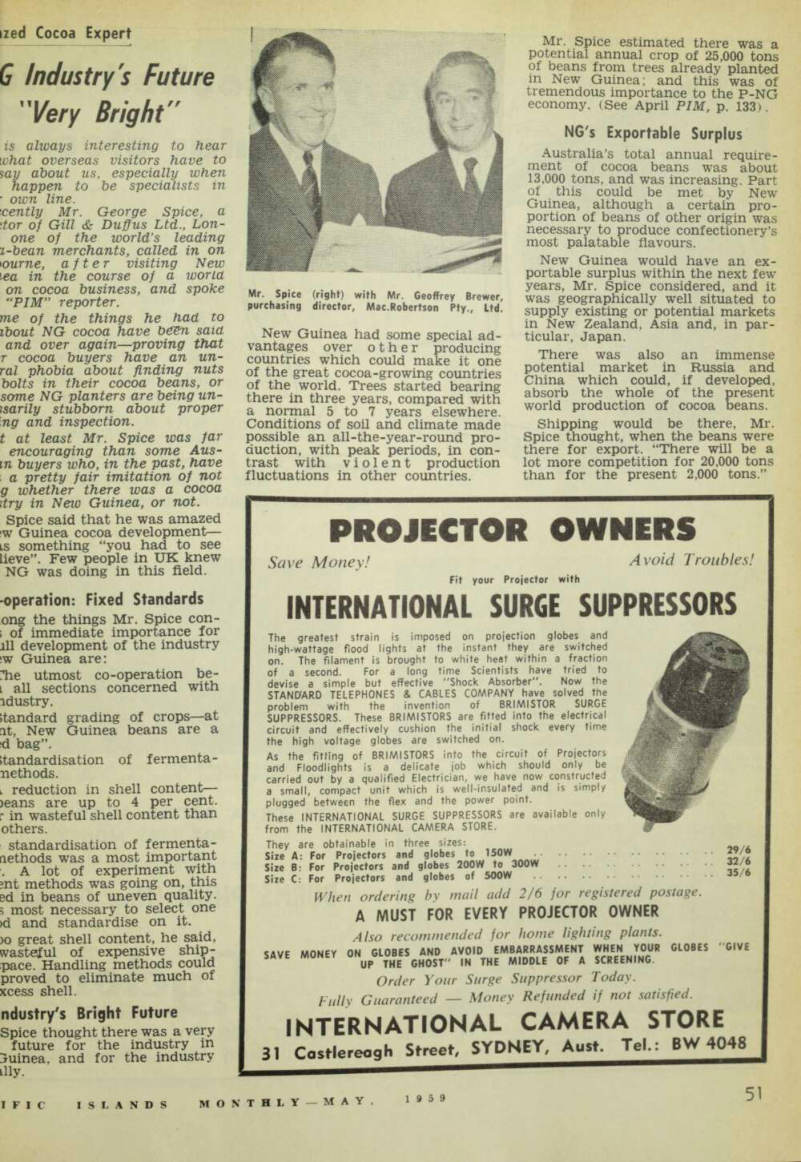
Mr. Spice (right) with Mr. Geoffrey Brewer, purchasing director, Mac. Robertson Pty., Ltd.