Simple And Easy, He Says!
pp. 33-137 · Read in the full issue


A Brief Lesson in Banana Importing Simple And Easy, He Says!
But Has He Tried It?
By a Staff Writer
When Mr. H. G. Menzies, Australian Trade Commissioner m Wellington, NZ, suggested last January that getting Fiji bananas into Australia was simple and easy, he interested a lot of people, including the PIM.
FOWEVER, after recent experi- L ence here in Sydney we now wonder if Mr. Menzies has ever ed to perform this miracle himf —which in practice can only be ened to the Biblical parable about ? camel and the eye of the needle. \ PIM staff member who tried import some mythical bananas •m Fiji, Indonesia or Tonga in :ly April did not get further than >t-base, and then, even though it s just-pretend, decided to give up d stick to the uncertain product m the NSW North Coast. (It is ie that very good bananas are times grown on the North Coast t is just that Sydneysiders rarely them, except in periods of glut, at present).
Australian policy is to curtail )orts as much as possible, and her it line of defence in the matter idmirably chosen in the Customs iff officers—or the one we picked, rway—whose function it is to dis ise information on duties and ited matters. No one but the most ermined importer would get ther than this initial encounter.
Mscussions “cannot be entered 3 over the phone.” The caller is tructed to go down to the itoms house and get into the ue with the other “waiting •lie.”
hat the Q'ld Banana Bd. Says
he Queensland Banana Board, PIM was informed by this toms officer, has the final word ut the import of bananas, and N and its bananas just don’t t officially. you want to import bananas n Indonesia, or Fiji, or Tim tu, then you ask permission of Queensland Banana Board, and hey say you cannot, that is the of it—except in the case of Fiji ch, under a special dispensa , is allowed to send in 40,000 ;als per annum (that is 4,000,000 and for which there is a special f of 2/1 per cental, or one hing per lb. ut there, again according to this toms official, the thing must . Just 40,000 centals from Fiji, no more—or not without per
mission of the Queensland Banana Board.
That is what the Customs Depart ment says. But the Department of Trade, which makes the final de cision in these matters, reaffirms what Mr. Menzies said: You can im port 40,000 centals of bananas from Fiji at a duty of 2/1 per cental; and all other bananas from Fiji or else where at 8/4 per cental —providing you have a B Category licence, which is issued for a whole range of con sumer or non-essential imports.
The crux of the matter is the licence.
The number of fruit importers in Australia is virtually nil, and those who already have B category licences would, we should imagine, be hardly likely to use them to import bananas.
They are already using them to import other things.
That Finishes That!
So, presumably, you would have to find somebody new and willing to get a licence to import bananas.
You could find somebody willing— but they stand no chance at all of getting a licence because they did not have one four or five years ago when import licensing was intro duced.
That finished that!
But anybody wanting to follow the theory through will be interested in the following pieces of informa tion: • These farthing -per- pound bananas must be landed at Sydney or Melbourne (a minor restriction in which it is easy to recognise the
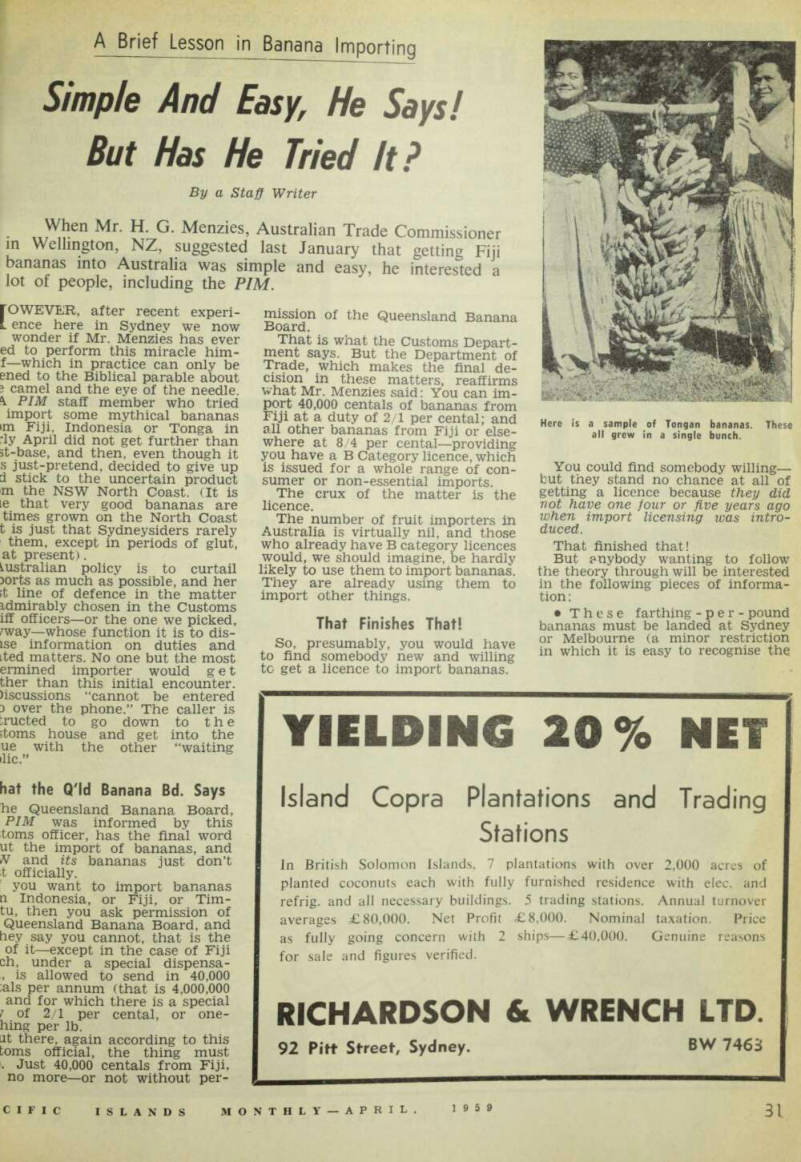
Here is a sample of Tongan bananas. These all grew in a single bunch.
? Italian hand of that old bogey, Queensland Banana Board.)
How Q'ld Beat Fiji
'he Queensland Fruit and Vege le News recently bought itself ) the banana import argument, sumably because of something in motion by Tonga’s Premier, ace Tungi, who made an outburst le months ago when it seemed tain NZ would restrict the entry Tongan bananas. He said if he Idn’t sell them in NZ he would them in Australia. he Queensland Fruit and Vege le News thinks he has a pretty r chance of doing what he jatened, and we cannot but agree la him. To quote from the News: rliN> M I 8 ! the early ’3o’s the Lyons Government ed to relax restrictions, which had i imposed for many years, on the re y of Fiji bananas to Australia, leensland growers were up in s, and the COD arranged for special is to carry hundreds of banana ?ers from both north and south coasts i gigantic meeting held at the City ilegrams were sent to Queensland mem of Parliament, and to sundry other who, it was thought, might have in ice in preventing outside competition, a result of the representations, a of Id was imposed and entry was ted to 50,000 cases a year, few minor shipments of bananas ar i from Fiji, but transport and market litions plus duty, apparently proved ofitable and they soon ceased, bile a duty of Id was a fairly heavy >st against prices in the early ’3o’s, it light price today. ill. we think other factors may operate in conjunction with the duty, prove a hurdle for Tongan bananas. he PIM had a paternal interest Fiji bananas for a long time,
and takes a little modest credit for the fact that the duty concession was given 25 years or more ago. It was after publicity in PIM that the Fiji Government took the matter up with Australia and indicated that if there were not some concession for Fiji bananas, the Fiji Govern ment woud consider a duty on Aus tralian flour.
Even the Bananas Have Changed
Fiji got its concession, but it was only a paper victory, as the Queens land News indicates. Mighty few Fiji bananas have ever managed to negotiate all the hoops.
And things have changed since the days when Fiji bananas did enter freely. Apart from local growers’
boycotts and other restrictive practices, there is now little direct shipping for this class of mer chandise and transportation in ships equipped for the specialised banana trade would be a real problem. At the moment, of course, due to alternative floods and droughts and to an odd hurricane or two, Fiji is hard put to it to supply even her quota to New Zealand.
There is another factor, too. If we are to believe the reports from New Zealand readers, Islands export bananas are now not all they once were cracked up to be. There are just as many howls from New Zea land consumers of Islands bananas as there are Sydneysider howls about the poor quality fruit from
3W North Coast. memories are apparently A few weeks ago, one of editors, doing a lunchtime in Sydney, came across one ! itinerant barrow-men who feature of this city. He had 3W full of yellow fruit labelled Shipment of Fiji Bananas”, laven’t been able to trace any s from the Colony; so you robably just write that one an astute piece of salesman
(See also page 134)
Bananas—ln And Out
Of Bunch
Though the major interests in volved in the South Pacific banana industry seem generally opposed to any reversion to shipping bananas by the bunch rather than by the case, there is at least one import ant ambassador for the bunch. He is Mr. J. C. Gerlach, agriculture economist and adviser in tropical agriculture to New Zealand’s tropical territories. Mr. Gerlach was making one of his routine rounds to the Islands in April—the first in over two years—from his headquarters at the New Zealand Department of Agriculture’s experimental station near Hamilton, NZ, PIM recently reported that sub stantial numbers of bananas from the Islands —and not from any specific area —were reaching the New Zealand consumer in very poor condition. Superficially such fruit
appears to be in its usual indif ferent condition as regards skin blemish though otherwise often sound.
However, on peeling the fruit a large percentage have been found to be rotten at the ends, particularly the stem ends, or sometimes for the full length at heart. This latter condition is not evident until the fruit is broken in half.
Questioned on this, Mr. Gerlach said that the infection could be wind-born. It could be drawn in through the ventilation system of a ship while loading, and could thus infect a whole shipment, though this might not be the most common source of infection in the case of Pacific Islands shipments.
Naturally, said Mr. Gerlach, such infection entered the fruit via a wound or blemish—and the most obvious wound on a plucked banana was the stem. Eliminate that wound and you automatically reduce very
substantially this source of spo ing.
The answer: bananas in bunches Whatever the present opposite from shippers, importers, distribute and retailers, Mr, Gerlach made? clear that in his opinion the bun system, once organised, is the befc from the viewpoint of the consumr Because New Zealand consume have never seen unblemislr bananas there is no real pressu for an improvement in quality, b that situation may not always appe Mr. Gerlach said that the po sibilities for the marketing of t) banana crop in processed for either as a by-product of the fres fruit trade, or as separate se; contained industries, was not beii lost sight of, but regularity of su plies would probably be essenti for such industries.
Failure of supplies throng natural and other causes is stillJ recurring problem.
Going's More Important
Than Coming in Fiji
A passport and other travel doc ments were sufficient to see Kv Stoboy, of Berlin, through countries —and then he met I Waterloo with the Fiji Immigrate laws.
Mr. Stoboy appeared in tl Magistrates Court in Lautoka, F.' in March to answer a charge having entered Fiji illegally. I had asked to be brought before t; court to clarify the position.
Stoboy is a travelling journalii While passing through Australia a transient he applied for and g a visa for a three months visitoi permit to Fiji, from the Unit: Kingdom High Commissioner Australia.
He then bought a single ticket Fiji. Assistant Superintendent Marlow, who appeared in the col for the Immigration authoriti. said that the Immigration Ordi: ancs demanded a monetary securi or an onward air or sea ticket. T' airlines were well aware of th After the court had adjourned allow Mr. Marlow to consult t airline which had carried t German journalist to Fiji, Stobi was released into the care of t; airline.
Good Market for
Samoan Coffee in Aust.
Increasing interest is being shov; by European and Samoan plante of the Territory of Western Same in the cultivation of coffee beai for which, reports our Apia correii pondent, there exists a good mark in New Zealand and Australia ar also locally.
Large areas of land both Upolu and Savai’i are at preset being planted in coffee, mostly the Arabica variety. The Wester
Da Trust Estates are at present esting their first large crop iffee beans and have altogether ;ed 375 acres of coffee. They id to increase their area under 3 considerably during the next Bars. It appears certain that 3 exports will be a major part restern Samoa’s economy.
Falls Into
With a Club
nj, Western Highlands of New ea, is following the pattern of • Territory settlements. As one said in PIM last month — >on as there are half a dozen ies grouped together in one they build a club, e club at Minj will have a d position at the top of the course and is being built by itary labour of people living le station and the plantations i about. They hope to have it ilete by the end of June. It be used for screening films, ell as for other social events.
Jamoan C-o-L
■But Not Much
e annual report of the Western >an Commissioner of Labour .958, contains the information the Consumer’s Price Index, iled by the labour Department, s an increase of two per cent, le cost of living for seconded rnment employees, and of 25 lent. for local employees, e index comprises 168 items is subject to quarterly review.
The index is used as a guide for the fixing of salary scales and allowances of the Western Samoa Public Service,
The Island Bug—
And Bugs
Talk of an island and there’ll always be an interested, if not en vious, audience: and somehow or other the more isolated and less inhabited they are, the greater their
pull. At least to those who’ve never set foot on one..
Mr. Frank Hanley—a one-time BP engineer, mentioned in this month’s shipping news—who passed through Suva in the Southern Cross in April, should have known better as an ex-resident of Fiji of the 1920’5, but his case illustrates the tenaciousness of that Island Bug.
After 30 intervening years in the newspaper and other business in Australia, he was more than ready to “get away from it all” and his mind turned to that normally un attainable vision which lurks at the back of many minds—an unin habited island.
By now he was financially capable of realising such a dream. His wife was more than willing. A Queens land land agent did the rest.
Timana island, miles off the coast, plus a 12-mile road journey from Tully, was the result. Out there, away from it all, was a two storied house, a caretaker’s cottage, endless supplies of bananas, pine apples, the choicest oysters, and in fact all that range of tropical pro duce listed in the novels—plus a few others unlisted. As for in stance, the colony of ten thousand flying foxes close to the house, that screeched all night and every night; and the parakeets that took over when even the flying foxes eased up; and the millions of ants of several varieties, and all the other insects that bit, invaded the food supplies, or otherwise made life a misery; and the snakes..
Then there was the often risky voyage across open water to the mainland, with the back-breaking job of winching the launch up above the high-water mark after first getting it into its cradle —for the mainland’s foods, newspapers, and