The Editars' Madillag
pp. 29-31 · Read in the full issue
nother Old Illusion
one West?
“Now here is where I stick my !Ck out,” writes Wallace S. Thorpe, Dm Northland, New Zealand—and es on to pour cold water on one the fables upon which one of M’s editors (born on the NZ estcoast) was brought up: That \lliope made her dash from Apia, est Samoa, during the famous rricane of March, 1889, burning cstport coal.
Vlr. Thorpe refers to our story of 5 hurricane, in February PIM, d particularly to the paragraph: alliope had allegedly bunkered in istport and the credit for her :ape has often been given to that Derb coal,” ie goes on: Many old timers in the Bay of mds, NZ, heatedly point out that en Calliope steamed out of Apia rbour in March, 1889 , she was ng coal from Kawa Kawa, Bay Islands, and not Westport coal, ifter bunkering at Wellington on mary 17, 1889 (more than likely h Westport coal), she left there the 21st. She arrived at Apia March 18, and it is reasonable assume that she would have very rly used up the 322.8 tons she k on at Wellington. >n March 18 and 19 she bunkered n a ship alongside, taking a total 190 tons of coal. Now, in those s, the Bay of Islands coal-mine Kawa Kawa was in its hey-day 1 it was a regular thing for the 3 Co.’s Intercolonial and Pacific nds steamers to bunker with va Kawa coal at Opua, Bay of .nds, and also USS Co.’s colliers d to take full loads to bunker r al Naval ships at Suva, Apia, •otonga, etc. rhe old W ainu i, Arawatta, whera, Ovalau, Tavinui, etc., ilarly did this and it is almost ;ain that one of them bunkered Hope. I say again, then, that it Id have been Kawa Kawa coal — ,t least a mixture of Kawa Kawa Westport coal.. js there any student of maritime ory that wants to take me up that one?” r e should add here that when r was putting that Calliope story ;ther for the February issue, we id our Auckland man, Jim rtall, for some extra informa . Jim volunteered the news that e “was quite a lot of doubt” that itport coal had been used, and ; he himself thought it hadn’t i used. But he couldn’t provide pter and verse. s a result of that, PIM changed story, which was already in type,
r 4£ d “ alle sedly bunkered”. So Mr. Thorpe needn’t be worried that he is sticking his neck too far out. t- ls u^ ny . w ?' y ’ no farther out than Jim Shortall’s!
Sacred to the Memory
of William Bligh Esq.
Strange as it may seem to the uncompromising Liverpudlian who begins his letter with “Strange as it may seem, I often read a copy of your paper,” PIM is read in stranger places than Liverpool, UK.
Moscow, for instance. (Come the Revolution, PIM editors have already marked down a hide-out among the tall timber).
Our Liverpool reader, Cyril R.
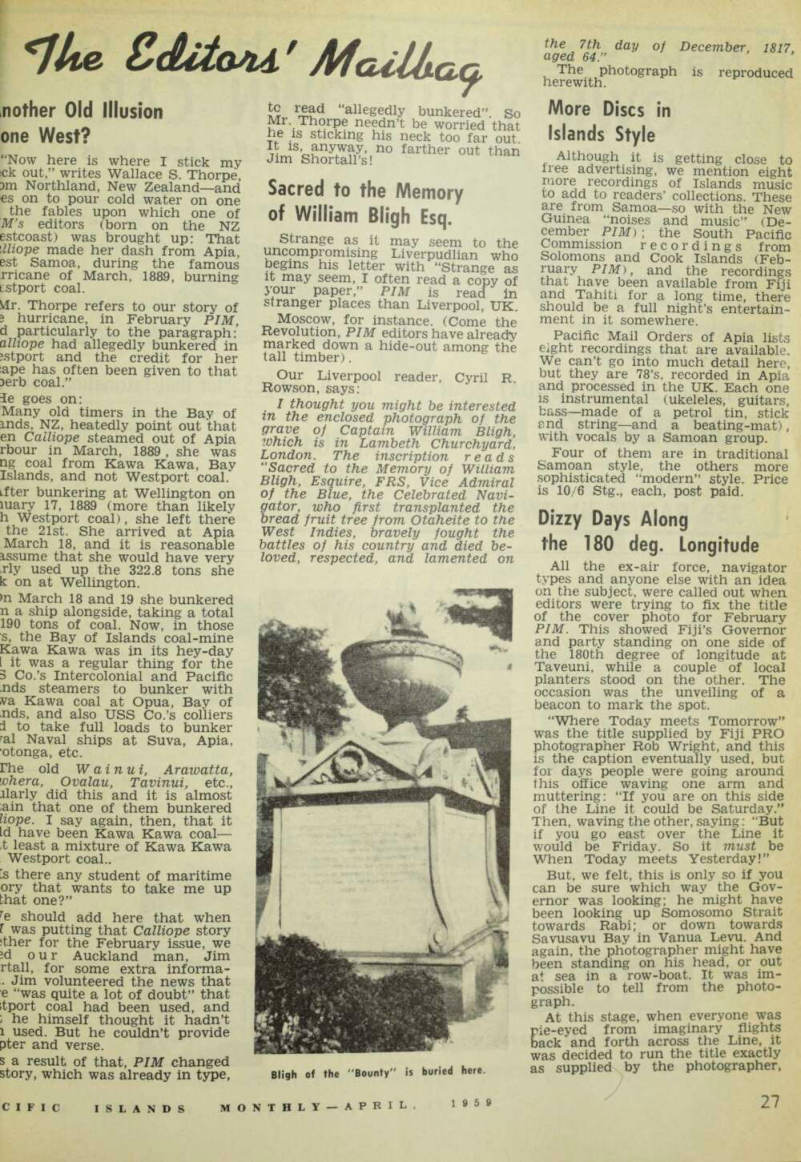
Rowson, says: I thought you might be interested in the enclosed photograph of the grave of Captain William Bligh, which is in Lambeth Churchyard, London. The inscription reads “Sacred to the Memory of William Bligh, Esquire, FRS, Vice Admiral of the Blue, the Celebrated Navi gator, who first transplanted the bread fruit tree from Otaheite to the West Indies, bravely fought the battles of his country and died be loved, respected, and lamented on
the 7th day of December, 1817. aged 64.”
The photograph is reproduced herewith.
More Discs in
Islands Style
Although it is getting close to free advertising, we mention eight more recordings of Islands music to add to readers’ collections. These are from Samoa—so with the New Guinea “noises and music” (De cember PIM) ; the South Pacific Commission recordings from Solomons and Cook Islands (Feb ruary PIM), and the recordings that have been available from Fiji and Tahiti for a long time, there should be a full night’s entertain ment in it somewhere.
Pacific Mail Orders of Apia lists eight recordings that are available.
We can’t go into much detail here, but they are 78’s, recorded in Apia and processed in the UK. Each one is instrumental (ukeleles, guitars, bass—made of a petrol tin, stick and string—and a beating-mat), with vocals by a Samoan group.
Four of them are in traditional Samoan style, the others more sophisticated “modern” style. Price is 10/6 Stg., each, post paid.
Dizzy Days Along
the 180 deg. Longitude
All the ex-air force, navigator types and anyone else with an idea on the subject, were called out when editors were trying to fix the title of the cover photo for February PIM. This showed Fiji’s Governor and party standing on one side of the 180th degree of longitude at Taveuni, while a couple of local planters stood on the other. The occasion was the unveiling of a beacon to mark the spot.
“Where Today meets Tomorrow” was the title supplied by Fiji PRO photographer Rob Wright, and this is the caption eventually used, but for days people were going around this office waving one arm and muttering: “If you are on this side of the Line it could be Saturday.”
Then, waving the other, saying: “But if you go east over the Line it v/ould be Friday. So it must be When Today meets Yesterday!”
But, we felt, this is only so if you can be sure which way the Gov ernor was looking; he might have been looking up Somosomo Strait towards Rabi; or down towards Savusavu Bay in Vanua Levu. And again, the photographer might have been standing on his head, or out at sea in a row-boat. It was im possible to tell from the photo graph.
At this stage, when everyone was pie-eyed from imaginary flights back and forth across the Line, it was decided to run the title exactly as supplied by the photographer,
Bligh of the "Bounty" is buried here.
the knowledge that if he and we re wrong we would be told about Ne have been —by half-a-dozen iple who say the title should be liere Today Meets Yesterday” i that the Governor is standing Yesterday with the planters in day. ind that is now where the matter ts, until we are convinced other e.
The Adelaide Chronicle, which ilished a feature article based on Fiji PRO photographs, also fell 3 the same pit as PlM —although, imagine, with less heart burnings nd had the Governor standing tomorrow and the planters in ay.) Tie inevitable Fiji resident has tten, of course, to point out that are all wrong, and that the 180 , of longtitude is not the Inter ional Dateline —at any rate as as Fiji is concerned, and that vas bent 11 deg. around Fiji in ) in order that everyone in the >ny could enjoy the same day ;he week at the same time. (The e is similarly bent for the benefit the Aleutians and Eastern sria, says the correspondent). he cover title might have in ited that PIM editors were not ,re of this but you can’t write rything into a cover, and inside magazine, p. 82, it was made ,r that even if our navigation aad, our general knowledge of and its crooked Dateline is p, and that Today Meeting terday (or tomorrow) in Taveuni one of those pleasant little micks that help to make the Id go round —strictly according Eastern or Western Time, of rse.
stralia Gives Away
)0 Millions in 13 Years
i old resident of New Guinea ts us to find out how much Aus a is spending on the Colombo i—and “is Australia getting any benefit out of it, anyway?” i March 10, in the Australian iament, in reply to a question Prime Minister said that Aus a has spent the following sums jr the Colombo Plan;
Menzies also said that much le money went in the purchase
of agricultural and industrial equip merit—such equipment being given by the Australian Government to member governments” in South and Southeast Asia, in compliance with formal requests. ‘Ts it retained and used by them, or sold or given to private pro ducers?” asked Mr. Ward.
Mr. Menzies said Australia ex pected it to be used by the gov ernments or by institutions under their control, and not sold or other wise disposed of.
It is not apparent that this Santa Claus system is policed in any way.
As to whether it really achieves any good, from Australia’s point of view —that is a matter of opinion.
In the period from the end of
World War II to June 30, 1958, Aus tralia gave over £27 millions to Asian Colombo Planners, and over £67 millions to Papua and New Guinea —close to £lOO millions, as a free gift, without conditions. It looks as if the proverbial rich uncle actually lives in Australia, and not in Fiji.
One boy was fatally injured, 16 badly injured and 10 others suffered minor injuries when a truck carry ing 55 native schoolboys overturned on the main road 30 miles outside of Noumea, New Caledonia in early April. The truck, owned by the Catholic Mission and driven by a European brother, was carrying Catholic schoolboys from Paita. The dead boy was the son of the Grand Chief of Canala.
£ 0-51 .. .. 19.190 1-52 .. .. 4,225,193 2-53 .. .. 3,301,038 3-54 .. .. 2.662,079 1-55 . . ,. 2,393,978 5-56 .. .. 4.675,805 3-57 .. .. 5,038.432 7-58 .. .. 4,997,259 otal .. ..