The Two Faces Of Bulolo
p. 47 · Read in the full issue
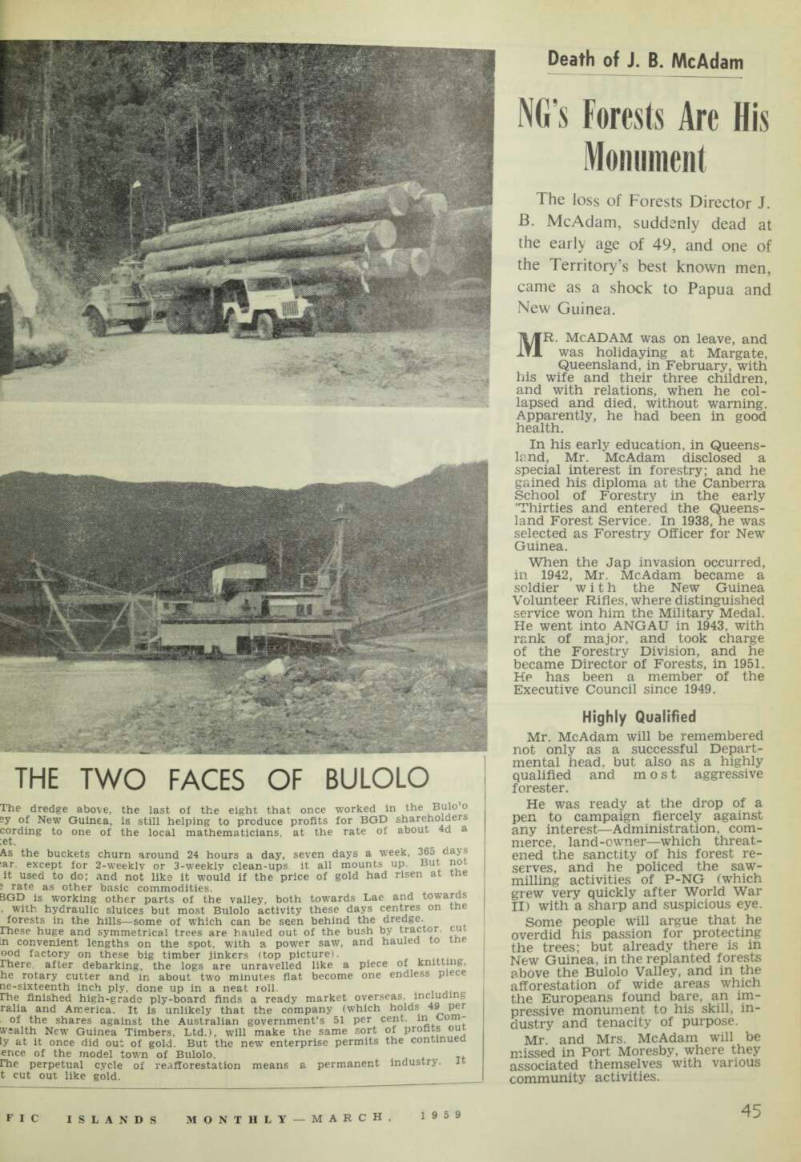
The dredge above, the last of the eight that once worked in the Bulo lo [?]eY of New Guinea, is still helping to produce profits for BGD shareholders [?]cording to one of the local mathematicians, at the rate of about 4d a [?]et.
As the buckets churn around 24 hours a day, seven days a week, 365 days [?]ar. except for 2-weekly or 3-weekly clean-ups. it all mounts up. But not [?] it used to do; and not like it would if the price of gold had risen at the [?]e rate as other basic commodities. [?] BGD is working other parts of the valley, both towards Lae and towards [?] with hydraulic sluices but most Bulolo activity these days centres on the [?]forests in the hills—some of which can be seen behind the dredge.
These huge and symmetrical trees are hauled out of the bush by tractor, cut [?]n convenient lengths on the spot, with a power saw, and hauled to the [?]ood factory on these big timber jinkers (top picture).
There after debarking, the logs are unravelled like a piece of knitting, [?]he rotary cutter and in about two minutes flat become one endless piece [?]ne-sixteenth inch ply, done up in a neat roll. , The finished high-grade ply-board finds a ready market overseas, including [?]ralia and America. It is unlikely that the company (which holds 49 per [?] of the shares against the Australian government’s 51 per cent, in Corn [?]wealth New Guinea Timbers, Ltd.), will make the same sort of profits out [?]y at it once did out of gold. But the new enterprise permits the continued [?]ence of the model town of Bulolo. . Tt T he perpetual cycle of reafforestation means a permanent industry, it [?]t cut out like gold.