fiji talanoa
pp. 43-45 · Read in the full issue

Vakatawa Laiks Of This And That
It could be that the Rewa Delta will become Fiji’s rice >wl when the Nausori sugar mill closes next year.
VT a tropical country such as 'iji should have to import more nd more rice each year seems silly, but that is the position. 3 demand for rice is growing ise the Indian population is ng, but there are other factors, ians, for instance, are becom egular rice eaters. (I like the of a little Fijian girl who 3f some Indian friends, “They urry and rice, just like us.”) e imports last year cost 324,000. The amount imported 4,230 tons. A Government nent on the position says that 3 there is large-scale planting ie Colony, imports will have by 1976 to 35,000 tons. 3 Colonial Sugar Refining >any, as part of its patient and • endeavour to find alternative for farmers who now supply lausori sugar mill, has made a ed study of rice possibilities e Nausori area. Experts have brought from Australia and study, in which the Depart of Agriculture has joined, re some promising prospects, mt 3,000 acres of potential rice can be used immediately and sugar is no longer grown this can be substantially extended iut eating into land which is fie for other economic crops. 3 CSR Co.’s experts suggest the possibilities do not end rice itself. Indian housewives arge quantities of sharps (a oduct of wheaten flour milling) he suggestion is that the im d sharps might be replaced by y produced rice flour. 3 opportunity certainly seems there. The land is available, narket is growing, and assured, al is needed, and milling and eting organisation is required, hat is where the worth of the rship available in Fiji can be battle mence :tle has been joined between rade union giants in Fiji. But not much of battle and they lot very big giants, e late Mr. Ami Chandra, whose i in a plane crash at Singa robbed Fiji of a wise and
balanced, though when necessary forthright and determined, labour leader, gathered the infant trade unions of the day into the Fiji In dustrial Workers’ Congress, modelled on the Trades Union Congress of the United Kingdom.
After his death, the presidency fell to Mr. B. D. Lakshman, but it was not long before he was deposed by the member unions and replaced by Mr. C. P. Bidesi, of Suva.
In neither case are qualifications for trade union leadership par ticularly obvious. Both men are, or have been, for instance, employers rather than workers.
In recent years, Mr. Lakshman’s activities have kept him in the public eye mainly as a focus for trouble in the sugar industry. After much manoeuvring, he became pre sident last year of the sugar mill workers’ union. The union, like a number of others in the Colony, has a curiously undemocratic con stitution which allows officers to be elected by “packed” meetings at a particular place, regardless of the views of members who are not able to travel from distant centres to vote.
Memories of his defeat in the In dustrial Workers’ Congress still rankle with Mr. Lakshman, and last month he brought into being a Fiji Trades Union Congress.
The inaugural meeting was held at the same time as a previously advertised meeting of the older body. Mr. Lakshman claimed wide and enthusiastic support for his congress, but he was oddly reticent about who was actually present.
The list of unions represented at Mr. Bidesi’s meeting, on the other hand, included all the larger and more important unions except Mr.
Lakshman’s sugar workers.
Politics in Fiji are bedevilled only too often by personal and factional rivalries. It looks as if the same blight may be falling on the trade union movement.
Delayed Reaction
Over Water When water rates in Suva were more than doubled in 1958 there was some murmuring, but little true realisation of what 3/9 per thousand gallons would mean when the bills came in.
Now they have come in and the murmurings have risen to dismayed shouts of rage.
Fijian housegirls are notorious wasters of water, but they are be ing sternly disciplined by house hold heads with water rate notices in hand. Some flat-dwellers have found that the bill for water is half, or more, as big as the bill for rent.
Wage earners who found it difficult enough to make ends meet previ ously are now faced with a severe extra burden. Industrial concerns are finding their costs increased by hundreds of pounds a year.
To all this the Government re-
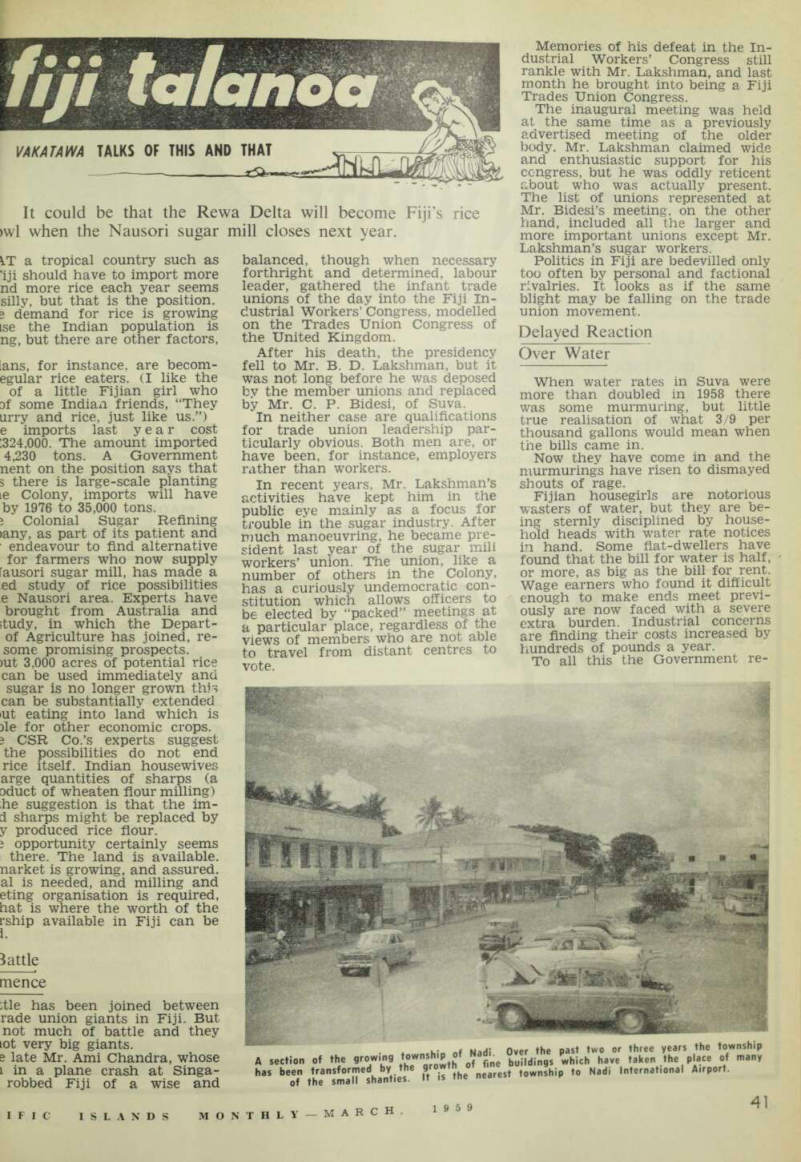
A section of the growing township of nadi. Over the past two or three years the township has been transformed by the growth of fine buildings which have taken the place of many of the small shanties. It is the nearest township to Nadi International Airport.
“economic charges”, and ; the recommendation of the Review Committee that all nment services should be paid users at rates which will re costs. i Chamber of Commerce ers are not impressed. They at the “economic charge” for includes far too high an it of capital cost. The Public Department is trying to pay i cost of the new Suva supply ch too short a time. jolt of the new rates has le effect at least of making isers water-conscious and has d them into fixing leaking iromptly and into trying to IVB/Sto an interesting point arises. If can’t pay the new high rates ater is cut off from a sub il number of houses, what will e effect on sanitation and health, and what will the net 3?
niters Will Blow Up
r ish Industry
5 fish supplies, or at least irawn from near-shore waters, ;ing seriously threatened by discriminate use of dynamite iison. l methods of catching fish in the destruction of finger >n which the fish harvest in depends, so the damage is itive. y now and then a fisherman i finger, or the greater part rand, but still the dynamit es on, and the police seem ess to stop it. l a mile or two from Suva, 3 Lami foreshore, explosions jard almost daily. Watching its phone the police, who :rom Suva in full uniform in :ly recognisable vehicle. It is urprising that when they ally make their well-adver appearance the lawbreakers lisappeared. osives are used for quarrying lining in a good many parts I Levu and supplies seem to dily accessible to the fish de •s. w years ago, the appointment a-official wardens to guard ilony’s resources of fish and birds was proposed, but the 3 fizzled out and the waste ,t should be one of Fiji’s main 3 of cheap food continues, awhile, canned fish comes is far away as South Africa, ? to accentuate Fiji’s adverse e of trade. ■e’s probably some sense in it aewhere. ka’s Tree
lent Again
avenue of trees at Natabua, iautoka, is in the news again, avenue is one of the beauty
spots of north-western Viti Levu, but every few years somebody decides that the trees should be cut down because they are a Menace to Traffic.
Defenders of the avenue swing smartly into action and point out once more that the obvious solution is to plant another row of trees and widen the road to take two lanes of traffic. Discussion rages fiercely and then dies down and the trees remain and the road remains, ready for the next attack by the critics.
This time, it is the Lautoka Chamber of Commerce, which is be coming a lively and vocal body under the presidency of Mr. W. L.
Bygrave, that wants to wield the
axe. The Chamber does not claim that the whole avenue should be destroyed, but would like to see seven trees removed from one end to expand a bottleneck.
The Automobile Association of Fiji leads the opposition. Widen the entrance to the bottleneck, says the Association’s patrol, Mr. R. Frow, and you merely increase the danger when the narrow part is reached.
Plant another row of trees, urges the Association (this is where we came in) and widen the road.
The discussion has special in terest for exporters of timber to Hawaii, where “monkey-pod” souvenirs are made from the wood of trees of the type of those in the avenue.