"Ah, That’s My Boy!"
p. 92 · Read in the full issue
A Brett Milder Profile
ABOUT 50 years ago the little island of Petats. off the west coast of Buka, was ruled by a luluai named Magum.
This luluai sent his son Namus to the Methodist Mission school at Skotolan, where he learnt the three R’s.
I was passing that way in February, 1939, picking up copra and doing a little blackbirding on the side, when two boys came alongside in a canoe, wanting to “make paper”. They both signed on, and became my house-boys in Rabaul.
The elder and more experienced was Namus. and the younger one’s name was Jupile. He had never seen a township before and his enlightenment was a con tinued source of delight to my family, to whom the boys became most devoted ser vants.
When we left for the war. Namus stayed behind with the ship to finish his time, and w T as back on Petats during the Japanese occupation.
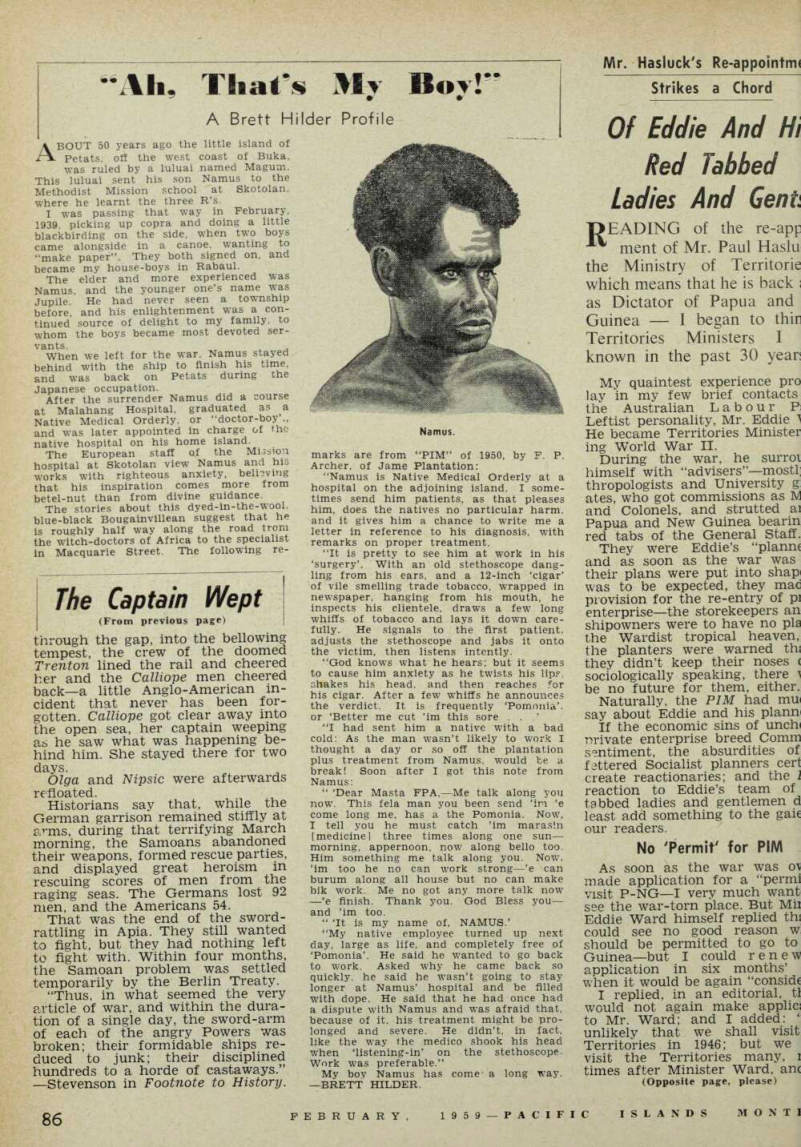
After the surrender Namus did a course at Malahang Hospital, graduated as a Native Medical Orderly, or “doctor-boy and was later appointed in charge of the native hospital on his home island.
The European staff of the Mission hospital at Skotolan view Namus and his works with righteous anxiety, believing that his inspiration comes more from betel-nut than from divine guidance.
The stories about this dyed-in-the-wool, blue-black Bougainvillean suggest that he is roughly half way along the road trom the witch-doctors of Africa to the specialist in Macquarie Street. The following re-
marks are from “PIM” of 1950, by F. P.
Archer, of Jame Plantation: “Namus is Native Medical Orderly at a hospital on the adjoining island. I some times send him patients, as that pleases him, does the natives no particular harm, and it gives him a chance to write me a letter in reference to his diagnosis, with remarks on proper treatment.
“It is pretty to see him at work in his ‘surgery’. With an old stethoscope dang ling from his ears, and a 12-inch ‘cigar’ of vile smelling trade tobacco, wrapped in newspaper, hanging from his mouth, he inspects his clientele, draws a few long whiffs of tobacco and lays it down care fully. He signals to the first patient, adjusts the stethoscope and jabs it onto the victim, then listens intently.
“God knows what he hears; but it seems to cause him anxiety as he twists his lip?, shakes his head, and then reaches for his cigar. After a few whiffs he announces the verdict. It is frequently ‘Pomonia’. or ‘Better me cut ’im this sore . . .’
“I had sent him a native with a bad cold: As the man wasn’t likely to work I thought a day or so off the plantation plus treatment from Namus, would be a break! Soon after I got this note from Namus; “ ‘Dear Masta FPA, —Me talk along you now. This fela man you been send ’in ’e come long me, has a the Pomonia. Now, I tell you he must catch ’im marasln [medicine] three times along one sun morning, appernoon, now along bello too.
Him something me talk along you. Now, ’im too he no can work strong—’e can burum along all house but no can make bik work. Me no got any more talk now —’e finish. Thank you. God Bless you— and ’im too.
“ ‘lt is my name of, NAMUS.’
“My native employee turned up next day, large as life, and completely free of ‘Pomonia’. He said he wanted to go back to work. Asked why he came back so quickly, he said he wasn’t going to stay longer at Namus’ hospital and be filled with dope. He said that he had once had a dispute with Namus and was afraid that, because of it. his treatment might be pro longed and severe. He didn’t, in fact, like the way the medico shook his head when ‘listening-in’ on the stethoscope.
Work was preferable.”
My boy Namus has come- a long way.
Brett Hilder.
Namus.