Seventieth Anniversary of a Hurrican[?]
pp. 90-92 · Read in the full issue
That Stopped a War
On March 15, 1889—70 years ago—there was acute danger of war in Samoa between United States and Germany, with Britain on the side-lines, and probably in the fight. On March 1889, all probability of war had disappeared, mostly because the snarling nations had nothing in Samoa to fight with.
A crisis was avoided, and an international “situation” wiped out, when a second-class hurricane came out of the north in the evening of March 15 and, in 24 hours, threw three German warships, three American warships, and four merchant ships upon the coral reefs, drowned 116 servicemen and a lot of civilians and forced the Calliope, the only British warship, out to sea.
JT probably was the most spec tacular event in the history of the South Pacific Islands.
The three Powers—Britain, United States and Germany—had been jostling each other in the Samoan archipelago for 30 years—ever since the group was found commercially desirable, and a suitable half-way stopping-place between North America and Australasia. America
wanted Pago Pago and Germany wanted Samoa.
Britain apparently sought neither —she had been invited to annex, again and again, and declined—but she did not want any Power (especi ally Germany) to become established there.
In an endeavour to establish a paramount king and stable govern ment, the Samoans, from the 1860’s,
carried on a series of inter wars and gradually the Power mixed up in those struggles.
After the Franco-Prussian Germany really began to thruj her tentacles in search of a col empire; and her grip on the Sa: especially through planting trading, became stronger and aggressive. Germany backed group of kingmakers.
Following the Meade Trea the early ’Seventies, America be the occupant of Pago Pago. Bu interests in all the Samoas large and growing, and she di( at all like the increasing infli of the Germans, nor Germ arrogance. She backed an group of kingmakers.
Ugly Situation Developed
Britain could not remain i ferent. She did not want Sa but she had huge interests in New Zealand and Australia an ruthlessness of the German t in Samoa and New Guinea Micronesia, not to mention 1 and the Solomons, kept Whit uneasy and fretful.
The tension increased, thi the ’Eighties, as the San squabbled and the Consuls intri Unit by unit, the Powers bui each a little fleet in Samoa; in March of 1889, the situ really was ugly.
The bush around Apia Bay full of armed Samoans, pro l and spying on each other.
Harbour —really little better th sheltered anchorage was fu warships, bristling with guns seething with suspicion.
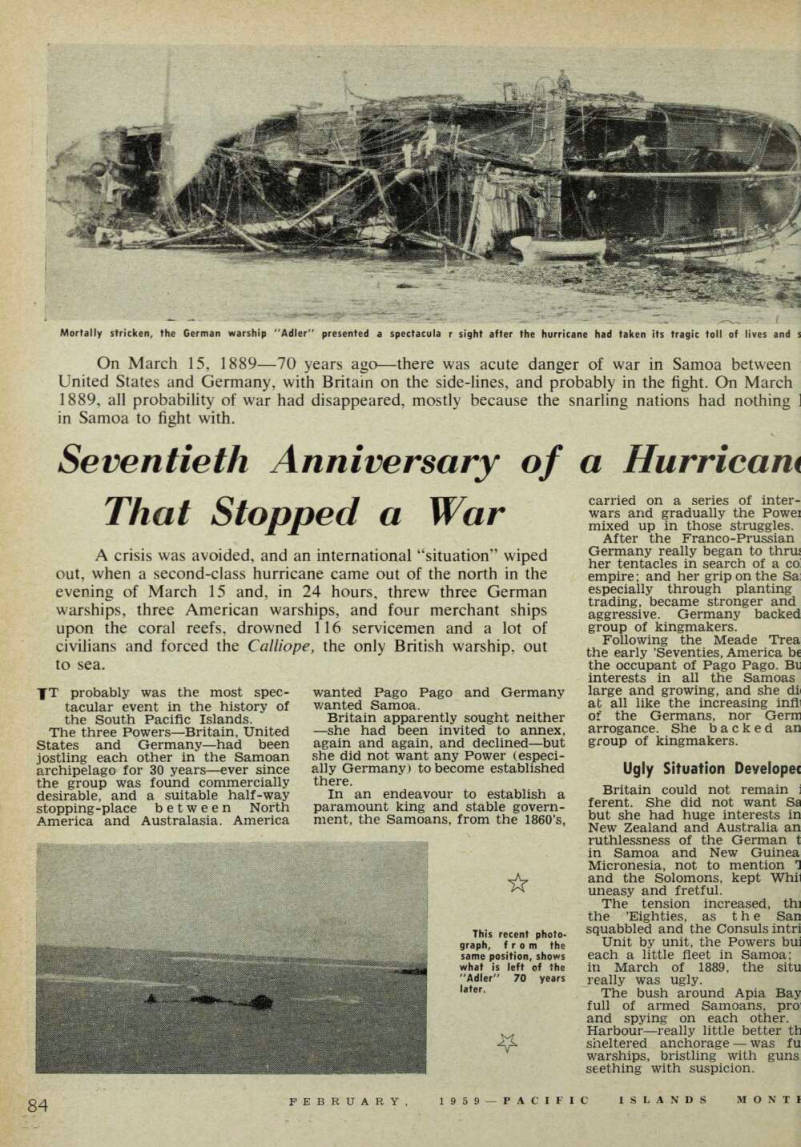
Mortally stricken, the German warship “Adler" presented a spectacula r sight after the hurricane had taken its tragic toll of lives and s
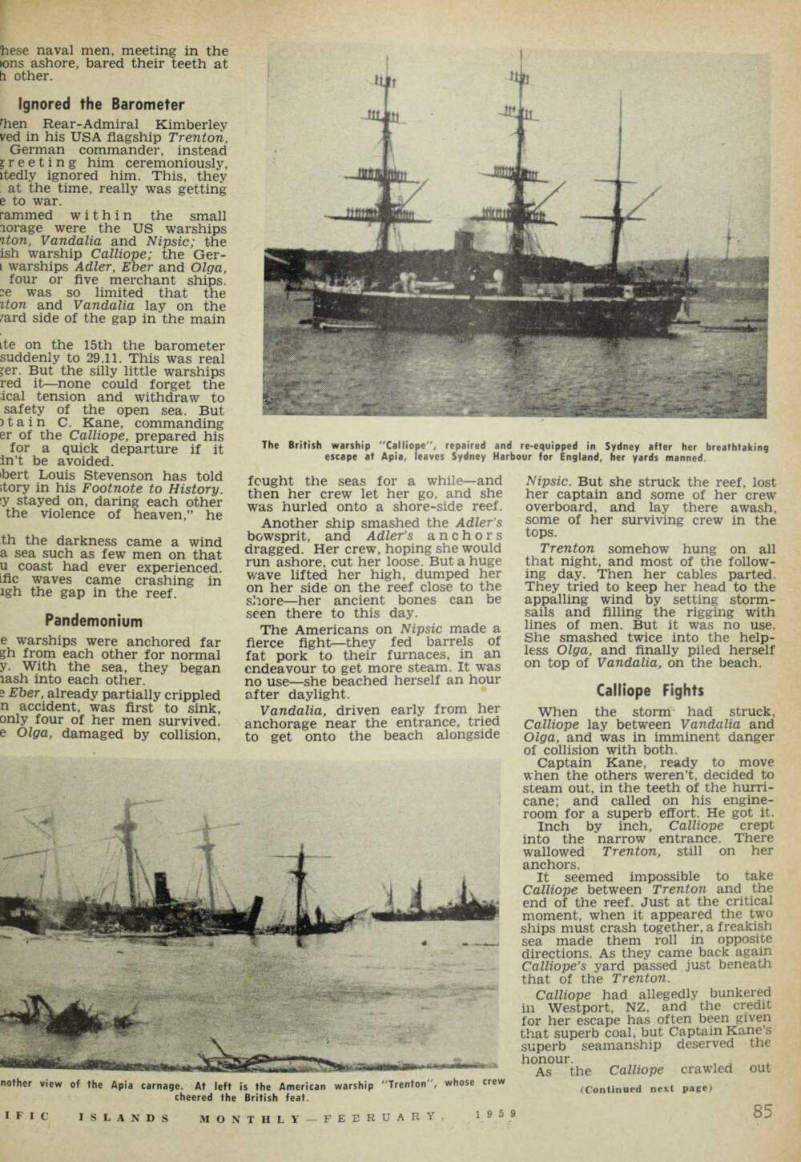
This recent photo graph, from the same position, shows what is left of the "Adler" 70 years later.
hese naval men, meeting in the tons ashore, bared their teeth at h other.
Ignored the Barometer Tien Rear-Admiral Kimberley ved in his USA flagship Trenton, German commander, instead greeting him ceremoniously, itedly ignored him. This, they at the time, really was getting e to war. rammed within the small lorage were the US warships ' iton, Vandalia and Nipsic; the ish warship Calliope; the Ger i warships Adler, Eher and Olga, four or five merchant ships. :e was so limited that the iton and Vandalia lay on the rard side of the gap in the main ite on the 15th the barometer suddenly to 29.11. This was real jer. But the silly little warships red it—none could forget the leal tension and withdraw to safety of the open sea. But )ta i n C. Kane, commanding er of the Calliope, prepared his for a quick departure if it In’t be avoided. •bert Louis Stevenson has told ;tory in his Footnote to History, y stayed on, daring each other the violence of heaven,” he th the darkness came a wind a sea such as few men on that u coast had ever experienced, [fie waves came crashing in igh the gap in the reef.
Pandemonium
e warships were anchored far gh from each other for normal y. With the sea, they began lash into each other, s Eher, already partially crippled n accident, was first to sink, only four of her men survived, e Olga, damaged by collision,
fought the seas for a while —and then her crew let her go, and she was hurled onto a shore-side reef.
Another ship smashed the Adler’s bowsprit, and Adler’s anchors dragged. Her crew, hoping she would run ashore, cut her loose. But a huge wave lifted her high, dumped her on her side on the reef close to the shore —her ancient bones can be seen there to this day.
The Americans on Nipsic made a fierce fight—they fed barrels of fat pork to their furnaces, in an endeavour to get more steam. It was no use—she beached herself an hour after daylight.
Vandalia, driven early from her anchorage near the entrance, tried to get onto the beach alongside
Nipsic. But she struck the reef, lost her captain and some of her crew overboard, and lay there awash, some of her surviving crew in the tops.
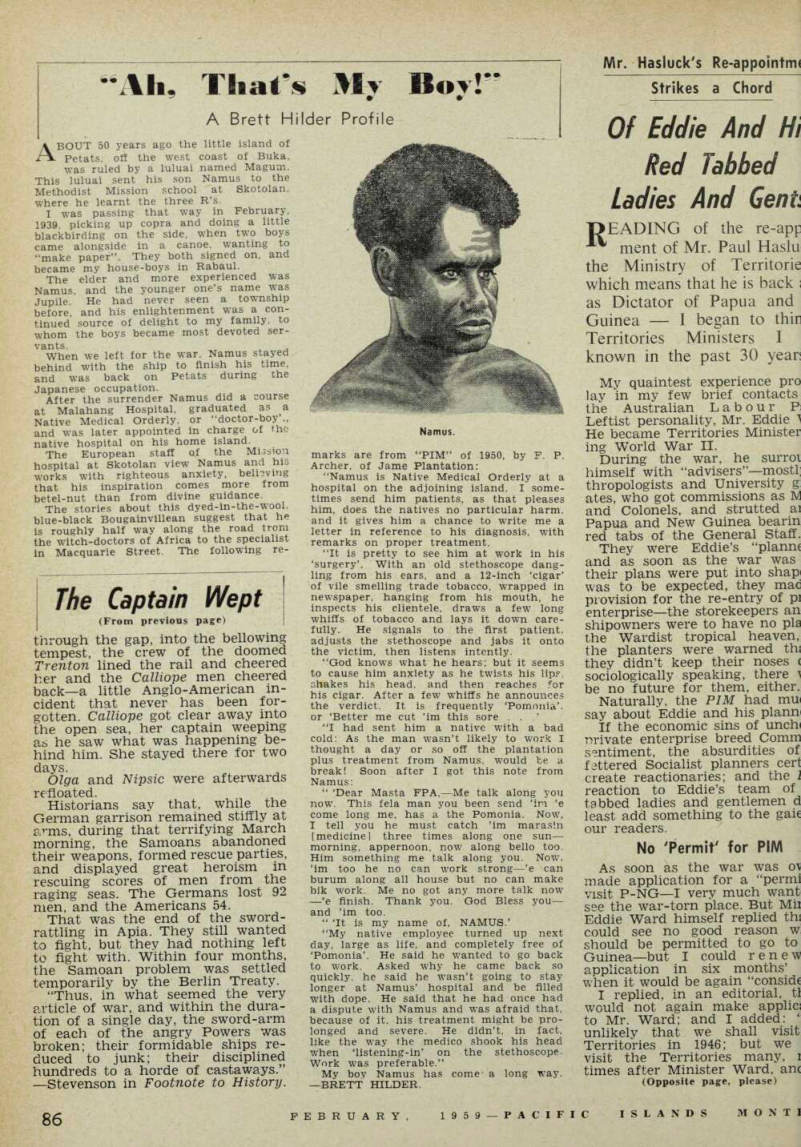
Trenton somehow hung on all that night, and most of the follow ing day. Then her cables parted.
They tried to keep her head to the appalling wind by setting storm sails and filling the rigging with lines of men. But it was no use.
She smashed twice into the help less Olga, and finally piled herself on top of Vandalia, on the beach.
Calliope Fights
When the storm had struck, Calliope lay between Vandalia and Olga, and was in imminent danger of collision with both.
Captain Kane, ready to move when the others weren’t, decided to steam out, in the teeth of the hurri cane; and called on his engine room for a superb effort. He got it.
Inch by inch, Calliope crept into the narrow entrance. There wallowed Trenton, still on her anchors.
It seemed impossible to take Calliope between Trenton and the end of the reef. Just at the critical moment, when it appeared the two ships must crash together, a freakish sea made them roll in opposite directions. As they came back again Calliope’s yard passed just beneath that of the Trenton.
Calliope had allegedly bunkered in Westport, NZ, and the credit for her escape has often been given that superb coal, but Captain Kane’s superb seamanship deserved the honour. , , , As the Calliope crawled out
(Continued next page)
[?]other view of the Apia carnage. At left is the American warship "Trenton", whose crew cheered the British feat.
The British warship "Calliope", repaired and re-equipped in Sydney after her breathtaking escape at Apia, leaves Sydney Harbour for England, her yards manned.
through the gap, into the bellowing tempest, the crew of the doomed Trenton lined the rail and cheered her and the Calliope men cheered back—a little Anglo-American in cident that never has been for gotten. Calliope got clear away into the open sea, her captain weeping as he saw what was happening be hind him. She stayed there for two days.
Olga and Nipsic were afterwards refloated.
Historians say that, while the German garrison remained stiffly at f/ms, during that terrifying March morning, the Samoans abandoned their weapons, formed rescue parties, and displayed great heroism in rescuing scores of men from the raging seas. The Germans lost 92 men, and the Americans 54.
That was the end of the sword rattling in Apia. They still wanted to fight, but they had nothing left to fight with. Within four months, the Samoan problem was settled temporarily by the Berlin Treaty.
“Thus, in what seemed the very article of war, and within the dura tion of a single day, the sword-arm of each of the angry Powers was broken; their formidable ships re duced to junk; their disciplined hundreds to a horde of castaways.” —Stevenson in Footnote to History.