Pacific Report
pp. 119-151 · Read in the full issue
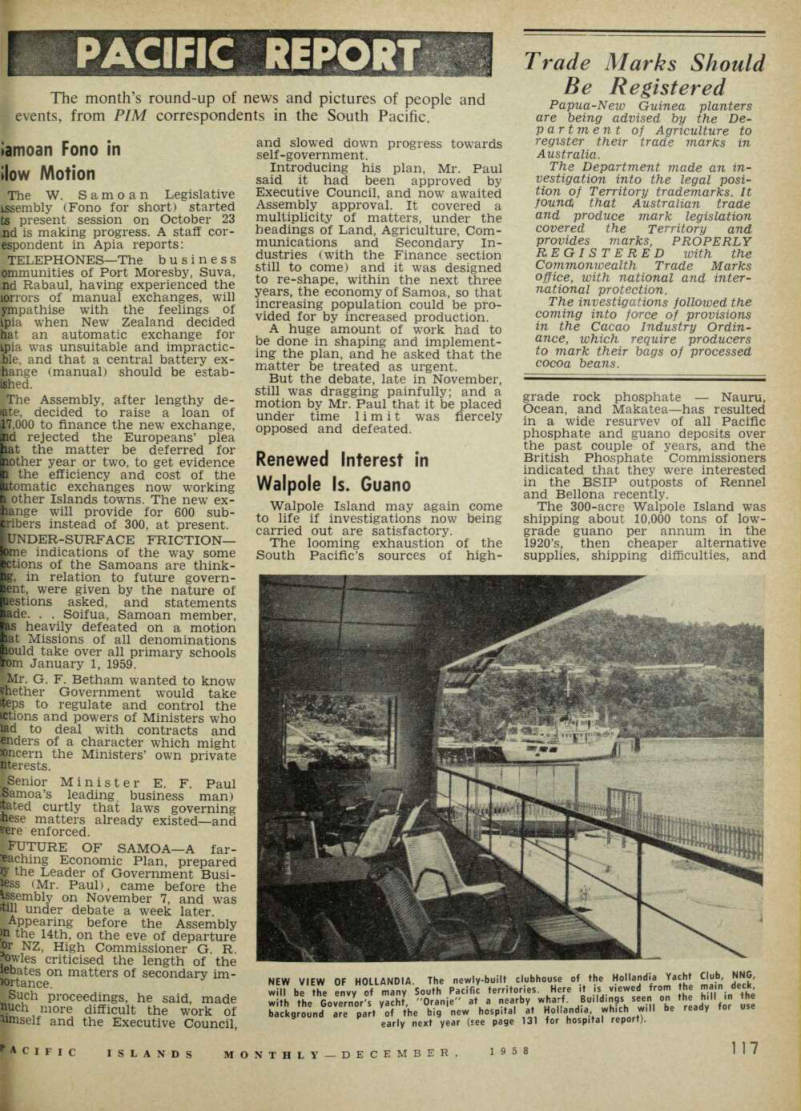

The month’s round-up of news and pictures of people and events, from PIM correspondents in the South Pacific.
lamoan Fono in
How Motion
The W. Samoan Legislative issembly (Fono for short) started ts present session on October 23 ,nd is making progress. A staff cor espondent in Apia reports: TELEPHONES—The business ommunities of Port Moresby, Suva, nd Rabaul, having experienced the lorrors of manual exchanges, will ympathise with the feelings of ipia when New Zealand decided hat an automatic exchange for Lpia was unsuitable and impractic ble, and that a central battery ex iiange (manual) should be estab ihed.
The Assembly, after lengthy de late, decided to raise a loan of |7,000 to finance the new exchange, md rejected the Europeans’ plea bat the matter be deferred for pother year or two, to get evidence »n the efficiency and cost of the litomatic exchanges now working I other Islands towns. The new ex pange will provide for 600 sub- Iribers instead of 300, at present.
Lunder-Surface Friction—
bme indications of the way some fections of the Samoans are think ng, in relation to future govern ment, were given by the nature of liestions asked, and statements pade. . . Soifua, Samoan member, las heavily defeated on a motion pat Missions of all denominations pould take over all primary schools lom January 1, 1959.
Mr. G. F. Betham wanted to know Inether Government would take fcps to regulate and control the ictions and powers of Ministers who iad to deal with contracts and ■finders of a character which might Joncern the Ministers’ own private nterests. • Senior Minister E. F. Paul Samoa’s leading business man) ated curtly that laws governing lese matters already existed—and ere enforced.
{Future Of Samoa—A Far
'fiaching Economic Plan, prepared >y the Leader of Government Busi ness (Mr. Paul), came before the Assembly on November 7, and was •till under debate a week later.
Appearing before the Assembly P the 14th, on the eve of departure *> r NZ, High Commissioner G. R. • owles criticised the length of the debates on matters of secondary im portance.
Such proceedings, he said, made nuch more difficult the work of nimself and the Executive Council,
and slowed down progress towards self-government.
Introducing his plan, Mr. Paul said it had been approved by Executive Council, and now awaited Assembly approval. It covered a multiplicity of matters, under the headings of Land, Agriculture, Com munications and Secondary In dustries (with the Finance section still to come) and it was designed to re-shape, within the next three years, the economy of Samoa, so that increasing population could be pro vided for by increased production.
A huge amount of work had to be done in shaping and implement ing the plan, and he asked that the matter be treated as urgent.
But the debate, late in November, still was dragging painfully; and a motion by Mr. Paul that it be placed under time limit was fiercely opposed and defeated.
Renewed Interest in
Walpole Is. Guano
Walpole Island may again come to life if investigations now being carried out are satisfactory.
The looming exhaustion of the South Pacific’s sources of high
grade rock phosphate Nauru, Ocean, and Makatea—has resulted In a wide resurvev of all Pacific phosphate and guano deposits over the past couple of years, and the British Phosphate Commissioners indicated that they were interested in the BSIP outposts of Rennel and Bellona recently.
The 300-acre Walpole Island was shipping about 10,000 tons of low grade guano per annum in the 1920’5, then cheaper alternative supplies, shipping difficulties, and
NEW VIEW OF HOLLANDIA. The newly-built clubhouse of the Hollandia Yacht Club NNG, will be the envy of many South Pacific territories. Here it is viewed from the main deck, with the Governor's yacht, "Oranje" at a nearby wharf. Buildings seen on the hill m the background are part of the big new hospital at Hollandia, which.will be ready for use early next year (see page 131 for hospital report).
Bier problems slowed up the ex erts.
The Austral Guano Co„ of Mel ourne, arranged a contract with n Auckland importer in 1934, but lis was terminated in 1936 after tie 8,500 tons agreed upon had een supplied by the Melbourne rm which was then working the eposits.
After that, and up to February, J4O, only small shipments left the iland, and when the company ithdrew its 60-odd staff and most f its machinery in that year there r as said to be a stockpile of about ,000 tons ready for shipment and bout 100,000 tons of economically wkable deposits still untouched. 0 far as we know, no guano has een shipped since 1940.
In mid-November Mr. L. Ellis, f Auckland, flew to Noumea where e was to join representatives of gence Tsutsui, a Japanese or anisation with an office in Noumea, nd export interest in other iinerals from New Caledonia to apan. The party was to travel 1 a Noumea-based Japanese tug 50 miles south to Walpole to study tie situation.
In 1955 Captain Emile Savoie, of loumea, who is believed still to be ssociated with a group having tgnts of exploitation, made in juries in New Zealand where much f the Guano was formerly ex orted, with a view to reopening ■ie industry with his own small tups.
He found, however, that higher
grade guano from Seychelles in the Indian Ocean could be landed in New Zealand at a price below the figure which he considered it would cost to deliver Walpole supplies, so the scheme was abandoned.
Importers pointed out also, at that time, that the consumers, market gardeners, etc., were now quite un familiar with Walpole guano and that they would not readily change from a fertiliser which they knew to one which was unfamiliar.
Since then the situation has changed somewhat.
The Seychelles deposits are re ported to be nearing exhaustion— though a shipment arrived in Auckland recently, the first for some years.
If the Walpole trade with New Zealand is revived, the guano, which has to be loaded by lighters, would most probably be carried in Japanese ships on the regular run between Japan and New Zealand.
Lighters and tugs used by Japanese mineral shippers at New Caledonia would be available for this work.
Another New Route
For Teal
If they can get the travel money out of their Government, blue nosed, shivering New Zealanders will have an extra winter holiday choice next year: They will be able to fly north to Fiji, as usual; or to
Queensland’s fabulous Gold Coast, :direct—which will be new.
Tasman Empire Airways will run the special Auckland-Brisbane iservices once weekly through July, August and September as an :experiment.
If successful they may be con tinued on a round-the-year basis, with heat-affected Queenslanders cooling off in New Zealand in the isummer months. The odd thing about Queenslanders, of course, is that they are not nearly so keen on escaping from the heat as New Zealanders are from the cold —but there should be sufficient of them to make this a paying proposition.
Super DC6 airliners will be used on the service, carrying first-class and tourist passengers. The flight time will be 6i hours for the Auckland-Brisbane journey and hours on the homeward run. This will be TEAL’S fifth trans-Tasman route.
Critics Don't Like
Film of Gann's Story
I Those—if any—who have, been waiting with bated breath for the Ippearace of Hollywood’s latest advertised South Seas drama, Twilight for the Gods, may now relax. It’s a flop—according to American film reviews.
I Twilight for the Gods, whatever its artistic demerits, should, how ever, have had some special interest for some people in French Polynesia Iho met American writer Ernest K.
Gann and hi s brigantine-yacht Albatros two years ago when Gann made a quick cruise south to Tahiti to gain local colour for this film, and for a possible future book.
It was immediately following that cruise that shooting began in Hawaii, with Albatros as the schooner Cannibal, and Rock Hudson as the gin-soaked skipper, as it voyaged north from the Marquesas to Hono lulu. Also featured, as passengers or crew, are plenty of other box office favourites Leif Erickson, Ernest Truex, Cyd Chansse, Vladimir Sokoloff, Arthur Kennedy, Judith Evelyn, Wallace Ford, ana Richard Haydn. But in spite of that the reviewers are not impressed.
The film has profited nothing from the stage play, which had a short run and was a financial failure.
Principal complaint about the film is that it lacks action of the type traditionally expected of a South Seas film. , Albatros, which was advertised following the making of the film, but which was unsold, was sailed to England by Gann and made the newsreels several months ago as she sailed up the Thames. We hear that the brigantine has again been put up for sale.
Expert Will Assess
Coconut Research
The first major assessment of coconut research work will be carried out in Papua-New Guinea next year by a leading international
scientist.
The Chief of the Division of Plant Industry of the P-NG De partment of Agriculture, Mr. F. C.
Henderson, said the scientist, who has not yet been named, will start work on January 1.
The scientist will work under the auspices of the United Nations Food and Agricultural Association. His job will be to assess the coconut research work now under way in the main copra-producing countries —the Philippines, Indonesia, Malaya, Ceylon, West Africa, the West Indies and the Pacific Islands—and to provide for an ex change of scientific information.
They Plan For
Mission Extension
Seventh Day Adventist church leaders from Perth to Pitcairn, and throughout Pacific Islands terri tories were attending a South Pacific Missionary Conference, be tween November 30 and December 6, near Newcastle, NSW. They planned a four year programme of mission activity, calling for ex tension of the work in New Guinea, the New Hebrides and other Islands.
Native representatives at the conference included Elisha Goropava, of Rabaul, New Guinea; Gapi Ravu and Vave Pitu, of Papua; Solomon Tevita, of the New Hebrides; and Manase Niuafe, of Tonga. All are ordained pastors of the Adventist church.
Other problems are the staffing
[?]Orfolk Island Wedding. Mr. And Mrs.
Thillip Sims, after their marriage at St. [?]arnabas Chapel, with one of their two flower girls, Cathy Stanton. Mr. Sims is with Burns Philp, on Norfolk. The bride was Judith Virtue, of Christchurch, NZ.
of mission schools and clinics, answering the requests of hundreds of native chiefs for the establish ment of mission schools and the teaching of hygienic care of infants to reduce the high mortality rate. Mission leaders for New Guinßa and the central Pacific Islands were also to be elected at the con ference.
I Pastor F. G. Clifford, president of the Seventh Day Adventist church for Australasia and South Pacific, said before the conference started that Christian responsibility to islands peoples must “go beyond a modernising of primitive heathen
living”.
Now It's Happening
In Pairs
I On the same day in November, and at approximately the same hour, the same sort of accident happened to two well-known men in the Islands —Mr. Dave Butler, man ager of Union SS Co., in Suva, and Mr. A. M. Gurau, in Apia, Samoa, i Mr. Butler was driving fairly fast along an empty street, and had to swerve suddenly to avoid a child Chasing a cat. His front wheel went deep into an unexpected hole dug by linesmen of some kind at the edge of the grass, and his car rolled over into a muddy ditch.
Mr. Gurau was turning his car in front of Mrs. Aggie Gray’s hotel, and did not take enough lock as he "went rapidly forward.
He went right over the sea-wall into the salt water of Apia Harbour.
Both men escaped with a severe
bruising.
Mr. Butler was lucky—no one was around to give him advice. Mr.
Ourau’s adventure was witnessed by many. He came up, swimming
strongly, to be told by an old friend: “You should have been a submarine captain!”
Mr. Gurau was unperturbed. He said to another old friend (Mr.
Bartley): “Kulolo, will you please get my coat and umbrella out of there?”
It Was a Japanese
Museum Expedition
Quite a number of listeners to Pacific news broadcasts probably wondered “what cooked” when it was reported that the Rabaul-based vessel Gona— a former Canadian naval hospital tender of the Fair mile type—was overdue between Honiara and Luganville in October with a party of Japanese scientists and news-men aboard. (See also PIM October, p. 145.) Inquiry indicates that the charterers, apart from a couple of Japanese copra buyers who travelled to Honiara, consisted of a small expedition from the Osaka Muni cipal Museum of Natural History, making a collection of marine life specimens and marine photographs.
The party was headed by Mr.
Yoshitaka Tsutsui, director of the museum. Some collecting was done in the Solomons and Banks en route to Luganville—possibly accounting for some of the delay in arrival there.
The party then travelled on to Noumea by the Polynesie and was working there early November .
Mr. Tsutsui then repeated that he was awaiting a permit to make similar collections in the New Hebrides. The French had agreed but a British permit was still awaited. The expedition apparently has no connection with Inter national Geophysical Year activities.
Three well-known residents of the Polynesian islands, photographed in American Samoa in November. From left to right: Dr. Hans Thieme, Medical Officer in charge of the Apia Hospital, who was in Pago Pago attending a conference on tuberculosis; Mrs. Protheroe, widow of the late manager of Morris Hedstrom, Ltd., in Nukualofa, on her way to New Zealand; and Mr. J. B. McKinney, well known in many islands and now Officer-in-Charge of Government Transport in Pago Pago.
They're Leaving
West Samoa
More by coincidence than design, :quite a number of well-known old 'residents of Western Samoa are leaving the Territory, or are about to depart; and there have been numerous farewell functions. Those leaving include Mr. K. R. LAMBIE, Director of Education, returning to NZ after 11 years very hard work...
Mr, HARRY NEWTON, who for many years has successfully man aged the Samoan Banana Scheme...
Mr. GEORGE LEOPARD, manager of the Union SS Co. in Apia for three years, and formerly a resident in other Islands centres, now to be manager at Gisborne, NZ. . . . Mr, LES PEARSON, who built Apia’s Methodist Church, Morris Hedstrom’s premises, the A. M.
Macdonald Building, and other modern structures. . . . Mr, TERRY DUNLEAVY, editor of Samoa Bulletin for seven years, and now transfer ring to a business management in Wellington, to take care of his chil dren’s education. . . In each case, the departing wife will leave a real gap in Apia’s social life.
Telegraphic Secrecy
For Tonga
I Somewhat belatedly it would seem, the Tonga Legislative As sembly recently passed a Bill whereby the Kingdom will be brought into line with international practice in enforcing secrecy of correspondence handled by the in land and overseas telegraph system. - Apparently, prior to the intro duction of this Bill, there was no legal provision for enforcing such secrecy in Tonga.
Barramundi on
Moresby Menus
f Barramundi, regarded by Aus tralians as the best-eating tropical fish in the world, was caught in quantity by Division of Fisheries re search teams operating out of Port
Moresby recently.
It is probably too soon yet to cheer—but if these big fish can be caught regularly, not only will they help out with Moresby’s perpetual fish famine but they could be a source of income if snap-frozen and shipped south.
Burramundi appears infrequently, and at a high price, on the menus of Sydney’s best clubs, restaurants and hotels. The supply comes frozen from Northern Australian waters, and the Gulf around Normanton.
Barramundi can be any size from 10 lb to 80 lb, and unlike most tropical fish, their flesh is firm and good flavoured.
Frpnrh Parifir Mow
rruntil rdtmt mew
Governors All Round
With the departure for Paris of M. Aime Grimaid, formerly Governor of New Caledonia and High Pa^^ ISS the 61 hi top French official nosts has been com? ni r ptp Cn omcial P° sts nas been com piete> In early October, M. Pierre Anthonioz, French Resident Commissioner in the New Hebrides, left Vila by air for France, and reposting. M. Camille Bailly, has already handed over to a new Governor of French Polynesia, M. Pierre Sicaud,
who was formerly a senior official of the overseas Territories “xhfnew Governor of New
Sholo^hieltrailht'MS
n os t'h“ wirformerlv aGova-nOT f French Afrlr? * Governor There is no si g nificance in the reshuffle M. Anthonioz established some sort of record in the Hebrides.
He has been there since 1949—which is four times as long as any French official remains anywhere, The number of Governors that New Caledonia and French Polynesia have had since the end of World War II have been almost as many as the number of French Govern
ments. These gubernatorial appointments are, of course, not political.
Governments come and go, but France’s bureaucracy goes on, and allows the Empire to function.
M. Grimald had been in Noumea since March, 1956—which is slightly longer than most.
ineyve bOt Virile
Anctralisnc In AUSirananS in Honiara, TOO accents P ‘X^X C maL^n“s n she found that quite half of the Austrians” 01 ’ 6 " 11 r6SldentS W6re f in caL the Other Half should
thaTre?entfy
appeared in Granny’s column in The Sydney Morning Herald. It con cerns a young Australian journalist, female, currently in London, The journalist was talking to a model and small-part actress at a reception at the famous Savoy Hotel, “You’re an Australian?” asked the small-part actress.
“Yes,” said the journalist, “You recognised the accent quickly.” . “P h ’ but rm mad about the Aus tralian accent; it’s wonderful,” re
dlar^t's^the'lomfng
thins amons actors in Fmi.nH irs ‘° “ k Uke ty% y ° U C ° lonial ° fflCe
TAI Sandringham
Back on Job
TAl’s Sandringham flying-boc purchased from Sir Gordon Tay\j for use on the Papeete-Boraboi water sector of its Paris service,, now in operation.
The aircraft was still undergoii( a refit at Papeete when the Pa* service commenced, and local sh:x were chartered to meet the situati; for a couple of flights.
Canadian Missionaries
For Papua-New Guinea
Canadian Montfortian missionan will establish a Mission post on tt Fly River in Papua-New Guim next year.
The National Director of Pontid cal Works for Australia and tt Pacific, Monsignor R. E. Thome said in November that no site hri been decided for the Mission, buttj was expected to operate near Bose Village, almost on the Dutch NT' Guinea border.
Monsignor Thomas said in futud years, with the expansion missionary service, more overs©? workers would be called on to to Papua-New Guinea if Austrae could not meet the demand.
Chathams Get
RNZAF Service
A RNZAF Sunderland flying-boc is being converted for use as z commerial passenger carrier— the Air Force —on the Wellington Chatham Islands service as requinl by traffic demands.
Prior to TEAL disposing of all fcf its remaining Coral Route Solo! flying-boat, TEAL made commercD' flights from Wellington to tf Chathams in the summer. Most J the traffic offering is the transpoq of children to and from mainla:jBj schools, before and after the sumirn school holidays.
After TEAL disposed of its flyimi boats, NAC made flights wi 11
DC3’s to an airfield on private land many miles—and hours —over a very poor road from the main settlement.
It is now reported that the civil aviation authorities have condemned the radio navigational facilities at the Chathams, but this factor does not interfere with RNZAF opera tions.
The converted Sunderland will carry 24 passengers: two flights were likely before Christmas, and next
year flights may be more frequent than in the past.
All bookings are being handled by RNZAF Movements Section, Wellington, and not by commercial airlines.
No Legal Action on
Goilala Reports
An investigation by the P-NG Administrative into a report some months ago that children from a mission in the Goilala had been chained and suffered other punish ment ended in November.
The Administrator, Brigadier Cleland, said evidence in the report was “not sufficiently strong to warrant legal action”.
“The Administration is taking the matter up with the authority of the Mission concerned, with a view to ensuring that such practices must cease,” he added.
Brigadier Cleland said investiga tion had showed there were some grounds for allegations being made.
First reports were made by two patrol officers, who alleged that they had seen chains around necks of school children attending the mission school at Woitape.
One officer also alleged that for further punishment, children worked on roads and were locked under the priest’s house at night to stop them from running away. (See PIM, September).
Tahiti Airport:
A Stage Further
The long planned and much talked about Papeete international airport has apparently advanced one stage nearer realisation.
Mr. Collet, South Pacific regional representative for TAI (headquart ers Noumea) said in Auckland in mid-November that a contract has now been let to Compagnie des Dragagis of France, which has just completed the big new jet airfield at Hongkong.
Mr. Collet said that the con tractors will commence work at Papeete next February and that construction will take upwards of two years to complete.
The 10,000-ft strip will, of course, be capable of handling modern jet aircraft. Preliminary work has been proceeding at the site out on the reef off Faaa, beyond Hotel les Tropiques, for a long time past.
The airport will not occupy any useful land and will be located within two miles of Papeete city by making use of this broad area of shore reef, which at present is covered by shallow water.
This airport may yet be completed in time for TEAL to use with the jet-prop Electras which it hopes to put on its Hibiscus Route-Coral Route Service two years f rom ., no^: However, before that could be done the airstrips at Western Samoa and Rarotonga—if the latter is to be used—will also have to be
lengthened to the presumed mini mum of 10,000 feet.
The lay-outs of the Faleolo strip at Western Samoa and of the Nikao strip at Rarotonga permit of lengthening fairly easily, but at Aitutaki it would be necessary to build on to the reef to bring either of the two strips up to near that length. But the E-W strip, which verges on the sea at each end could probably be extended only 2,000 feet from its present 4,963 feet.
P-NG Credit Scheme
Starts Operating
Papua-New Guinea’s new credit scheme for ex-servicemen {PIM, October and November) began operating on November 6.
A credit board has been appointed to administer the scheme.
The members of the Board are Mr. H. H. Reeve (chairman), Mr.
C. L. Anthony (deputy chairman) and Mr. F. C. Henderson (all senior officers of the Administration.) A classification committee has been appointed also to consider the eligibility and suitability of applicants. The members of this committee are Mr. A. P. Newman, Mr. F. C. Henderson and Mr. C. L.
Anthony (officers of the Adminis tration) and Mr. R. F. Bunting, state president of the Papua and New Guinea Branch of the RSS & AIL A. The committee in November heard about 10 applications in Moresby, a similar number in Lae and about twice that number in Rabaul.
Eligible ex-servicemen are those who served in the Second World War and since discharge, have resided in Papua and New Guinea for at least five years prior to, but not necessarily immediately prior to, the commencement of the scheme.
Ex-servicemen with service in the Korea and Malaya operations who have certain residential qualifica tions also are eligible. The maxi mum amount of a loan granted will be £25,000. , (I .
Loans may be made to qualified eligible ex-servicemen for the pur pose of providing working capital, paying for and effecting improve ments, acquiring stock, plant and equipment, and discharging any
Mr. D. W. R. Heatley.
Mr. Donald S. Reid.
THEY CHANGED FACES. The many friends of Mr. D. W. R. Heatley, newly appointed Resident Commissioner on Niue, and Mr. Donald S. Reid, newly appointed Resident Commissioner of the Chatham Islands, must have been somewhat surprised at reading PlM's November report on their appointments. The details were correct -the faces were wrong—including PIM'S, which was red. By an unfortunate error, the blocks were transposed so that Mr. Reid's name appeared under Mr. Heatley's picture—and vice-versa. Here they are—with their own faces!
FROM FIJI. Recent visitors to the Polynesian Association in Sydney—Mr. Leslie Hong Lee member of a well-known Suva family—with Mr. Wayne Bently, of Rotuma and Fiji. -Tele-Photo.
mortgage, charge, bill of sale or ther encumbrance on the property.” l borrower must reside on and undertake full management of his uroperty.
Applications for a loan have to be übmitted within the next three rears.
Application forms for a certificate if eligibility and for a loan may be btained by writing to the Executive )fficer, Ex-servicemen’s Credit toard, Port Moresby.
Natives on New Guinea
’ublic Service Committee
jThree P-NG native public servants /ere elected to the committee of the *ort Moresby Branch of the Public Service Association in November.
It will be the first time that latives have served on this com nittee. They will make up one hird of the committee’s strength.
The three members are Mr. Toua Capena, of the Department of education; Mr. Sinaka Goava, Jepartment of Native Affairs; and to. Elliott Elijah, a Co-operative ospector with the Department of Native Affairs.
Although it is the first time that mxiliary members have served on he Port Moresby committee of the issociation some have already «rved on other branch committee.
The general secretary of the PSA, £r, W. C. O’Brien, said the elections fere a “most encouraging step or ward”.
feyerdahl Says
fe's Satisfied
Thor Heyerdahl ,the Norwegian fho set out with his Kon Tiki raft o show that the first eastern- J acific settlers came from South hnerica, not Asia, said in an inter iew in America that he had “finally” nade his point. He had proved his heory—unless something new came ip.
'Heyerdahl wants most of all to be aiown as a scientist —although the K>pularity of his Kon Tiki book (20 nillion copies in more than 50 anguages) has made this reputa ion somewhat suspect in some cientific circles.
It’s not that the book doesn’t add mything to science. It’s just that, •s anthropologist Dr. Margaret Mead >nce noted about herself, it’s diffi cult to hold down a reputation as a »pular author and as a scientist it the same time.
Most people would be on the side « the scientist-authors.
Too many “pure” scientists hide )ehind a smokescreen of confused •obbledegook because they are in capable of saying just what they uean in English. The result is that he information they have to impart s often just as difficult for their colleagues to understand as the lay nan.
Invpctlnatmn tho
mve»nydimg me
Unknown
A Netherlands Government patrol is now in the little-known area of the Casuarin coast of south-western New Guinea. It’s inhabited with head-hunters and cannibals, but it has had such little contact that no river in that area has been named.
Preliminary contacts were made last year by medical patrols, and the present patrol is an attempt at making permanent contact.
In October, a Dutch patrol vessel unloaded equipment for the party in Cook Bay, at the mouth of the Cook River, and a depot camp was set up on what a Hollandia corre-
spondent describes as “the only dry spot in an oceaa of mud and swamps.”
Meanwhile, plans are still going ahead for the private expedition into the Star Mountains area near the P-NG border, probably in April. A French fijm company has become involved with this scheme, and there have been hopeful reports in Europe that the expedition will find men 18 ft tall, and the usual tribe of women Amazons (See PIM, October).
No doubt, however, what they will find there will not be so very far removed from what an Australian patrol found in the Star and Hind enburg Ranges and along the Ok Tedi River, which goes into Dutch
erritory, during three months at ie beginning of 1955.
This patrol, led by ADO James ilent, and PO David Jacobs, with ine native police, a native medical rderly and 51 carriers, penetrated •reas not previously visited by .uropeans. They got a friendly welcome —although a friendly wel ome in the first instance is not iways an indication that the wel ome will be friendly for the second third patrol.
Natives varied in height from nort, stockily built types to fine oecimens 5 ft 7 in. tall —“among le handsomest we had seen”. Some f the natives lived in three houses ) ft from the ground.
Reported Kent of that country: [n this region there exist areas of idescribable roughness. . . it is readful country to traverse. . . bn their upper reaches, all the lajor rivers flow with incredible jriftness through huge limestone irges, the sides thousands of feet igh and marked from gigantic mdslides which have left glisten ig white scars hundreds of feet igh and wide. . . It was hair-raising aling these almost sheer faces ith only slender toe-and-finger olds and by the aid of vine ropes.”
lew Caledonia Goes
o The Polls
New Caledonia will go to the polls a December 7 to elect a new
territorial Assembly.
A Noumea correspondent reports lat the election could easily be a itter one, because of its importance ■the future of the Colony—which as recently been involved in strife ?er the de Gaulle issue, and which lay have serious economic problems K>ming because of the fall in nickel sports.
The method of voting and the umber elected —30—is unchanged *om the previous Assembly.
In late November there were fears aat there might be changes in tectoral boundaries, but these roved groundless.
There were also rumblings be ause of an announcement by the ickel Company that 250 workers ould have to be laid off. Some eople saw this as some kind of Bister election move—but it wasn’t tear just why they considered it Bister.
There was some surprise in Noumea u Sunday, November 9, when police apped cars entering the city from utlying districts and searched them >r weapons.
This was reminiscent of the June •°ting, but if the authorities ex ited any trouble (some believed lore might be trouble on Armistice tey), then it didn’t come.
Hollandia's New Hospital
Ready Soon
Hollandia’s big new £95,000 hos pital, now nearing completion, is built on the spot where three Jap anse war criminals were executed in 1945.
The site has a beautiful view overlooking Humboldt Bay (see photograph, p. 117).
The hospital will have 460 beds, half for Papuans; including labour and children’s wards. All the wards will bear the names of famous doctors.
There are also school buildings for
trainee nurses, male and female; assistant pharmacists and malarial control assistants, among other technical jobs.
Tongans Would Like
AAore for Their Copra
Representatives of the Tonga Agricultural Council from all parts of Tonga held their annual dis cussion of agricultural affairs at Nukualofa in October. Some 58 motions were dealt with, some grievances aired, and government policy in various matters fully ex plained.
Among the grievances was the
unfavourable copra pries paid to producers in Tonga in comparison ;with that in Fiji.
In reply to this, it was explained that Fiji had no 10 per cent, ex port tax on copra, and that the freight factor was much lower there, where the copra was being processed locally.
Tonga on the other hand had to pay freight, not only within the Group, but also to the overseas markets. These factors might be counterbalanced however by the advantage of free-market price variations and of sometimes favourable freights, as applied to that portion of Tonga’s exports re served for free-market sale.
It was announced that in ad dition to the geological reconnais sance survey now being made in Tonga, finance has now been set aside for a soil survey to assure the most beneficial use of the soil resources of the Kingdom.
Arrangements are being made with the New Zealand Department Df Agriculture to supply a suitable officer.
Representatives from Ha’apai and Vava’u were told that it was hoped to extend the facilities of the ag ricultural machinery pool to those areas, but that it would be neces sary for the use of such machinery there to be most carefully con trolled due to the danger of erosion 3f the soil.
Other subjects discussed included possible alternative markets over seas, especially in Suva, for Tongan diversified crops. There was the juestion of plant diseases and pests, but this was being investigated in Fiji.
'Australian Subjects"
loin NG Planters' Assn.
Members of the Planters’ Asso ciation of New Guinea have de cided by majority vote that non- Europeans may now join the As sociation. The constitution has been altered accordingly—from “A mem ber shall be a planter of European brigin”, to “A member shall be a planter of European origin or an Australian subject”.
This opens the way for Chinese planters who have become natu *alised Australians, to join the As sociation, if they wish. Natives, Jho produce about one-fifth of the territory's copra, are not usually, n the strict sense of the term, owners of plantations”.
Although the majority of Asso ciation members agreed that the ;ime had come when the Associa tion should not remain exclusively European in membership, a minority were opposed to the idea, frequently on conflicting grounds, some said that the Chinese Planters would not want to join, anyway; others that if they did hey would outnumber the Euro peans and probably want to take me show over. (Over)
*The new state of affairs should flease the Minister for Territories, vho in the past has told the Asse rtion that it did not speak for he industry as a whole, fit has been stated that Euro jean producers are responsible for ibout 28 per cent, of NG copra, Chinese producers for about 39 per ;ent., and natives 20 per cent.
I (Unless our arithmetic is at f ault, this leaves 13 per cent, un counted for; perhaps Public Ser vants make this in their spare time. ?IM —Editor.)
: iji's GPH Goes Over
Co The Government
After owning and running the 3rand Pacific Hotel, in Suva, Fiji, ! or 44 years, the Union SS Co. jtd., of New Zealand, has decided » part with the famous old hos-
Slry.
The lease expires shortly; owner ship will revert to the Fiji Govern ment; and the property probably vill be sold to the highest bidder, i About the beginning of the ;entury, the Co. acquired a lease )ver a waterside swamp. The rent vas about 1/- per annum. The Co. carried out a reclamation work of ‘-onsiderable magnitude. Thereon t built the GPH—a large, white wo-storey building of attractive colonial design, commenced in 1914 ■-bedrooms for about 40 people, uning-room and lounges for double hat number.
The GPH became known to most vorld travellers and, since 1914, ias been a sort of social focus for ’iji residents. Famous people, from witish Royalty downwards, have stayed there. From its spacious irst-floor balconies Queen Eliza |eth H and Philip greeted the Suva ; rowds, on one memorable even ts in 1954.
The GPH must have been a very good investment for the Union Co.
There has been no rent, and those canny Dunedin financiers probably wrote off the original cost many years ago.
There have been numerous re ports of a sale, in recent years.
But Union SS Co. directors showed no eagerness to sell. Apparently under the original lease, the lessee need not seek a renewal, and the Government may take over at an arranged valuation.
When the GPH was built, there was nothing in Fiji to cater for the good-class tourist traffic. The Union Co. did a service to the Colony, in thus introducing a new and valuable industry. Now, there
are new hotels and services cater ing for tourism. The next stage of the GPH life will be awaited with lively interest.
There's a Million
Dollars Left
Million Dollar Point in Segond Channel, South Santo, yielded more of its wartime scrap treasure to an Auckland firm in October, when an assorted collection of fork-lift trucks, cranes, mooring anchors, girders, and trucks, was hauled out of the sea and shipped to Japanese smelters.
A large quantity of wartime am munition stowed in huts was ex amined but left strictly alone. By the same ship a large number of American Bofors and other guns were loaded at Noumea.
Mr. Les Ellis of Auckland was in charge of loading operations. On his return there he said that huge quantities of scrap still remain in the sea off Million Dollar Point.
Flag of Convenience
Ships Inconvenienced
Waterfront workers of the world united (well, almost) and in the first days of December declared a four-day boycott of the ships that sail under the “flags of con venience” — Panama, Liberia, Hon duras and Costa Rica.
The boycott was being sponsored by the International Transport Workers’ Federation, which hoped that the move would draw the at tention of governments to “con ditions and wages” aboard the ships.
Generally, the flag of convenience
TOWN FROM TAHITI. In Sydney in November at a gathering of the Polynesian Association were Mrs. John Canning, and Mr. and Mrs. T. Goulaz —all of Papeete. — Tele-Photos.
ountries have no merchant fleet f their own, and they are in the usiness to collect the registration ees and nothing else. Because of he less stringent rules under which he vessels sail, their owners are ble to operate at considerably re uced costs. However, their crews re not shanghaied on board and f they wish to work on these ships I probably can be regarded as heir own business.
A large proportion of the tanker eet of the world is registered un er the flag of one of these ountries—and the conditions under fliich tanker crews exist are sually very good.
A number of “Convenience” ves -ls operate in the Pacific, particu tfly in the frozen meat and fruit ■ade, but just how many of them rare affected by the four days oycqtt is not known.
United States and UK unions Jpported the ban; West German, talian and other European union jts did not. Netherlands unions in 'Otterdam and Amsterdam were in *° .minds about it—one port was )r . it, the other against it. Most aian countries could not care less; apan supported it “in principle aiy ’ (with reason, considering the j£) 10nS ° n some Ja P ane se ves- Australian unionists (also as JJght be expected) were “for” the oycqtt. About four vessels were aected in Australian ports.
Costa Rica, on the eve of the ban, passed legislation cancelling all shipping licences from December 31. As this country has no mer chant fleet, that means that this flag will cease to be seen on the high seas after the end of this year; it also means that a lot of foreign-owned ships registered there, will have to find new flags to sail under.
In view of the world shipping re cession, a move of this sort was almost a certainty. The frivolous demands of post-war waterside unionists have done a lot to bring this recession about. At the same time, pre-war shipowners can take some of the blame for excessive
demands of seamen once the sea men got the whip hand.
Some of the conditions under which pre-war seamen were ex pected to sail even on British articles—were shocking.
Nino Back With
The Weird Mob
Nino Culotta, known in some quarters by his real name of John O’Grady, returned to Sydney late November, after three years in Western Samoa as Government pharmacist.
While he has been in Samoa he has become famous at home (and
[?]ORESBY WEDDING. Goroka, in the NG High [?]nds, was the honeymoon spot for Miss A. [?]b and Mr. J. Flynn after their marriage at St. John's, Port Moresby. —Papuan Prints.
i elsewhere) as author of the best \ seller, They’re a Weird Mob. He says Australians are still a weird mob, but good to come home to. ’ The great Australian accent is i music to the ears of the returning ► exile —ears that have become ac customed to the Continental vowel .sounds of Polynesians, and the strange speech of New Zealand pub lic servants.
In an article in the Sunday Tele graph he elaborates on the theme: “Not bad blokes, the Kiwis, but I their speech is not our speech and I their ways are not our ways. Nor ican a country be judged by its ex- I ported public servants, so I’ll say mo more.
“New Zealand is guiding Western I Samoa towards independence due lin another couple of years and, generally speaking, has done a I pretty good job. 1 “Samoans are not easy to guide.
They are courteous, kindly, gen erous and lovable people, but stub born as mules if anyone tries to alter their ancient customs and way of life.”
32 Jewels Missing
From Fiji's Crown
The only public servants who come right out and say nasty things about their own Governments are Auditors-General, and in November Fiji’s Director of Audit, Mr. K. A. W.
Johnson, was taking full advantage of his privilege in the matter of 32 missing pearls which were, apparently, part of the Colony’s
tangible assets.
pn November 23, Mr. Johnson said sourly that he was still waiting for an explanation of how property held by an officer in his official
capacity came to be handed over to a private person.
It seems that the Auditor in him had been bottling this up for over a year, and the whole thing stemmed from a snap test survey made in September, 1957, when 32 of the 55 pearls that Fiji had acquired when it took over some Jap expropriated property during the war, were found missing.
The entry on Security Envelope No. 3, in which they had been kept, was found to have been cancelled, the cancellation being initialled by the Registrar-G ene r a 1 as the Custodian of Enemy Property, and further endorsed by him to the effect that the pearls “had no com mercial value”.
Reported Mr. Johnson: “It was understood that with the knowledge of the Registrar-General, they had
been given away to a private per son.”
After this horrible skeleton in the cupboard of the Registrar-General’s Dept, had been bared, there must have been a swift whip-round, be cause next day the missing pearls were all present and correct.
The Auditor had them valued in dependently, and finally they were auctioned with the result that he was able to announce, triumphantly: “The net proceeds from the sale, £32/16/6, have been credited to Colony Revenue.”
Prince Tungi Has
Sold Those Bananas
When Prince Tungi of Tonga ar rived in New Zealand at the be ginning of November he spoke of arranging the sale of his country’s bananas locked out by New Zealand import restrictions to Australia.
The lock-out, or a substantial re duction of imports, was to come in to force next year.
However when Prince Tungi de parted for home three weeks later, it appeared that he might have reached an agreement by offering to have some small ships built in New Zealand (see elsewhere).
No reference was made to such a deal by Prince Tungi, but he in dicated to the press on his de parture that New Zealand will still be taking his bananas next year.
It has been agreed however, that the Tongan banana crop will be replanned to provide its main out put during the winter months so as not to coincide with Fiji-Samoa supplies.
Apart from any ship deal, Tonga has the additional talking point with New Zealand of a trade balance heavily weighted against Tonga which already purchases
Some old New Guinea hands of note were aboard the MV "Citos", southbound from NG in November. Left to right they are: Mr. and Mrs. Jack I. Allen (with their grandson Michael Wheeler); Mrs. J. Hawnt; Mr. and Mrs. "Bill" Orr. The Allens have been in the Territory since 1917, and have seven grandchildren. Mr. Allen escaped from New Britain just ahead of the Japs in 1942, and later became a Coastwatcher. After the war he built up Gilalum Plantation again—and now he has about 70,000 producing cocoa trees. Mrs.
Hawnt, of Rabaul, has been in the Territory since 1919. Her husband, E. M. Hawnt, who pre-war was NG's official photographer, was lost during the Jap occupation. Mr. Orr owns Bulolo's Golden Pines sawmilling company, and also has an interest in New Britain cocoa.
He took all of the "Citos" passengers on a trip to Bulolo during the call at Lae.
about four times the value of goods ifrom New Zealand as NZ does from Tonga.
Prince Tungi also indicated that Tonga will look into the possibilities rf the New Zealand ginger and [spice market, which his country is capable of contributing to.
Points from Cook Is.
First LEGAS Meeting
Some random points from the :first annual session of the newly formed Cook Islands Legislative (Assembly: • Territories Minister Mathison said that it would cost about £600,000 to bring the Western Samoa and Rarotonga airstrips up to the standard required for future nurcraft. • In a lengthy debate on land law reform to permit government bousing loans, the President of the Council gave the following interest ing figures on Cook Islands Maori public servant’s salary scales. Four persons only were in the over £BOO group; three in £7OO-£800; nine in E6OO-£700; 14 in £5OO-£600; 38 in £4OO-£500; 64 in £3OO-£4OO, and 78 in £260-£3OO per annum scales. • Mr. F. Bateson, European member, discussing profit and loss in various Departments, suggested I new postage stamp issue as one possible source of revenue; thought that the government printery, if properly managed, could be a profitable local industry, possibly handling work from New Zealand; considered it wrong that the censor ing of films should cost the Police Department more than it received in fees; deplored the expenditure of £3,000 per annum on the operation of Rarotonga gaol; expressed pleasure that government transport costs, £31,000 last year, were cut to £22,000 under this year’s estimates; noted that expenditure on educa tion was currently at the rate of £3O per child, and that health ex penditure was at the rate of £6/7/6 per head of population; felt that Resident Agents, Maori and Euro pean, were one class of public servant which deserved upgrading; and agreed that expenditure on Agriculture and secondary industries was the best way of increasing revenue. • A petition was received from the Executive Committee of the Cook Islands Christian Church (LMS) asking that the liquor laws be modified in such a way as to defeat the illegal liquor traffic and that a Commission be set up to study the problem. • A second petition asked that the Assembly consider the establish ment of a quota system by which the number of missionaries entering the territory bear a reasonable
relationship to the number of adherents, and suggesting that one missionary per hundred adherents would be fair. Both petitions were referred to Select Committees. • The Hon. Ngatupuna Matepi, of Mangaia, indicated that cucumbers and pumpkins may be added to tomatoes and pineapples as cash
crops from that island next year.
He said that thousands of young coffee trees were now coming on well and thousands of young coconuts have been planted as long term crops. • The Hon. Mr. Noakes, official member and head of Social Development Department, reported that the SPC had authorised the engagement of a marine biologist to conduct research in the Cooks on blacklip oysters, with a view to safeguarding and fostering the shell industry. He favoured the establishment of further local industries, especially those based on locally produced raw materials, such as the local processing of coconut oil from copra. The meal by-product was currently selling in New Zealand at £3O per ton, he said.
Mr. Noakes also suggested the possibilities of a coconut fibre industry. • Several members urged in vestigation of a fresh fish industry based on the northern group and marketing the catch in Rarotonga. • Mr. Bateson deplored the con dition of some of the Rarotonga citrus plots outside the official re planting scheme—some 30,000 trees are outside the scheme —which have been permitted to become very neglected and sources of pests which were attacking the scheme plots adjoining, • The Radio Department was having great difficulty in inducing boys leaving school to train as radio operators and technicians, never theless the Department had now managed to reduce its European staff to two persons—the superin tendent and a supervisor. All senior operators are now Maoris.
Mr. Frank Bateson, MLA, who represents the 167 European electors of the Cook Islands in the new Legislative Assembly. (See PIM, November, and story below). Mr. Bateson is managing director for the Cook Islands Trading Company and is even better known as an astronomer of note.
Photo: G. Russell.
Leahy Damages Claim
For Hearing
The hearing of a claim by Mr.
Michael J. Leahy, of Zenag, New Guinea, for £lB,OOO damages, against the New Guinea Department of Agriculture, is set down for De cember 8, in Port Moresby. Mr.
Leahy alleges neglect and incom petence on the part of certain officials of the Department, and claims that, as a result, his cattle herds in the Lower Highlands of New Guinea were so affected that the value of the herds and of his irazing properties was much re duced. Mr. Dudley Jones, Rabaul Barrister, is appearing for him; and the Chief Justice, Mr. Justice Mann, is hearing the case.
Plenty of Phosphate
A survey by the Australian Bureau of Mineral Resources of phosphate deposits on Bellona Island, BSIP, proved that there were eight million tons. But the deposits are low grade, and there are no immediate prospects of it being used commercially.
BSIP Wharfies
Go On Strike
f The MV Beaverhank was involved in a series of wharf-labourers’ strikes at Honiara and Gizo in No vember. Trouble started on No vember 17 at Honiara (a public holiday in the BSD, when a gang of 80 Malaita islanders refused to load copra on the Beaverhank un less they got a 100 per cent, increase m overtime pay. i After negotiations had failed, the gang was sacked and sent home to Malaita. A second gang returned from Gizo the next day, but it went on strike in sympathy with the previous gang, and was also sacked.
A third gang was recruited and oompleted loading on November 22.
But the Beaverhank was not out of
trouble.
it went on to Gizo to load copra there, only to have the Gizo gang go on strike shortly after starting work. There was no alternative labour, so the Beaverbank sailed with only 71 tons of an estimated 750 tons of available Gizo copra.
After these events, it was feared that the Fengning, which arrived on November 25 to load 1,000 tons of copra for Japan, would also strike trouble—but she was loaded without any delay.
Minor Hurricdne
Strikes Fiji
First hurricane of the season hit Fiji on December 2.
It had developed northwest of Fiji the previous day, then travelled across eastern Viti Levu, Nausori and Suva, went past the Lau
group and to the east, decreasing in intensity. It missed Tonga.
All Eastern Viti Levu—especially Nausori and Suva —battened down on Tuesday. The centre of the storm was over Suva late on Tuesday afternoon.
It was not a very bad hurricane.
The winds were from 80 to 100 miles per hour, and accompanied by torrential rain; but it was not nearly as severe as the hurricane experi enced in Suva in 1952.
A good deal of minor damage was done —lightly built houses were wrecked, power and telephone lines were smashed, trees uprooted, trans port services disrupted, and many thoroughfares (including Ki n g’s Road) were put out of action by heavy flooding. All shipping and most air services were suspended.
Warangoi Land—Slow
And By No Means Sure
Although the much disputed land in the Warangoi Valley of New Britain was purchased by the Papua-New Guinea Administration from the natives for non-native development, three years ago, they still have disposed of no more than seven blocks, with four more just recently put up for tender.
These 11 blocks are just a drop in the bucket of land requirements in New Britain, particularly so now that the Ex-serviceman’s Rural Credit Scheme is operating.
Under this scheme —so very beneficial in principle—the position can arise where a man who wants to take advantage of it cannot do so unless he has land, while on the other hand he cannot tender for land as he has no financial
backing. And thus is completed the vicious circle. ;Now is the time, when the scheme is beginning to operate, to throw the whole of the Warangoi land open. The Administration excuse is that it has not been completely
iirveyed yet.
iLocal residents have also had some rude remarks to make about the fact that, in the recent blocks put up for tender, natives were asked to tender for no less than three of them. Why buv the land from the natives only to give it back to them, ask the critics? It just goes to show, they say, how frightened the Administration is of
Uno.
Depends What You
Mean By Free
•Thirty-seven stowaways from Indonesia who were given last ninute asylum in Netherlands New Guinea in November brought with them some problems.
The stowaways had originally been found in Holland, where they had ?one because they had decided Holland would be a better place to live in than the South Moluccas Jnder the rule of the present In donesian Government. The South Moluccas have for years been straining to set up their own re public, free of Djakarta rule.
In Holland the stowaways received Plenty of sympathy when they pointed out that they would lose fceir freedom if sent back home.
The men, nevertheless, were put mpard the Johan van Oldenbame- Wdt, which headed for Djakarta fia Australian ports. But thanks f last-minute moves in Amster dam they were taken off the ship
in the Arafura Sea and transferred to the Dutch New Guinea survey ship, Luymes, and then landed at M ® r , au^ /r e - . .. .
At Merauke they were given a warm welcome by the authorities, put in their own camp and told they were free citizens now.
But the free citizens are not happy. Not all of them are willing to work, because they feel if they accept a job in Dutch New Guinea they won’t be able to go to Holland.
And Holland is really where they want to go. It’s the bright lights for them.
If that wasn’t enough to upset the livers of the Dutch officials, there soon followed (a) a protest from
Papuans at Merauke that the new free citizens oughtn’t anyhow to be given jobs that should be kept for Papuans, and (b) in Hollandia, Papuan leader Nicolaas Jouwe pro tested that West New Guinea should not be used as a dumping-off ground.
I
Learning ADOUT
tl_ 1 rienCii Only 17 Australian school children will make the exchange trip to Noumea this year; last year there were 30.
The students are due to arrive in Noumea by Qantas on December 10
nd will be in charge of a teacher, liss Marjorie Rose. They will re irn to Sydney on January 8.
Later, 25 students from New Zea md will spend three weeks in New
lledonia.
Special programmes have been rranged for the youngsters of both arties. They will be billeted with ovate families in New Caledonia.
den Put Off In
lickel Slump
The Nickel Company at Noumea as had to lay off 244 workers from ie smelters. Included in this num -5r are Tahitians, Wallisians, In donesians, Indo-Chinese, Italians ad a few natives.
The company has warned that if Editions on the nickel market do at improve by next April, probably »ne 400 workers in all will have to ? dismissed.
This would be a catastrophe for ew Caledonia and the new Terri >riale Assembly to be elected soon 01 have as its major problem, the tteat of widespread unemployment. - will not be easy to solve.
New Caledonia’s ecoriomy is based «nost entirely on nickel mining ad smelting. That country has
always preferred importing food to growing it, which leaves it par ticularly vulnerable in a time of crisis in the nickel industry.
There is no sign of any upward trend in the nickel market, despite earlier hopes. The International Nickel Co. has stated that for the period up to September this year, revenue had fallen from the 66 million dollars for the correspond ing period in 1957, to 30 million dollars.
It is considered that the nickel industry takes longer than any other to recover from a recession.
Enercal, the company consisting of the New Caledonian and French governments and the Nickel Com pa n y combined, which is the operating authority of the new £lO million Yate River Dam, has an nounced that there will be a huge quantity of material for sale in the near future.
Prefabricated buildings, pipes, trucks, diesel generators and many other items are included.
The retaining wall is complete but it is expected to be some time before the dam is completely filled.
Meanwhil e everything points to another season of drought in the country.
Gale force south-easterlies are drying up the country-side and in Noumea and environs the fire fighters answer calls daily to fight grass fires.
New Guinea Women
Give Two Parties
The New Guinea Women’s Club of Sydney is entertaining again this Christmas. Twice—o nee for the adults (cocktail party at 77 King Street, Sydney, on December 12); and again on the afternoon of the 15th, for the youngsters.
Most of the 150 children who will attend the party this year will be children of the children who were entertained when the club was first formed in 1941.
Providing for 150 children in these days of skyrocketing prices is no light task for a small club; but members and the executive have pitched in as usual, dressing dolls and making toys; others were donated and a great many bought— two members volunteering for this arduous task. Old friends have helped by making cash donations.
Another Union Co.
Ship laid Up
Although a Union Co. spokesman said when the company’s trans pacific freighter Wairuna was re cently laid up at Auckland, that it was not anticipated that any oi the other vessels on this service would be laid up, the announcement on November 27 that the Waikawa
is also being laid up came as no surprise.
Both are oil burning steamers built in Canada in 1944 and, quite apart from the higher costs in volved in operating New Zealand ships as compared with some other flag ships, these vessels could not compete with more modern motor vessels in fuel costs.
Waikama, formerly the Canadian Government ship Parkdale Park — Wairuna was formerly Salt Lake Park —is on Canadian Articles with Canadian crew, so naturally will be laid up at Vancouver to avoid re patriation of the crew from New Zealand.
The lay-up was to take place on completion of the December north bound voyage. The terms of pur chase from the Canadian govern ment, under pressure of Canadian maritime unions, were that this and some of the other vessels on the Union Co. trans-Pacific run were to be retained on Canadian Articles.
The cause of the lay-up of these ships is the uneconomic freight rates at present offered by tramp shipping due to the world lack of cargoes and the sharp competition for cargoes offering.
Union Co. freighters on the Pacific run depend on lumber car goes for the south-bound run, and these are currently going to foreign tramp companies, and the
[?]. D. Elphinstone, well-known ex-Territorian [?]s now disposed of his New Guinea interests [?]d has started in business in Sydney. He [?]lls cars to overseas visitors and guarantees [?]at he will buy them back again at the end their visit. He went to New Guinea in 1938 [?] a Guinea Airways pilot; after the war he [?]as first Chief Pilot for Mandated Airlines and ter manager of the company—until he started [?]anting up his Eastern Highlands coffee planta on, "Elenbarlie" in 1952. He sold "Elen [?]rlie" to a private Sydney company about two months ago.
quantities have in any case been Ifreduced by the present stringent dollar import restrictions in force in New Zealand.
Some More Fiji
Sea Drama
■ Fiji, hardly over the alarums and excursions caused by the ill fated Annette (see elsewhere) had another sea drama when a Public Works Department tug, No. 8, founded off a reef at Gau Island, east of Levuka, on November 16.
I The tug reported heavy seas on the passage from Vanua Vatu in the Lau group, but then failed to maintain radio contact with Suva.
The RNZAF began an air search.
S Fears for the safety of the nine people aboard mounted as the searching aircraft failed to report anything. The Fiji Broadcasting Commission called the tug at in tervals around the clock. People on Batiki Island, near Gau, reported having seen the tug heading towards the dreaded Reef on November 15.
T Relief came on November 18 when the auxiliary ketch Tui Vunilagi, owned by veteran Suva fisherman George Houng Lee, arrived at Suva with five of the nine people aboard.
The others were safe at Nukuloa [Village, in eastern Gau, and the tug was submerged nearby. attempt will be made to salvage
Fatal Helicopter Crash
f Pilot of a helicopter operated for the Netherlands New Guinea Petroleum Co. by World Wide Heli copters was killed in late October when the aircraft crashed near a seismic camp at Lorentz, north of the Administration post at Agats, NNg. The pilot, a Dutchman named Hulsman, was the only occupant.
Masta Ben . . .
. . . and Buka