Pacific Shipping And Cruising Yachts
pp. 105-117 · Read in the full issue
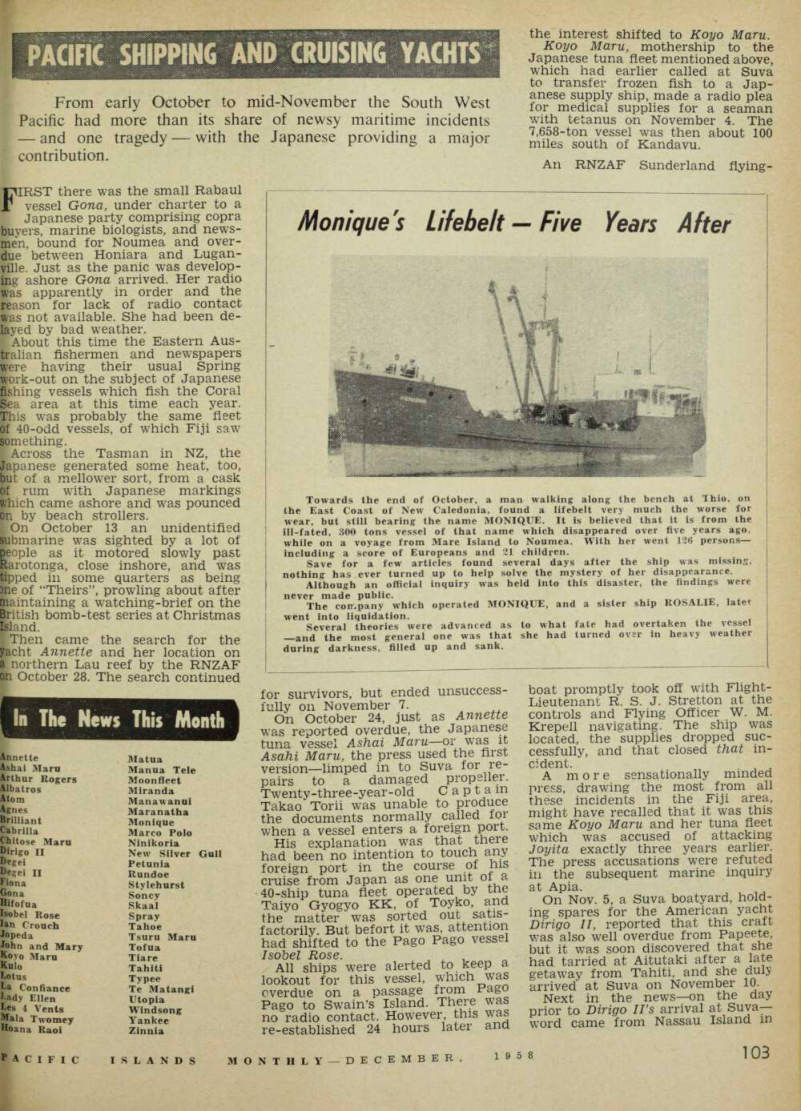
From early October to mid-November the South West Pacific had more than its share of newsy maritime incidents and one tragedy with the Japanese providing a major contribution.
FIRST there was the small Rabaul vessel Gona, under charter to a Japanese party comprising copra buyers, marine biologists, and news men, bound for Noumea and over due between Honiara and Lugan ville. Just as the panic was develop ing ashore Gona arrived. Her radio was apparently in order and the reason for lack of radio contact was not available. She had been de layed by bad weather, i About this time the Eastern Aus tralian fishermen and newspapers were having their usual Spring work-out on the subject of Japanese fishing vessels which fish the Coral Sea area at this time each year.
This was probably the same fleet of 40-odd vessels, of which Fiji saw something.
I Across the Tasman in NZ, the Japanese generated some heat, too, but of a mellower sort, from a cask of rum with Japanese markings Which came ashore and was pounced on by beach strollers. lOn October 13 an unidentified submarine was sighted by a lot of people as it motored slowly past Rarotonga, close inshore, and was lipped in some quarters as being 3ne of “Theirs”, prowling about after maintaining a watching-brief on the British bomb-test series at Christmas Island.
I Then came the search for the yacht Annette and her location on a northern Lau reef by the RNZAF on October 28. The search continued
for survivors, but ended unsuccessfifilv on November 7.
On October 24 just as Annette was reported overdue, the Japanese SinaveSef AshaiMaru-ov was it Asahi Maru, the press used the first version limned in to Suva for re- S to a damaged propeller.
Twentv-three-year-oM Captain
TakaoToSi was Enable to produce
the documents normally called for when a vessel enters a foreign port.
Pxnlanatton was that there , to touch any hadbeenno intention to touch any
cruisedrom 'j one unit'of a
T/ and
the Y matter gY was sorted out satisfactorilv But befort it was, attention haH tshiTtod to the Pago Pago vessel
rfohW
All shins were alerted to keep a lookout for this vessel, whiuh was P V a«o d aSS ?e O -eTtablis C h 0 ?d a 2r V s er iatef Sd
the interest shifted to Koyo Maru.
Koyo Maru, mothership to the Japanese tuna fleet mentioned above, which had earlier called at Suva to transfer frozen fish to a Jap anese supply ship, made a radio plea for medical supplies for a seaman with tetanus on November 4. The 7,658-ton vessel was then about 100 miles south of Kandavu.
An RNZAF Sunderland flying
boat promptly took off with Flight- Lieutenant R. S. J. Stretton at the controls and Flying Officer W. M.
Krepell navigating. The ship was located, the supplies dropped suc cessfully, and that closed that in cident. , , A more sensationally minded press, drawing the most from all these incidents in the Fiji area, might have recalled that it was this same Koyo Maru and her tuna fleet which was accused of attacking Joyita exactly three years earlier, * accusations were refuted in tSe subsequent marine inquiry oTnov. 5, a Suva boatyard, hold ing spares for the American yacht Dirigo 11, reported that this craft was also well overdue from P a P ee t®» but it was soon discovered that she had tarried at Aitutaki after a late
grtawg,
S-ord came from Nassau Island m
ie Northern Cooks that the Jap nese tuna boat Tsuru Maru No. 2 -one of the Pago Pago-based fleet -was firmly aground. The 25 crew tembers landed safely and a radio all was made for another vessel •om Pago Pago to uplift them and erhaps attempt salvage.
While this was going on, calls ent out along the Australian East oast and in New Guinea for re arts of the brand-new, 500-ton, iree-masted schooner lan Crouch, 1 days out of Hongkong on de very voyage to her owners at delaide with an Australian crew of 1 aboard. The pilot of a New Guinta ircraft reported sighting a vessel lat seemed to fit the description >uth of New Britain. (See front ages, this issue, for later news).
• Going Thataway; As The
apanese tuna fleet moved north in bvember —at least radio morse gnals indicated this —another great eet of Japanese vessels was mov ig south.
These were the Antarctic whalers, ive separate fleets cleared Japan a October 31, and the sixth and nal fleet moved off on November I. As usual, many of these vessels ould hunt sperm whales in the ■opics prior to the opening of the irictly controlled baleen whale Jason early in January. Some of lese fleets are owned by the own rs of the Koyo Maru tuna fleet lentioned above. The others are «med or operated by Nihon Marine o.
In the Antarctic they will join ae Russian, three British, and nine brwegian fleets in the annual ice to get the lion’s share of the 1,500 Blue Whale Units permitted > be taken. When the total catch Jaches that level the International foaling Commission declares the Jason closed — usually about mid larch or a little earlier.
The Blue Whale, being the largest f whales, is taken as the standard nit, smaller whales being equiv lent to several Blues, thus the »ual total of whales taken is very mch greater than 14,500. These are ie non-toothed whales; the Sperm nd other toothed varieties do not »ne under the same controls.
• The Fishing Was Good;
avia Pouai, Atiu Island (Cooks) Sherman, made a lucky catch one ay in mid-October while fishing I the south-east corner of the land. Grabbing a bottle as it Dated by, he saw that it contained , note. Extracted, it read: Mr. : E. Plunners, 36 Holmes Rd., Town, London, NWS Eng ind. Will the finder of this bottle ith note inside please return by jtet to the above address—Reward Oceanographers would wish that n Plunners and other bottle unchers would add details of prewhere and when they launched
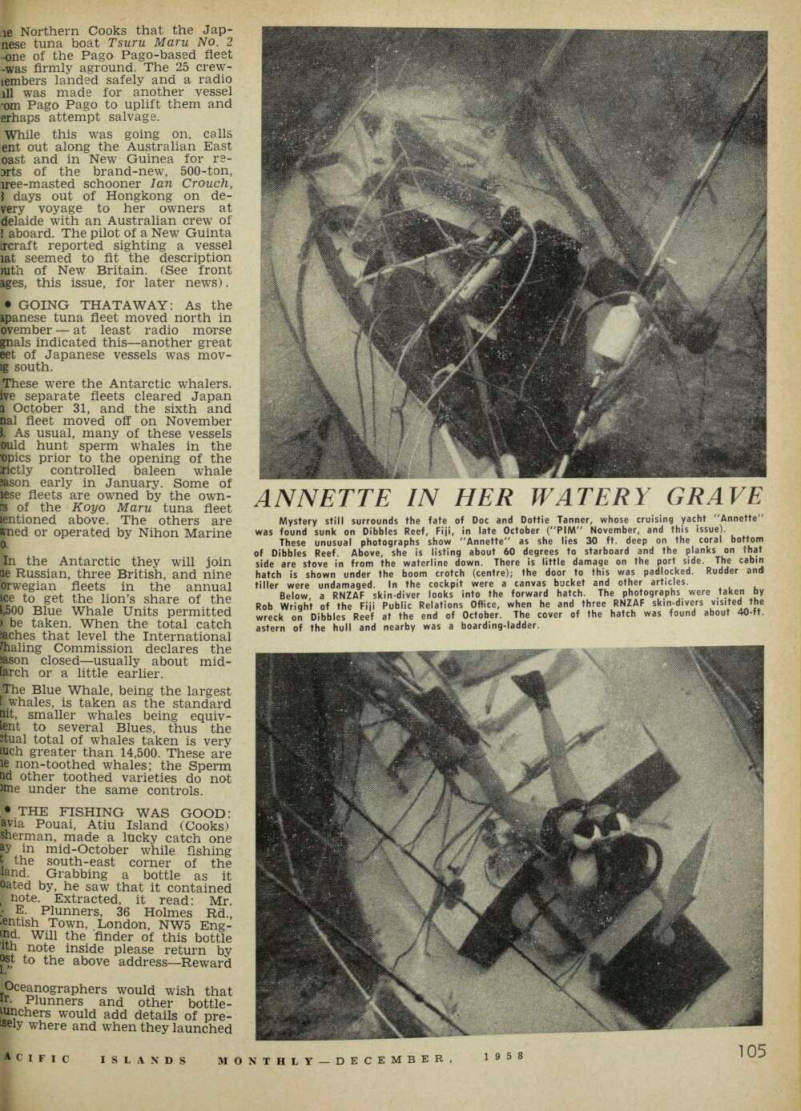
Annette In Her Watery Grave
Mystery still surrounds the fate of Doc and Dottie Tanner, whose cruising yacht "Annette" was found sunk on Dibbles Reef, Fiji, in late October ("PIM" November, and this issue).
These unusual photographs show "Annette" as she lies 30 ft. deep on the coral bottom of Dibbles Reef. Above, she is listing about 60 degrees to starboard and the planks on that side are stove in from the waterline down. There is little damage on the port side. The cabin hatch is shown under the boom crotch (centre); the door to this was padlocked. Rudder and tiller were undamaged. In the cockpit were a canvas bucket and other articles.
Below a RNZAF skin-diver looks into the forward hatch. The photographs were taken by Rob Wright of the Fiji Public Relations Office, when he and three RNZAF skin-divers visited the wreck on Dibbles Reef at the end of October. The cover of the hatch was found about 40-ft. astern of the hull and nearby was a boarding-ladder.
leir bottles, but guess that this |e began its drift somewhere along i shipping route between Pitcairn nd Panama. To where, and for long, it might have drifted had [not been intercepted will provide Short period of interesting specu lation during the still watches of ie night for Third Mates who Ippen to read this.
Meanwhile, we’re contacting bitish Town for the missing de lls.
• Slow Boat From China:
ife in an ocean tug is not every jdy’s meat, but for seamen of the Pore days, more dollars” philosophy ’s undoubtedly the life.
The voyage of the 232-ton Manila mistered tug Cabrilla from Hong >ng towards Auckland was, for ex ample, a good money-saving run for er crew. The vessel cleared Hong [>ng September 5, with barges for uckland and Fiji Government’s tyei II in tow. [Certainly the voyage was broken ith three days at Rabaul, but it as to be very late in November Kfore she was expected at Auck md. ■Degei 11, detaching from the tow I the New Hebrides area on No anber 15, reached Suva under her wn power at noon, two days later.
The tow had been a good deal ower than at first anticipated at 16 Auckland end. Cabrilla was to
pick up two old New Zealand coasters, Rata, 974 tons, and Murray (ex Titoki), 628 tons, at Nelson, NZ, for the return run.
These Anchor Shipping & Foundry Co. veterans are coal burners and could hardly have made the distance under their own steam. This convoy may also be seen in Rabaul or some other en route Islands port, as it heads north in December-January.
Meanwhile, the 148-ton Pana manian tug Inglis is heading south with a variety of craft in tow, but not with the new BSIP vessel Coral Queen, as earlier reported. She is making her own way south.
All the vessels in both these towns are from the yard of Pacific Islands Shipbuilding Co. Ltd., and the com pany is seeking a return tow for Inglis.
• As Is, Where Is: Burns
Philp’s Kulu, one of the well known war-time-built 300-tonners, lately riding at moorings in Rabaul Harbour, is reported to be for sale.
Kulu was built in Freemantle, in 1944, and like other members of the family, is powered with twin 120hp bhp Gardners. She first went to New Guinea as one of the Shipping Board fleet.
• Tenders Called: The Fiji
Government has lost no time in calling for tenders for its 205-t9n,
composite-built, 18-year-old, maid
of-all-work Degei, now for disposal since the new vessel arrived from Hongkong. The Suva-built twin screw, muntz-metal sheathed Degei was advertised widely in October- November. Tenders close De cember 13.
• Salvage Proceeds: Salvage
of war-wrecks in Rabaul Harbour, excluding some under disputed ownership and some in inaccessible depths, has now been virtually com pleted by the Japanese organisation of Okada Gumi.
In October, the company’s salvage vessel Chitose Maru towed a barge down to Buin, Bougainville, with sheerlegs and with scrap, which is being concentrated there for load ing in an overseas ship. Most of the salvage crew are now at Buin, where further work is proceeding.
• Third Try For Ar; The
New Hebrides-b ase d, converted Brixham trawler Arthur Rogers, with the Hepworth trio and new partners Jack and Eileen Close, of England aboard, was scheduled to clear from Totara North, NZ, about November 10 on a third attempt to get back to the Islands.
As earlier reported, Arthur Rogers was twice forced back with damage from heavy weather met north ol New Zealand. With the hurricane season already here, fingers were firmly crossed for a good passage this time.
• That Man Again: That
blown-away son of the Gilbert Islands, Willie Schutz, was sighted in Honolulu late October, where hi*
[?]e Auckland motor-sailer "Manawanui" now in Polynesia. Photo: J. P. Shortall.
hip, the British MV Stylehurst, ad popped in briefly for bunkers n route for Yokohama with 10,700 ijns of sugar from Santiago, Cuba.
Stylehurst, a comparatively new hip, is one of the lucky tramps hat has managed to stay at sea espite the present tramp shipping gcession, but Second Officer Schutz sported that his ship lay for 22 ays off Miami, Florida, awaiting rrangement of the present cargo, leanwhile sea-time is piling up and H examination for Master’s ticket r likely next year,
• Quarantine To Be En
FORCED: Vessels arriving in the dok Islands from Fiji-Tonga amoa are liable to strict quaran ne at present as a result of the 3cent outbreak of polio in those jrritories, which, to mid-November, ad not invaded the Cooks. Normally, lere is no shipping connection be veen the Cooks and these other roups, but there is air connection, nd certain restrictions have been laced on passengers arriving in by lat means. « BETIO HARBOUR: Good pro fess is reported from Tarawa on le Betio small-ships harbour pro set A great deal of work has still ■be done but by early 1960 that art should be transformed. • IN THE WATER; The third I the trio of medical patrol craft lilt by the NZ Lepers’ Trust Board >r the use of religious Missions Ithe Western Pacific went down p ways at Charles Bailey & Sons ird in Auckland on November 18. his one, named Mala Twomey, goes I the Marist Mission in the Bomons, and like the others, will I delivered by Auckland yachts man Mark Anthony. Each of the Ift auxiliary ketches is understood [have cost about £22,000. They are ell-equipped for their work and lilt of the best kauri timber, metal teathed. Despite the hurricane ason, Mala Twomey was expected *go north in December.
• Wanted, Reflectors:
here may be some new land-marks ringing up round the Gilbert and Uice Islands atolls now that radar is become a part of the local ferchant marine. Both Ninikoria id Moana Raoi, the new Hongkong nit vessels, have Decca radar luipment, but the range is often nited to a maximum of 17 miles I less, due to the low-lying nature Ithese islands and the absence lany structures with good reflect £ properties.
This situation could be very greatly iproved with the erection of a w metal reflectors on poles or Uttrned coconut palms at strategic iints —to the advantage of not only i e local shipmasters but also of her vessels occasionally in those pel's, and of aircraft flying over bad.
• Old Days Recalled; There
was a reunion of retired Union Steam Ship Co. Masters and Chief Engineers aboard Matua at an Auckland wharf on November 18, the excuse for it all being the celebration of the 90th birthday anniversary of Mr. David Carter, one of the company’s most popular former managers in Fiji—he was there about World War I days.
Mr. Carter served the company for 51 years, in various offices, re tiring in 1934. In the years since he joined the Auckland office in 1883 as a boy of 15, Mr. Carter has seen some remarkable changes in
the Union Co. fleet, which once had many fine passenger vessels but now, except for the ageing Monowai, the ferry steamers, Tofua and Matua, and a few others carrying a few passengers, is almost entirely a cargo fleet. • NEW LIGHT; The Mama’o Reef, or Hakau Mama’o, in the approaches to Nukualofa, Tonga, now carries an electrically lit beacon.
Details given in a recent Nukua lofa Harbour Master’s notice are as follows: Elevation, 85 ft on a steel tower; shows white from 286 deg. through north to 204 deg., thence
I to 259 deg., thence green to 286 g. true from seaward. Character ise is a six-second flash with four lond eclipse. Clean-weather range 114 miles. This light, says the lice, used together with Malinoa id Niu’aunofo lights, will enable Isels approaching Nukualofa to lain a more accurate fix as well ■ indicate the dangerous Hakau Ima’o.
I French Flowers: The Well
bwn French naval patrol craft pe, decommissioned at Noumea me time ago when replaced by a [ger and more modern craft, now E at that port for sale—a starting Ice mentioned was £AIO,OOO. fiare started her life from an herican yard as a US Navy YMS lard Mine Sweeper), similar —but >t identical—to the Pago Pago ■ding vessel Manua Tele. Both are toden-hulled, twin-screw diesel bered vessels of the same general ©file raised foc’sle, machinery janel, and bridge midships, etc., I there is a difference in length id other dimensions. Both are »ut the same mid-1940 vintage.
We, and her sister, Lotus, based I Papeete, have been officially tmeless since they were decom issioned early 1957. The names sre transferred to the replacement ssels Petunia and Zinnia respec tely. At the same time the well membered Dumont d’Urville was rapped and replaced by La Con duce.
It is not known what equipment go with Tiare.
•Another Weather
IANNEL: In our summary of 'tee radio storm warnings and sather information for mariners
given in October PIM, we did not include one Fiji frequency which we now understand is in use. This is the Suva Post Office station’s out let VRO72 on 7360 kc/s. The weather broadcasts given at 0230/2130 GMT are apparently broadcast over this channel simultaneously with the 4445 kc/s frequency which we listed. The higher frequency should be useful for more distant vessels.
• Tsunami Warnings; Suva,
Honolulu, Rarotonga, Papeete, and some other less well-known places are not likely to quickly forget the so-called “tidal” waves which have on several occasions in recent years caused damage and excitement.
Since the one which caused heavy damage in Hawaii in 1946, a warning system has been slowly built-up in the Pacific, mainly by the US Coast and Geodetic Survey, a branch of the US Department of Commerce.
With headquarters centrally located at Honolulu and under the control of Rear-Admiral H. Arnold Karo, the warning system is now able ta advise distant areas of the likely approach of a tsunami —as these waves produced by undersea earth quakes or eruptions are correctly named. According to a recent an nouncement, Fiji, Chile, and Aus tralia have now joined the warning system.
Tsunami waves, which are rarely more than six or seven feet high on the open sea, usually move in a series at intervals of up to 20 minutes apart and at speeds of up to 600 miles per hour. Under certain geographical conditions of shore line, etc., the waves will build up to 100 feet in height on striking land, and they have caused damage as much as 2,500 miles from their point
of origin. At this distance there is about 4 I hours of warning time, but at shorter distances the interval is less and the system, to be of any use—for example, in getting ships away from wharves or out of harbour, has to operate at high speed and have an extremely efficient radio communication.
• Cruising, At A Price: De
spite reports that Ernest K. Gann’s beautiful little brigantine Albatros is for sale at London—she was ad vertised in PIM last year—adver tisements have appeared in the US calling for paying crew-men for a Mediterranean cruise to commence from Portugal next July and end in May, 1960.
The vessel, which closely re sembled the Johnson’s Yankee No. 2, will be commanded by an ex-Yankee Mate, Christopher B. Sheldon, Ph.D.
Men and women between the ages of 16 and 30, and with $3,185 each to chip in, are invited to apply to Box 948, Darien, Conn., USA—and we do not doubt that there will be a full muster by next July.
• More For Tonga Fleet;
Prince Tungi, who has been in strumental in gradually building up a modern fleet of small craft to serve Tonga’s needs, placed orders for two more vessels with the Cable- Price Corporation in Auckland in November. The first of these is a 35 ft x 10 ft x 5 ft 10 in. kauri pilot launch powered with a 65-90 bhp Leyland Ajax Amazon motor. The hull will be sheathed and the vessel will be fitted with a searchlight. She will be stationed at Nukualofa. No
"TAHOE'S" NEW CREW. From left; Denis Osment of England, Rick Rewin and Dick Corisn of Australia, Don Beer of New Zealand, and skipper Reg Blake. Not in the photo is Fred Garton of Australia. "Tahoe" was to clear Auckland for Sydney and eventually the US late in November. Photo: J. P. Shortall.
"Shiralee", 35 days out of Sydney, reached Rarotonga October 30 and departed November 4 for Honolulu, Pacific base of the new owners of this solid Australian-built double-ended ketch, Jack and Peggy Burke. This blue water couple are eastbound on their new home only because a cyclone wrote finis to their 60 ft schooner "Venturer" and a planned world circuit off the Queensland last.
name is yet fixed. She will be built at the Corporation’s W. G.
Lowe & Son yard, and delivery is for about next May.
The other vessel is a 112 ft x 22 ft x 8 h ft welded steel barge with a loaded draught of 7 ft. This will be capable of carrying 80,000 gallons in eight tanks, four for petrol and two each for diesel oil and kerosene.
The barge will not be self-propelled, but she will be fitted with steering
gear and will have a wheel-house ’midships and accommodation for three helmsmen. There will be the usual fire-fighting equipment, and two Gilbert & Barker rotary pumps, each driven by a 5 bhp Lister diesel, will be fitted for discharging the cargo through 2i-inch pipe lines.
She will have a shaped bow for easy towing, and will be used to carry bulk oil from Suva to Tonga and perhaps to Apia.
The new 500 bhp all-purpose;
Hifofua, expected from Hollani
January, will be mainly engage
towing this barge.
At present Tonga has no bull
tanks, all supplies coming in
drums. The barge will be bull; A. & G. Price Ltd. and laum from the Lowe Yard. Comple date is about next July.
• To Swell The Coffe
Fiji Government expects to n
an additional £F66,000 out of creased port charges in 1959. was part of the Colony’s recent e; to boost revenue—although it said at the time that port cha in Suva were far too cheap, ; how.
The newest slug is in additiot the Port and Customs Service: of 2s per cent, that became opers in August this year.
There have previously not port dues in Suva but now they\ be levied at 3d per ton for ves
registered outside the Colony,
2d per ton for local vessels.
Pilotage, berthing, wharfage
light dues also go up steeply, will fall most heavily on large o
seas ships.
News of Cruising Yacl
• Wanted, Some Yachts: The ]
Akarana Yacht Club of Auckland is ing: for some keen snort-minded oo yacht owners to enter their craft ini planned sixth trans-Tasman yacht scheduled for February next.
The race, to be officially known ai> Auckland-Brisbane Trans-Tasman will start from Auckland on Februa,s —if a minimum of five entries arn ceived. It is earnestly hoped sponsors however that there will be more entries than this by the closings of January 31. The entrance fee isi guineas—or about SUSI 4. The prize i highly esteemed Trans-Tasman Cupq miniature, the Rangi Cup and minis! and in addition certain trophies r will be put up by the Queensland Cnn Yacht Club of Brisbane who have • instrumental in having the race termiii there instead of further south, fl change.
Very careful safety plans are beingg pared, and a study has been main weather movements in the area ovc long period in selecting this partil starting date. So, men of the cnn fraternity, what about it? • Discovery of ANNETTE of Bonn in 20-odd feet of water on Dibbles 10 miles south of Wailangilala Light,,! on October 28, solved the mystery oo yacht’s where-abouts after she had b reported several weeks overdue on past from Apia to Suva. But an examimi of the yacht by RNZAF divers whoor located her from the air showed thasi cabin was padlocked and that shesi been at anchor.
Life belts and dinghy were later 1 —the latter on Udu Point, Vuana with an oar and a six-gallon plastic T container still in it—but there waEi sign of William B. Tanner andh. wife. It seemed that the yacht k have struck the reef, an unsucctac attempt made to kedge her off, and hi she was locked up while the ownena out in the small dinghy on an ill—ll voyage to some neighbouring islan^n
assistance; or, as the Tanners were known ito be keen divers, it may have been that the yacht was anchored off this or some jther reef further north, and the cabin locked while the owners went onto the ireef for some diving.
Perhaps the yacht then dragged, and aerhaps she was pursued in the dinghy— ,r perhaps the yacht just dragged onto he reef. Whatever the exact details, it ieems quite clear that the dinghy must jave been overturned and the Tanners Irowned.
For a while there was a scare that fanner’s 15-year-old niece, Carol Ray nond of USA, had also been aboard, but t was soon established that she had javelled in the yacht only from Papeete 0 Apia and was in fact safely home at Icarsdale, NY.
Charts recovered from ANNETTE merely :ave a last recorded position midway be ween Niuafou and Wailangilala. on Sep ember 28. Pending instructions from next if-kin there has been no move to salvage he yacht, which apparently was not very tadly damaged up to early November, my inquiry would be initiated by the Hono olu authorities, is such were considered lecessary. • DIRIGO II (see Shipping News) cached Suva from Papeete on November 1 via Aitutaki and Vavau, and owner ames Crawford indicated that he will re tain in Fiji waters through the hurri ane season, that is, until about April. • MOONFLEET, mentioned last month a for sale in Suva, is none other than Ur old friend KONA, changing hands gains. This was the 40-ft. Block Island laysail schooner of San Pedro, California, I which Paul Blackford and Bob Bouts raised Polynesia in 1950-54 and then sold Suva late 1956. f • JOPEDA, ex-LA MOUETTE, on the Bef at Ngatangiia. Rarotonga since June, 95:, is there for keeps, in the opinion John O’Donnell of MIRANDA, despite ews of salvage attempts from time to ime. David Field, one of the former pt-owners, is now in charge of the taiisphere Observatory at Rarotonga, >ving returned there from New Zealand, he 34-ft. yawl is owned by a local trader, D. C, Brown, who bought her on the eef. • MIRANDA of Auckland, which cleared Rarotonga on October 18, suffered a roken rudder when 11 days out. Tem- Orary repairs were managed and the »cht made Auckland via Great Barrier sland on November 17. Kurt Hari, of witzerland, who had joined at Papeete Igned off at Rarotonga and his place was »ken by two Cook Islanders. Also aboard: irthur J. Giddons of the US. Purchased 1 Auckland by O’Donnell two years ago, M 34-ft. gaff ketch is again for sale. • RUNDOE of Oslo, 44 ft. x 15 ft. x ft. ex-pilot boat owned by Messrs. jrunborg and Anderson, left Balboa for »e Galapagos, Marquesas, Papeete and few Zealand in mid-October. The ketch 1 on a circumnavigation voyage. • NEW SILVER GULL and the Scotts I Sydney, Australia, who have been cruis the Americas in the 44-footer for a >n? time past, were at Balboa in late •ctober and preparing to head for Poly esia on the home run. The yacht left ydney 11 years ago. and passed through Wynesia north-east bound about 1950. • TAHITI, of Honolulu, which has •yaged as far as Auckland in recent was northbound from Papeete for ome—and the auction-block—in mid •ctober. Lorrin Smith has been offered Job in Rarotonga by Walter S. Johnson, who owns the trading schooner TIARE AORI, so will be heading that way by
commercial transport soon. “Smithy” and TAHITI have been mates for a long time.
With him on the passage north was Yves Garcion, who formerly sailed as crew-man in Conny Hitchcock’s MAKAI, and Bill
Weir, Ex-Staghound, Jada. Prima
VERA, and other well-known yachts. • MARANATHA, an American - built wishbone schooner of about 50-ft., which was given to the Seventh Day Adventist Mission in French Polynesia some years ago, and was recently sold to some New Zealanders at Papeete, went ashore at Avapeihi Pass on the north-west coast of Huahine while bound for Auckland in August or September and was still on the reef two weeks later, though apparently little damaged. Arrangements were then in hand for a local government LCT to come and attempt a refloating, meanwhile all hands were living ashore with Mr.
Howard Milbrandt, ex-UTOPIA, who has built a house on a property near there.
• SKAAL, a little double-ender of about 29-ft., believed to have been built in France and shipped out to Tahiti about 10 years ago and which has since changed hands several times, will be a familiar craft to many yachtsmen who have called at Papeete in recent years. Her latest role is as an advertising medium. She now cruises the harbour when passenger ships are in port, displaying painted sails pub licising a Tahiti shirt factory. • TYPEE, with Bob and Marie Grant and Ken Mildon aboard, was reported in Papeete in mid-November, bound for the West Indies from Auckland. • UTOPIA and her crew were in trouble in Bali, Indonesia, in early November when owner-skipper Fred Peterson and his entire crew spent five days in gaol there. Peterson, a retired Wisconsin boat builder, has been cruising around the Pacific for a couple of years in the big
yacht, but this is the first adventure of ; this kind that has come his way. Reports from Singapore indicate that Mr. Peterson was not pleased about it—and with reason.
The yacht put into Bali to obtain fuel. ;and the seven men and one woman on i board were detained for five days “because I they had no permission to enter Bali”.
When they were released they were re l fused fuel and told to get going and keep away from any other Indonesian ports.
In the Java Sea, an Indonesian gunboat came alongside and smashed the UTOPIA’S dinghy. On November 7, they broadcast a message asking for any passing tanker to drop some drums of fuel—and then the petrol-driven radio gave out and they made the rest of the way to Singapore under sail. • BRILLIANT, 42 ft. Bermudian stay sail schooner owned and sailed by Mr. and Mrs. Mac Forster of Hobart, Tasmania, was in Suva, Fiji, mid-November, 11 months out from her home port. She is now on the way home, via Noumea and Lord Howe, and expects to make it by Christmas. Nine of the last 11 months have been spent in NZ waters, and the last two, cruising from Auckland to Tonga and on to Fiji. Besides the owners she carries two crew members, Les Nibbs, of Hobart, and Peter Luxmoore, of Auckland. • TE MATANGI: Probably because of the ANNETTE tragedy, friends in Hono lulu are already inquiring for the Fergu sons of TE MATANGI of whom they have not heard since they cleared that port.
Papeete-bound, in July. PIM had a letter, written about mid-September, from Papeete. (Also another letter, dated mid- October, after this was in type. They are well, and enjoying French Polynesia.) • SONCY: October 26 saw the 38-foot ketch SONCY leaving the Ala Wai Yacht Harbour, Honolulu, for a four-month South Seas cruise. On board is Skipper, Rockne Johnson and his bride. Ruby. Other crew members are Jack Ward and Tom Keck, landfall will be made in the Marquesas.
However, most of their cruising will be in the Tuamotus and Society Islands.
Johnson will record ocean temeperaturcs in the Marquesas for the US Fish and Wildlife Service. Specimens of South Sea Bora will also be collected for the Uni versity of Hawaii. • FIONA: Another new yacht at the
Ala Wai Yacht Harbour in mid-November was FIONA. Owner Joseph Sage has been converting an aviation fuel-boat for the Past year. The result is the FIONA—a neatf re d-hulled. 44-foot schooner. Mr.
Sage and his wife hope to sail to the So * th Seas next year ' H e has already had a piano installed on board. Scuttlebut around the harbour is that he intends to — S «“‘ h •« .slanders, LADY ELLEN: Around November 17 the 73-foot Tasmanian ketch, LADY
ELLEN was to leave Honolulu for New port Beach, California. Aboard are Mr.
Derek Horn, owner, and his wife Lesley; Brian Wilson, engineman; Maurice Camp ton, cook; and five crew members from Honolulu. Horn said he hopes to sell LADY ELLEN in Newport Beach, then travel on to England.
• Slocum Society Awards: The
Slocum Society, a world-wide group dedi cated to the study of various aspects of pleasure and working boats, with head quarters at 9 Eastern Avenue, Annapolis.
Maryland, USA. established a number of awards in 1956. The winners of these awards for 1957 have just been announced, and include the following which have sailed through PlM’s pages: The Slocum Award for the year’s outstanding single handed ocean passage went to Marcel Bardiaux and LES 4 VENTS, with Jean Gau and ATOM as runner-up.
The Voss Award for the outstanding two-man passage went to Armit and Loe in MARCO POLO (the yacht has sin-'e changed hands in New Zealand). Smith and erstwhile partner, Ted Grant, in TAHITI received honourable mention. The J B. Charcot Award went to Squadron- Leader D. H. Clarke and Mrs. Clarke in JOHN AND MARY but this craft has not been seen in the Pacific. This award is for the “most notable use of a working boat or a working boat fleet”. The Hak luyt Award for the most notable writing of the year dealing with boats went to Kenneth E. Slack for a learned paper on Slocum’s SPRAY published by the Society.
The Slocum Society has plans well ad vanced for trans-Atlantic single-hander yacht race to start from Cowes, England, on July 18 next and to end at New York.
Many entries have already been received. • WINDSONG IV of Melbourne, owned by J. Walker and with a crew of five others, reached Rarotonga from Papeete on November 14, bound Niue, Suva, and Auckland. This is a 42-ft ketch.
"Miranda" back at her home port of Auckland with the top of her rudder missing.
Photo: J. P. Shortall.