The Month S New Reading
pp. 90-103 · Read in the full issue
With Judy Tudor
When, in late 1941, General Alan Brooke (now Viscount Alanbrooke) was told by Mr. Churchill that he was to become Chief of the Imperial General Staff, he records in his diary that, although not a religious man, his first impulse was to kneel down and ask God for guidance and support in the task ahead.
This may be the essential difference between him and his col league—and ultimate successor—Field-Marshal the Viscount Montgomery.
Montgomery would probably claim that he was a religious man. But he never seems to have had any doubts as to which side God was on: Montgomery’s.
Montgomery’s Memoirs, every word of which he claims to have written himself (which we can believe), in lead pencil (which seems beside the point), were pub lished in November. To use a phrase he frequently employs him self: They have fairly put the cat among the pigeons.
It has been said of him that he ‘‘didn’t get on with Americans”.
The fact is, that he didn’t get on with a lot of the British, either He supplies the clue himself, in the early part of his book, when in dis cussing his schooldays, he says that his teachers complained that his English was weak; that he couldn’t write essays. He concludes, with a typical Montgomery touch; “To day I should say that my English is at least clear; people may not agree with what I say, but at least they know what I am saying”.
The Monty Cat
Among Allied Pigeons
J .i_® e T nar d Law Montgomery was the fourth in a family of nine—of whom seven are still living. His mother he describes as a domineer ing woman, and his father as a gentle saint. His father was a Vicar in London when he married, and was later, for about 11 years ?if hop o f Tasmania. The family returned to London again from Tasmania in late 1901, at ’ which stage Bernard was 14. His educa tion had been received at the hands of tutors and was sketchy he now went to schpol for the first tiW and threw himself into cricket and ment y ’ lf not lnt ° scholastic attain already decided that he wanted to be a soldier.
He went to Sandhurst and when pas , s T e d out, chose to join the 1 S a T<: ICkJ S ire Sf e o if, lts attractive hat-badge but also because he was poor and had to live on his pay. This was
an inexpensive regiment, and with it he soon went to India. The business of war had begun for Bernard Montgomery.
If he sowed a wild oat or two at this time, we hear nothing of it.
He was, so he says, never interesteo in women, social life and parties: and fell in love but once—when he was 38.
He married Mrs. Betty Carven a widow with two young sons, in July, 1927. Their son, David, was born in August, 1928. Montgomery’s' marriage was happy and lasted only 11 years; his Betty died in 19371 following some strange infection from an insect bite on the foot.
Thereafter Montgomery’s main interest in life was the business of soldiering. As he conceived it, the duty of a soldier in war was to win battles, and to win battles it was necessary to kill the enemy.
He pursued these concepts withl a singleness of purpose that is made plain in the Memoirs to the extent, of turning the delicate stomachs ofl some of his critics. He makes ofl war a blood sport, they cry im anguish: and further, that at th© time that Monty emerged into th© limelight and the headlines, th© build-up of arms and forces hadb been going on to such effect in thee Middle East that any commanden of moderate intelligence could havee led a victorious Eighth Arrays across North Africa.
The answer to that probably liesa in the hearts of the men whoo served under him, who regard himc with unswerving devotion.
Monty’s own build-up to battles was meticulously planned; particu larly so as to relationship betweeno men and commander. This wasa conditioned largely by his own ex perience in the First World War..’: He remarks that he went through ri all the war on the Western Front f and never once saw the British si Commander in Chief, neither!: French nor Haig, and only twice e did he see an Army Commander.
He tells of a Chief of Staff who,,c on the point of returning to England b after the heavy winter fighting offi 1917-18, on the Passchendaeles.
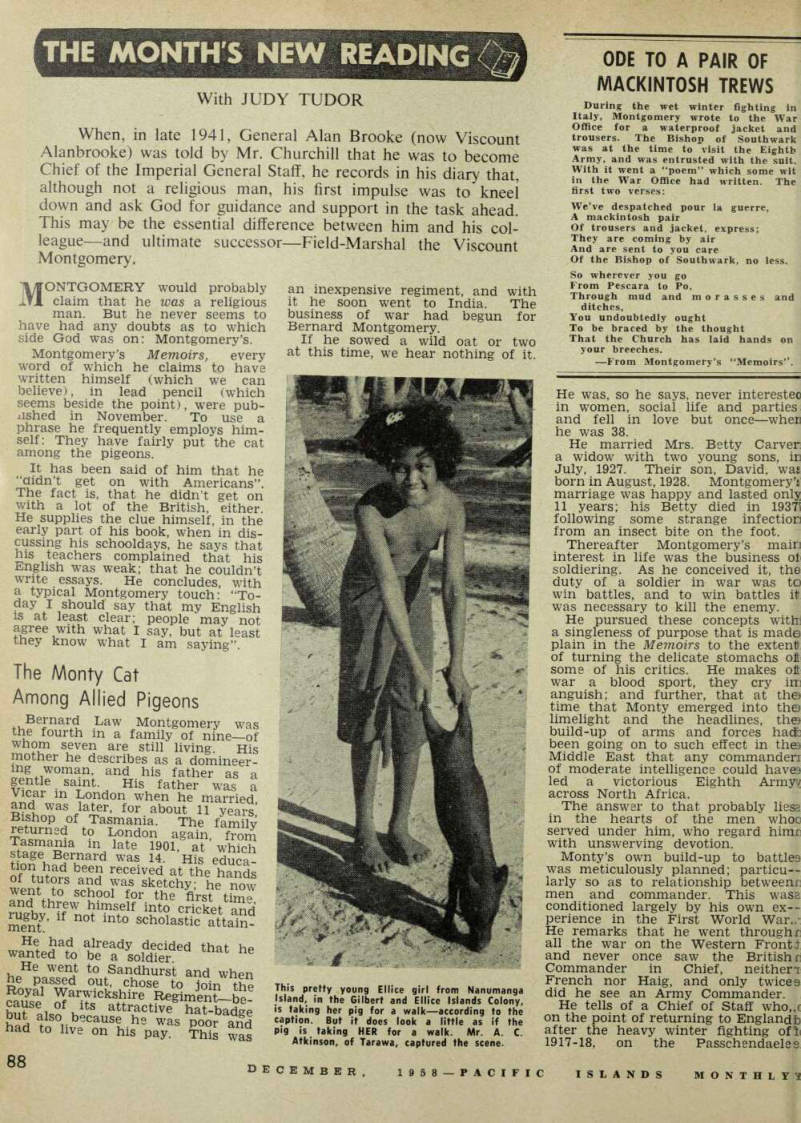
This pretty young Ellice girl from Nanumanga Island, in the Gilbert and Ellice Islands Colony, is taking her pig for a walk —according to the caption. But it does look a little as if the pig is taking HER for a walk. Mr. A. C.
Atkinson, of Tarawa, captured the scene.
front, thought he would take a look at the Passchendaele Ridge. 1 When he saw the mud and the ghastly conditions he said; “Do you mean to tell me soldiers have had to fight in that?” [ Montgomery was determined that he would never be that sort of Commander. He lived with his troops and made himself con spicuous amongst them —with his caravans or with his fancy head gear. He met, inspected, talked to thousands upon thousands of men.
The exhortation to “kill and win battles” was the culmination of this preparation, and it paid divi dends. ■ It seems too late in the day to 'say that anyone could have done as well; that he treated fighting as blood-sport. At the time, the moment was crucial enough, and Montgomery turned the tide towards Allied victory.
Across Africa in Tunisia, Mont gomery met up with General Eisenhower and, for the first time, the Americans. From that point on, in more ways than one, the real fighting began.
At the end of his book Mont gomery says: I would not class Ike as a great soldier in the true sense of the word. He might have become one if he had ever had the experience of exercising direct command of a division, corps and army . . . But he was a great Supreme Commander—a military Statesman. I know of no other person who could have welded the Allied forces into such a fine fighting machine in the way he did, and kept a balance among the many conflicting and disturb ing elements which threatened at times to wreck the ship.
The story that goes before makes this abundantly clear. Eisenhower had not, in fact, seen fighting until the American landing in North Africa.
After the Battle of Normandy had been won and the Allies were pressing on into Europe, it was shown clearly how far Eisenhower’s and Montgomery’s strategy diverged.
Montgomery was for making a break-through at one point; Eisenhower, egged on by his own ambitious generals, for an all-out effort, everywhere.
Montgomery believed that if he had had his way, the British would have been spared the last nine to 12 months of the war.
Eisenhower, however, loses nothing by Montgomery’s book—he emerges as a man of great sincerity and infinite diplomacy—two qualities which were as necessary as battle tactics and grand strategy under the circumstances of 1942-45.
Montgomery developed a great respect and affection for him and places him among the four men who most influenced his life. (The other three are his father, Sir Winston Churchill and Viscount Alanbrooke), Monty was not, however, so fortunate in his relations with other American Top Brass. It was “most distressing that the Americans do not like him”, wrote Alanbrooke.
Montgomery expounds at con-
siderable length on the subject himself—of “feelings” between the British and Americans—and adds; “Patton’s remarks from time to time did not help. When stopped by Bradley at Argentan he said L J* 1 . 6 go on to Falaise and we Wlll d nve the British back into the sea for an °ther Dunkirk .
In his time Montgomery has fought everyone: Germans, Italians, Americans, British, the Russians, the Navy, Air Force, the other Chiefs of Staff, the Prime Minister of the day, and politicians generally.
As his critics have so truly said, it would be impossible for any one man to be so right so often as he himself believes. But Montgomery was right often enough to matter, He was defeated by all of the above protagonists at one time or another, and when he was, bore no grudge, kept to his opinion but carried out orders. According to Brooke, he could take his ticking off with no ill will, “A nation needs two things to survive,” he writes at the end of his Memoirs. “A religion; and an educated elite, who are not afraid to take an independent line of thought and action and who will not merely follow the popular cry.”
These two requirements he bent to his own personal needs, i n his book he displays no particular literary talent, but he never bores. It is simply 50 years
of history, seen though the e of one remarkable man—and, he predicts in the beginni although people may not agree w, what he says, at least they kr what he is saying.
A quarter of the book is taH up with events after 1945occupation of Germany, Britai Colonial difficulties, the Russ Cold War.
(The Memoirs Of Field-Marsha
MONTGOMERY. Published by Collins, Ltd. Australian price, 43/6.)
Fiction Department
BEST of the middling to lig fiction (into which catego Doctor Zhivago, review separately, does not fit) has be supplied by two women and o man, this month. The ladies a naturally enough, more concern with the emotions; the gentlerac of the trio, an old hand at t game, with the American way life, which doesn’t give him be great cause for joy.
Any of the three novels wov make good, light, holiday readii. as absorption in all cases, guaranteed quite painless. m they are: One Helen Foley, author of Betw& the Parties, is married to an An officer, has three children and] Siamese cat.
The Siamese cat doesn’t shoe although the children and 0 Army officer do.
Stripped down to bare essentia this is the story of two stroc characters, women; and one wes one, male. William, however, weak only in his association wi the women, Rose and her cousj Nancy, to whom he is unhappe married.
Rose and William had been love, and lovers, years previous when the story opens, but for som reason which is never very feasibd had not married. William Anar married Nancy, and they all mej again in a British Army post occupied Austria.
Because Nancy has some quaiL ideas about marriage, William an Rose carry on where they had lot off, and so institute a sort of uu easy triumvirate that causes a grea deal of speculation in the smtr world of the Army post.
The plot is slim to the point non-existence but the characterisa: tion is excellent and the store written with humour and insigH? flows smoothly against the bado ground of occupied Austria. (BETWEEN THE PARTIES. Published fc Hodder and Stoughton, Ltd. Australiil price, 17/-.) Two John P. Marquand’s Life Happy Knoll, is a frolicsome trifr
hat can be consumed at a sitting. ;t is a repeat performance, having ■een published first in 1955.
According to the American Con titution, or Lincoln’s Gettysburg iddress (or perhaps both), the nursuit of happiness is the right of the American.
Tiis has led him by easy stages, o the Country Club —described as n area of bridge tables, a bar, a olf course, swimming pool, tennis ourts —and a high annual sub cription.
It is the pinnacle of suburban nd rural American society and to r belong the local unhappy busi iessmen, rising or arrived, all fter some sort of escape; and their Ives, and adult sons and daughters.
Apparently believing it to be jnerica in microcosm, Marquand roceeds to take it to pieces. The tory consists of a series of letters d the absent President who is ravelling in foreign parts to try d erase the troubles of Happy [noli Country Club from his mind, hit there is no escape—they pursue im: Everything, from the state of he finances, to feuds in the men’s Dcker room, to the desirable Ingth for ladies Bermuda shorts.
In a foreword, in a sort of Don’t •et it Happen to YOU, the author iplains the phenomenon of the Sountry Club: i“. . . Americans find in their ountry clubs escape from reality, reams of wish-fulfillment, means f avoiding the drudgery of home ife. areas for the entertainment t their children ... As each year oils round, it becomes increasingly bvious that the sort of life that nee centred around the American tome is becoming more difficult to ttain . . . There are now over ,000,000 unemployed, but is there nyone available to cook a middle lass meal, or wash a middle-class lish, iron a shirt or set a middle lass table? Their numbers de fease every year. The modest American home now has only com plicated labour saving devices to ake the place of vanished hands.
Sven our stop-gap domestic in titution, baby-sitters, are begin ling to form unions and are Hindering each other with increas es frequency. In fact, after a reek of babies, bottles, dogs and ash-washers, home often becomes • place to escape from, if possible, rtien searching for momentary lappiness.” (LIFE AT HAPPY KNOLL. Published by 7m Collins. Australian price, 13/3.)
‘hree
Most people find newspaperwomen errifying enough, anyhow—the hnericans being the only ones to lave done anything about it by ailing them Newshens and thus totting them down to size—but a emale Foreign Correspondent is ilmost too overpowering to contem )late.
But that is what E. Arnot Robertson, in Justice of the Heart, has made Louise Downes.
As Foreign Correspondent for a London daily, Louise, 26, travels constantly from Oslo to Brussels to Tobruk and back to Trondheim and all points east, west and south, getting scoops for her newspaper, Louise has looks, culture, extreme sang-froid, enterprise, and is always a perfect lady. The outfit she works for is as nasty a piece of press-baronism as you will find anywhere; the bunch of newspaper correspondents she meets on her travels, as dog-eat-doggish as they usually are. All this is credible —except that beautiful, 26-yearsold Female Foreign Correspondents are, believe us, very rare.
What isn’t credible is that, with £2O in the bank, she should give it all up to dash off to Zanzibar because she feels that an Arab political trouble-maker, who has been put into gaol, has been wrongly done-by. Cynical news paper correspondents are not given to such altruism, which makes this fiction so much stranger than fact.
Once in Zanzibar the story gets interesting—even though still slightly incredible, Says the author, in the ap propriate spot in the beginning of the book; None of the characters can be met in Zanzibar —" but only \ n several of the other 33 British protectorates and colonies ”. (Over)
[She can say that again, although he italics are ours, i- Verdict on this one is: Three izes larger, than life, but enter
lining.
[(JUSTICE OF THE HEART. Published & Wm. Collins. Australian price, 18/9.)
Russian
inigma
rO reduce Boris Pasternak’s Doctor Zhivago to a column- I sized review is a manifest im lossibility when even to read it re tires some sort of fourth dimen fcnalism. This is not so much a iovel as a tapestry, so vast in con bpt and execution, that the irdinary senses of the reader, used p the styles and forms of Western Rithorship, take time to adjust to k. [The story of Pasternak and his look have now become well known: Prepared for publication in the Joviet at the time of the so-called maw, it has been repudiated by he succeeding Re-freeze. But ilthough no Russian version has leen published, it has been trans ated into 18 languages, and in America and Europe has become a )est-seller.
At the end of October it was warded the 1958 Nobel Prize for jiterature. Pasternak first accepted he award, and the £20,000 that went ?ith it, then rejeced it.
The rejection followed his de louncement by the Soviet’s cultural lommissars who put on a series of antrums so typical of what the West has come to expect, as to be, mder the circumstances, almost un )elievable. |Why Pasternak refused the award 5 not clear. It has been suggested ; hat the Russians would have been had to see the end of him and if le . had gone to Stockholm to re vive his award they would not have permitted him to return. To prevent
this, so it is surmised, he declined the award and chose to remain.
That is as may be. He made all the usual retractions in Pravda— said that he realised, on reflection, that the award was a political measure. He had not given his per mission to have the novel published abroad. (In which event, it would be interesting to know who did arrange it, and who gets the royalties).
The novel itself perhaps illus trates better than anything, the futility of measuring Russia and Russians with our own yardsticks.
The characters are bewildering in their very numbers and the con fusion of their various names; they are fundamentally deeply religious people—yet possessed of primitive superstitions and a belief in good and ill omens.
The style of the writing is abrupt, episodic, unusual. Yet, the pattern of the story is maintained to a degree that seldom allows the reader to slacken interest.
Zhivago, like his creator, is given a cultured background. His family and associates were intellectuals whose sympathies were with the radicals. As these political elements crystallise into revolution, the in telligentsia watch fascinated — elated that a corrupt regime should end; fearful of the inevitable results as the Juggernaut gathers speed.
After two years of famine and privation in Moscow, Zhivago, his wife and child, and his wife’s father, decided to seek shelter on a former family estate in the remote Ural Mountains. This fantastic journey by train occupies a large section of the book.
The family sought only somewhere where they could grow their own food and shut the rest of the world out. But even this was denied them.
White Russian fought Red; Zhivago again meets Lara to whom he has been attracted while serving in a medical unit at the Front, and his illicit relationship with her, and what he believes to be his betrayal of the family to whom he is de voted, robs him of what peace of mind he might have achieved at this time.
His moral decline begins when he is captured by partisans and sep arated from those whom he loves.
In its usual sense, this is not a political novel. Pasternak urges neither one view nor another. He is concerned only with people, against a background of inevitable events bigger than themselves. Nonetheless, in spite of the writer’s restraint, rather than because of it, it does emerge as an indictment of the regime that has developed today, as district from the revolutionary phase with which the novel concerns it self. (DOCTOR ZHIVAGO. Published by Collins and Harvill Press, London. Aus tralian price, 26/-.)
Two Pieces
From Malaya
IN spite of the Emergency, which one might have imagined would have produced the usual crop of writing, there have been few modern books about Malaya.
And neither of the two recently received are likely to emerge into the best-seller class, although both concern that country and are con temporary.
The first is Noone of the Ulu, by Dennis Holman; and the other The Door Marked Malaya, by Oliver Crawford.
Noone should have been the better of the two, but fails to grip the imagination. Possibly this is because it becomes too complicated to follow easily. Pat Noone was an English anthropologist who worked, in the 1930’5, among the Temiar, the light skinned aboriginal tribesmen of northern Malaya.
During the war in Malaya, he fought with the Argyll and Sutherland Highlanders and when the retreat commenced, he broke away and took to the jungle.
In 1953, during the Emergency, his younger brother, Richard, was summoned by General Templar and given the task of wooing the Temiar who were supporting the Communists. Richard took on the job eagerly, as it afforded him an opportunity of finding out the fate of his brother, Pat. Possibly, this might have made a better story if Richard had written it; but a
third person enters to do that — Dennis Holman.
Holman does not make Pat Noone the sympathetic figure he might have been and probably would have done him more service by leaving out the childish letters home It is hard for anyone with Colonial prejudices to take seriously a grown man who begins his letters Dear Mummy, even if he is supposed to have grown into a legend in Malaya.
In one of these early missives, Noone wrote: “Actually I am cut ting down my meat intake. Life becomes much simpler on the sexual and emotional side if one avoids too much meat in the jungle”, if' Something must have come un stuck from that theory; the next vie hear of him is that he has married a Temiar girl, who ul timately proves his undoing. < Prejudice is not lacking from the other side, either. Somewhere along the way, the author remarks on the behaviour of the Australian soldiers arho were found, during the retreat, flumping in chairs in the lounge of a hotel with mangrove-mud still plastered all over them. [They should, of course, have been
Rearing dinner-jackets.
[(NOONE OF THE ULU. Published by Heinemann, Ltd. Australian price, 26/-.) [ The other book is a much simpler Piece of writing, being an account by Oliver Crawford, 21, who as soon as he had finished with Oxford, found himself involved in his two fears’ National Service. He was Commissioned in the Somerset Light Infantry and sent to Malaya.
I His service there was not much different to the service of similar loung officers from all parts of the Commonwealth —Fiji, Africa, UK, New Zealand and Australia— except that he was interested in everything that went on around him, kept a diary and later wrote this book from it.
I (The Door Marked Malaya. Pub-
Ished by Rupert Hart Davies. Australian price, 22/6.)
The Tolerable
Americans
HAL BORLAND obviously did not mean to, but succeeds in show ing that Americans were a great deal more tolerable before they pro gressed to the stage of the Country Club. The Amulet is a story of the Civil War, but it has a tranquility at which few novels of the period aim, much less achieve.
It is the story of Quincy Scott, 19 years old, of Denver, Colorado, who joins a group who, in 1862, try to break through to the Confederate forces in Missouri. t Mostly it is the story of the ride, and the men who undertook it, rather than of the fighting, which, anyhow, took part in the rather de
tached Missouri sector. It is also the story of Quincy, of course, and the reasons that he went—which were everytihng and nothing.
A simple but rich story of the American West and South at a time when American culture was not yet founded on gadgety and business men had not become tired. (THE AMULET. Published by Wm.
Heinemann. Ltd. Australian price, 18/9.)
For Sailors
NUMBER 38, and latest, in the Mariners’ Library series, is Arthur Ransom’s Racundra’s First Cruise —published originally about 30 years ago.
Racundra’s cruise on that occasion was made to the Baltic, and took place in 1922-23. The war referred
to, therefore, is the First World War, and the map has undergone several alterations thereabouts since.
But cruising in small yachts is virutally unaltered and amateur, armchair or even professional sailors who like to read about their hobby, will find that they get plenty of value out of this one.
(Racundra’S First Cruise. Pub
lished by Rupert Hart-Davis. Australian price, 15/6.)
Too Wild For Us
ITIHIS must be exclusiely for the t zany or fey Irish (A Wild Taste , by Harry Bewick). It doesn’t make much sense to beings of lesser calibre.
Harry (who happens to be a lady) met Patsy in a Letchworth hotel and
subsequently took her two small daughters over to live in Ireland in order that she might care for Patsy’s niece and nephew, Mary and Timmy.
What happens subsequently is all terribly Irish, and no doubt supposed to be funny.
It didn’t amuse us. Perhaps we’ve known the wrong Irishmen. (A WILD TASTE. Published by Peter Davies. Australian price, 20/-.)
For Children
IT was a god-send for Father (“who sometimes has to stand all the way home in the train and comes in tired and cross. . . With six children to bring up, it’s no wonder his suits are a bit shiny and his shoes shabby”); and no doubt mother, when Cousin Annabelle off ered to take the Lattimer children to Brighton for a holiday. ; Cousin Annabelle was a tall, bony girl with gold hair, blue eyes, freckles, and teeth “on the large side, although very white,” She was a lot of fun. [ The Sea Shell Guest House at Brighton was as extraordinary as its scatter-brained owner, Prissy
pike.
This is good fare for Tens-to-
Teenagers. Even mum might get a
laugh out of it.
I ,OFF TO THE SEA WITH ANNABELLE. [Published by Heinemann. Australian price, ■3/3.)
What's New in Paper Jackets
The Mystery Of The Blue Train:
An early model Agatha Christie, with a early model Poirot. It was first published in 1928 and now, of course, the characters would probably be travelling by Air France. However, there is a satisfy ing amount of mystery, against a back ground of Europe in a more leisured age. (Fontana, yellow-spine).
I Science And Christian Belief, By
C. A. Coulson. If you have tried to tie orthodox Christian teachings to modern science this may help you. Coulson is Professor of Applied Mathematics at Oxford University, and a churchman. He believes that science does not nullify Christian beliefs; to the contrary. (Fon- Ktana, yellow-spine).
ATOMIC ENERGY: The intelligent lay man’s guide to the nuclear age. by Egon Larsen. This small book is just what it says—a report of the first 100 years of atomic research and harnessing, skipping altogether the subject of nuclear weapons —the author hopes that mankind will f “eventually triumph over its own suicidal mania”. It has an excellent index and reference list. (Great Pan).
DARK DUET: A Peter Cheyney epic of counter espionage, with all sorts of foreign bodies flitting in and out of the pages. (Great Pan).
A POWER OF ROSES: The story is by Ruth Park—the cover and the blurb on the back by the publishers, we think. “In the shadow of Sydney’s great Bridge . . . a teeming, colourful mass of slum dwellers I: . . .” As we remember it, Ruth lived briefly in and wrote about Riley Street, Surry Hills, two hops and a jump from
where this review is being written, and where no Bridge casts a shadow. Today, this area is the favourite dwelling area of Southern European migrants who have shown the locals that even a Victorian terrace house can be turned into a thing of near-beauty. It is an area of well-dressed healthy kids and more television aerials to the square inch than anywhere else in Sydney. Notwithstanding, there are plenty of Ruth Park characters as well. (Great Pan).
NO STARS TO GUIDE, by Adrian Selig man, is an exciting war-time experience of the author who, during 1941, was one of a small Royal Navy party which was sent ot the Dardanelles to pilot five Russian ships through the Axis blockade to neutral waters. (Great Pan).
THE DEAD OF NIGHT, by Harry Car michael. Who dun it? Or was it dun?
That’s the theme of this mystery, in a house full of doings and neurotic women.
“The surprise at the end is a knock-out . . . ” said the “Daily Telegraph”. We couldn’t agree more. (Fontana, yellow spine).
How To Write English, By Hugh
Jarrett. This is not aimed at book re viewers and others of the trade—although it perhaps could do good even there— but to foreign students of English. The author is an expert in his field, and now is director of studies at Davies’ School of English, Cambridge. (Comet), TOBACCO ROAD: Erskine Caldwell’s novel of the American South and a sort of companion piece to “God’s Little Acre” which was published in a paper jacket recently. Either you like this ribald kind of writing about America’s poor whites, or it bores you. About 10,000,000 Americans like it. (Great Pan).
RIOT, by John Wyllie. Rape, murder, rioting and more murder follow when a British police officer, in momentary panic, shoots one man and wounds two others, after a procession of West Africans gets out of hand. It is what the anthro pologists call “culture clash’ . (Great Pan).
BEYOND DESIRE, by Pierre La Mure, whose first novel in English, “Moulin Rouge”, made his name. The current novel is about Mendelssohn famous as a musician, and in his time, equally famous as a lover on an international scale. Dot” fames considerably complicated his life, which might have been a much more un eventful one as son of a wealthy banking family. (Fontana, pink-spine).
ABRAHAM LINCOLN, by Herbert Agar.
Not particularly original subject matter there must be thousands of Lincoln bio graphies, but an interesting enough study of America’s secular saint, who was re garded as nothing of the sort by many of his contemporaries. (Comet).
WOMAN OF STRAW, by Catherine Arley —a newcomer to the thriller field, in that it is a translation from the German, un like most translations from this lan E« a S£it is a smooth -flowing product no doubt thanks to the translator. Excellent of its type, about a woman who ans^ e r e J a matrimonial advertisement and landedl her self with a murder she did not commit.
(Fontana, yellow-spine).
MANDARIN RED, by James Cameron, a London “News Chronicle” journalist who spent some months in R e( * . teresting both as travel mature and personal experience, and a fresh slant on the inscrutability of the East ‘/ it The most entertaining travel writing have read for a long time. (Comet).
The Case Of The One-Eyed Wit
NESS; Erie Stanley Gardner has Perry Mason in court again, defending a client whose story (as usual) won’t hold water.
The District Attorney (also as usual) almost succeeds in snatching victory. The evidence is greatly concerned with the art of spectacle making. Good ESG fare. (Great Pan).
", (Our copies from Wm. Collins (Over seas), Ltd. Australian prices: Comet, 3/6; Fontana, yellow-spine, 3/6, pink-spine, 5/-; Great Pan. 3/6.)