Champagne-With-Stout And
pp. 87-103 · Read in the full issue
Gold Dust A-Plenty
Christmas Eve On The Goldfields
It was Christmas Eve in Salamaua, New Guinea’s new goldfields port, a quarter-century ago. Rain had fallen steadily since morning. The coastal mountains were blanketed in dreary mists.
SQUELCHING slowly out of the jungle, across Samoa Bay, came a line of tired, dirty men—a dozen native carriers and two very wet, very unshaven Europeans.
They had spent five days walking out from Koranga—Bo miles, as the track twisted—and they looked like it.
But they brightened when they saw the Allen Innes pub. It was a hurried structure of corrugated iron and asbestos sheets and rough timber—but it had white beds and bright lights and it was all the civilisation they had seen in twelve tough months. Beyond Salamaua were clean passenger ships and Sydney Town.
A man could get a bit of the Christmas spirit in the Salamaua Hotel, They licked their lips, and got another knot of hurry out of the weary carriers.
Within the hour, Joe and Mick had found accommodation for themselves and their “line"; had rooted a couple of fairly clean
shirts out of their battered bags; and now, with smiles instead ot whiskers across their hard young faces, they entered the Allen Innes They carried a couple of small, very heavy sacks. They calculated they had enough gold dust there to celebrate Christmas—with plenty over for “South”.
A Respectful Bow Four or five men were at one end of the bar, talking with great animation with the square-faced bar-man. No one took much notice of Joe and Mick—but Joe and Mick were not hurt. They were busy reading the labels of the bottles on the shelves. , , . , . „ There was a sudden swishing sound. A long glass tumbler came sliding along the bar from the other end, rose up on its side and made a respectful bow, and settled down flatly in front of Mick. Mick glared at it in ast I ?, nl 1 f “Well, what d’you know! he said.
While he and Joe stared at the tumbler, there came again the swishing noise. A second tumbler came sliding rapidly along the bar, halted in front of Joe, and bowed.
“Jesus, Mick!" cried the thoroughly startled Joe “Wot’s got into ’urn?" He seized the tumbler, and examined its bottom.
“Good day, gentlemen," said the bar-man. “What’s it going to be?
He had followed the tumblers along the bar.
The two miners examined the solemn bar-man suspiciously; looked again at the peripatetic tumblers; and then named their liquor.
Thus they began their Christmas party—and thus they met Bill Cameron, once a famous juggler
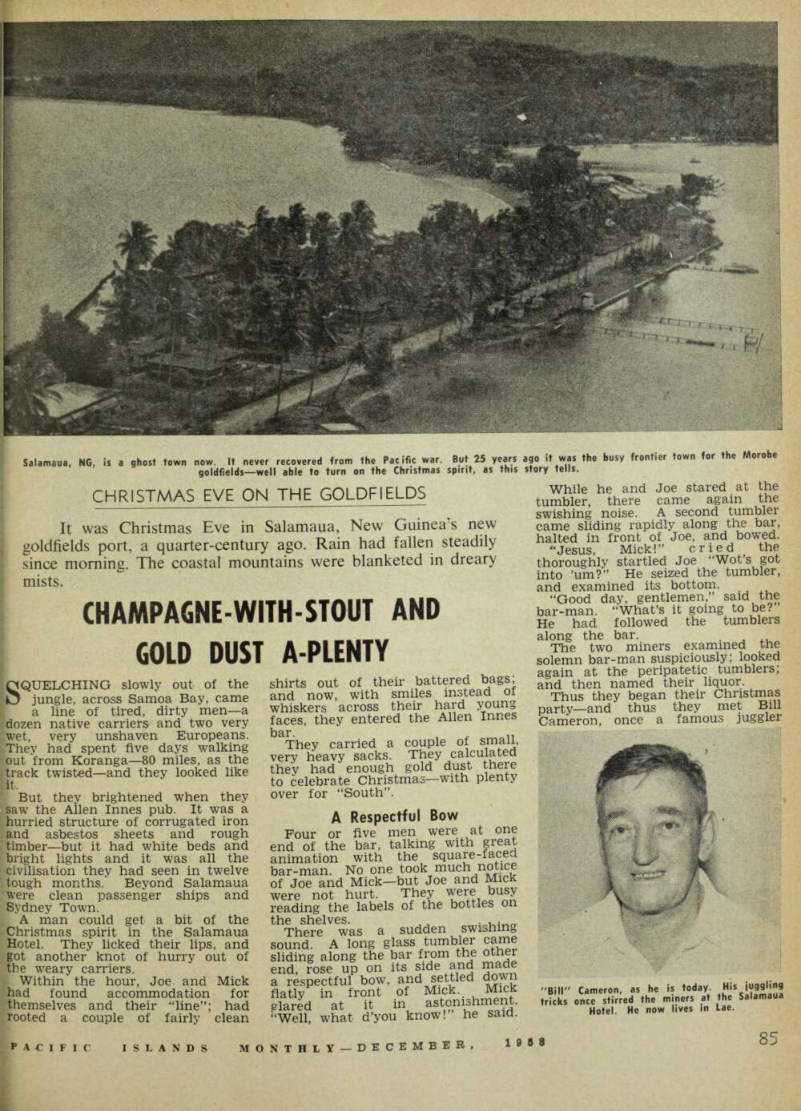
Satamaua, NG, is a ghost town now. It never recovered from the Pacific war. But 25 years ago it was the busy frontier town for the Morobe goldfields—well able to turn on the Christmas spirit, as this story tells.
"Bill" Cameron, as he is today. His juggling tricks once stirred the miners at the Salamaua Hotel. He now lives in Lae.
and circus-man in Europe, and now filling in time with a hotel job while he hovered on the edge of one of the world’s richest and most inaccessible goldfields.
Bill Cameron and his tricks be jPown on the Morobe goldfield of those days. He loved to startle new arrivals with his galloping glasses.
The trick did no harm when the audience was sober, as Mick and Joe were, for the moment; blut when it happened to men who had been for some time celebrating their f ßcap . e , f f om the jungle, their faith m their own liquor storage
capacity was suddenly weakened.
Heavily endowed but exhausted gents from the goldfields, having been greeted by the frisky glasses, had been known to withdraw suddenly from bar to lonely beach, and swear off the grog for life.
Bill Cameron also was the guide, philosopher and friend of the irresponsible miners who drifted in and out of the jungle tracks, be tween Salamaua and Wau. Those were the days before medical science conquered malaria and scrub typhus—and many died miserably in that region, from blackwater and from the typhus (the source of
which they then did not know they called it “Japanese rive' fever”).
Gold Dust A-Plenty
Within an hour, Joe and Mio were well advanced on the;s Christmas party. They teamed uj with other men there.
There was gold dust a-plenty, s the company settled down to steady diet of champagne-ancb stout, as mixed by the experienceos skilled hand of Bill Cameron.
As the day advanced, more mea came in—that Christmas Eve ii Salamaua was long remembered. (Opposite page)
When the wet dusk was falling, (there arrived in the raw township a solitary European, attended only Iby a “monkey” (native boy). He had come down on one of the small I planes, which had just begun freighting between Salamaua and Wau.
He was greeted at the door of the crowded bar-room with howls of pleasure. It was Hector Wales.
He carried two tea-tins, and in each tin there was £7OO worth of gold.
With Hector in good form, the pace of the Christmas party accelerated. The champagne-stout mixture circulated freely—whenever the proceedings quietened a little, “Hec” extracted a little more gold dust from his tea-tins.
That party went on for three days—right over Christmas. Mick and Joe were submerged again and again; but they always came up for air, and they finally passed South, out of this story.
At the end of three days. Hector Wales had had it. He called for his “monkey”, packed hurriedly, and caught a small plane back to Wau and Edie Creek.
(Continued on page 101)
-1 Home on his famous Cleopatra claim, the mists cleared, and he began to wonder what had happened to the £1,400 worth of gold he had taken out for safe cutody in Salamaua. He could not remember Anything after his tenth cham
pagne-and-stout.
\ He hurried down to Wau. The weather had closed in, and no plane moved in or out for several days.
Straight for the Pub
I It was in the following week that Hector arrived in Salamaua, and headed straight for the pub. ; “Bill,” he said, his voice a little tremulous. “My gold—what became of it Did you see anything of my two tins?”
I “Yes, I got ’em here,” replied Bill, reaching in under his bar. The two tins contained all the gold brought in by Hector —less, of Bourse, the heavy cost of many, Jnany rounds of stout-and-cham pagne.
After all, it had been a Merry Christmas. * * * The Old Hands still like to tell of how Bill Cameron supplied Salamaua with its first billiard table. $ Bill saved his money, and brought in a fine table from South. It needed eight posts, or legs, of concrete, upon which it might sit, firm and level. Bill assembled the fcecessary material, and Allen Innes willingly allowed him a week-end ?clear of the bar-room job, to set the table.
I Bill started work early one Saturday. It looked like a Herculean one-man task.
The Saturday morning drinkers .presently drifted around, to watch Bill at work. To some of the more knowing ones, the concrete leg under construction did not seem right. They told Bill about it.
BIT’S reply was calculated to excite wrath. The- outcome of the argument was that critics started on another leg, to show Bill just how it should be done. x The argument spread. None could agree about billiard-table legs.
Soon five different groups of concrete experts were demonstrating
five different ways of building legs.
Before the sun sank that Satur day, the grateful Bill was putting the finishing touches on the eight table legs. They were somewhat different in shape and design, but they provided all that was needed a firm, level bed for the table.
Champagne in Concrete
The company became so in terested in Bill’s enterprise that good liquor was purchased, and at least one bottle of champagne was placed in each table-leg and cemented over.
A cotiple of days later, when the table was in position, Bill auctioned off the first games, and the bids, in 10 - and 20/- rises, provided
Bill with a fund of £l3/10/-. Then Bill used the fund to provide a long series of free drinks for the billiard players.
Bill Cameron had his ups and downs on the goldfield, but he made no fortune, and he remained in New Guinea 4 I found him in September, 1958, in an Administra tion post in Lae—and I induced him to go (most unwillingly) into the light, so I could take his photograph.
“I wonder what happed to those billiard table legs,” said an old timer, wistfully, after he had told me those stories of Bill Cameron in Salamaua.
“Salamaua was blown to pieces by the Japs, and the billiard table with it, I suppose. Too bad.”—RWR