Up Stevenson’s Tomb
p. 86 · Read in the full issue
The Man Who Cleaned Up Stevenson’s Tomb
It was a bright morning in February, 1906, when young Australian journalist W. Farmer Whyte visited the tomb on Mount Vaea where Robert Louis Stevenson’s body had been placed 12 years before.
r 1 get to it he passed by “Vailima”, then known as “Villa Vailima” and in the hands of a wealthy German gentleman named Kunst, who had paid about £2,000 for it.
He passed the cottage where Joe Strong had lived, and then followed a little winding track from the back of the house, across a rustic bridge, and began the final climb. And what a climb!
“Three times I stopped and told myself this could not be the way to Stevenson’s grave,” he wrote later. But it was. And when eventually he got to the top he was even more disappointed.
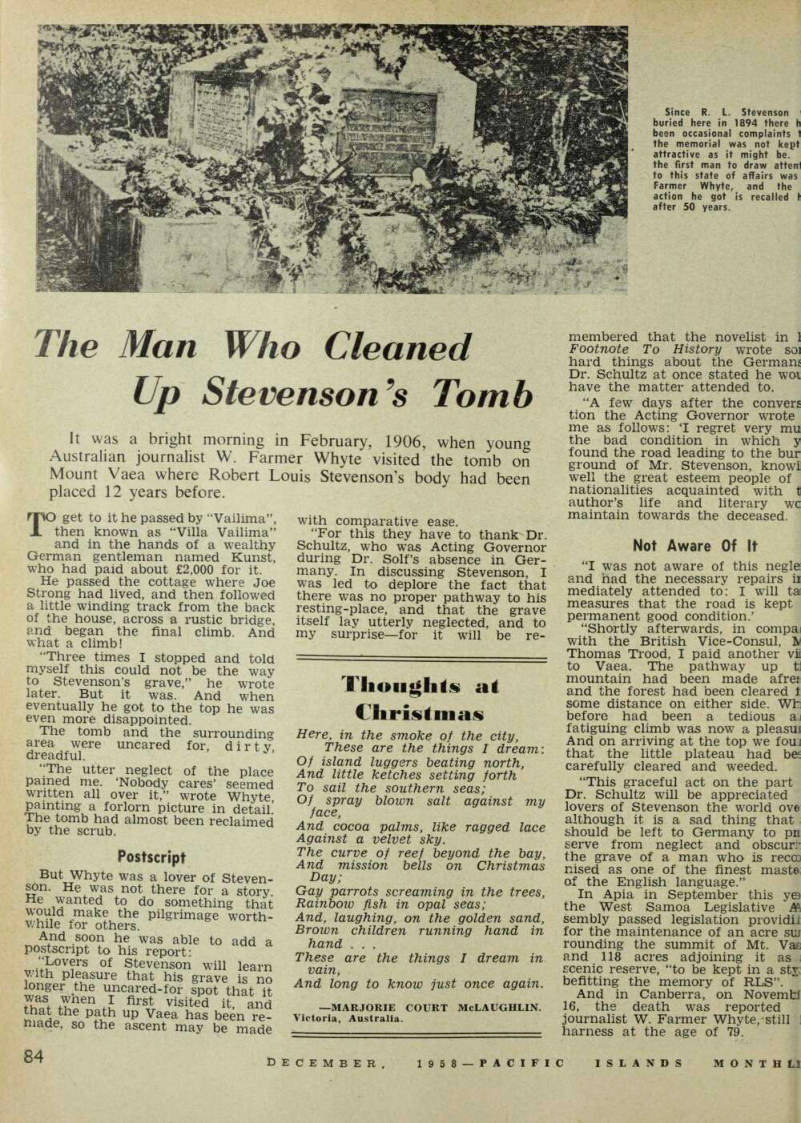
The tomb and the surrounding area were uncared for, dir t v dreadful. ‘‘The utter neglect of the place pained me. ‘Nobody cares’ seemed written all over it,” wrote Whyte painting a forlorn picture in detail’
The tomb had almost been reclaimed by the scrub.
Postscript
But Whyte was a lover of Steven son. He was not there for a story He wanted to do something that would make the pilgrimage worth while for others.
And soon he was able to add a postscript to his report: “Lovers of Stevenson will learn with pleasure that his grave is no longer the uncared-for spot that it S,f en I first Visited it and that the path up Vaea has been re made, so the ascent may be made
with comparative ease.
“For this they have to thank Dr.
Schultz, who was Acting Governor during Dr. Solf’s absence in Ger many. in discussing Stevenson, I was led to deplore the fact that there was no proper pathway to his resting-place, and that the grave itself lay utterly neglected, and to my surprise—for it will be re
membered that the novelist in 1 Footnote To History wrote soi hard things about the Germans Dr. Schultz at once stated he woi have the matter attended to.
“A few days after the convers tion the Acting Governor wrote me as follows: ‘I regret very mu the bad condition in which y found the road leading to the bur ground of Mr. Stevenson, knowi well the great esteem people of nationalities acquainted with t author’s life and literary wc maintain towards the deceased.
Not Aware Of It
“I was not aware of this negle and had the necessary repairs in mediately attended to: I will tai measures that the road is kept permanent good condition.’
“Shortly afterwards, in compai with the British Vice-Consul, ft Thomas Trood, I paid another vii to Vaea. The pathway up t: mountain had been made afres and the forest had been cleared t some distance on either side. Wh before had been a tedious aj fatiguing climb was now a pleasui And on arriving at the top we fouj that the little plateau had b© carefully cleared and weeded.
“This graceful act on the part Dr. Schultz will be appreciated lovers of Stevenson the world ove although it is a sad thing that should be left to Germany to pn serve from neglect and obscur;the grave of a man who is recco nised as one of the finest maste. of the English language.”
In Apia in September this y© the West Samoa Legislative sembly passed legislation providii for the maintenance of an acre sm rounding the summit of Mt. Vae and 118 acres adjoining it as scenic reserve, “to be kept in a sty; befitting the memory of RLS”.
And in Canberra, on Novembf 16, the death was reported journalist W. Farmer Whyte, still harness at the age of 79.
Since R. L. Stevenson [?] buried here in 1894 there h[?] been occasional complaints t[?] the memorial was not kept attractive as it might be. the first man to draw attent to this state of affairs was Farmer Whyte, and the action he got is recalled h[?] after 50 years.