Humphrey Berkeley
pp. 79-81 · Read in the full issue
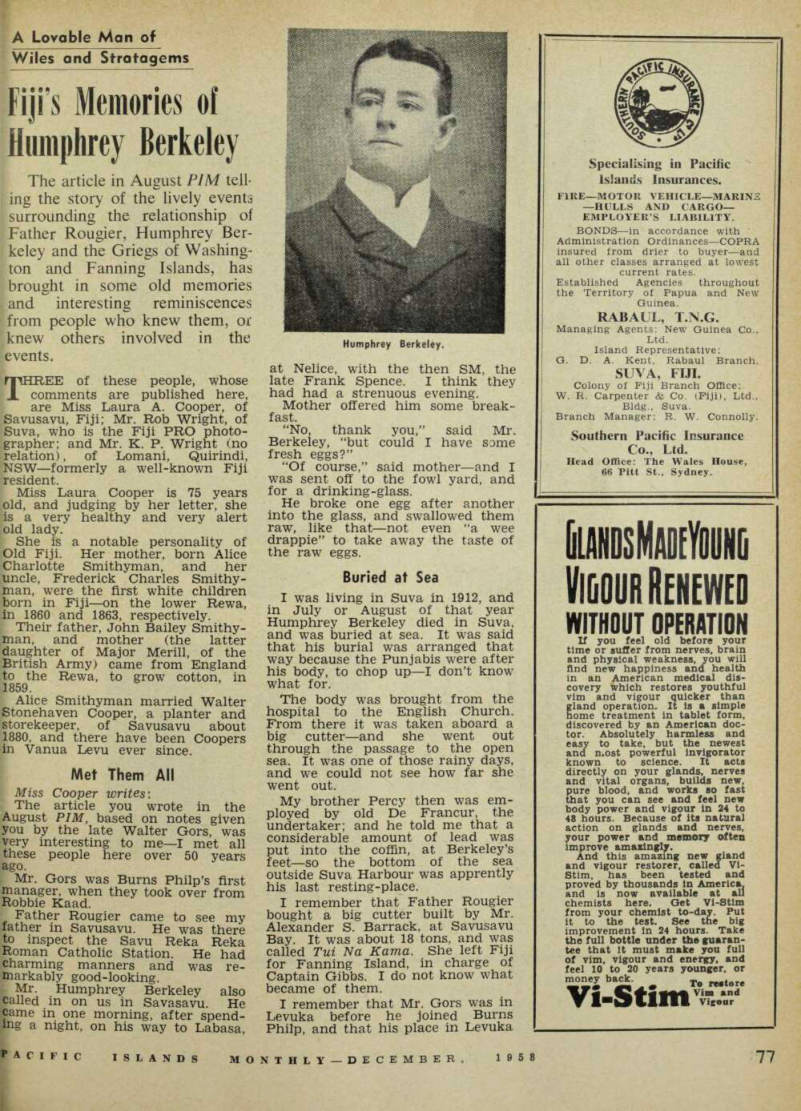
A Lovable Man of Wiles and Stratagems Fiji’s Memories of
The article in August PIM tell ing the story of the lively events
surrounding the relationship of
Father Rougier, Humphrey Ber
keley and the Griegs of Washing
, ton and Fanning Islands, has
brought in some old memories and interesting reminiscences from people who knew them, or knew others involved in the events. r[REE of these people, whose comments are published here, are Miss Laura A. Cooper, of Savusavu, Fiji; Mr. Rob Wright, of Suva, who is the Fiji PRO photo grapher; and Mr. K. P. Wright (no relation), of Lomani, Quirindi, NSW—formerly a well-known Fiji resident.
Miss Laura Cooper is 75 years old, and judging by her letter, she is a very healthy and very alert old lady.
She is a notable personality of Old Fiji. Her mother, born Alice Charlotte Smithyman, and her uncle, Frederick Charles Smithy man, were the first white children born in Fiji—on the lower Rewa, in 1860 and 1863, respectively.
Their father, John Bailey Smithy man, and mother (the latter daughter of Major Merill, of the British Army) came from England to the Rewa, to grow cotton, in 1859.
Alice Smithyman married Walter Stonehaven Cooper, a planter and storekeeper, of Savusavu about 1880, and there have been Coopers in Vanua Levu ever since.
Met Them All Miss Cooper writes : The article you wrote in the August PIM, based on notes given you by the late Walter Gors, was very interesting to me—l met all these people here over 50 years ago.
Mr. Gors was Burns Philp’s first manager, when they took over from Robbie Kaad.
Father Rougier came to see my father in Savusavu. He was there to inspect the Savu Reka Reka Roman Catholic Station. He had charming manners and was re markably good-looking.
Mr. Humphrey Berkeley also called in on us in Savasavu. He came in one morning, after spend ing a night, on his way to Labasa,
at Nelice, with the then SM, the late Frank Spence. I think they had had a strenuous evening.
Mother offered him some break fast.
“No, thank you,” said Mr.
Berkeley, “but could I have some fresh eggs?”
“Of course,” said mother —and I was sent off to the fowl yard, and for a drinking-glass.
He broke one egg after another into the glass, and swallowed them raw, like that —not even “a wee drappie” to take away the taste of the raw eggs.
Buried at Sea I was living in Suva in 1912, and in July or August of that year Humphrey Berkeley died in Suva, and was buried at sea. It was said that his burial was arranged that way because the Punjabis were after his body, to chop up—l don’t know what for.
The body was brought from the hospital to the English Church.
From there it was taken aboard a big cutter —and she went out through the passage to the open sea. It was one of those rainy days, and we could not see how far she went out.
My brother Percy then was em ployed by old De Francur, the undertaker; and he told me that a considerable amount of lead was put into the coffin, at Berkeley’s feet —so the bottom of the sea outside Suva Harbour was apprently his last resting-place.
I remember that Father Rougier bought a big cutter built by Mr.
Alexander S. Barrack, at Savusavu Bay. It was about 18 tons, and was called Tui Na Kama. She left Fiji for Fanning Island, in charge of Captain Gibbs. I do not know what became of them.
I remember that Mr. Gors was in Levuka before he joined Burns Philp, and that his place in Levuka
Humphrey Berkeley.
was taken by Mr. W. R. (afterwards Sir Walter) Carpenter.
Brother Was Writer Mr. Rob Wright writes: I am reminded that one of Humphrey Berkeley’s sons grew up with my older brothers. His name was Reginald Berkeley and, after leaving Fiji, he became a writer.
One of his books was, I believe, called French Leave, and this was the subject of an early British movie. I think it was also a stage play.
In the early 30’s, Reginald went to Hollywood as a screen writer.
While I was in that city—l think it was 1934—1 attempted to get in touch with him at the Writer’s Club. Instead, I met the late Sir Aubrey Smith, filmdom’s Grand Old Man, who informed me that Reginald had died of an illness a week or two before.
"Loveable Man"
Mr. K. P. Wright, of NSW, writes: I was much interested in your article describing the relationship between Father Rougier and Mr.
Humphrey Berkeley, of Suva, prior to the acquisition by Rougier of his Coconut Empire. The writer said that he did not know what had happened to Berkeley.
Humphrey Berkeley’s end was as dramatic as his career, as set out by the writer; and it must have been about the beginning of World War I, in 1914.
At that time there were a con siderable number of Indians in Fiji who wished to return to India, but could not secure passages.
So our friend, Humphrey Berkeley, promised to provide a ship; and he collected a consider able amount of money from Indians to “charter” a vessel. The ship, however, for all sorts of reasons, never materialised. There was a great deal of ill-feeling and the Indians naturally wanted their money back.
At this juncture, Humphrey died in Suva; and a special dispensation was obtained from the Colonial Secretary, permitting his body to be buried at sea. The Indians were said to have theatened to desecrate the grave, had he been buried in the cemetery. His body definitely was committed to the ocean, just outside the Suva Passage.
Berkeley had a delightful per sonality and was a very well-known man.
Interesting incidents of his career were described for me about 50 years ago by another well-known Suva identity of those times, Mr.
Edgar Powell, of Lami Plantation.
Mr. Powell, after making a big impression on Fiji between about 1900 and 1920, died in Sydney, a broken man, in the late ’Twenties.
At one time, according to Powell, Berkeley was defending an Indian, who was accused of murder. The judge was summing up to the jury
(or assessors) at the conclusion of the evidence, and Berkeley realilsed that things looked very bad for the prisoner. He left the court for a moment, and arranged to have a note brought in to him just as the Judge (probably Sir Charles Major) concluded his remarks.
This was done and Berkeley, holding the note, jumped to his feet and asked permission to say a few words before the jury’s retirement, as his client’s life depended on it.
What he said was: “Gentlemen, His Honour has painted a dark picture of the prisoner’s conduct— but all pictures, like other things, have two sides. I ask you to turn this picture around, and look at the back of it. Gentlemen, there is nothing behind it!” The prisoner was acquitted! Only Berkeley’s social standing and popularity saved him from being struck off the rolls.
On other occasion, he was defending some Indians, or natives, before Mr. Spence, the Magistrate
at Navua. He realised he had no case, so he resorted to subterfuge.
He requested an adjournment, ex plaining that it would be some time before he was able to collect his “evidence” and appear in court again. “Therefore, would your Worship grant me three weeks’ adjournment?”
This was granted. When the case was again called, Berkeley rose to his feet and said: Your worship, I ask you to dismiss this case”.
“What are your grounds, Mr.
Berkeley?” asked the Magistrate.
“My grounds, your worship,” said Berkeley, “‘Are that you had no authority to grant a three weeks’ adjournment. You should have re called the case at the end of 10 days.” That was the end of that.
My times (both three weeks and 10 days) may be wrong; but that was the way in which he tricked the Court.
That was Humphrey Berkeley: a most likeable man, but full of wiles and stratagems.