Pacific Will Have To Meet The
pp. 61-63 · Read in the full issue
Shipping Lines Are Making £28-Million Tourist Gamble Pacific Will Have To Meet The Biggest Tourist Influx Ever
By Stuart Inder
Anybody who doubts that the Pacific tourist industry is now ripe for opening up in a big way, might be interested to learn that a British shipping combine is betting £2B million that this will happen in the next two years.
THAT’S what it’s going to cost the P & O Group, which includes the Orient Line, to build the 40,000-ton Oriana, and the 45,000-ton Canberra.
The two new ships, able to travel at about 28 knots, and carrying 2,000 passengers each, will go into the Pacific service in the next two years.
This service is being extended to form a great triangle, taking in both North and South Pacific; and its ships will operate under the name of the recently formed Orient and Pacific Lines, which is an in tegration of P & O and Orient Line services, and specially designed to handle this big new Pacific passenger trade.
The new services will involve eight passenger ships, worth about £65,000,000, including such luxury ships as the 28,000 Himalaya (which has already begun Pacific service), the 30,000-ton Arcadia, the 24,000ton Chusan, in addition to the two big ships now building.
They Need Passengers
These ships are dependent on passengers. [ The two new ships will be de pendent virtually on Pacific passeng ers. They will, like the others, operate other runs, mainly UK to
Australia, but the Canberra and the Oriana will not be able to exist on the UK run alone.
Yet at the present rate of Pacific
passenger bookings, they wouldn’t be able to pay there, either. There would need to be an additional 20,000 passengers a year to and from the US West Coast, across the North and South Pacific, to make it a worthwhile proposition.
In short, Americans and Can adians would have to “discover” the Pacific, as they discovered Europe after the war. And they would need to spend their dollars as freely in getting there. Since all these new tourists would not choose to travel by ship, there would have to a greater number of tourists av*n-
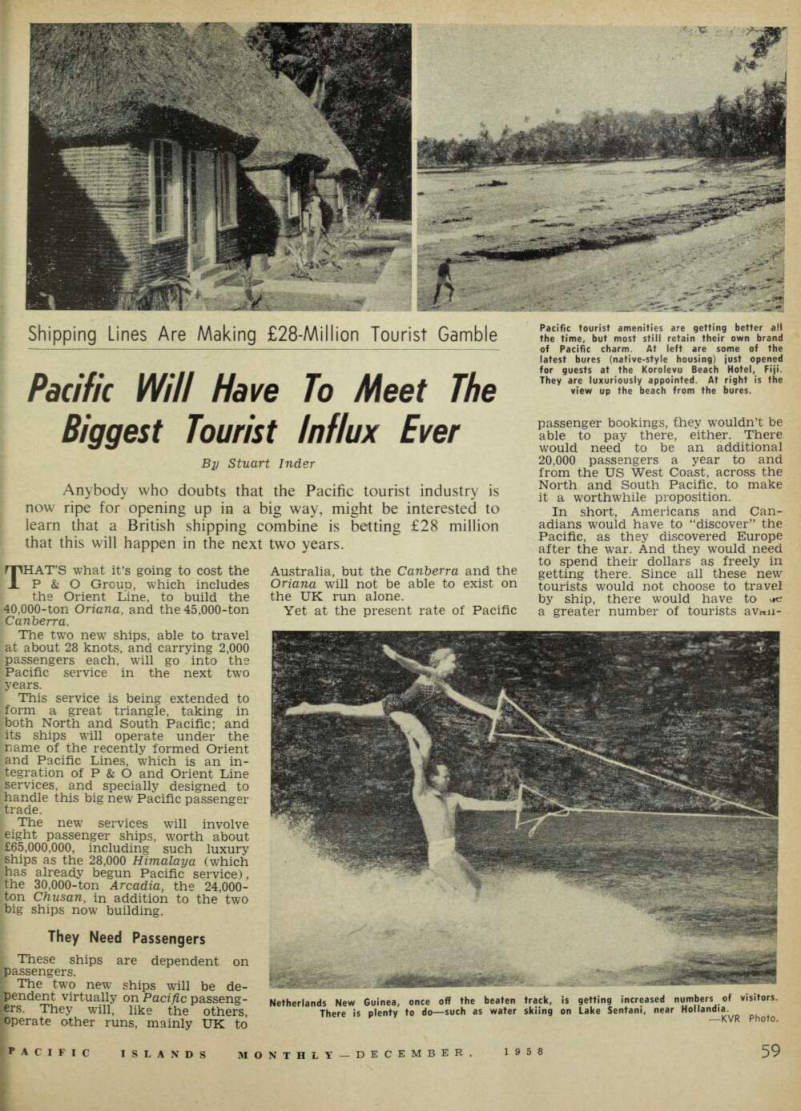
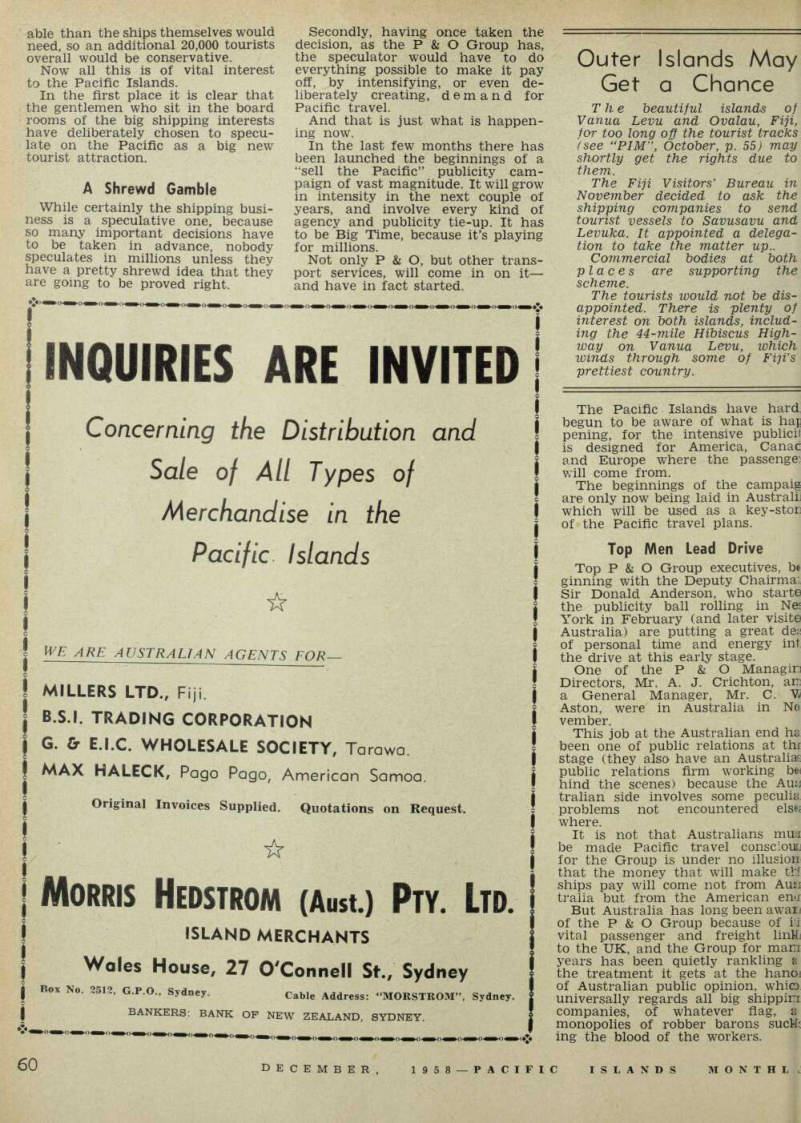
Pacific tourist amenities are getting better all the time, but most still retain their own brand of Pacific charm. At left are some of the latest bures (native-style housing) just opened for guests at the Korolevu Beach Hotel, Fiji.
They are luxuriously appointed. At right is the view up the beach from the bures.
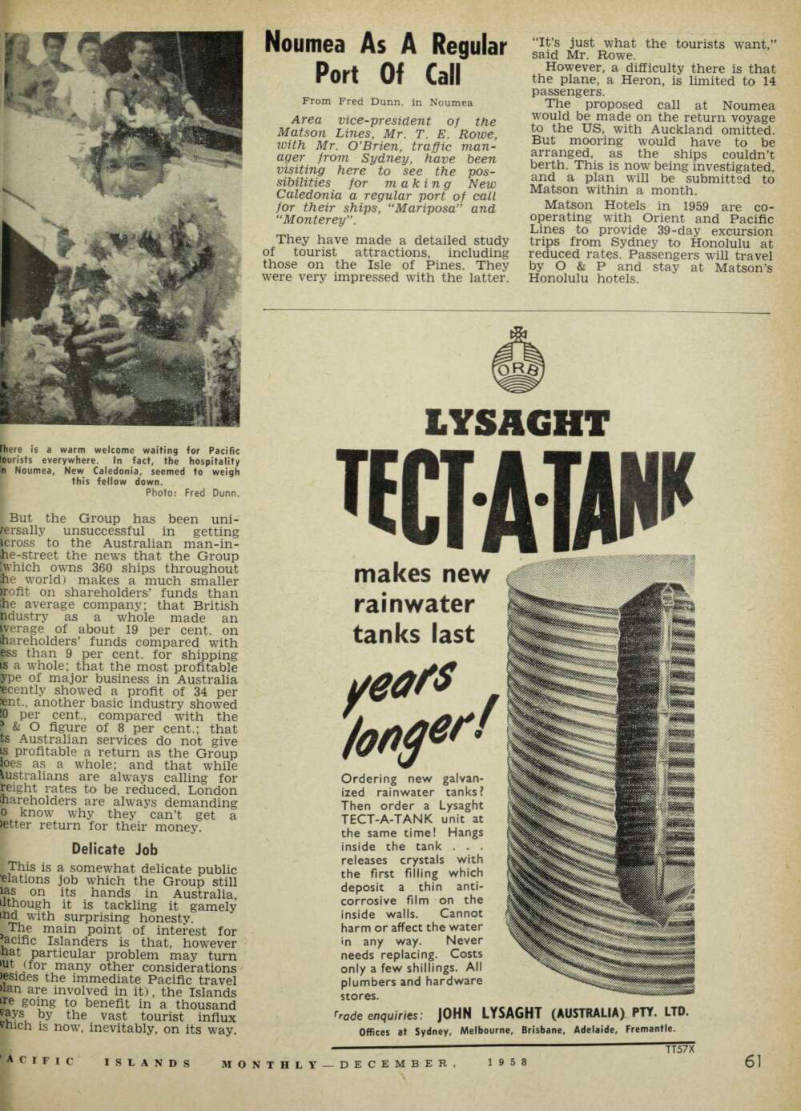
Netherlands New Guinea, once off the beaten track, is getting increased numbers of visitors.
There is plenty to do —such as water skiing on Lake Sentam, near Hollandia. -KVR Photo
able than the ships themselves would need, so an additional 20,000 tourists overall would be conservative.
Now all this is of vital interest to the Pacific Islands.
In the first place it is clear that the gentlemen who sit in the board rooms of the big shipping interests have deliberately chosen to speculate on the Pacific as a big new tourist attraction.
A Shrewd Gamble a >nrewc bambie While certainly the shipping business is a speculative one, because so many important decisions have to be taken in advance, nobody speculates in millions unless they have a pretty shrewd idea that they are going to be proved right.
Secondly, having once taken the decision, as the P & O Group has, the speculator would have to do everything possible to make it pay off, by intensifying, or even de liberately creating, demand for Pacific travel.
And that is just what is happen ing now.
In the last few months there has been launched the beginnings of a “sell the Pacific” publicity cam paign of vast magnitude. It will grow in intensity in the next couple of years, and involve every kind of agency and publicity tie-up. It has to be Big Time, because it’s playing for millions.
Not only P & O, but other trans port services, will come in on it— and have in fact started.
The Pacific Islands have hard, begun to be aware of what is hap pening, for the intensive publicil is designed for America, Canac and Europe where the passenge: will come from.
The beginnings of the campaig are only now being laid in Austral! which will be used as a key-stor of the Pacific travel plans.
Top Men Lead Drive
Top P & O Group executives, be ginning with the Deputy Chairma;, Sir Donald Anderson, who starte the publicity ball rolling in Nej York in February (and later visite Australia) are putting a great de;; of personal time and energy int the drive at this early stage.
One of the P & O Managin Directors, Mr. A. J. Crichton, air a General Manager, Mr. C. V) Aston, were in Australia in No vember.
This job at the Australian end hs been one of public relations at thr stage (they also have an Australian public relations firm working be< hind the scenes) because the Autj tralian side involves some peculia. problems not encountered else; where.
It is not that Australians muu be made Pacific travel consciouL for the Group is under no illusion that the money that will make thf ships pay will come not from Ausj tralia but from the American enn But Australia has long been awan of the P & O Group because of i i vital passenger and freight linMj to the UK, and the Group for mam years has been quietly rankling s the treatment it gets at the hanoi of Australian public opinion, whio universally regards all big shippim companies, of whatever flag, a monopolies of robber barons suck: ing the blood of the workers.
But the Group has been uni versally unsuccessful in getting Icross to the Australian man-in he-street the news that the Group [which owns 360 ships throughout he world) makes a much smaller profit on shareholders’ funds than he average company; that British Ddustry as a whole made an average of about 19 per cent, on hareholders’ funds compared with ess than 9 per cent, for shipping is a whole; that the most profitable ype of major business in Australia “ecently showed a profit of 34 per sent., another basic industry showed !0 per cent., compared with the f & O figure of 8 per cent.; that ts Australian services do not give is profitable a return as the Group joes as a whole; and that while Australians are always calling for reight rates to be reduced, London hareholders are always demanding o know why they can’t get a )etter return for their money.
Delicate Job
This is a somewhat delicate public elations job which the Group still las on its hands in Australia, uthough it is tackling it gamely hd with surprising honesty.
The main point of interest for acific Islanders is that, however hat particular problem may turn •ut (for many other considerations Resides the immediate Pacific travel »ian are involved in it), the Islands ire going to benefit in a thousand by the vast tourist influx vinch is now, inevitably, on its way.
There is a warm welcome waiting for Pacific tourists everywhere. In fact, the hospitality in Noumea, New Caledonia, seemed to weigh this fellow down.
Photo: Fred Dunn.