An Imaginative Approach To
pp. 55-57 · Read in the full issue
COCONUT CHIPS, TROPICAL LIQUEURS AND SNAILS IN BRINE
Pacific Trade Roosting
The writer of this article, “PlM’s” Auckland correspondent, has a few revolutionary ideas —such as shipping hack those snails to the Japs as a food delicacy—hut there is much in what he says. No day ever passes when “PlM’s” Sydney office has not at least one inquiry from someone interested in the commercial possibilities of the Islands. Authoriative information, readily available in the form suggested, would he a godsend to many—and providing it would not cut across the sacred function of the South Pacific Commission as an “advisory body only”.
By J. P. Shortall
Since the South Pacific Com mission was formed it has been
instrumental in carrying out
many agricultural, crop, and
fisheries surveys, mostly with a
view to investigating the possi
bility of establishing primary in
dustries in new areas so that all the local eggs are not in one— or two—baskets.
THE results of these surveys have been published in the form of Technical Papers.
I This is all very well; but what about a really useful survey of possible industries based on exist ing resources, including the market outlook for such produce? This seems to be something that is very badly needed, and the SPC appears to be well placed for carrying out such a survey.
There are, in the Islands, and outside the Islands, a great many people with some capital and plenty of enterprise, who are looking for profitable outlets in the form of small industries. What they lack is some guidance as to industrial pos sibilities in the Islands.
A great deal of time and money can be wasted at present by such an investor in slowly gathering factual information.
What first is wanted is a survey of possible industries, and an ex
planation of whether and why they are feasible, or not.
Americans Love Coconut-Chips For example, can anyone say with authority that a profitable little coconut-chip industry is out of the question?
Huge quantities of potato chips are eaten in Australia. Large quantities of coconut-chips are eaten in America. Why should Australians not eat coconut-chips if they are properly presented?
What about other markets—in America or elsewhere. And where in the Islands would it be practical to establish such an industry? What would it require in electricity, water,
and labour resources; how long can coconut chips be safely stored in the tropics after roasting; what regulations exist in nearby market ing countries which might have an important bearing on landed costs, etc.?
Such a survey might make a start by dealing thoroughly with the better known industries. One of these would be the possibility existing for small local copra-crushing mills.
The process may or may not require large quantities of water, steam, or electricity. These considerations could be the immediate deciding factors.
For example, at first sight there would seem to be many sound reasons for establishing a small mill in the Northern Cooks, or perhaps in the Gilberts, but some of the above-m enti o n e d considerations might rule such an industry out.
Or again, those particular require ments might all be met in the New Hebrides, but there might be no labour, where plenty of the right kind of labour might exist in the Cooks. And even if this industry were feasible, can the investor be sure that no government agreement at present exists whereby all the local copra is promised to some out
side organisation?
Miss Out, Perhaps
For an individual investor to set out to gather all this information piecemeal, the outlook is so dis heartening at present that he is apt to abandon all idea of investment after the first flush of enthusiasm, and in doing so perhaps miss out on a worthwhile venture.
Among the industries that could be listed for investigation of tech
nical requirements, suggested
locations, and market outlooks would be the following: Fruit peel; canned, dried and quick-frozen fruits; jams, pickles, and chutneys; peanut butter; coconut syrup; liqueurs made from tropical fruits; perfumes, meat tenderisers made from papain (a derivative of the pawpaw 01 papaya); “instant” coffee; pottery, cocoa in consumer form; salt PJ°" duction; shell button and wooden button manufacturing; plastic in dustries; canned soups, canned mushrooms: cut flowers. .
As well as these more obvious possibilities there may be others a
If there is one thing the South Pacific has plenty of, it's coconuts. And why not a coco nut chip business, indeed?
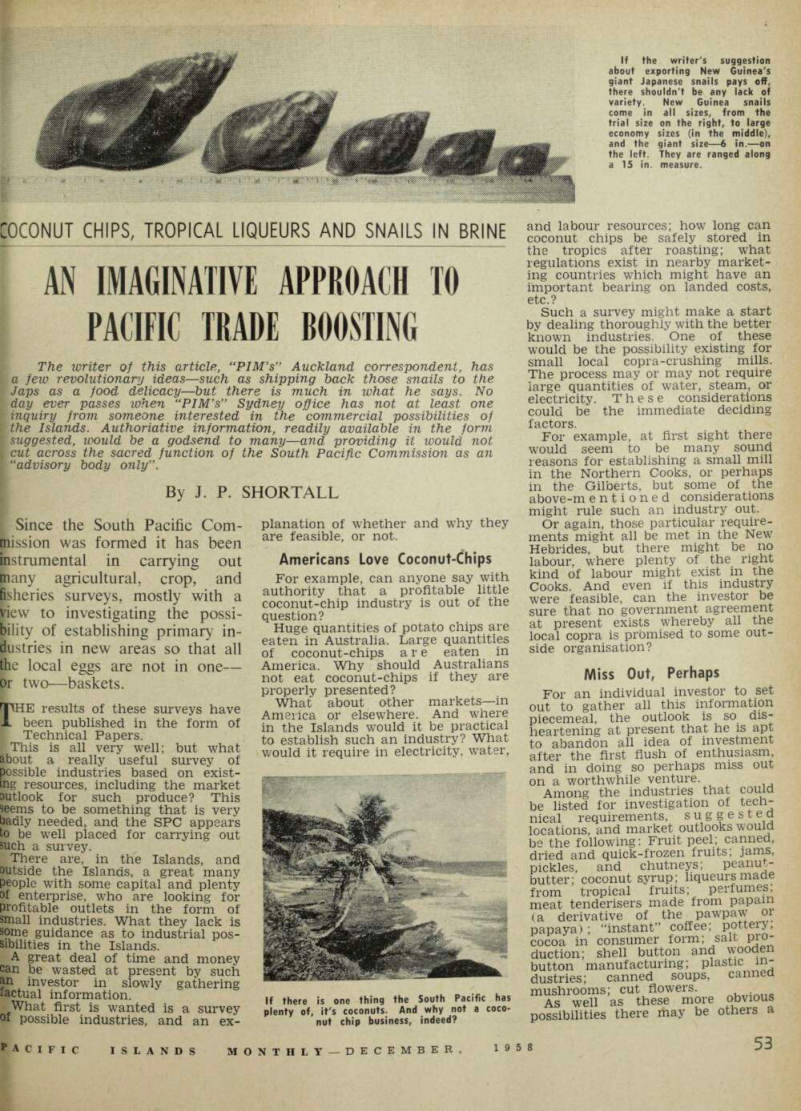
If the writer's suggestion about exporting New Guinea's giant Japanese snails pays off, there shouldn't be any lack of variety. New Guinea snails come in all sizes, from the trial size on the right, to large economy sizes (in the middle), and the giant size—6 in.—on the left. They are ranged along a 15 in. measure.
',ood deal less obvious. Shipping con nections are improving throughout [he Pacific and new markets are opening up.
Japanese Love Snails There may be many commodities ihat the Islands could produce from existing materials which would have 10 sale at all in the traditional narkets, but might have consider able sale, say, in Eastern markets.
The SPC might very profitably make - close investigation of such markets.
As an extreme example of pos ibilities under this heading, we night consider an item in November *IM where it was reported that ;iant snails are still a major and :ostly pest in New Britain, where hey have become established in nillions.
Remembering that these snails eere deliberately introduced to this sland as a war-time item of diet »y the Japanese, is it not just pos ible that they could be sold pro bably in that country now—perhaps hipped in brine, in casks, or in some •ther acceptable way?
Has anyone investigated this pos ibility? And if these giant snails lave no present commercial value, perhaps there are other, small 'arieties that do have. Plenty of xpensive cans of French-type snails toss the counters of Sydney lelicatessens and they have been mported all the way from Europe.
Perhaps there are other equally sxotic foodstuffs at present avail tble, or which could be very easily troduced in the Islands and which pould have a ready market in the East.
Hongkong still has its millionaires .s well as its refugees, and Aus tralia's population no longer con ists solely of people who eat dinkum Aussie” food.
How the SPC Could Help The survey of markets is a pecialised work, calling for access o many obscure trade journals rtiich are largely unknown to the lewcomer and certainly not avail -ble over the counter of many book ellers.
The SPC, on behalf of its member :overnments, who are keen to en ourage new industries, could be of :reat assistance by establishing a eally good market advisory service.
The market situation is constantly hanging. What may not be com petitive last year may be highly profitable this year, but unless and until there is such an advisory ser ice there is no encouragement or prewarning to take advantage of
ikely openings.
This particularly applies to land •wners in the Islands who would Perhaps be fully prepared and able o take advantage of market open ings in diversified catch-crops. - Suppose, for example, that ginger
roots are normally supplied to New Zealand mainly from Fiji, At present, should it be evident that the crop was going to fail due, say, to hooding, the farmers in perhaps the Cook Islands who might be ready ,mAwSS breech are pprtnSTv {? n oar ? bou JL ? r to get a crop in to meet the situation profitably.
To give such warning and advice would be the function of this advisory service. It would be given not through the individual governments or administrations or their agricultural departments (who for their own good reasons often oppose such diversifxcation) but in the form of a
regularly circulated published bulletin; perhaps even in the exist ing SPC Quarterly Bulletin, though a monthly bulletin would seem to be called for, to fully meet the situation.
A reliable service of this kind mi ght provide a very real contribu tion to the economy of the South pacific A salt industry will start near Port Moresby soon, as a native co operative. P-NG imports 1,000 tons of salt a year at present, but it’s hoped in 10 years local production will account for all of it. Production will be by solar evaporation.