fiji talanoa
pp. 49-53 · Read in the full issue
Vakatawa Talks Of This And That
Although it seems likely that more than one anopheles mosquito is needed to introduce malaria to a new field (other wise Australia would long ago have succumbed), Fiji has recently had an object lesson on how easily insect pests can be introduced in this age of air travel.
It/fR. G. F. BURNETT, who is in L? 1 charge of filariasis research in Fiji, told the Suva Rotary Club •ecently how a new and viciously jiting mosquito crept past the guards it Nadi, in spite of the insecticide vhich is sprayed into the aircraft >n arrival.
It arrived (or so it is supposed) iboard an aircraft from Australia »r New Caledonia. It escaped the f umes of the insecticide (because lobody pretends that these are 100 >er cent, effective, but the general dea is that 90 per cent, is better han no line of defence at all).
Even then all would have been veil if it had not been for special :ircumstances because mosquitoes ie e d congenial surroundings in vhich to survive and control teams it Nadi Airport are on the alert o deny them such surroundings.
A CSR Company flood gate had rot out of order and quite a lot •f land near the airport had be ome sodden and flooded.
The intruder welcomed this home rom-home, flourished, bred and
spread and in less than a year was savagely biting people in Suva on the other side of Viti Levu, 100 miles away.
Unpleasant as it was, it was not a disease-carrying mosquito. But it might have been.
It might—and could—have been anopheles, and the way would then have been opened for the curse of malaria to descend on now free Fiji.
Species of mosquito already in Fiji do carry dengue and filanasis.
Dengue appears in epidemic form every ten years or so, but there are a good many doses of individual illness in between that bear a strik ing resemblance to the disease that is well called “break-back fever”.
Bare-Belts for
Fijian Villages
The most important mosquito borne disease in Fiji is filariasis, which can, after repeated doses, cause the swelling of limbs known as elephantiasis.
A determined war on filariasis has been waged for 15 years or more, with quite a lot of success.
It is conducted by a special branch of the Medical Department, but in its earlier days the principal figure was a layman, the late David W. Amos.
Amos was for years an insurance company manager at Suva. In the early war years he retired and as his contribution to the war effort he threw himself with immense en thusiasm into the work of fighting the menace of the mosquito, a menace grown potentially greater because of the number of military aircraft flying in and out of Fiji.
He soon developed a special in terest in filariasis and studied in particular the life cycle of one of its vectors, or carriers, aedes pseudoscutellaris.
He found that after a blood meal this mosquito flew to the nearest low bush and rested for some days while the filariasis worms grew in its body, ready to be injected into the blood stream of the person next bitten. (Over)
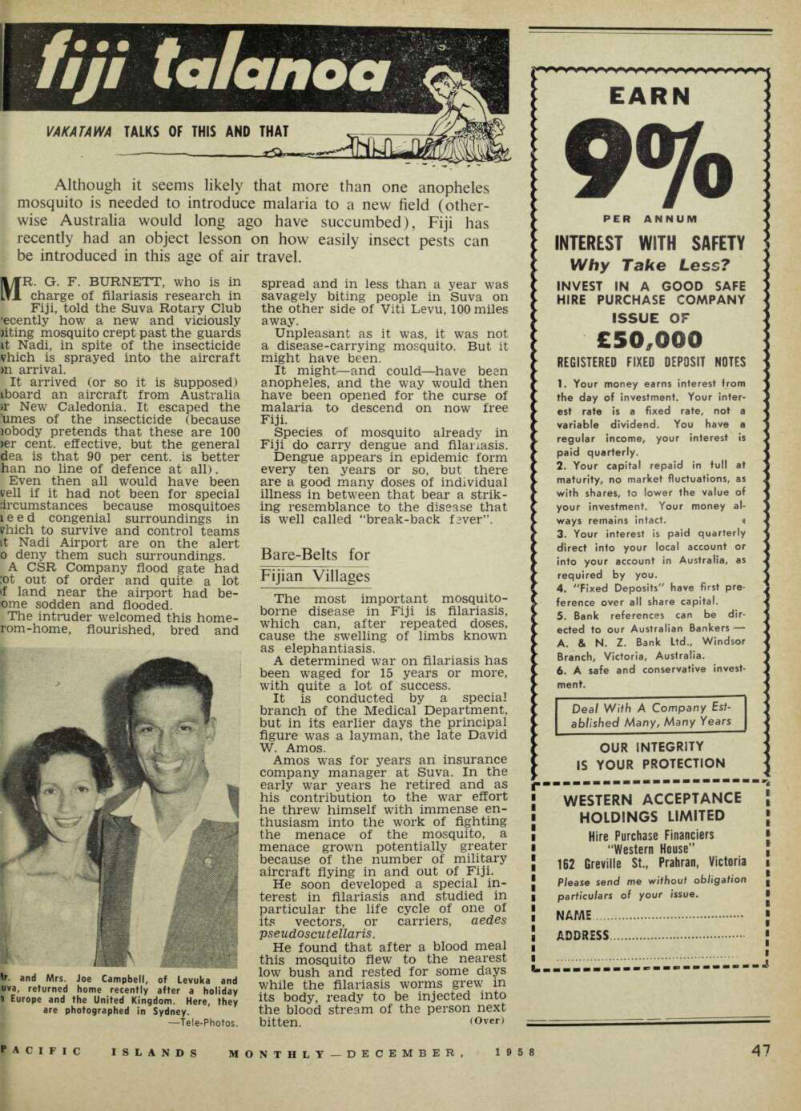
M r and Mrs. Joe Campbell, of Levuka and [?]uva, returned home recently after a holiday [?] Europe and the United Kingdom. Here, they are photographed in Sydney. —Tele-Photos.
He found also that the well-fed, aedes pseudoscutellaris could not fly much more than about 50 yards.
It then dawned on him that if there were no low bushes less than, say, a hundred yards from dwelling houses, the mosquito would have nowhere to rest during the filarial development process and the chain of infection would be broken.
With zeal he threw himself into a colony-wide campaign to persuade Fijians to clear a belt of 100 to 150 yards wide round every village.
Villages which responded well were praised in Fijian broadcasts. Those who remained indifferent were re buked. A , Teams of assistants travelled about the group, preaching the gospel of land clearing as a weapon in the fight against filariasis.
A spectacular reduction in the number of cases of the disease fol lowed, and it continues wherever the Amos plan is still followed.
Fiji Has Financial
Difficulty (Not Crisis)
The new Governor (Sir Kenneth Maddocks) and the new Financial Secretary (Mr. E. R. Bevington) arrived in Fiji just in time to walk into the boiling over of a pot of financial trouble.
The Colony’s plight was summed up by the Financial Secretary at the opening of the Budget Session of the Legislative Council. He said that 1958 would end with a deficit and that the reserves were almost exhausted.
The 1959 budget would have to be framed to make revenue meet expenditure, and to replenish some of the reserves. This would mean another quarter of a million pounds from somewhere.
So —3d more on income tax; 3d more per gallon on petrol, an extra 3d in the £ on the Port and Customs Service Tax (which is imposed on all imports—even duty free) and 6d a bottle on beer.
The beer tax blow will be softened to the consumer by the lower cost of the beer from the Suva brewery.
But instead of a substantial drop in the price of local beer —or draught beer anyhow—the consu mer will be paying about the same as he has been doing for imported beer.
The financial difficulty (not crisis, official circles insist) has produced the usual crawling-out-from-under by politicians.
Some of the Unofficial Members of Legislative Council have beeen talking loudly about waste of Gov ernment money in the past, con veniently forgetting that the Un official Members sitting in Finance Committee, month by month, have to approve expenditure.
One of the troubles is that the public knows nothing of what goes on at these secret meetings of the
Finance Committee, so it is always possible for members to respond to criticism with, “If only I could tell you what I said or how I voted”.
Lakshman Denounces
Budget, and Other Things
B. D. Lakshman’s struggle to get into the public eye continues.
He was elected to the Lautoka Town Council last month and spent a busy week trying to persuade his fellow councillors that he would be a very good mayor.
They remained singularly un moved and Mr. Keith Marlow was duly elected unopposed.
But Mr. Lakshman was not going to remain unheard. At the next meeting he challenged that portion of the minutes which referred to Mr. Marlow as a JP. The full mantle of office of a Justice of the Peace, Mr, Lakshman said, did not descend on the shoulders of a mayor until he had taken the necessary oath.
Mr, Marlow had not yet been sworn in.
Mr. Marlow promptly cut short this valuable contribution by the new councillor to the civic welfare of Lautoka. He moved that the letters JP be struck out of the minutes.
The Deputy-Mayor, Mr. Ingleton. seconded the motion, which was solemnly carried and the council was then able to get on to other matters which rate-payers probably consider rather more important.
When the Budget, with its new taxation, was introduced, a new organisation came suddenly into be ing at Lautoka. It was an “All Parties Congress”, with one of Mr.
Lakshman’s close associates, Mr. J.
C. O’Niel, as president and Mr.
Lakshman himself as not just secre tary but Secretary-General.
A memorandum to the Colonial Secretary was written, denouncing the Budget, and this was des patched, with a copy of a long speach delivered by Mr. Lakshman at Lautoka several weeks before.
The letter did not go direct to the Colonial Secretary, however. It was done up in a parcel, with simi lar letters, and sent to the editor
, of the Fiji Times with a note from Mr. Lakshman asking the editor to . take his own copy and deliver the rest, including one to the Secretary of State to the Colonies in Lon don, to the addressees.
The reply of the newspaper— which seems to have little admira tion for Mr. Lakshman and his works was discourteous and ap parently unprintable.
London’s Big
Sensation
During the month, the editor of the Fiji Times was warned that a radiophone call was coming in from New York. Then, this was cancelled, and soon there arrived a full-rate radiogram of about 300 words, signed by the “Foreign Editor” of one of London’s biggest dailies.
The Fiji Times editor was given the cabin number of a woman pas senger on the liner Orcades, due in Suva the next day. It was explained that she was a woman councillor in a large industrial city in England; and it was thought that she had run away with a medical man, also well-known in the city. This was de scribed as a “big sensation” in Britain.
The Fiji editor was asked to find cut whether the doctor was aboard with the lady; to interview her and report exactly on her attitude and conduct, as disclosed by herself and her fellow passengers. It was ex plained that she was likely to be “unco-operative”; but that the Suva journalist was not to be dis couraged on that account.
The Fiji Times editor was asked to acknowledge receipt of the mes sage. The Fiji Times did so, in one simple sentence; “We are not in terested in gutter journalism.”
Attractive Mrs. Ann Griffin, popular social secretary of the Polynesian Association of Sydney, recently spent a long holiday in her home town of Suva. She is photographed back in Sydney with the Association president, Mr.
Leonard Moran. —Tele-Photos.