There May 'Be A Bigger Oilfield At
pp. 45-47 · Read in the full issue


Papuan Oil Strike Could Have Come 20 years Ago There May 'Be A Bigger Oilfield At Puri Than Anyone Now Believes'
By G. A. V. Stanley
The general area around the head of the Gulf of Papua is one which, for many years, has attracted the attention of world geologists. Oil seepages were first discovered in 1910 on the Vailala River, about 20 miles from its mouth, and also downstream.
SOME drilling was done during the First World War under the direction of Dr. Arthur Wade (who enjoyed the title of Director Df Commonwealth Oilfields) but with very little success.
After the war the Australian Government consulted the British Government in the matter of the search for oil in Papua and the Vfandated Territory of New Guinea.
Between 1920 and 1923, a team of British geologists from the Anglo- Persian Oil Company carried out geological surveys in a number of Dlaces in both Territories.
One party consisting of William Vlclntosh Gray and John Bouchier, napped out the Era River in Papua reaching points about three niles to the south of Puri. Had hey gone on up-stream for a few nore miles, they would have found he mouth of Puri Creek—and if hey had been lucky enough to go ip the creek for about four ol ive miles, they must inevitably
have found the Puri anti-cline.
However, the discoverer of that structure—and the only true dis coverer of it—is a geologist named Samuel Warren Carey, who from about 1934 onwards, worked for Oil Search Ltd. and from 1938 until late in 1942, worked for Australa sian Petroleum Co. Ltd. At present he is a Professor of Geology in the University of Tasmania at Hobart.
The Discoverer
Professor Carey was lucky enough, in 1937, to be working with his other companions in a creek that runs into a tributory of the Era River. Following a small western tributary of the creek, a peculiar, unaccountable noise was heard in the bush near the head waters.
When this noise was investigated it proved to be caused by very considerable quantities of gas bub bling up through mud at the bot tom of a crater-shaped depression about 30 feet in diameter, and about 10 or 15 feet deep.
An iridescent scum of oil was coming to the surface with the gas —which was accompanied by some water and very soon Carey and his companions found other signs of oil in creeks nearby.
Puri Reeks of Oil
Pushing on to the westward, the party discovered the head of Puri Creek and found for the first time Puri limestone, which in many places reeks of oil, and through the cracks and crevices of which, in many places, gas issued. (Puri is 7 deg. 6 minutes south latitude and 145 deg. east longitude—or in layman’s language 220 air-miles from Port Moresby and 45 miles airline from the sea at the head of the Gulf of Papua. The Puri anti-cline is a mile or so to the southeast of Mount Saisau).
Carey immediately grasped the significance of his discovery but since his chief, the geologist in charge, Mr. J. N. Montgomery, was in Australia at the time, Carey telegraphed to Oil Search Ltd. recommending that Puri anti-cline be drilled as soon as possible.
The flow of 1,000 barrels of oil from Puri well in early November was big news in Papua. One man, Mr. G. A.
V. STANLEY, a retired APC geologist now living in Port Moresby, has been closely interested in the Puri area since 1937 when it was first discovered. He tells here a fascinating story of the events that led up to that discovery and of the reasons why, time and again, drilling was put off until 20 years had elapsed.
At the time I was geologist in charge of Oil Search Ltd. in the Mandated Territory, and with Mr.
Montgomery, who was in charge of Papua, I was in Australia for the purpose of conferring with the late Sir Herbert Gepp who had been commissioned by the Australian Government to investigate the whole field of oil prosperity in Australia and in its territories.
Attracting UK and US Interest Carey’s telegram came at the very moment when the conference was being held. The managing di rector of Oil Search Ltd., the late E. L. Walter, was delighted, but Mr. Montgomery cautiously per sisted that at least six months must elapse to allow more detailed in vestigations and geological map ping before he would be prepared to endorse a drilling recommenda tion. And with that caution I think
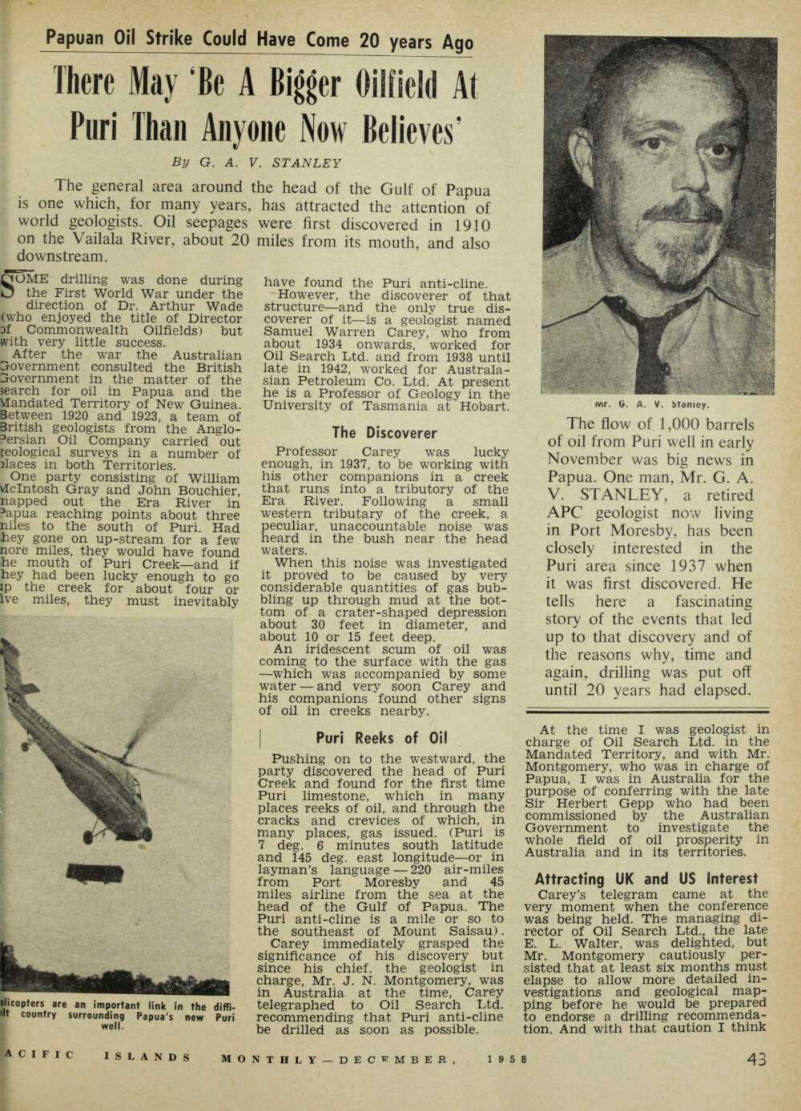
helicopters are an important link in the diffi cult country surrounding Papua's new Puri well.
Mr. G. A. V. Staniey.
everyone would be in agreement.
Soon after, unfortunately, the managing director of Oil Search Ltd., Mr. Walter, died and the new managing director, Mr. E. F.
Griffen, 'together with the chief geologist, an American, Mr. D.
Dale Condit, visited England and America with the intention of try ing to attract British or American capital and technical knowledge to come to the assistance of Oil Search which then appeared to have two immediate drilling pros pects: One at Puri in Papua and the other in the Sepik District, south of the Torricelli Mountains behind Aitape.
Eventually, British Petroleum and Stanvac combined to form
Australasian Petroleum Company, with Oil Search Ltd., a one-third partner, and the staff of Oil Search Ltd. transferred, almost to a man, to the new management.
Very soon after the amalgama tion, British Petroleum geophysicists carried out siesmic arc-shooting at the eastern end of the Puri anti cline and succeeded very clearly defining the direction of hade of the axial plane.
The decision to drill, however, was deferred owing to the fact that extensive aerial photographic sur veys had been carried out and these disclosed structures which appeared to be bigger than Puri and probably more accessible.
One after the other these other
sites were drilled, while Puri al ways got pushed to the end of th queue.
After the war Carey did not re join the APC but took a job i.
Tasmania which eventually led t his being appointed Professor c Geology in the University then
Puri Would Come Good
But he has always kept ver. closely in touch with Papua, geology. In a personal letter in re cent months he deplored the fac that APC should be withdrawin from Papua; he still had, he sai« considerable hopes that Puri woul eventually come good.
In 1951, British Petroleui pressed strongly that Puri be drills and I was sent there, accompanie by Mr. David Swenson and Mr. 11 G. O’Halloran to make a more de tailed geological survey.
We spent four months there be tween September and the end o the year, 1951; and in 1952 at dil ferent times, two British Petroleui geologists Martin Strong and laU C. A. E. O’Brien, visited Puri.
Since that year British Petro leum continued to press for drill ing at Puri, but the difficulties ai ways were with the other Big Par’ ner which did not agree to inr mediate drilling of the whole < Puri; and it was feared that the. might withdraw from the counti; without a hole being drilled the;j at all.
I retired from APC at the en of July 1954, and so I was sitting o the sidelines when Puri eventuall was drilled.
Living in Port Moresby and r tained as consultant for APC, was able to know a great deal what went on behind the scene; but I must say that even I w\ disappointed, although not necee sarily discouraged, when the neg? tive results of the first drilling Puri were obtained.
As is so often the case, the u:x derground picture is more compll than the geologist on the surfas had foreseen.
Nonetheless, the complexities cfo not necessarily mean that t!f chances of finding oil at Puri hir lessened; just as good a case com have been made out that tf chances were enhanced.
It was a distinct blow to all us when the technical staff Vacuum announced early this yes that they would withdraw fro search in Papua. And, when afti a conference in London in Juu British Petroleum announced thl they would follow suit, it seerm inevitable that the search for in Papua would, as far as AEi were concerned, come to an end.
But that persistent group in H in London, which had all along tf lieved in Puri, urged strongly ora more that the whole of the am be tested —or even that the fi:fl well which had seemingly prowc less negative be retested.
It was this last throw of the dice, i the retesting of Puri No. 1, that ventually produced the dramatic esults of early November.
Gas and condensate, so-called, egan to come into the hole in suf icient quantities to be burnt con inously at the end of a line tretching some hundreds of yards rom the rig. And then, very ramatically at 5 a.m. one day, tie noise of burning gas and con ensate altered note suddenly, and ; was found that the well was pro ucing greenish-brown crude oil.
Waited 21 Years Some of us had waited 21 years )r that moment.
I was at Mt. Hagen when the ews came that Puri was produc ig oil at the rate of 1,000 barrels day.
After all that time it seemed in redible. I had recently been in etherlands New Guinea where the itire oilfield produces only 5,000 irrels a day. Puri was doing better lan some of those wells.
Since that first exciting nejws, uri, of course, has begun to pro (ice water as well as oil. Opinions iner as to the significance of this, it I do not necessarily think it a iscouraging sign.
Many more holes must be drilled ; Puri—the future can be decided ily by the drill.
I believe that there is an oil field iere-and further, that it is likely > be a much larger oil field than Jople connected with the industry 3w envisage.