First War Delayed Discovery
pp. 29-31 · Read in the full issue

It's Their Silver Jubilee Year First War Delayed Discovery Of The N. Guinea Highlands
Based Partly on Material Supplied
by the Rev. Dr. R. M. Wiltgen, SVD
It is now 25 years since Roman Catholic missionaries of the Divine Word Order started to work amongst the natives of the New Guinea Highlands, and it was planned that the Silver Jubilee would be celebrated at Mt. Hagen on November 1, in the presence of distinguished visitors including the Apostolic Delegate, the Most Rev. Romolo Carboni, from Sydney.
lOWEVER, the death of Pope Pius XII, altered the plans and the celebrations will now take iace at a later date.
Even before 1933, missionaries and hers were interested in finding out hat lay behind the Bismarck ange, although it was left for achael and Dan Leahy, who were rospecting for gold, and Jim Taylor, i Administration business, to metrate as far as Mt. Hagen in lat year, and incidentally, to dis- >ver some hundreds of thousands : natives.
The first European to see the ighlands was undoubtedly Captain ermann Detzner, of the German dministrative service, who took to ie bush in the Morobe District hen the Australians landed at abaul in 1914. In his efforts to sach neutral Dutch Territory, he andered for four years in the area e now call the New Guinea High- -nds, and the book he wrote after ie war (and never translated from
the German) makes it clear that he got as far west as Mt. Hagen, But even before this, the Ger mans were thinking of what lay over range and were planning an expedition, - u Germans May Have Found Them Except for World War I, the Highland peoples may have been discovered 20 years earlier than they were by the English-German air borne expedition planned in Berlin in 1913, when the Territory was still a German possession.
Graetz, an African explorer, was to use a non-rigid airship called the Parseval and, in the course of several years was to examine, from the air, every inch of land, He was to begin in the spring of 1914, but the war and Germany’s consequent loss of the Territory prevented the plan from ever being carried out.
In 1930, Father Franz Kirschbaum, famous Sepik missionary and
anthropologist, planned to cross the Bismarck Mountain Range from the upper reaches of the Sepik River and to return to the coast via the Ramu River.
But when he asked for a guard of 50 native police and a patrol officer to accompany him, the
Somewhere between 1914-18, a German official is credited with being the first European to have looked upon Mt. Hagen; and even before that, the Ger mans were planning an air borne expedition to the area.
But so far as Australian New Guinea is concerned, this year is the Silver Jubilee of the un locking of the door to the rich Highlands by the Leahy brothers and Jim Taylor, with hard upon their heels, the pioneering missionaries.
Administrator of the Territory re fused permission and so Fr.
Kirschbaum decided against the ex pedition.
In 1931, Father Albert Aufinger, and Brother Anton Baas set out for the Bismarck Mountains from Harip, going up the Ramu River, but sick ness and lack of supplies forced them to turn back.
In June of 1932, Father Alfons Schaefer, and Brother Anton re ceived orders from the Most Rev.
Francis Wolf, then Bishop of Alexishafen, to make an expedition to the Bismarck Mountains. They set out 14 days later, reached the Bismarck Mountains, but did not cross them.
First Contact With Chimbus
At Guyebi, however, they had their first contact with the Arava, a name given by the Ivam people there to others in their area who came from the Chimbu and Wahgi
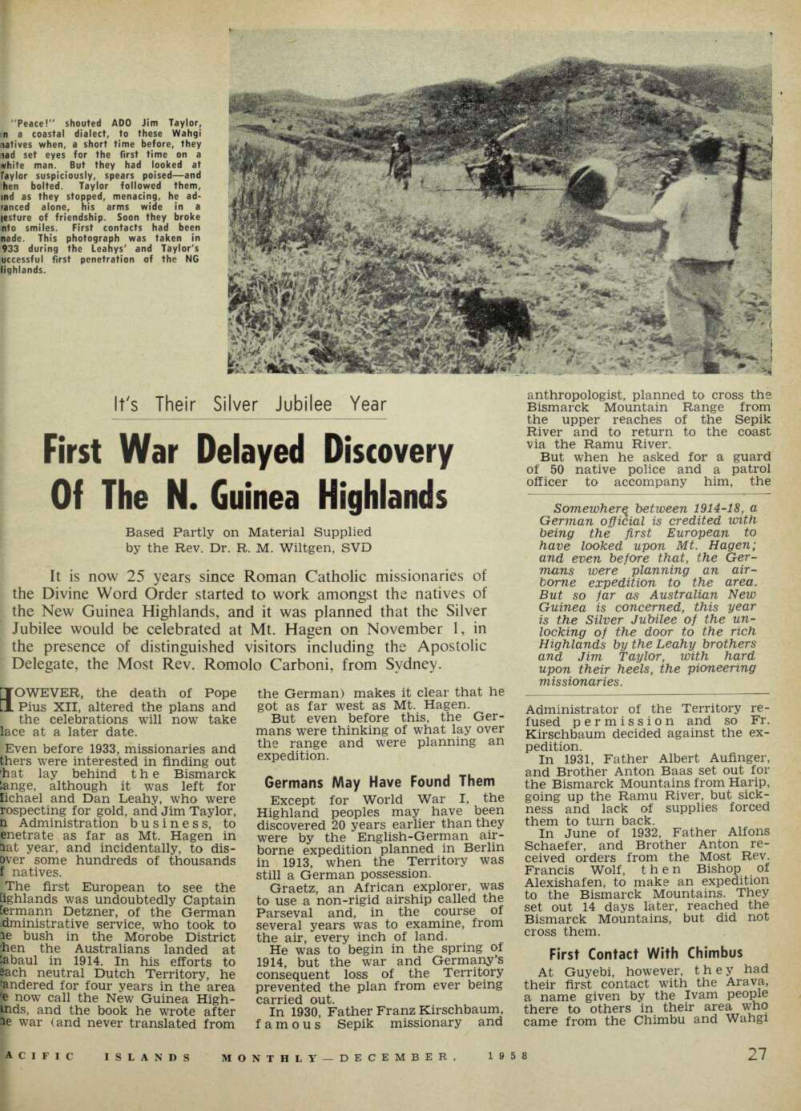
"Peace!" shouted ADO Jim Taylor, [?]n a coastal dialect, to these Wahgi [?]atives when, a short time before, they [?]ad set eyes for the first time on a white man. But they had looked at Taylor suspiciously, spears poised—and hen bolted. Taylor followed them, [?]nd as they stopped, menacing, he ad [?]anced alone, his arms wide in a [?]esture of friendship. Soon they broke into smiles. First contacts had been made. This photograph was taken in 933 during the Leahys' and Taylor's uccessful first penetration of the NG lighlands.
valleys on the other side of the Bismarck Mountain Range. The Arava told the missionaries about a large river (the Wahgi) and a large valley filled with many people.
In September of 1932, and again in February of 1933, Father Schaefer and Brother Anton reconnoitred the Guyebi area, and finally crossed the Bismarck Mountains via the Mondia pass on November 9, 1933, along with Father Anthony Cranssen.
They were the first white men to reach this section of the densely populated Chimbu Valley. Brother Anton planted a huge cross atop Mount Kunambau.
By November 15 all three missionaries had pentrated to the Wahgi Valley and got their first panoramic view of this vast new mission field, which quickly over shadowed coastal missions in im portance. Missionaries were soon ; assigned to the new area.
Returning to the coast, the small band of missionaries learned that the Leahy brothers and Jim Taylor had discovered and explored the Wahgi Valley six months earlier, entering it by another route.
By then the Leahys had invited their friend, Father William Ross, to come into the Waghi Valley and set up a mission. Father Ross, with Father Alfons Schaefer, who died a short while ago, became the best known missionaries in the area. Fr.
Schaefer was stationed at Mingendi for 25 years; and Fr. Ross has been at Mt. Hagen for the same period.
In the early days of the High lands Mission two missionary lives were lost because the missionaries were not yet familiar with the ways of these easily excitable warriors.
They were Father Karl Morsch heuser, who was killed on December 16, 1934, by an arrow through the mouth and another through the lungs; and Brother Eugene Frank, an American, who was pierced by eight arrows on January 7. 1935, and died from his wounds on January 28.
It was the deaths of these missionaries which led directly to the closing of the New Guinea Highlands for about 13 years. A special “dispensation” allowed the Leahys to work a gold lease they had near Mt. Hagen, but the Central Highlands (as they were then called) were officially uncontrolled territory until some years after the Pacific War.